



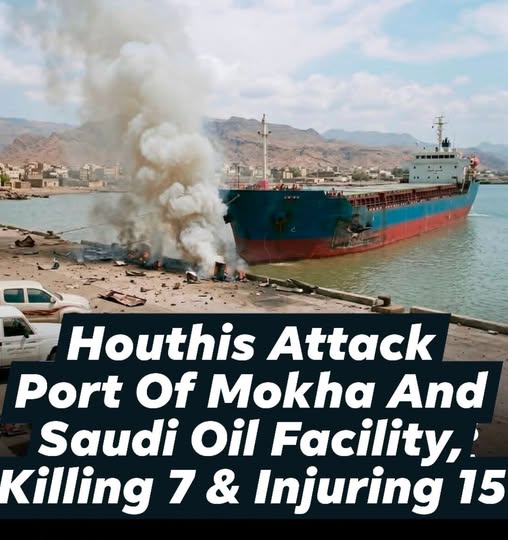
SANAA : Yemen’s Houthis attacked a crucial port on the Red Sea, killing people and further escalating the conflict over strategic waterways in the Middle East. They also said they attacked an oil facility on Sunday in southwestern Saudi Arabia, the latest attack by the Iranian-backed rebels on the kingdom.
Meanwhile, Iran has made new demands about the restart of negotiations and the reopening of the Strait of Hormuz, the Pentagon is pressing the US defence industry to accelerate production of weapons, and Israel is insisting it won’t withdraw from Gaza until Hamas disarms.
The National Resistance Forces, a Yemeni government-allied force, said at least seven people four troops and three civilians were killed, and 15 civilians were injured in the Houthis’ attacks Sunday on Mokha, a crucial port on the Red Sea.
Fayed al-Noman, assistant undersecretary of the information ministry, said the Houthis fired missiles and drones on the port, severely damaging its buildings and pier as well as commercial goods and food supplies at the facility.
Mokha is one of the main ports under Yemen’s internationally recognised government, renovated in recent years to handle shipping that avoids the Houthi-held ports in Hodeida.
The Houthis later claimed the attack, saying they fired “a large number of ballistic missiles and drones” that targeted military enforcement and warehouses in the area.
Yahya Saree, a military spokesperson for the Houthis, said they also targeted an Aramco refinery in the city of Jazan with a drone. The attack was in response to Saudi drones’ breaching Yemen’s airspace over the provinces of Hajjah and Saada, he said.
Early on Sunday, the Saudi Energy Ministry reported a fire at a facility belonging to the Aramco refinery without casualties. The ministry said the fire was extinguished, but it didn’t describe its cause.
Sunday’s Houthi attack is the latest in a series of missile and drone attacks that have targeted Saudi Arabia and its shipping in the Red Sea.
The escalation threatens to reignite Yemen’s civil war more than four years after a 2022 truce stopped major fighting in the impoverished Arab country.
The Houthis claimed responsibility for the attack, saying they had fired a large number of ballistic missiles and drones at military forces and warehouses.
Mokha is one of the main ports controlled by Yemen’s internationally recognised government. The port has been renovated to handle shipping that avoids the Houthi-controlled port of Hodeida.
The Houthis said they were targeting Saudi-backed troops and military equipment near the city.
The attack comes more than four years after a 2022 truce brought major fighting in Yemen to an end.
Mokha’s location on the Red Sea also gives the attack significance for maritime security. Yemen lies near the Bab el-Mandeb Strait, an important route connecting the Red Sea with the Gulf of Aden.
Houthi military spokesperson Yahya Saree said the group also targeted an Aramco refinery in the Saudi city of Jazan with a drone.
Saree said the attack was carried out in response to Saudi drones allegedly entering Yemen’s airspace over the provinces of Hajjah and Saada.
Saudi Arabia’s Energy Ministry reported a fire at a facility belonging to the Aramco refinery early on Sunday.The ministry said the fire was extinguished and that there were no casualties. It did not say what caused the fire.
The Houthi attack on the Saudi facility took place on the same day as the missile and drone attack on Mokha.
Mokha has been renovated to handle vessels avoiding Hodeida, which is under Houthi control. Damage to its buildings, pier and cargo could affect the port’s operations, although the supplied information does not give details of any vessel diversions or wider commercial losses following Sunday’s attack.
The Houthis have also sought to control shipping around the Bab el-Mandeb Strait, adding to concerns over the movement of oil and other cargo through the region. Iran’s Foreign Minister Abbas Araghchi said negotiations with Oman about “new maritime routes” through the Strait of Hormuz were “in the final stages.”
“This, however, does not mean that the Strait of Hormuz will reopen,” Araghchi told reporters in Tehran on Sunday. “An agreement on the routes may be reached, but reopening the strait is subject to a number of other conditions, which have been conveyed through intermediaries.”
Iran’s powerful Supreme National Security Council has said the Strait of Hormuz will not open until the US “corrects its behaviour,” issuing new demands that could shake up talks on a deal to manage the waterway.
The demands include the US never threatening Iran again, a permanent end to the war with Iran and its armed allies in the region, a lifting of the naval blockade of Iranian ports and a withdrawal of its military from the area, according to the statement by the supreme council’s secretary, Mohammad Bagher Zolghadr, published by Iran’s state broadcaster.
According to the US Central Command, the blockade has redirected 53 commercial vessels, disabled two, and boarded two through Saturday.
About overall negotiations, Araghchi said that an “exchange of messages through intermediaries” is continuing with the United States, but that doesn’t constitute negotiations.
“From our perspective, negotiations cannot resume until the violations of the memorandum of understanding have ended and the United States has remedied the provisions of the memorandum that it violated,” he said.