


₹9,930 Crore Central Capital Assistance to Support World-Class Shipbuilding Infrastructure Across Five Coastal States
NEW DELHI: India has taken a major step towards transforming itself into a globally competitive shipbuilding hub with the National Shipbuilding Mission (NSbM) granting In-Principle Approval (IPA) to five Greenfield Shipbuilding Clusters across strategically located coastal states.
The approval, granted through the Inter-Ministerial Governing Board (IMGB) under the Shipbuilding Development Scheme (SbDS), marks a significant milestone in the country’s ambitious Maritime Amrit Kaal Vision 2047 and its goal of becoming one of the world’s top five shipbuilding nations by 2047.
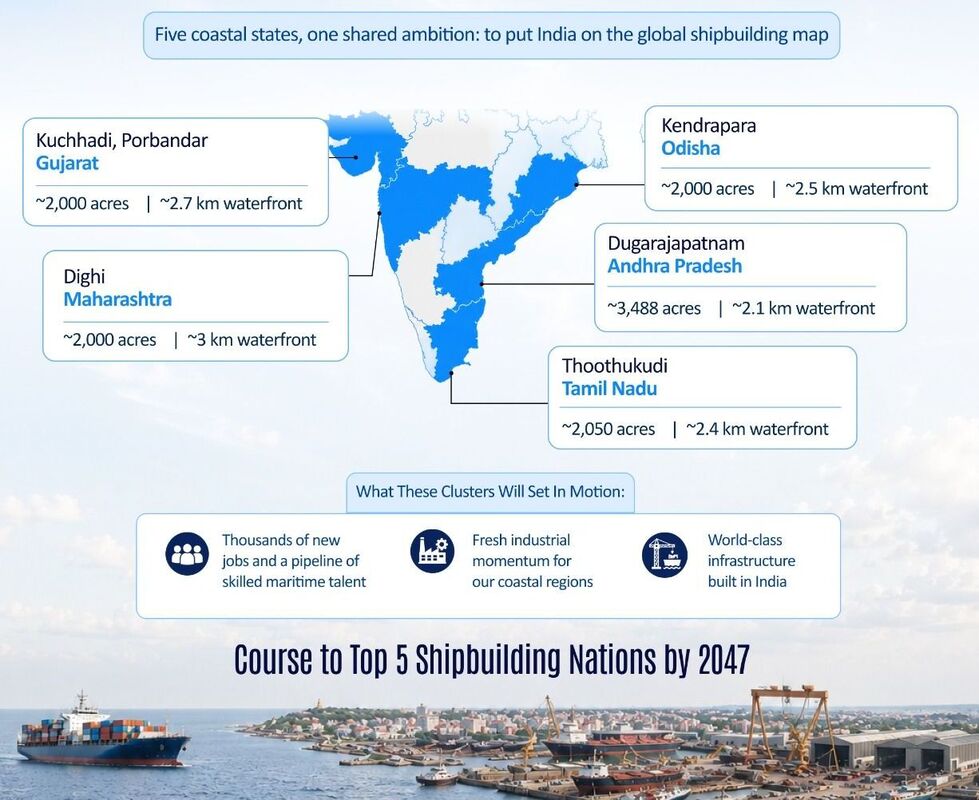
The five proposed clusters are spread across Gujarat, Maharashtra, Andhra Pradesh, Odisha and Tamil Nadu, creating a nationwide platform for expanding India’s shipbuilding capacity, developing maritime infrastructure and generating thousands of skilled employment opportunities.
The Government has earmarked ₹9,930 crore in Central capital assistance, including support for common maritime infrastructure, to help establish these shipbuilding ecosystems.
Five Strategic Locations
The approved Greenfield Shipbuilding Clusters are:
- Kuchhadi, Porbandar, Gujarat – approximately 2,000 acres with around 2.7 km of waterfront
- Dighi, Maharashtra – approximately 2,000 acres with around 3 km of waterfront
- Dugarajapatnam, Andhra Pradesh – approximately 3,488 acres with around 2.1 km of waterfront
- Kendrapara, Odisha – approximately 2,000 acres with around 2.5 km of waterfront
- Thoothukudi, Tamil Nadu – approximately 2,050 acres with around 2.4 km of waterfront
The strategic spread of these clusters along India’s coastline is expected to create new centres of maritime industrial activity while strengthening the country’s ability to design, construct and service large-tonnage vessels within India.
From Infrastructure to Global Shipbuilding Capacity
According to the Directorate General of Shipping, the five clusters are designed to provide the foundation for world-class shipbuilding infrastructure, develop a large pool of skilled maritime talent and create a pipeline of globally competitive, Indian-built vessels.
The initiative is also expected to provide a major industrial boost to India’s coastal regions by encouraging ancillary industries, maritime services, engineering capabilities and supply-chain ecosystems around the shipbuilding sector.
Each cluster is being structured as a 50:50 Joint Venture Special Purpose Vehicle (SPV) between State and Central Government entities. With the SPVs formed, land secured and IPA granted, the Government has established the basic framework required to move the projects towards implementation.
However, the approval does not yet represent the final financial commitment for individual clusters. Financial assistance will follow the selection of anchor shipyards and submission of Detailed Project Reports (DPRs).
Global Shipyards Invited to Anchor India’s Next Maritime Chapter
The Government is now seeking participation from world-class anchor shipyards from India and across the globe to establish large-scale shipbuilding operations within these clusters.
The proposition is significant: strategic coastal locations, dedicated land parcels, waterfront access and Central Government support for common infrastructure are being brought together to create a platform where major shipyards can establish globally competitive manufacturing facilities.
The emphasis now shifts from creating the framework to attracting the anchor shipyards capable of bringing technology, investment, expertise and global order books to India.
The initiative therefore represents more than the creation of five new shipyards. It aims to build complete maritime industrial ecosystems, supporting vessel construction, repair and maintenance, equipment manufacturing, engineering services, logistics and a new generation of skilled maritime professionals.
A Major Step Towards Maritime Amrit Kaal Vision 2047
For decades, India has possessed a strong maritime tradition but has remained a relatively small player in global shipbuilding. The Greenfield Shipbuilding Clusters initiative seeks to change that equation by creating the scale, infrastructure and industrial ecosystem required to compete with established shipbuilding nations.
With five coastal states now positioned to participate in this transformation, the Government’s latest move provides a clear roadmap for expanding domestic shipbuilding capacity while reducing dependence on overseas construction for large and strategically important vessels.
As India progresses towards Maritime Amrit Kaal Vision 2047, the message is increasingly clear: the country does not merely intend to sail more ships—it intends to build more of them in India.
The five Greenfield Shipbuilding Clusters, backed by Central Government assistance and now open for anchor-shipyard partnerships, could become a defining component of India’s maritime industrial transformation.
The groundwork has been laid. The next chapter will depend on global shipbuilding leaders stepping forward to build at scale—and build India’s shipbuilding future.