


NEW DELHI: Climate change and conflict are conspiring to open up the Arctic to Asian commercial shipping, with China, South Korea and India all eyeing the icy short cut to Europe.
Last Saturday, Chinese shipping company Sea Legend launched the first scheduled weekly container service across the top of the world, marking the realisation of Beijing’s long-held ambition to build a “Polar Silk Road”. It will not sail alone for long, however. This Sunday, South Korea’s PanStar Group plans to send its own pilot vessel from Busan through Russia’s Northern Sea Route (NSR) towards ports in the UK, the Netherlands and Poland.
India is also preparing to dispatch its first cargo ship along the same corridor next year.
“In 2027, we are planning to have the first pilot vessel running through the Northern Sea Route. We are seeing huge possibilities,” S. Venkatesapathy, a Joint Secretary in India’s shipping ministry, reportedly told the Arctic-Regions Forum in Arkhangelsk, Russia, on August 13.
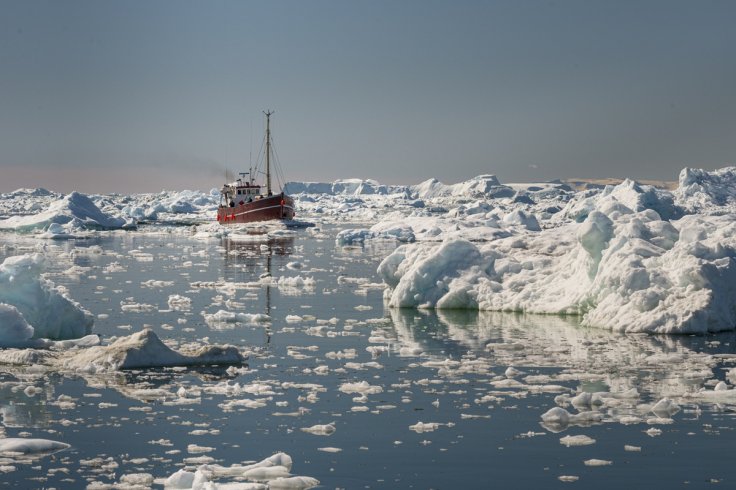
Two crises are pushing Asian shippers north. The first is climate change: warming sea temperatures mean that the Arctic ice pack is no longer impassable in summer, opening a navigable window running roughly from July to October.
The second is geopolitics. Threats to shipping in the Red Sea, layered atop the near-total closure of the Strait of Hormuz amid the Iran war, have forced many shippers to divert around southern Africa, adding mounting costs and up to two weeks to journeys that once ran through the Suez Canal without incident.
The NSR promises to slash transit times between Asia and northern Europe by roughly two weeks compared to the Suez run, shortening shipping distances by up to 40 per cent.
Sea Legend says it can make the journey from Ningbo, China, to Felixstowe in the UK in around 20 days vs about 40 days via Suez.
“The NSR and the related Northeast Passage have great potential to connect Asia and Europe faster and more easily, and this potential is gradually starting to be realised,” said Ivan Lidarev, an Asian security expert at the Institute of South Asian Studies in Singapore.
“Significantly, it will also help transit more Russian energy resources to Asia.”
A route European explorers searched for and failed to conquer from the 1500s onwards is now the subject of serious commercial planning.
More than a short cut
For China, whose two-way goods trade with Europe reached €759 billion (US$887 billion) last year, according to European Union statistics, the advantages are obvious.
“China will be the main beneficiary,” Lidarev said. “The route will greatly facilitate its trade with Europe, a crucial trading partner amid tensions with Washington, and avoid US-controlled sea lanes and chokepoints.”
India’s interest in the NSR was as much about signalling as logistics, according to Cedomir Nestorovic, a geopolitics professor at ESSEC Business School who said using the route would advertise New Delhi’s “strategic autonomy” to Washington while also opening up a new channel to access Russian oil, gas and minerals.
Not only could the route shave weeks off India’s shipping times to Europe, Lidarev said it also offered Delhi leverage in talks on a long-awaited free-trade agreement with the United States.
Equally important was the enhanced connectivity to Russia’s far east that using the NSR could offer, said Uday Chandra, a political-science professor at India’s Ashoka University, pointing to Delhi’s parallel push to increase links between Vladivostok and Indian port cities such as Chennai, Visakhapatnam and Paradip.
China’s head start dated back to 2013, Chandra noted, when the first commercial transit of an Arctic shipping route by a Chinese merchant ship took place, five years before Beijing formalised its Polar Silk Road ambitions in a 2018 policy paper.
South Korea, meanwhile, plans to use Sunday’s trial voyage to test the commercial viability of the NSR, with its vice-minister of oceans and fisheries Nam Jae-hon recently proclaiming that the Arctic passage was “bound to become an alternative to Middle Eastern routes”.
The government-funded Korea Institute for Economic Policy think tank has estimated that travelling through the Arctic could cut journey times to Europe by about 10 days, shaving some 7,000km off the distance travelled.
In addition to South Korea, Lidarev said Japan had also shown an interest in the route, with Southeast Asian states such as Singapore set to follow, should the geopolitics align.
“Over the long term, if climate trends further extend the navigable window, East Asian economies will inevitably utilise the corridor to optimise seasonal trade,” Nestorovic said.
No Hormuz replacement
Despite the growing interest, traffic through the NSR remains modest. Last year, Norwegian non-profit research foundation the Centre for High North Logistics tracked 88 vessels making 103 transits, up from 97 in 2024 and just 43 in 2022.
Tanker shipments carrying Russian crude oil and petroleum products accounted for the bulk of the traffic last year, according to an analysis by the Eurasian Rail Alliance Index, alongside dry bulk carriers likely transporting coal eastward.
The route has its limits, however, offering no relief for energy flows restricted by chokepoints in the Middle East, which historically accounts for roughly half of China and India’s oil imports.
“The NSR cannot replace the Strait of Hormuz or the Strait of Malacca for Asia’s energy security,” Nestorovic said.
“The Arctic route connects northern Europe and Russian energy fields to East Asia, but it is geographically irrelevant for Middle Eastern energy flows.”
Then there are the practical challenges. Navigable without icebreaker support for only three to four months a year, the NSR is also unpredictable due to the shifting Arctic ice floes and shallow waters that prevent the passage of mega-ships, according to Nestorovic.
Add to that sparse search-and-rescue coverage, steep insurance costs and environmental rules limiting commercial scale, and he said the route should be considered a supplementary seasonal corridor rather than a wholesale replacement for existing maritime arteries.
Environmental groups see other trade-offs. The non-profit Clean Arctic Alliance and Norwegian Bellona Foundation NGO have warned that the soot emitted by ships’ exhausts settles on Arctic snow and ice, increasing heat absorption and speeding up the melting of polar ice caps that opened up the route in the first place, exacerbating the effects of climate change.
Those trade-offs do not appear to be slowing Asia down, however, and a sea passage explorers gave up on centuries ago is now, for a brief window each summer, open for business.