



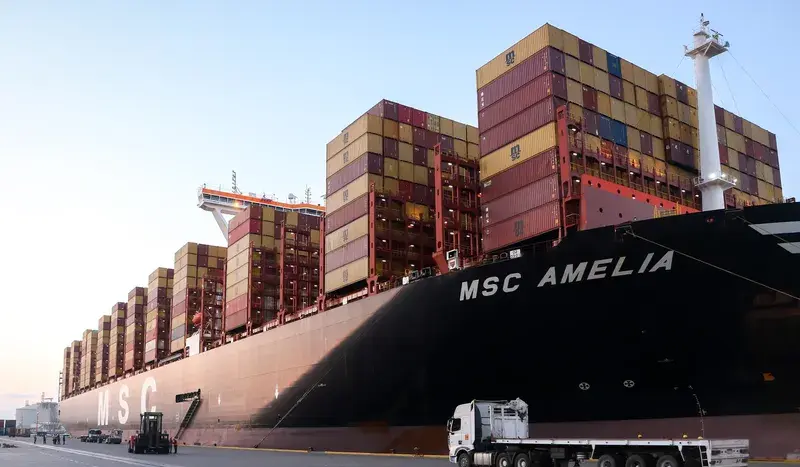
TRIESTE: MSC has resumed shipping its container ships passing through the Red Sea and the Bab el-Mandeb Strait. At least seven ships The company’s vessels have been sailing eastbound on this route over the past two weeks, even though the world’s leading container carrier has not announced the resumption of its services via the Suez Canal.
The situation therefore still appears to be different from a structural return. On MSC’s official website, the East-West network continues to be labeled “Network via Suez (on hold).” The transits recorded in August therefore seem to represent, at least for now, an operational decision regarding individual ships and services rather than a general change to the network.
Linerlytica reported these movements, noting that the seven eastbound crossings involved various routes from Europe and the Mediterranean to China. Among the vessels listed is the 23,782-TEU MSC Amelia, which operates on the Tiger service between the Mediterranean and Asia. The analyst also forecasts additional transits through the Red Sea over the next two weeks.
MSC’s caution contrasts with the more explicit approach adopted in recent weeks by Maersk and Hapag-Lloyd. On August 10, the two partners in the Gemini Cooperation officially announced the rerouting of the AE19 service from the route around the Cape of Good Hope to the route through the Suez Canal. The change began with the Berlin Maersk and applies to both directions of travel. The AE19 service connects Asia, the Mediterranean, Saudi Arabia, and Europe.
In this case as well, however, the two companies are talking about a gradual return. Maersk clarified that no further changes to the other Gemini services are currently planned and that there is no timeline for returning the entire East-West network to the Suez route. The process had already begun in the preceding months. In July, Maersk had resumed the MECL service—operated independently by the company—across the Red Sea, as well as the WAF6 service between the Middle East, the Mediterranean, and West Africa. On the MECL, the carrier estimated that the new route would save approximately seven days on westbound voyages and 14 days on eastbound voyages compared to the detour around Africa.
Some Gemini services had also already been gradually shifted back to the corridor. Maersk and Hapag-Lloyd have made structural changes to the AE15 service and, starting in August, have also added a stop in Jeddah. However, the companies have explicitly retained the option to return to the Cape of Good Hope route should security conditions in the Red Sea deteriorate.
Hapag-Lloyd confirms that the situation is still far from the pre-crisis normalcy. In its latest official update, revised on August 14, the German group states that the vast majority of its services continue to be routed around the Cape of Good Hope. Only the SE3 and SE4 services of the Gemini network currently transit through the Red Sea and Suez, using vessels operated by Maersk. The group anticipates a gradual return to the route, but not an immediate one