


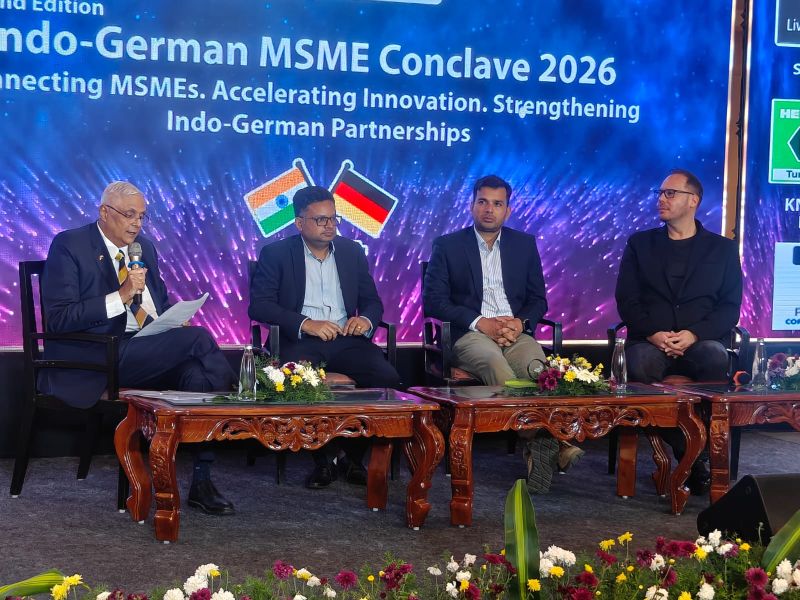
CHENNAI: Key Indian and German trade leaders, policymakers, and industry executives convened in Chennai to chart a roadmap for Tamil Nadu’s Micro, Small, and Medium Enterprises (MSMEs) aiming to expand their footprint across the European Union during Indo-German Partnership Summit 2026.
The high-level dialogue highlighted strategic pathways for local manufacturers to overcome export hurdles, leverage emerging free trade frameworks, and align with global environmental mandates.
Dignitaries on the Dais
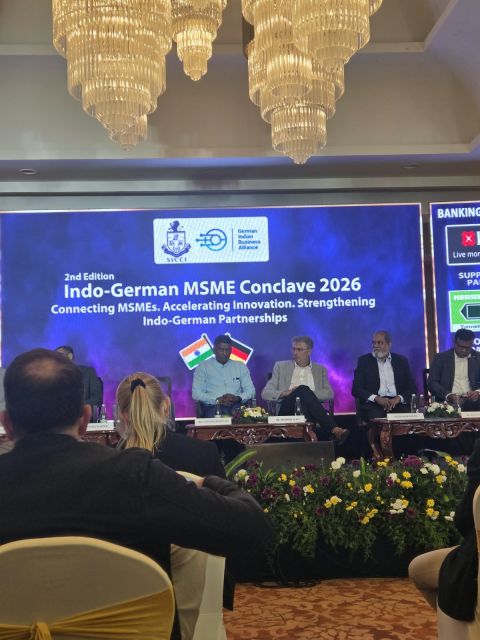
The inaugural session was graced by a distinguished panel of industry leaders and trade experts:
- Mr. V.N. Shiva Shankar, Senior Vice President, SICCI
- Dr. Joern Plettig, Senior Counsel, ETL IP
- Mr. Tasvvar Ali, Founder, Insourcify Germany
- Mr. Girish Pandian, President, IEMA
- Mr. Thomas Dose, Managing Director, BMW
Bridging the Skills Gap and Targeting Germany’s Mittelstand
Opening the proceedings, Nirmal Raman Kannaiyan, Co-founder of German Indian Business Alliance (GIBA), highlighted a major milestone achieved by the Tamil Nadu Skill Development Centre, announcing the successful graduation of its first batch of students with B1-level German language proficiency.
Addressing the structural hurdles faced by regional manufacturers, Nirmal noted that despite shifting trade landscapes, Tamil Nadu MSMEs frequently encounter challenges regarding European market entry and customer acquisition. He urged local enterprises to emulate the business models of Germany’s “Hidden Champions”—the innovative, export-oriented Mittelstand companies that form the backbone of the German economy.
“GIBA is fully committed to providing end-to-end support for Indian MSMEs seeking to launch and scale their businesses directly in Germany,” Nirmal stated.
Synergizing German Technology with Indian Scale
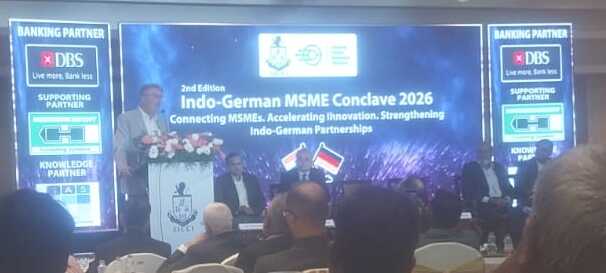
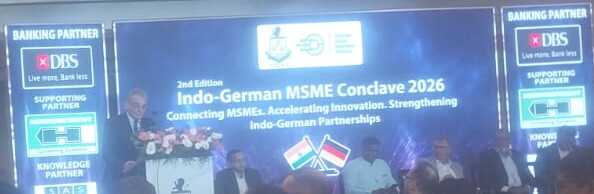
Reinforcing the strength of bilateral ties, the Consul General for Germany in Chennai Mr. Michael Hasper emphasized India’s robust 7% economic growth trajectory and the rising global standards of Indian corporations. Marking 75 years of diplomatic relations, the Council noted that combining German precision, advanced engineering, and technology with Indian labor efficiency, scale, and execution creates an unbeatable global partnership.
Echoing this sentiment, Manfred Ockel, Mayor of Kelsterbach, highlighted the strategic gateway offered by the Frankfurt region. Representing the Innovation Hub RheinMain, Ockel affirmed that local municipal bodies near Frankfurt stand ready to facilitate Indian companies looking to establish European operations.
Capitalizing on Free Trade Agreements and EU Market Verticals
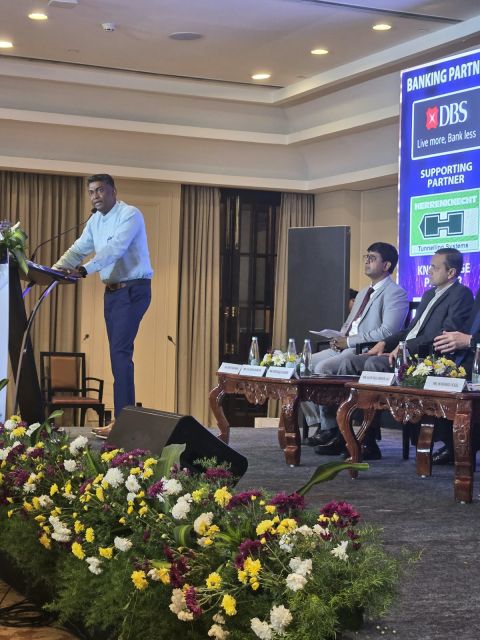
Providing an insider’s perspective on international trade policy, Mr. Alex Paul Menon, IAS, Development Commissioner of MEPZ and a former member of the trade negotiation committee, detailed specific high-value export verticals across the European market:
- Textiles & Apparels ($265 Billion Market): Shift focus away from commodity volume toward technical textiles, sustainable materials, and value-added finished goods.
- Footwear ($100 Billion Market): Prioritize proprietary design, brand building, and premium positioning.
- Engineering & Components: Capitalize on labour-intensive sectors—including automobile components, toys, sports goods, marine seafood, chemicals, plastics, and rubber—which collectively represent a $33 billion employment-generating ecosystem in Europe.
Addressing compliance challenges, Menon warned that the primary hurdles for Indian MSMEs under modern FTAs involve strict Intellectual Property (IP) enforcement and the EU’s stringent decarbonization mandates. European buyers increasingly evaluate supply chain partners based on green manufacturing, carbon accounting, and Environmental, Social, and Governance (ESG) metrics.
To streamline investments, Menon highlighted a newly launched Benefit Calculation Portal, designed to help investors evaluate factory setup costs and operational efficiencies within MEPZ and SEZ zones.
Institutional Support and Industry Case Studies
State backing for international expansion was reaffirmed by Mr. Nandhakumar Bhoorasmi, who confirmed that the Government of Tamil Nadu has structured comprehensive policy frameworks and administrative support systems in place through 2031.
Adding an institutional perspective via video conference, Mrs. Suchita Kishore, IAS, Consul General for Frankfurt, Germany, assured gathering stakeholders of continuous diplomatic and structural backing from German counterparts to foster mutual economic growth.
Providing a practical industry benchmark, Mr. Thomas K. Varghese, Chair of the SICCI MSME Committee and representative of Fabri Mech Engineers, shared that his organization successfully channels 15% of its total business volume directly into the German market, proving that regional engineering firms can effectively integrate into high-value European supply chains.