



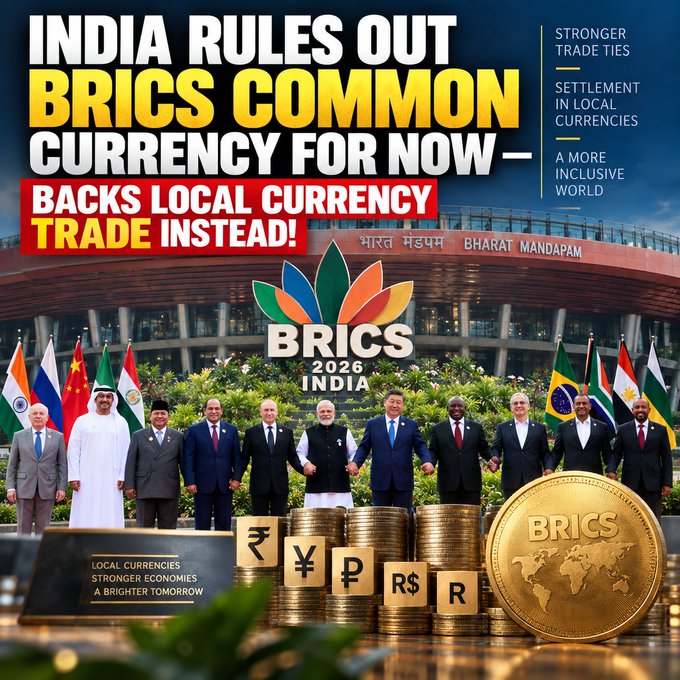
NEW DELHI: BRICS nations are continuing discussions on promoting trade settlements in local currencies as a practical measure to lower transaction costs and strengthen cross-border payment mechanisms, while India has clarified that there is currently no proposal to introduce a common BRICS currency.
India’s position was outlined by Shri Sudhakar Dalela, Secretary (Economic Relations), Ministry of External Affairs, during a media briefing on the first day of the two-day BRICS Summit being held in New Delhi under India’s chairship.
“There is no proposal in BRICS for a BRICS currency, as of now,” Dalela said, clarifying that discussions on local-currency trade settlements have been underway within the grouping for some time.
According to the government, settlement of bilateral trade in national currencies is being considered as a practical mechanism to reduce transaction costs and facilitate smoother trade between BRICS economies. The approach is also being viewed as complementary to the existing global payment and settlement architecture rather than as an attempt to replace it.
India Calls for Greater Payment-System Integration
The issue of strengthening cross-border payments also featured prominently in India’s economic engagement with BRICS members.
Addressing the Opening Session of the BRICS Business Forum 2026, Union Minister for Commerce and Industry Shri Piyush Goyal called for greater integration of payment systems among BRICS members and partner countries.
Highlighting India’s experience with digital public infrastructure, particularly the Unified Payments Interface (UPI), Goyal encouraged BRICS economies to explore greater interoperability between their payment networks, expand trade using local currencies and accelerate digital trade.
India’s UPI is currently accepted in 11 countries, reflecting the growing international reach of the country’s digital payment infrastructure.
New Delhi Declaration Recognises Local-Currency Discussions
The New Delhi Declaration, adopted during the 2026 BRICS Summit, acknowledged ongoing discussions aimed at facilitating trade settlements and investments through the use of BRICS members’ local currencies.
The declaration also recognised that approaches to trade and financial settlements would need to take into account individual national priorities, with no single model necessarily applicable to all member countries.
The emphasis on local currencies has gained attention amid wider global discussions on reducing dependence on the US dollar in international trade and finance, commonly referred to as de-dollarisation.
However, India’s latest clarification makes it clear that the current BRICS agenda is focused on practical mechanisms such as local-currency settlements and payment-system cooperation, rather than establishing a common BRICS currency.
BRICS Emerges as Major Global Economic Grouping
The BRICS grouping has expanded significantly in recent years and now comprises 11 member countries — Brazil, Russia, India, China, South Africa, Egypt, Ethiopia, Iran, the United Arab Emirates, Saudi Arabia and Indonesia.
The grouping has also developed a partner-country framework, with Belarus, Bolivia, Kazakhstan, Cuba, Malaysia, Nigeria, Thailand, Uganda, Uzbekistan and Vietnam among the partner countries.
With its expanding membership, BRICS has emerged as an increasingly significant platform representing a substantial share of the global population, economic output and international trade.
The continued push for local-currency settlements, interoperable payment systems and digital trade is therefore expected to remain an important part of BRICS economic cooperation, while discussions on a common currency remain outside the bloc’s current agenda.