


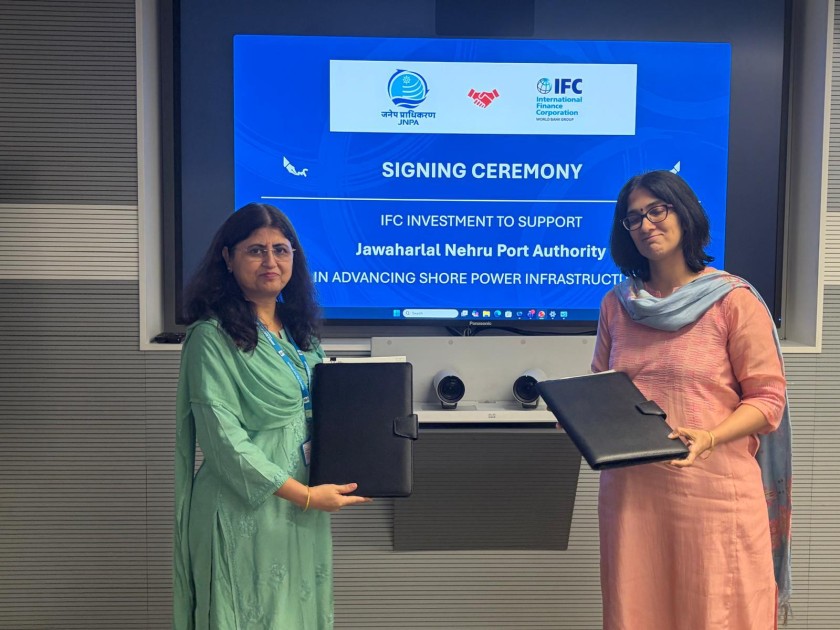
The US$ 70 million investment—aligned with Government of India’s maritime vision—to boost shore power supply infrastructure
MUMBAI : In a landmark move for sustainable maritime development, the Jawaharlal Nehru Port Authority (JNPA), India’s largest container port, has partnered with the International Finance Corporation (IFC) to pioneer the country’s first-ever Blue Finance framework for the maritime sector.
This strategic collaboration with a member of the World Bank Group focused on the private sector aims to raise targeted capital dedicated exclusively to building eco-friendly, resilient port infrastructure and advancing India’s blue economy. IFC’s US$70 million investment will finance Shore Power Supply (SPS) infrastructure across JNPA’s terminals and enable ships at berth to switch off diesel engines and connect to land-based electricity—cutting carbon emissions by 63%, reducing harmful air pollution by up to 90%, and creating over 400 jobs. The collaboration aims to elevate India’s maritime sector by setting new benchmarks for its ports and elevating them to meet global standards.
As the first labeled ‘blue financing’ for port infrastructure in Asia-Pacific, this project is among the first to be aligned with the new Blue Finance guidelines of the Indian Ports Act, 2025. The transaction also represents a historic milestone as the first DFI investment in India’s state-owned major port authorities.
Shore power technology is new to Indian ports. No major Indian port has yet deployed it at scale commercially. IFC’s long-term financing is expected to support the adoption of this emerging technology and demonstrate a replicable financing model that could facilitate similar investments across other Indian ports.
Expressing his views on the collaboration, Shri Gaurav Dayal, IAS, Chairperson, JNPA, said, “Indian ports have not yet commercialized SPS at scale. Funding from international development institutions like IFC will enable JNPA to manage early-stage commercial risks, build operational experience, and bring international best-practices, prior to scale-up. A successful operational and commercial demonstration by India’s largest container port would provide proof of concept for broader adoption of SPS across Indian ports and other emerging markets, delivering economic as well as environmental benefits.“
The Project is expected to demonstrate JNPA’s pioneering commitment to achieving Harit Sagar Green Port Guidelines, setting a new benchmark for Indian Ports infrastructure sector.” Speaking on the partnership, Manuel Reyes Retana, Division Director, South Asia, IFC said, “India’s ports are critical to its trade, and this investment is about making them future ready. By partnering with India’s largest and busiest container port we are going beyond an infrastructure upgrade to demonstrate that sustainable financing can work for the country’s maritime sector at scale. This is how the World Bank Group adds value: unlocking, mobilizing and expanding access to finance, creating jobs, and helping India scale modern smart infrastructurethat expands trade, applies first-in-market innovation, and builds a maritime economy the world will look to.”
India has set itself an ambitious target. The Maritime India Vision 2030, launched by the Ministry of Ports, Shipping and Waterways, calls for Indian ports to become globally competitive, digitally advanced, and environmentally sustainable by the end of this decade. At the heart of this vision is the Harit Sagar Green Port Guidelines: India’s national framework for decarbonizing port operations, reducing pollution, and transitioning the maritime sector to cleaner fuels and technologies.
Shore power is one of Harit Sagar’s flagship interventions. IFC also supported the development of JNPA’s Sustainable Finance Framework to mobilize additional green and blue financing for future investments. DNV’s Second Party Opinion confirms that JNPA’s framework is in full alignment with the LMA Green Loan Principles and IFC Blue Finance Guidelines.
JNPA remains committed to embedding sustainability across its operations, balancing efficient trade facilitation with long-term environmental responsibility.
About Jawaharlal Nehru Port Authority (JNPA):
The Jawaharlal Nehru Port Authority (JNPA) is one of India’s premier containerhandling ports and a key gateway for the country’s EXIM trade. JNPA currently operates five container terminals — NSFT, NSICT, NSIGT, BMCT and APMT. The port also has a shallow water berth for general cargo, operated by NSDT. Its liquid cargo facilities include a terminal managed by the BPCL-IOCL consortium and an additional liquid cargo terminal developed by JNPA and operated by M/s JSW-JNPT Liquid Terminal Pvt. Ltd. The port’s coastal berth further strengthens maritime connectivity with other Indian ports and supports the growth of coastal cargo and container movement.
Spread across 277 hectares, JNPA also operates a strategically located multi-product Special Economic Zone (SEZ) equipped with modern infrastructure and facilities to support export-oriented industries and promote trade and investment. Looking ahead, JNPA is developing the Vadhvan Port, an all-weather, deep-draft, greenfield port in Maharashtra and the 13th Major Port of India.