


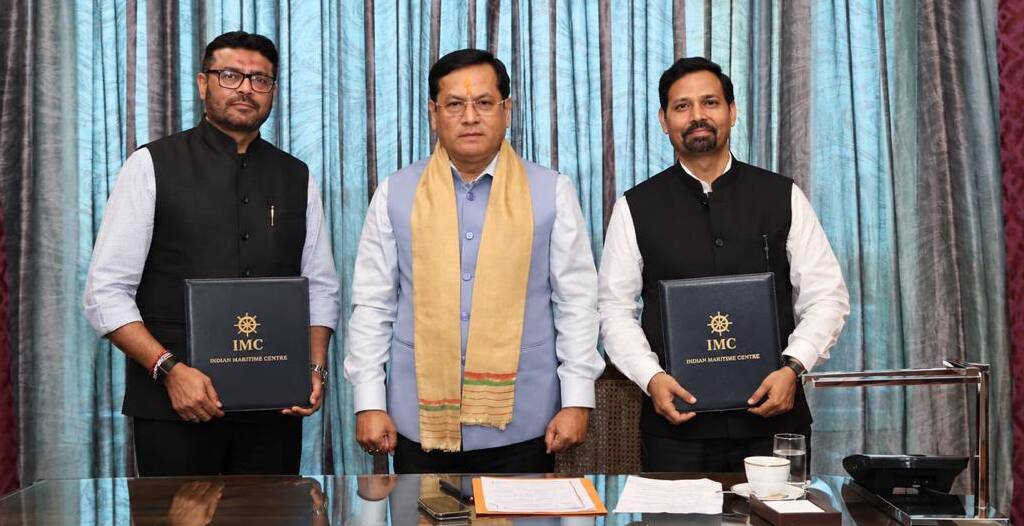
MUMBAI: Mr. Rahul Modi has formally taken charge as Chairman of the Indian Maritime Centre (IMC), marking a new phase for the apex maritime industry body as India intensifies efforts to strengthen its global maritime presence and build institutional partnerships with leading maritime nations.
Modi assumed office in Mumbai on October 2, 2026, in the presence of Shri Sarbananda Sonowal, Union Minister for Ports, Shipping and Waterways, following his election as Chairman at the 12th meeting of the IMC Board of Directors on September 22, 2026. Alongside Modi, Mr. Maneesh Pradhan was elected Vice Chairman.
Modi, who serves as President of the Coastal Container Transporters Association (CCTA) and is a member of the National Shipping Board, succeeds Mr. Devki Nandan as Chairman. Mr. Pradhan, Chairman of the Maritime Association of Ship Owners and Ship Agents (MASSA) and Chief Operating Officer of Synergy Marine Group, succeeds Mr. Shankar Shinde as Vice Chairman.
The leadership transition comes at an important juncture for the IMC, which seeks to bring together diverse stakeholders across India’s maritime ecosystem and serve as a bridge between industry and government. According to the Centre, its mandate encompasses policy formulation and advocacy, knowledge sharing, technology and international best practices, while creating a collaborative platform for India’s maritime community.
Sonowal Reviews IMC’s Progress and Future Priorities
On October 2, Minister Shri Sonowal chaired a review meeting of the Indian Maritime Centre to assess its progress, future plans and operational requirements.
The meeting brought together Mr. Rahul Modi, former Chairman Mr. Devki Nandan, Capt. Dr. Sankalp Shukla, Capt. Chandran Daniel, P.K. Mishra, CEO Capt. Tushar Pradhan and Advisor Capt. Vikas Vij, former First Director of the IMC.
A key theme of the discussions was the need for the IMC to expand its role as a facilitator of international maritime engagement, while developing structured relationships with maritime institutions and industry bodies across the world.
The discussions assume added significance as India seeks to strengthen its maritime capabilities across shipping, shipbuilding, maritime skills, technology and related services under the broader objectives of Maritime India Vision 2030 and Maritime Amrit Kaal Vision 2047.
India-Germany Maritime Cooperation Opens New Opportunities
Devki Nandan highlighted the recently signed Memorandum of Understanding between the Indian Maritime Centre and the German Maritime Centre (DMZ), describing it as an important step towards closer maritime cooperation between India and Germany.
The MoU was signed in Hamburg during SMM 2026, one of the world’s leading maritime industry exhibitions. The agreement establishes a framework for greater cooperation and knowledge exchange between the two maritime ecosystems, with areas including maritime innovation, shipbuilding, technology, sustainability and capacity building forming part of the broader cooperation agenda.
The meeting also highlighted the growing requirement in Germany for skilled maritime manpower, including professionals for defence and private shipyards, engineering facilities and seafaring positions. This could create new opportunities for India’s highly skilled maritime workforce.
Capt. Dr. Sankalp Shukla noted that Germany, Japan and Singapore have shown interest in greater cooperation with India. He emphasised that the IMC should convert such interest into structured institutional partnerships and MoUs with leading maritime organisations.
He also proposed that India’s international maritime engagement should extend beyond manpower development to include opportunities for manufacturing and supplying marine spare parts from India, thereby creating a wider value proposition for the country’s maritime industry.
Japan Emerges as Another Strategic Maritime Partner
Capt. Vikas Vij briefed the Minister on his visit to Japan in August 2026, where he accompanied the Union Minister for Commerce and Industry and interacted with Japanese government officials and industry representatives in the presence of the Indian Ambassador in Tokyo.
The discussions covered India’s maritime development priorities, including Maritime India Vision 2030 and Maritime Amrit Kaal Vision 2047, along with opportunities for deeper India-Japan maritime cooperation.
Vij also highlighted discussions with the Japan Maritime Centre concerning potential cooperation in areas such as shipbuilding, maritime skill development and shipping trade. Dialogue has reportedly begun towards a possible institutional MoU between the two organisations.
Recognising the strategic importance of the engagement, Minister Sonowal advised the IMC to invite the Chairman of the Japan Maritime Centre to India for further discussions and explore concrete areas of collaboration.
Building India’s Global Maritime Knowledge and Skills Network
P.K. Mishra emphasised India’s considerable institutional capacity to develop and upskill its maritime workforce through the country’s network of training and educational institutions.
This capability, he noted, can become an important component of India’s international maritime partnerships, allowing the country to contribute skilled human resources while simultaneously strengthening knowledge exchange and professional development across global maritime markets.
The approach aligns closely with the IMC’s stated objective of creating a collaborative maritime ecosystem encompassing shipping and container shipping, freight forwarding, container train operations, ports and terminals, shipyards, training institutions, seafarers, regulatory bodies, transporters and other maritime professionals.
Sonowal Calls for Stronger Institutional Partnerships
Congratulating Mr. Rahul Modi on his appointment, Minister Shri Sonowal assured the Indian Maritime Centre of the Government’s support in taking forward its agenda.
The Minister stressed that the IMC should continue to function as a common platform for India’s maritime stakeholders and play a more active role in facilitating international maritime engagement.
He further advised the Centre to establish structured engagement with maritime nations and leading international organisations and to pursue institutional partnerships and MoUs that can generate tangible outcomes for India’s maritime sector.
The emphasis reflects India’s broader ambition of moving beyond participation in the global maritime ecosystem towards becoming a leading maritime nation, supported by stronger capabilities in shipping, shipbuilding, maritime services, skills, technology and international trade.
Rahul Modi Pledges to Advance IMC’s Global Maritime Role
Taking charge as Chairman, Mr. Rahul Modi assured the Minister that the IMC team would make every effort to meet the Government’s expectations and advance the Centre’s objectives.
His tenure begins at a time when India’s maritime sector is witnessing increasing international interest and when institutional cooperation is emerging as an important tool for expanding India’s footprint across global maritime markets.
With the recent India-Germany maritime cooperation, ongoing dialogue with Japan and interest from other maritime nations, the IMC under Modi’s leadership is expected to increasingly focus on converting international engagement into long-term partnerships, knowledge exchange, skill development, technology cooperation, shipbuilding opportunities and greater participation of Indian maritime enterprises in global value chains.
The leadership transition, therefore, represents more than a change at the top of the organisation. It comes with an opportunity for the Indian Maritime Centre to strengthen its role as a unifying platform for India’s maritime community and a catalyst for India’s growing engagement with the international maritime industry.