



An ageing fleet changes the economics of corrosion protection, writes Steelpaint Director Frank Müller
HAMBURG: Shipping is investing heavily in the next generation of vessels, fuels and propulsion technologies, but a large part of the existing fleet will still be trading well into the next decade. This will mean the steel structure must be protected for much longer.
For instance, Clarksons data from July 2025 showed that 38% of global fleet capacity was more than 15 years old, including 30% of bulk carrier capacity and 33% of containership capacity.
As such, structures, tanks, cargo spaces and working areas have to remain fit for purpose with the older steel requiring greater attention to protect again corrosion.
DNV describes corrosion as the most common cause of hull findings. Its survey data for bulk carriers and oil tankers shows a significant increase in corrosion findings in water ballast and cargo tanks at the third renewal survey, with findings peaking at the fourth, broadly when ships are reaching 15 and 20 years of age.
This should prompt a change in the way owners think about corrosion protection. The question is not how much it costs to coat a structure at the next drydocking, but what level of maintenance will be required over the remaining working life of the vessel.
Certainly, the economics change when a ship is expected to continue operating for another ten or 15 years, or so. Steel protection then becomes part of the asset-life calculation. And owners need to consider how often an area will have to be repaired, how much steel may eventually have to be replaced and how much maintenance can be avoided during the remaining life of the vessel.
Corrosion can cause both local and general reductions in steel thickness, while pitting and grooving can contribute to cracking, holes and leakage. Where deterioration becomes sufficiently advanced, steel renewal may be required between scheduled class surveys, bringing additional repair and off-hire costs.
IMO RULES
Amendments to the IMO Enhanced Survey Programme Code that entered into force in July 2024 also mean certain tanks where protective coatings are below a “good” condition can become subject to more frequent examination.
Yet corrosion protection becomes particularly difficult where the coating itself is repeatedly challenged.
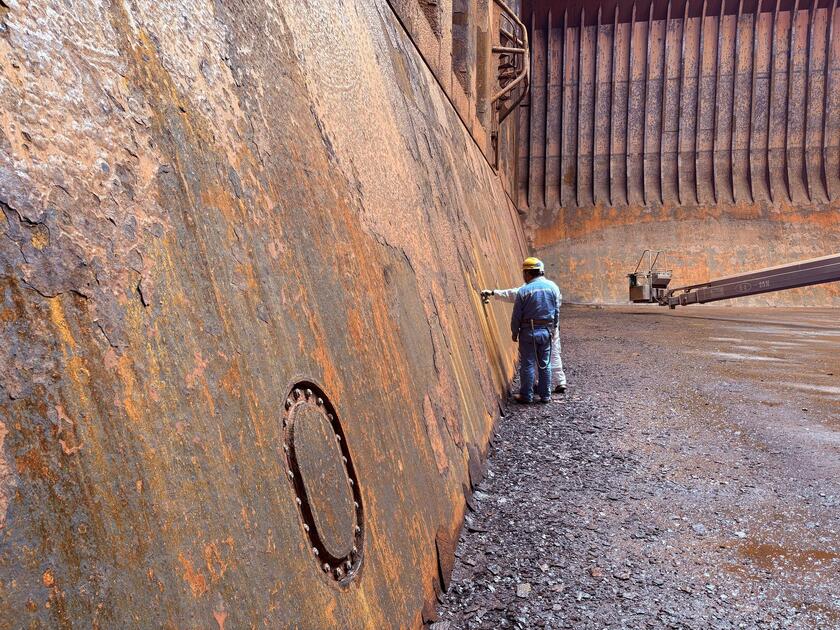
Tank tops, lower stools and other cargo hold structures on bulk carriers face abrasion and impact during cargo operations. Lashing bridges and other working areas on containerships are similarly exposed to mechanical damage. Once the protective barrier is breached, the underlying steel is again exposed to the marine environment.
This is where coating selection needs to move beyond initial application cost.
The cheapest system at the point of application is not necessarily the lowest-cost system over the remaining life of the structure. If coatings repeatedly require repair, or deterioration eventually results in steel renewal, the owner is paying for that original decision several times over.
For Steelpaint, we are seeing more orders for our single-component, moisture-curing polyurethane coatings as a way of protecting some critical areas against corrosion. These tough coating systems with a zinc-rich primers have been designed specifically for steel structures exposed to aggressive marine and industrial environments and are proven to last.
The single-component chemistry also removes the requirement to mix separate components immediately before application.
All Stelpant coatings can be applied across a broad range of temperatures and at high relative humidity up to 98% and on damp surfaces.
For shipboard maintenance and drydocking, where time and environmental conditions can constrain coating work, those application characteristics have practical significance. But performance after application is ultimately the more important measure.
PATCH TESTS
A three-year comparative trial aboard a 15,300TEU containership provides one example. Steelpaint’s single component zinc-rich polyurethane system was applied to a lashing bridge during drydocking in March 2023. At inspection in July 2026, the coated area showed only minor corrosion and required no crew maintenance.
Such trials matter because ageing-fleet economics will be determined by what happens between drydockings, not what happens during them.
In the year up to June 2026, Steelpaint has been trialled on some 16 bulk carriers with many going on to order full coats. And some of the yards that are now routinely applying Steelpaint systems include Youlian shipyard, Xinya dockyard, Qingdao Beihai shipyard, and Shanghaiyuan shipyard, with bulkheads, tank tops, lower hopper/stools, and hatch coaming the primary application areas.
An older ship is not necessarily a corroded ship, just as corrosion does not automatically make a vessel structurally unsafe.
Inspection, maintenance and timely steel repair remain fundamental. But with substantial proportions of the bulker and containership fleets already beyond 15 years, corrosion protection should increasingly be viewed as part of through-life asset management.
Shipping is rightly spending a great deal of time considering what will power its ships in the future. But many of the ships that will carry those technologies are already afloat. If we expect those vessels to keep trading, preserving the steel structure has to be part of the same conversation.