



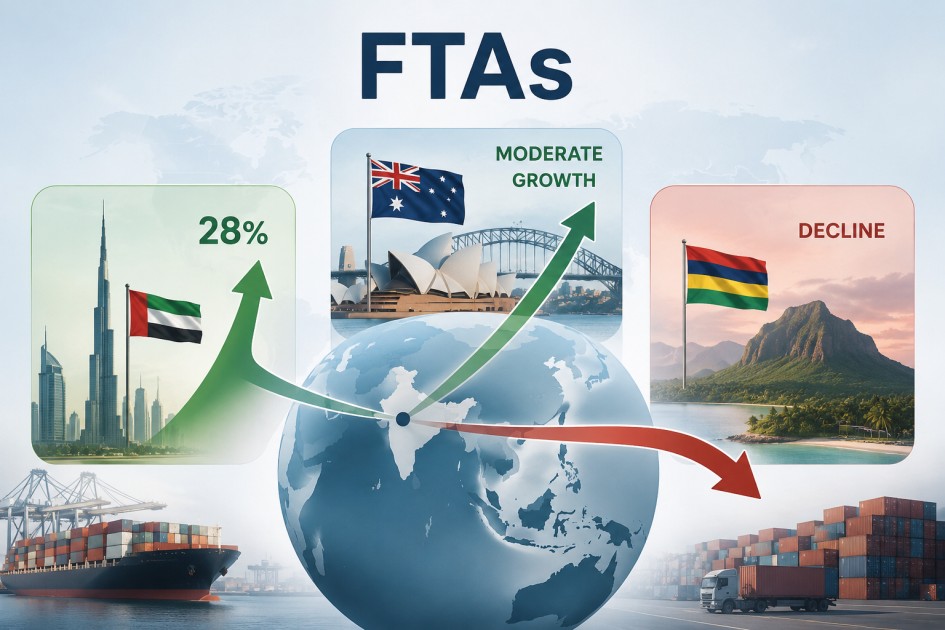
NEW DELHI: India’s free trade agreements (FTAs) have delivered uneven results, with exports to the United Arab Emirates rising nearly 28 percent, shipments to Australia recording only modest growth and exports to Mauritius declining, a Moneycontrol analysis of trade data shows.
The analysis of merchandise exports to three FTA partners shows that shipments to the UAE increased 27.8 percent to $36.26 billion from a pre-agreement average of $28.38 billion. Exports to Australia grew just 2.3 percent to $7.74 billion from $7.56 billion, while those to Mauritius declined 24.3 percent to $631.8 million from $834.5 million in the two years before and the time period after the signing of FTA.
The Australia and UAE agreements came into force in 2022, while the Mauritius agreement started in 2021. Taken together, exports to the three countries increased 21.3 percent to $44.63 billion from $36.78 billion.
More recent agreements with the United Kingdom and the four-member European Free Trade Association (EFTA) have also shown signs of stronger trade activity. But the initial experience suggests that tariff concessions alone do not guarantee a sustained increase in exports.
The UAE has emerged as the strongest performer among the three established FTA partners in the dataset, with export gains extending across consumer and capital goods.
Consumer goods exports to the UAE increased 25.7 percent to $18.77 billion from $14.93 billion. Capital goods exports recorded an even sharper increase of 77.1 percent, rising to $7.87 billion from $4.44 billion.
Together, these two categories accounted for more than 90 percent of the increase in Indian exports to the UAE.
The India-UAE Comprehensive Economic Partnership Agreement came into force in May 2022.
Australia presents a different picture. Despite its Economic Cooperation and Trade Agreement coming into effect in December 2022, India’s overall exports have remained relatively stable in the supplied dataset.
Consumer goods exports increased just 2.4 percent to $5.93 billion, while intermediate goods exports declined 12.8 percent to $829.5 million.
Capital goods were a brighter spot, with exports growing 20.8 percent to $868.8 million.
Mauritius recorded a contraction in the supplied comparison, with consumer goods exports declining 28.6 percent to $447.5 million and intermediate goods shipments falling 25.8 percent to $89.9 million. Capital goods exports, however, increased 24.4 percent to $52.3 million.
EFTA trade grows, Norway emerges as bright spot
India’s newer agreement with EFTA, comprising Switzerland, Norway, Iceland and Liechtenstein, has shown encouraging early results.
A previous Moneycontrol analysis showed that India’s merchandise trade with Norway, excluding mineral fuels, gems, jewellery and precious metals, increased 27.6 percent to $771.5 million during November 2025–July 2026, compared with $604.6 million a year earlier.
India’s exports to Norway rose 27.8 percent to $389.2 million, while imports increased 27.4 percent to $382.3 million.
Across EFTA, India’s exports excluding these volatile commodity categories increased 9.7 percent to $1.15 billion, slightly outperforming the 8.1 percent growth recorded in comparable exports globally.
Switzerland, however, showed a more modest increase in Indian exports of 2.8 percent to $754 million, even as imports from the country increased 11.9 percent.
UK deal sees trade rise, but imports grow faster
The latest agreement with the UK has also recorded an increase in bilateral trade, although the initial gains have been accompanied by faster import growth.
Bilateral merchandise trade increased 15.08 percent year-on-year to nearly $2 billion in August 2026, the first full month after the India-UK FTA came into force on July 15.
Indian exports increased 10.35 percent to $1.26 billion, while imports from the UK rose 24.23 percent to $733 million.
Consequently, India’s trade surplus with Britain narrowed to $527.4 million from $552.1 million a year earlier.
India has since signed agreements with the EU and New Zealand. The government expects the EU agreement to come into force by the end of the year.
India is also negotiating a trade deal with the US, and is considering expansion of its previous deal with Mercosur countries.
Source: Moneycontrol