
Bureau Veritas approves BAR Technologies’, supporting Pwind compliance within FuelEU the Maritime framework
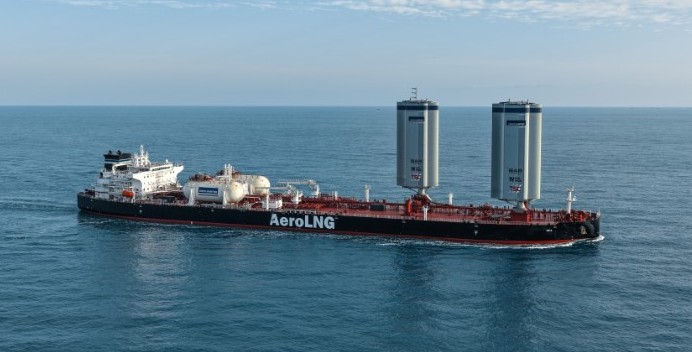
PORTSMOUTH: Bureau Veritas Marine & Offshore (BV) has completed a technical review confirming BAR Technologies’ calculation of available effective power of the two 37.5m WindWings® of 760m² installed on the tankers as part of UML AeroPower LR2 programme.
The approval confirms that BAR Technologies’ computational fluid dynamics (CFD) approach and resulting force matrix align with IMO Guidance for innovative energy-efficiency technologies, providing shipowners with a recognised pathway to quantify the propulsive contribution of WindWings® installations under IMO frameworks.
Following a detailed technical review, VersionBureau Veritas concluded that BAR Technologies’ submission is acceptable across all assessment categories, including CFD code specification, boundary conditions, grid independence, validation against experimental data and the generation of installation-specific force matrices.
The outcome provides a transparent, class-reviewed calculation of wind-assisted power contribution without the need for extended full-scale testing.
WindWings® technology is already in commercial operation across the Union Maritime fleet, including on the AeroPower vessels Brands Hatch and SPA. Meanwhile, the AeroPower newbuild programme at Xiamen Shipbuilding Industry (XSI) continues to advance. Construction is underway on the first 113,600 dwt vessel, with additional LR2 and MR2 tanker projects in development at major shipyards across Asia.
As vessels trade and newbuild programmes advance, wind propulsion is being integrated into mainstream bulker and tanker construction rather than confined to isolated installations. Bureau Veritas’ approval provides a support to methodological consistency required to support scale in these and other vessel types.
John Cooper, CEO of BAR Technologies, said: “WindWings® are already delivering in commercial service. What this approval does is formalise how that performance is assessed and recognised by class. Owners don’t need promises — they need certainty. A consistent, class-recognised methodology provides that certainty.”
Lauren Eatwell, Head of WindWings® at BAR Technologies, added: “As WindWings® continue to be adopted in larger tanker programmes, consistency in performance validation becomes critical. This approval ensures that the engineering analysis behind each installation is assessed to recognised standards, supporting predictable integration across vessel series.”
Alex Gregg-Smith, President, Marine & Offshore at Bureau Veritas, added: “Bureau Veritas’ review confirmed that BAR Technologies’ WindWings® available effective wind power calculation for UML AeroPower LR2 tankers is consistent with IMO Circ.896 Guidance for innovative energy-efficiency technologies. Our assessment examined the underlying modelling approach, validation processes and generation of installation-specific force matrices. Independent verification supports the consistent application of recognised technical standards and enables safe integration of wind-assisted propulsion systems within existing regulatory frameworks.”
As fleet renewal continues and tanker newbuild programmes expand, approvals such as this reinforce that wind propulsion can be incorporated into large-scale shipbuilding projects with technical rigour and regulatory clarity.