


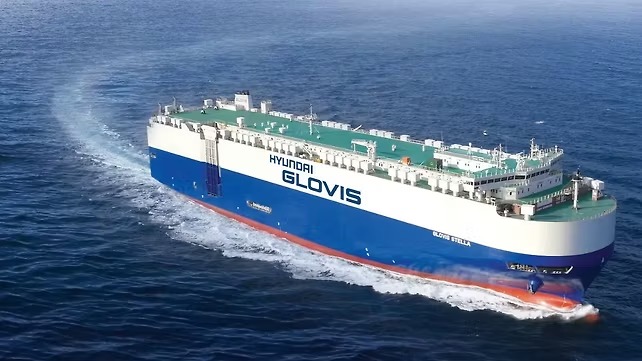
SEOUL : Hyundai Glovis has been signing transportation contracts in succession with Chinese manufacturing corporations, expanding non-affiliate (outside the group) revenue.
Hyundai Glovis said on the 27th that it recently signed a transportation contract with a leading Chinese battery corporation. Under the deal, Hyundai Glovis will transport electric-vehicle batteries produced by this corporation by sea from the South China coast, or Huanan , to countries such as Hungary, Spain, and Italy where global automaker factories are located.
Hyundai Glovis had earlier signed transportation contracts for knockdown (KD) auto parts and press plant equipment bound for the Eastern European factories of major Chinese electric-vehicle manufacturing corporations. Under the contracts, starting in the first half of this year, Hyundai Glovis has been transporting finished auto parts and press plant equipment by sea from shipping points in the East China region, or Huadong, to Slovenia and Croatia, and then hauling them overland by trucks to the factories.
A Hyundai Glovis official said, “We are providing shippers with a highly efficient logistics supply chain through ‘end-to-end’ services that are responsible for transportation from factories in China to factories in Eastern Europe.”
Hyundai Glovis also won a contract for vehicle disassembly and packaging work from a Chinese automaker. Accordingly, after taking delivery of finished vehicles produced in China, it inspects quality in a warehouse, disassembles and packages them, loads them into containers, and transports them via the Trans-China Railway (TCR) to Kazakhstan and Uzbekistan.
Hyundai Glovis’s battery transport and the transportation of knockdown parts and finished vehicles are carried out through a container forwarding system that uses its global logistics infrastructure and network. Forwarding refers to a specialized freight company taking responsibility for and handling the entire transportation process from departure to arrival.
In addition, Hyundai Glovis is transporting shipments for multiple Chinese automakers by sea using pure car and truck carriers (PCTCs). The volume of finished vehicles shipped by sea from China by PCTC over the past three years increased about 93%, from about 260,000 units in 2023 to about 510,000 units last year.
Hyundai Glovis recently created a dedicated high and heavy cargo unit and is working to strengthen its large-scale logistics capabilities. China is the world’s largest producer of construction equipment and industrial machinery, and the company plans to actively communicate with shippers in the region to showcase its transport competitiveness.
Through this, it plans to actively expand non-affiliate customers. In June 2024, Hyundai Glovis said, “While prioritizing transport of affiliate volumes, we will increase non-affiliate customers and achieve 40 trillion won in revenue by 2030.” A Hyundai Glovis official said, “We will continue to expand logistics cooperation with mobility-related corporations around the world.”