


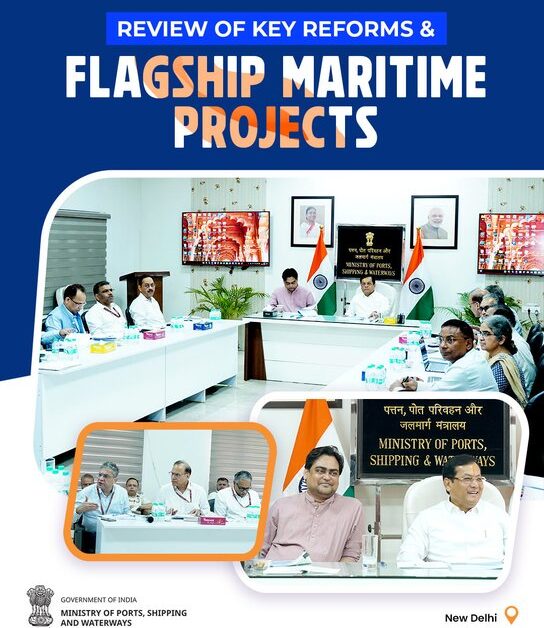
NEW DELHI : Hon’ble Union Minister for Ports, Shipping & Waterways Shri Sarbananda Sonowal, along with Hon’ble Union Minister of State Shri Shantanu Thakur, reviewed key reforms, flagship programmes and ongoing initiatives aimed at strengthening India’s maritime sector and accelerating its transformation into a globally competitive and future-ready ecosystem.
The review focused on advancing the Government’s priorities in indigenous shipbuilding, modern maritime infrastructure, enhanced port and shipping capabilities, global competitiveness and inclusive growth of coastal and riverine communities.
A major thrust of the review was on strengthening India’s domestic shipbuilding ecosystem and creating greater opportunities for Indian shipyards, maritime enterprises and allied industries. The Government’s focus on building a stronger indigenous maritime manufacturing base is aimed at enhancing India’s self-reliance while enabling the country to emerge as a competitive global shipbuilding and repair hub.
The discussions also emphasised the continued development and modernisation of ports, shipping infrastructure and multimodal maritime connectivity, with a focus on improving efficiency, capacity and the overall ease of doing business in the maritime sector.
The review comes against the backdrop of the Government’s broader efforts to position the maritime sector as a key driver of economic growth, trade competitiveness, employment generation and logistics efficiency. The Ministry’s ongoing reforms seek to strengthen the entire maritime value chain, from shipbuilding and shipping to ports, inland waterways and coastal logistics. The Ministry’s recent annual reporting also highlights continuing work on green hydrogen, maritime infrastructure and sectoral modernisation.
Shipping Ministry
Focus on Coastal and Riverine Communities
Particular emphasis was placed on ensuring that maritime development translates into greater economic opportunities for coastal and riverine communities. Initiatives aimed at improving livelihoods, skills, employment and participation in the maritime economy remain an important component of the Government’s inclusive maritime development agenda.
The review also underscored the importance of harnessing India’s extensive coastline and inland waterways to promote coastal shipping, inland water transport and more efficient movement of cargo, thereby supporting sustainable logistics and reducing pressure on conventional transportation networks.
Towards a Globally Competitive Maritime India
The leadership review reiterated the Government’s commitment to creating a strong, modern and globally integrated Indian maritime sector, supported by policy reforms, technology, infrastructure development, skilled human resources and greater private-sector participation.
The initiatives reviewed are aligned with the broader vision of Atmanirbhar Bharat and the Government’s objective of positioning India as a leading maritime nation, with greater domestic capabilities in shipbuilding and shipping and stronger integration with global maritime supply chains.
Under the leadership of Hon’ble Prime Minister Shri Narendra Modi, the Ministry of Ports, Shipping & Waterways continues to pursue an outcome-driven approach focused on measurable progress, institutional reforms and transformative growth across the maritime ecosystem.
The review reaffirmed the Government’s resolve to build a resilient, self-reliant, competitive, sustainable and future-ready maritime sector, while ensuring that the benefits of India’s maritime growth reach industries, workers, coastal communities and the wider economy.
Key Takeaways
Shri Sarbananda Sonowal and Shri Shantanu Thakur reviewed key maritime reforms and flagship initiatives.
Focus on indigenous shipbuilding and strengthening India’s domestic maritime manufacturing ecosystem.
Emphasis on modernising maritime infrastructure, ports and connectivity.
Measures aimed at enhancing India’s global maritime competitiveness.
Greater focus on coastal shipping and inland waterways.
Initiatives aimed at empowering coastal and riverine communities through skills, employment and economic opportunities.
Continued emphasis on self-reliance, technology, sustainability and private-sector participation.
Review reinforces the Government’s commitment to outcome-driven governance and transformative maritime growth.