
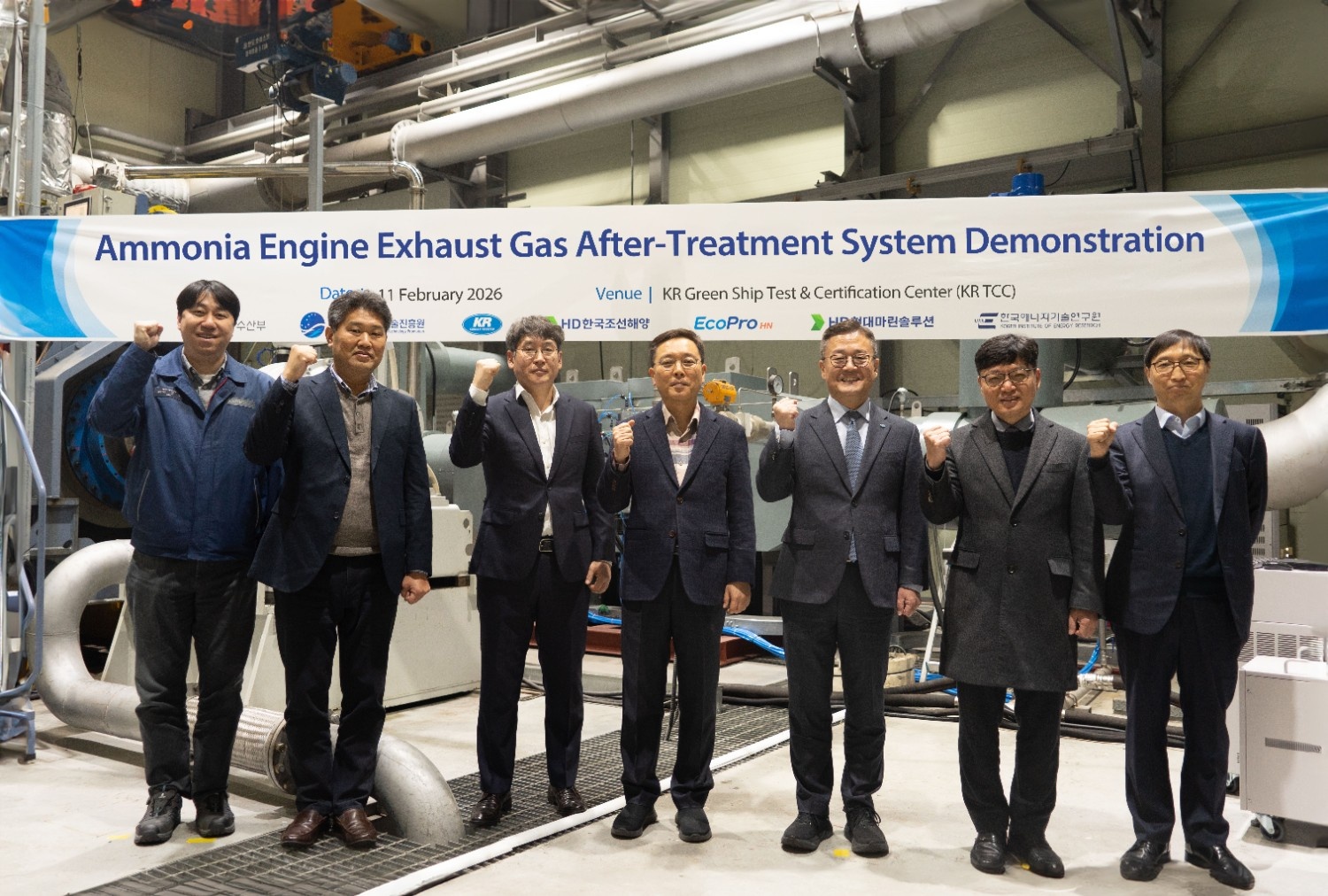
KR, EcoPro HN and HD Korea Shipbuilding & Offshore Engineering jointly develop Ammonia Engine Exhaust Gas After-Treatment System
Korean Register (KR) announced the successful development of an exhaust gas after-treatment system for ammonia-fueled engines, following the completion of a land-based demonstration and showcase. The system achieved a 95% reduction in nitrogen oxides (NOx) emissions and a 99.7% reduction in ammonia (NH₃) emissions, while reducing ammonia slip from an initial level of 10,000 ppm to 30 ppm.
KR is leading the government-funded project titled “Comprehensive Management Technology Development for Ship Greenhouse Gas Emissions,” supported by the Ministry of Oceans and Fisheries and the Korea Institute of Marine Science & Technology Promotion.
The newly developed system is Korea’s first microwave catalyst-heating exhaust gas after-treatment system applied to MW-class ammonia (NH₃) engine exhaust. The technology was jointly developed by KR in collaboration with EcoPro HN and HD Korea Shipbuilding & Offshore Engineering.
The prototype underwent extended operational tests at the KR Green Ship Test & Certification Center (KR TCC), where its durability and performance were successfully verified.
In addition to KR and its partners, the project has also brought together HD Hyundai Marine Solution, the Korea Institute of Industrial Technology, and other leading industry, academic, and research institutions to carry out end-to-end technology development and demonstration.
Ammonia is gaining growing attention as a next-generation carbon-free marine fuel, as it produces no carbon dioxide (CO₂) or sulfur oxides (SOx) during combustion and is relatively easy to store and transport. The International Energy Agency (IEA) projects in its “Net Zero by 2050” roadmap that ammonia could account for approximately 44% of total marine fuel consumption by 2050.
However, exhaust gas from ammonia engines may contain air pollutants such as nitrogen oxides (NOx, N₂O) and unburned ammonia. Securing effective after-treatment technology is therefore essential and critical for commercialization. These pollutants can be converted into harmless substances using catalytic reactions, but maintaining optimal catalyst activation temperature is widely considered a key technical challenge.
The newly developed system addresses this challenge by applying a microwave-based catalyst heating method that enables rapid and efficient catalyst activation, significantly enhancing exhaust gas purification performance. This system effectively reduces emissions under a wide range of operating conditions and is designed to ensure stable operation with minimized fuel consumption, even in changing navigation environments.
KIM Daeheon, Executive Vice President of KR, stated, “For the commercialization of ammonia-fueled vessels, securing exhaust gas after-treatment technology is just as important as fuel technology itself. Through this demonstration, we have validated the effectiveness of the jointly developed system. Going forward, we plan to expand its application to various dual-fuel engines and actively support the transition toward carbon-free shipping.”