



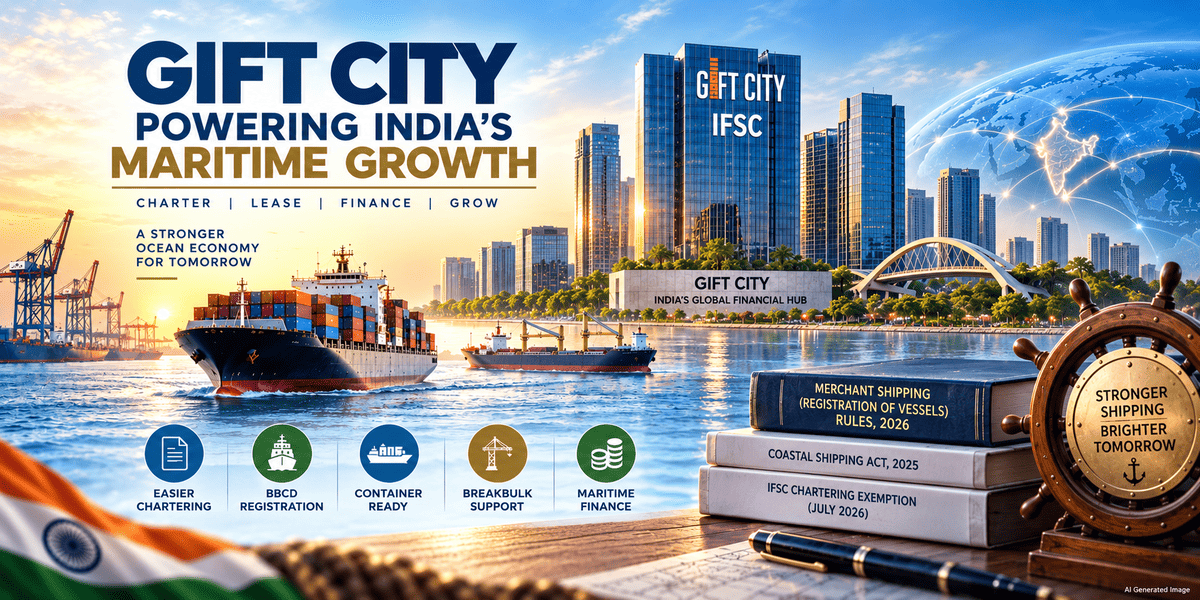
New 2026 vessel-registration framework, coupled with the IFSC licensing exemption, strengthens IFSCA–GIFT City’s potential as a global ship-leasing, financing and maritime-services hub
GANDHINAGAR: India’s evolving maritime regulatory framework is opening a more significant role for GIFT City and the International Financial Services Centre (IFSC) in ship chartering, leasing and maritime finance, leveraging the fact that the zone is free from FEMA restrictions and has tax holidays. Two developments in 2026 are particularly important: the Merchant Shipping (Registration of Vessels) Rules, 2026, which create a clearer route for bareboat charter-cum-demise (BBCD) registration of foreign vessels, and the Government’s July 2026 exemption allowing eligible IFSC units to charter foreign vessels for EXIM and international trade operations without the Section 11 licensing requirement under the Coastal Shipping Act, 2025.
A Stronger Chartering Platform for IFSCA–GIFT City
The July reform is especially significant for GIFT City. The Ministry of Ports, Shipping and Waterways exempted units established in the IFSC from the Section 11 licensing requirement for chartering foreign vessels. The Government said the measure is intended to strengthen GIFT City as a globally competitive maritime leasing and financing hub and facilitate ship-owning, ship-leasing, ship-financing and related maritime services.
This is separate from the 2026 Vessel Registration Rules. The exemption addresses the licensing requirement for eligible IFSC chartering activity, while the Registration Rules establish how qualifying foreign vessels can be registered in India under a BBCD arrangement. Together, the two measures create a more coherent regulatory pathway for maritime businesses operating from GIFT City.
BBCD Registration: A Practical Route for Foreign Vessels
Under Rule 15 of the 2026 Registration Rules, a foreign vessel chartered on bareboat charter-cum-demise to an eligible Indian charterer can seek Indian registration. The application requires the charter-party, confirmation from the vessel’s primary registry that its flag rights remain closed or suspended during the Indian registration, consent or no-objection from registered mortgagees or other encumbrance holders, and a certified extract of the primary registry.
Once registered under BBCD, the vessel must fly the Indian flag exclusively during the Indian registration period. The arrangement does not transfer legal ownership to the Indian charterer: title continues to be governed through the primary registry. The BBCD registration can run for the charter period, subject to the prescribed maximum and extension conditions.
The Rules also provide a Right of First Refusal for BBCD vessels over non-Indian vessels, although Indian controlled tonnage receives higher priority. This can improve the commercial positioning of qualifying chartered vessels in relevant Indian shipping opportunities.
Why This Matters for GIFT City’s Maritime Ecosystem
GIFT City already hosts India’s unified financial regulator for IFSC activities, the International Financial Services Centres Authority (IFSCA), and its permitted business activities expressly include ship leasing. IFSCA’s latest published highlights show 43 ship assets leased as of March 2026, underlining the growing asset-leasing ecosystem in GIFT IFSC.
The combination of financial-sector infrastructure in GIFT City and greater flexibility in vessel chartering can support a wider maritime value chain—ship leasing, structured finance, asset management, insurance, chartering and related professional services. For Indian and international maritime businesses, this could make GIFT City increasingly relevant as a location from which shipping assets are financed, leased and commercially managed.
Container Vessels: Greater Flexibility for Fleet Planning
The 2026 Registration Rules expressly capture container capacity in TEU in vessel particulars and registration documentation. The Rules also remove the need for a vessel to be physically present at an Indian port, or to call at an Indian port after registration, solely for registration. Surveys may also be undertaken outside India in the circumstances prescribed by the Rules.
For container shipping businesses, these provisions can reduce procedural friction and provide greater flexibility in structuring vessel acquisitions, chartering and fleet deployment. When combined with the GIFT City chartering and leasing framework, the reforms could support more internationally oriented asset and fleet structures.
Breakbulk and Multipurpose Vessels Also Stand to Benefit
The 2026 Rules do not create a separate registration category for breakbulk vessels. Instead, breakbulk and multipurpose vessels fall within the broader framework for sea-going vessels. The practical benefit is therefore regulatory flexibility rather than a special breakbulk regime.
For operators using chartered tonnage to move project cargo, machinery, steel, heavy-lift or other non-containerised cargo, the clearer BBCD pathway and the wider IFSC chartering reforms could provide additional options for fleet access and maritime asset structuring.
Indian Controlled Tonnage Adds Another Layer
The Rules also introduce a framework for Indian controlled tonnage. Foreign-flag tonnage owned or controlled by eligible persons cannot exceed their aggregate Indian-flag tonnage, while prescribed Indian-crewing requirements apply. A qualifying Indian controlled tonnage vessel operating under a charter arrangement and holding a licence under the Coastal Shipping Act, 2025 receives priority over non-Indian vessels and a Right of First Refusal immediately after Indian-flag vessels. ICT vessels owned from GIFT IFSC are exempt from these requirements of exceeding Indian-flag tonnage and crewing requirements.
This approach seeks to balance access to international tonnage with the policy objective of expanding Indian-controlled and Indian-flag shipping capacity.
A Potential Turning Point for India’s Maritime Finance Ambition
The significance of the 2026 reforms extends beyond vessel registration. By combining a modernised registration framework with a more enabling environment for IFSC-based foreign-vessel chartering, India is building stronger links between shipping operations and financial services. For GIFT City, this creates an opportunity to develop from a financial centre into a broader maritime business platform serving ship leasing, chartering, financing and asset-management needs.
For container, breakbulk and other commercial vessel operators, the message is equally important: India’s regulatory architecture is becoming more adaptable to internationally structured shipping businesses, with GIFT City positioned to play a growing role in that transformation.
Key Takeaways
The reforms could strengthen GIFT City’s role in ship leasing, financing, chartering and related maritime services.
GIFT City / IFSC units have received a major relaxation for chartering foreign vessels for EXIM and international trade operations under the July 2026 Section 11 exemption.
The 2026 Vessel Registration Rules provide a defined BBCD registration route for eligible foreign vessels chartered by Indian entities.
BBCD registration does not transfer legal ownership; the primary registry continues to govern title and related mortgage/encumbrance rights.
Container vessel capacity is expressly captured in TEU, while breakbulk vessels remain covered under the general sea-going vessel registration framework.