
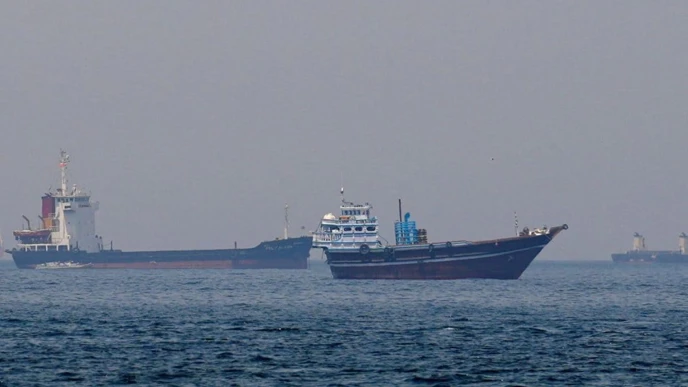
US redirects 48 vessels in Hormuz to enforce Iran port blockade
WASHINGTON : US President Donald Trump has said he was “not satisfied” with a new Iranian negotiating proposal, as peace talks remain frozen despite a weeks-long ceasefire.
Iran delivered the draft to mediator Pakistan on Thursday evening, the IRNA news agency reported, without detailing its contents.
“At this moment I’m not satisfied with what they’re offering,” Trump told reporters, blaming stalled talks on “tremendous discord” within Iran’s leadership.
“Do we want to go and just blast the hell out of them and finish them forever — or do we want to try and make a deal?” he added, saying he would “prefer not” to take the first option “on a human basis.”
According to the statement, the amphibious transport dock USS New Orleans (LPD-18) is currently deployed in the Arabian Sea. “USS New Orleans (LPD 18) sails in the Arabian Sea during the US blockade of Iranian ports, April 28. Over the past 20 days, 48 vessels have been redirected to ensure compliance with the blockade,” the post said, underscoring the scale of maritime enforcement underway.
The naval movements come amid fragile geopolitical conditions following a pause in hostilities between Iran and the United States and Israel. The conflict, which began in late February, has been on hold since April 8 after a ceasefire, though only one unsuccessful round of negotiations has taken place in Pakistan.
Tensions remain high as both sides express skepticism over diplomatic progress. A senior Iranian military official warned Saturday that “a renewed conflict between Iran and the United States is likely,” in remarks carried by Fars news agency. The same official added, “Evidence has shown that the United States is not committed to any promises or agreements,” reflecting deep mistrust.
Meanwhile, US President Donald Trump signaled dissatisfaction with Iran’s latest proposal, which was reportedly delivered to mediator Pakistan on Thursday evening. Without detailing its contents, Iranian state media confirmed the submission. Trump told reporters, “At this moment I’m not satisfied with what they’re offering,” attributing delays in negotiations to “tremendous discord” within Iran’s leadership.
He also framed the broader strategic choice facing Washington, saying, “Do we want to go and just blast the hell out of them and finish them forever — or do we want to try and make a deal?” while adding he would “prefer not” to take the military option “on a human basis.”
Iran’s judiciary chief Gholamhossein Mohseni Ejei reiterated that Tehran remains open to dialogue but rejects externally imposed terms. He stated the country had “never shied away from negotiations,” yet would not accept the “imposition” of peace conditions.
Details of the Iranian proposal remain undisclosed by the White House, though Axios reported that US envoy Steve Witkoff introduced revisions to a prior framework, placing Iran’s nuclear programme back at the center of discussions. These changes reportedly call for Iran not to transfer enriched uranium from damaged sites or restart operations at those locations during negotiations.
Iran’s mission to the United Nations responded by pointing to Washington’s own nuclear capabilities, accusing the United States of “hypocritical behaviour.” It maintained that there is no legal “restriction on the level of uranium enrichment, so long as it is conducted under the IAEA’s supervision, as was the case with Iran.”
Economic repercussions of the standoff have been immediate and far-reaching. News of the latest Iranian proposal briefly pushed oil prices down by nearly five percent, although prices remain roughly 50 percent higher than levels seen before the conflict. The continued disruption of the Strait of Hormuz has significantly affected global flows of oil, gas, and fertiliser, with Iran maintaining tight control over the chokepoint while the United States enforces a counter-blockade targeting Iranian ports.
Trump, speaking at a rally on Friday, used stark language to describe earlier enforcement actions, stating “we’re like pirates” in reference to a helicopter raid on an oil tanker during the blockade operations.
Despite the ceasefire in the Gulf, violence persists elsewhere. In Lebanon, Israeli forces have continued conducting strikes, with state media reporting new attacks in the south on Saturday, even as a separate truce with Hezbollah remains nominally in place.
On the military front, Washington announced fresh arms deals with regional allies, including a $4 billion agreement to supply Patriot missile systems to Qatar and nearly $1 billion worth of precision weapons to Israel.
Back in Washington, a political dispute has emerged over whether the administration complied with legal requirements related to the conflict. Lawmakers are debating whether Trump missed a deadline to seek congressional authorization. Administration officials argue the ceasefire effectively pauses the 60-day limit, a position contested by opposition Democrats.
Trump asserted in communications to congressional leaders, “There has been no exchange of fire between United States Forces and Iran since April 7, 2026,” adding that hostilities “have terminated.”
In Iran, however, the economic strain is intensifying. With oil exports curtailed and inflation exceeding 50 percent, the domestic situation is worsening. A Tehran resident identified as Amir described the growing hardship, saying, “Everyone is trying to endure it, but… they are falling apart.” He added, “We still have not seen much of the economic effects because everyone had a bit of savings… When they run out, things will change.”