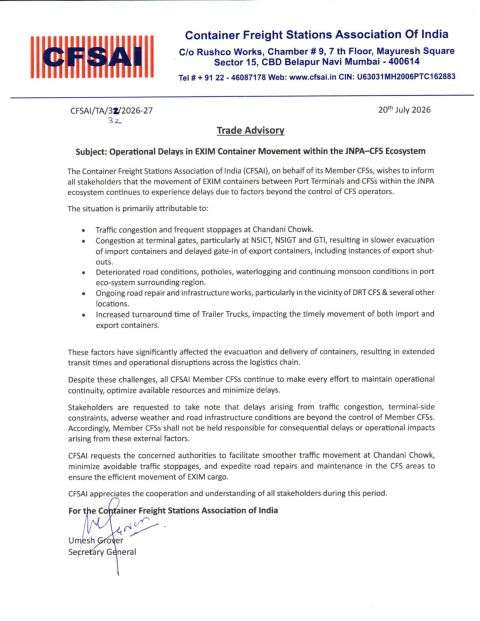



NAVI MUMBAI: The Container Freight Stations Association of India (CFSAI) has issued a Trade Advisory highlighting significant operational delays affecting the movement of EXIM containers between port terminals and Container Freight Stations (CFSs) within the Jawaharlal Nehru Port Authority (JNPA) ecosystem. The Association has clarified that the disruptions are primarily the result of external infrastructure and traffic-related issues that are beyond the control of CFS operators.
In its advisory issued on 20 July 2026, CFSAI informed stakeholders that container evacuation and delivery operations across the JNPA-CFS network continue to face severe challenges due to multiple factors impacting road connectivity and cargo movement.
According to the Association, the key reasons behind the operational delays include:
- Heavy traffic congestion and frequent stoppages at Chandani Chowk, disrupting the smooth movement of container trailers.
- Congestion at major port terminal gates, particularly NSICT, NSIGT and GTI, resulting in slower evacuation of import containers and delayed gate-in of export containers, including instances of export shut-outs.
- Poor road conditions, potholes, waterlogging and the continuing monsoon affecting road transport across the port region.
- Ongoing road repair and infrastructure development works, especially around DRT CFS and surrounding areas.
- A higher volume of trailer movements, impacting the timely transportation of both import and export containers.
CFSAI stated that these challenges have significantly impacted the evacuation and delivery of containers, leading to extended transit times and operational disruptions throughout the logistics chain.
Despite these constraints, the Association emphasized that member CFSs are making every effort to maintain operational continuity by optimising available resources and minimising delays wherever possible.
The advisory also stressed that the prevailing disruptions arise from traffic congestion, terminal-side constraints and adverse road infrastructure conditions, all of which are outside the operational control of member CFSs. Accordingly, CFSAI maintained that member CFSs should not be held responsible for delays or operational impacts resulting from these external circumstances.
To improve cargo movement, CFSAI has requested the concerned authorities to facilitate smoother traffic flow at Chandani Chowk, minimise avoidable traffic stoppages and expedite road repairs and maintenance around CFS locations to ensure the efficient movement of EXIM cargo.
The Association concluded by expressing appreciation for the cooperation and understanding of all stakeholders during this challenging period and reiterated its commitment to working closely with the trade and authorities to restore normal operational efficiency as early as possible.