


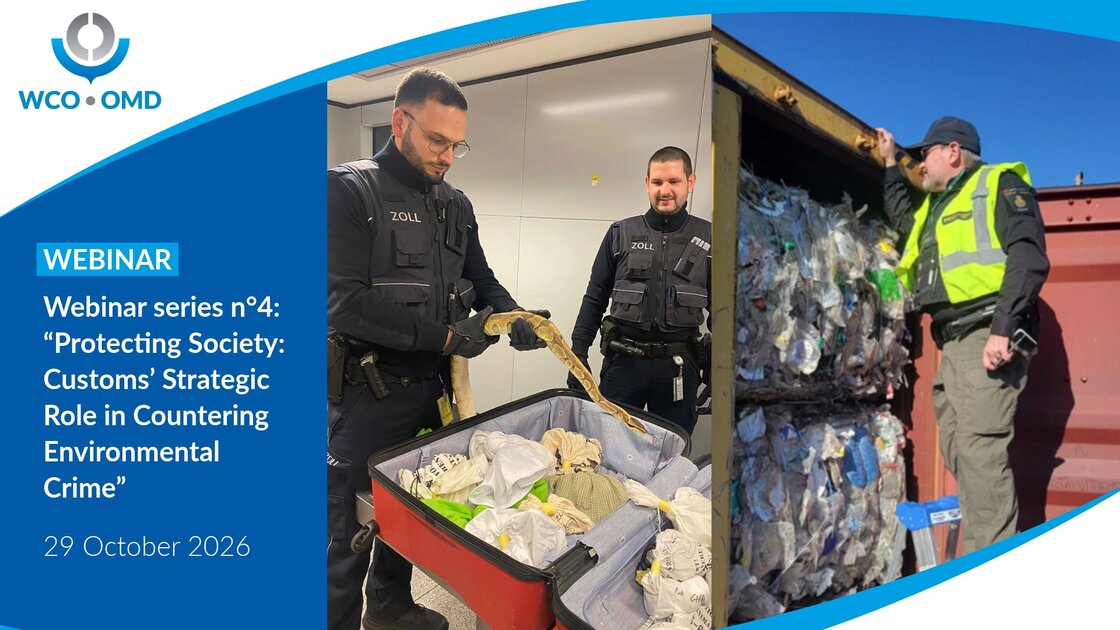
BRUSSELS: On 29 October 2026, the World Customs Organization (WCO) hosted the fourth webinar in its series under the theme “Customs Protecting Society through Vigilance and Commitment,” focusing on the critical role of Customs in combating environmental crime.
The webinar brought together representatives from Customs administrations, law enforcement agencies, relevant stakeholders and the Secretariats of Multilateral Environmental Agreements (MEAs) to exchange expertise, share operational experiences and explore ways to strengthen international cooperation.
Discussions highlighted the growing challenges posed by the illicit trade in environmentally sensitive commodities, including waste, wildlife, ozone-depleting substances (ODS) and hydrofluorocarbons (HFCs), and underscored the importance of effective border controls, intelligence-sharing and coordinated enforcement efforts.
In her opening remarks, Gael Grooby, WCO Director Policy and Standards underscored the rapidly evolving nature of environmental crime and the significant threat of illicit trade in environmentally sensitive commodities to environmental integrity, human health, and the achievement of the Sustainable Development Goals. She concluded by highlighting the complementary role of the WCO’s tools and instruments in tackling environmental crime noting: “the Harmonized System helps us identify and classify goods. MEAs provide the regulatory framework. WCO tools translate those requirements into operational procedures. WCO operations and projects provide a platform for enforcement and intelligence exchange. Our digital systems help us turn data into actionable intelligence.”
Protecting Society from Environmental Crime: The Role of Customs and International Cooperation
The keynote address was delivered by Maria Socorro Manguiat, Deputy Executive Secretary of the Ozone Secretariat. She highlighted the essential role of Customs administrations in supporting the implementation of the Montreal Protocol on Substances that Deplete the Ozone Layer through international cooperation, compliance monitoring, and assistance to Parties in phasing out ODS and phasing down HFCs. She also praised the strong partnership between the United Nations Environment Programme and the WCO, emphasizing Operation DEMETER, the development of Customs enforcement guidelines and capacity building support for Customs officers. She called for stronger coordination to strengthen Customs’ enforcement capacity, foster international cooperation, and combat environmental crime, particularly the illicit trade in substances controlled under the Montreal Protocol.
Customs efforts to combat Waste, Wildlife and Chemical Trafficking
A highly engaging panel discussion on “Customs Operations Against Waste, Wildlife and Chemical Trafficking” brought together experts from the Customs administrations of Indonesia and Nigeria, alongside a representative of the Secretariat of the Basel, Rotterdam and Stockholm Conventions.
The discussion highlighted that effective environmental enforcement at borders requires more than identifying and intercepting individual shipments. It depends on Customs’ ability to interpret and apply relevant regulatory requirements, identify risks through intelligence and data analysis, and access the technical expertise needed to determine the nature of goods and their regulatory status.
Panellists also stressed that enforcement should not be solely concerned with seizures. Analysing trafficking patterns, identifying vulnerabilities across supply chains, uncovering the networks behind illicit trade, and, where relevant, tracing associated financial flows are essential to developing more targeted, intelligence-led responses. Ultimately, effective action against environmental crime relies on an integrated approach that brings together regulatory knowledge, Customs expertise, intelligence, technology and operational cooperation at both national and international levels.
Looking Ahead
The final webinar in the Protecting Society series is scheduled for 15 December 2026 and will be dedicated to security threats. The virtual webinar will examine the evolving challenges faced by Customs administrations in protecting society from emerging and transnational threats.