



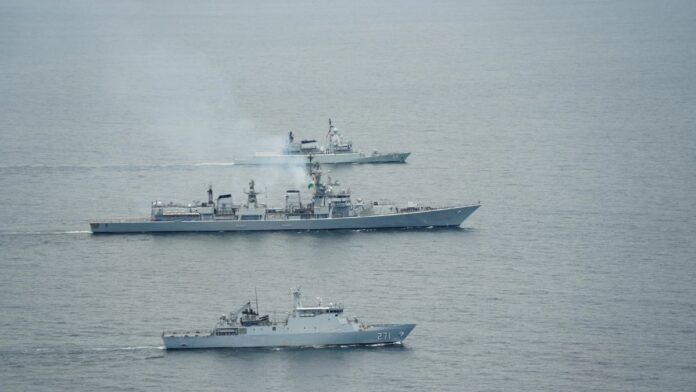
OMAN: Pakistan Navy’s PNS Hunain has returned to harbour after sustaining severe damage following a collision with an Indian Navy warship in the North Arabian Sea, in an incident that has now triggered a formal diplomatic protest from New Delhi.
The Pakistani vessel came dangerously close to an Indian frontline warship on the evening of September 15 while the Indian vessel was on a routine surveillance mission. The Pakistani ship approached at high speed and manoeuvred in an unsafe and unprofessional manner before the two vessels collided. The Pakistani vessel was identified as PNS Hunain, a Yarmook-class corvette.
The incident took place in international waters, around 220 kilometres east of Oman, according to reports citing defence sources.
PNS Hunain subsequently headed back to harbour after suffering severe damage. On the other hand, India’s Ministry of External Affairs has officially said that the incident did not cause any major damage to India’s vessel.
The differing details surrounding the extent of the damage have added to the questions over the circumstances that led to the confrontation between the two naval vessels.
Pakistan naval vessel allegedly approached at high speed
According to details released by India’s Ministry of External Affairs (MEA), an Indian Navy warship was conducting a routine surveillance mission when a Pakistan Navy vessel approached it at high speed. New Delhi described the Pakistani vessel’s movements as “unacceptable and unprofessional”, saying the close-range manoeuvres resulted in a minor collision. The two vessels were later steered away from each other.
The MEA said the incident occurred in international waters, outside the territorial waters of both India and Pakistan. It did not identify either of the ships involved or provide detailed information about the exact sequence of events leading to the collision.
However, sources cited by ANI identified the Pakistani vessel as PNS Hunain, an offshore patrol vessel belonging to the Yarmook class.
WION’s report claimed that the Pakistani naval vessel returned to harbour with severe damage following the incident. The Indian government, meanwhile, has maintained that the collision did not result in any major damage. The precise extent of the damage to either vessel has not been independently established in the information publicly released by the MEA.
India summons Pakistan diplomat over naval conduct
Following the incident, India summoned Pakistan’s Charge d’Affaires Saad Ahmad Warraich and lodged a strong protest over the conduct of the Pakistani naval unit.
The MEA said the actions of the Pakistani vessel were in direct contravention of Article 10 of the 1991 Agreement between India and Pakistan on Advance Notice on Military Exercises, Manoeuvres and Troops Movements.
New Delhi instructed Warraich to convey to the relevant Pakistani authorities that military units must exercise due care and comply with bilateral agreements intended to prevent accidents and maintain operational safety.
India also said its Charge d’Affaires in Islamabad had been directed to raise a similar protest with Pakistan’s Ministry of Foreign Affairs.
The diplomatic response reflects India’s objection to the alleged close-range manoeuvres by the Pakistani vessel. However, the MEA has not publicly released additional operational details, including the distance between the ships immediately before the collision or whether any warning signals were issued.
What does the 1991 India-Pakistan agreement say?
Article 10 of the 1991 agreement requires Indian and Pakistani naval ships and submarines operating in international waters to maintain a minimum distance of three nautical miles from each other.
The provision is intended to reduce the risk of accidents and prevent potentially dangerous encounters between military vessels belonging to the two countries.
The agreement has previously been cited in disputes involving the Indian and Pakistani navies. In 2011, India protested what it described as risky manoeuvres by the Pakistan Navy vessel PNS Babur involving the Indian Navy’s INS Godavari. New Delhi also referred to Article 10 during that episode.
The latest collision has therefore brought renewed attention to the practical enforcement of maritime safety commitments between the two countries, particularly when their naval units operate in proximity in international waters.
Incident adds to India-Pakistan military tensions
The collision comes against the backdrop of heightened tensions between India and Pakistan following the military confrontation in May 2025 and continuing disputes over security, terrorism and military activity.
Although the latest incident has not been described by India as a deliberate attack, New Delhi’s decision to summon Pakistan’s diplomatic representative indicates the seriousness with which it views the alleged conduct of the Pakistani naval vessel.
The episode also highlights the risks associated with close encounters between military ships in strategically important waters. The North Arabian Sea is a key maritime zone linking the Indian Ocean with the Gulf region, and naval activity in the area has broader implications for surveillance, shipping security and regional military operations.
Source : Moneycontrol