


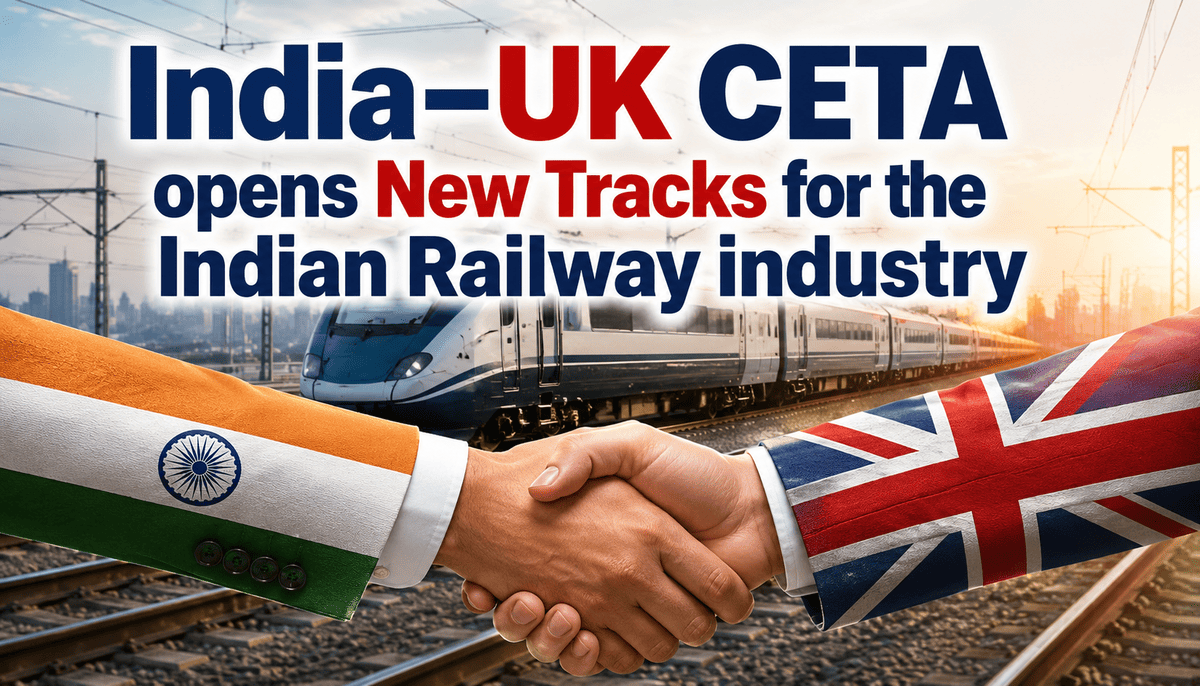
NEW DELHI: The Chamber of Railway Industries (Rail Chamber) welcomes the coming into force of the India–United Kingdom Comprehensive Economic and Trade Agreement (CETA), describing it as a transformative milestone that has the potential to strengthen India’s railway manufacturing ecosystem, accelerate technology partnerships, and position the country as a global hub for rail exports.
With zero-duty market access for nearly 99% of India’s exports to the UK, the agreement creates fresh opportunities for Indian manufacturers to expand exports of railway components, engineering products, electrical equipment, fabricated steel structures, signalling hardware, rolling stock sub-systems, and maintenance technologies to one of the world’s most advanced rail markets.
India’s railway industry has undergone a remarkable transformation over the past decade, driven by unprecedented public investment, large-scale infrastructure development, and the Government’s vision of Make in India and Atmanirbhar Bharat. As Indian companies increasingly meet global quality and safety standards, CETA provides a timely platform to showcase India’s manufacturing capabilities to the UK and beyond.
For the railway sector, the agreement should not be viewed merely as a trade pact but as a strategic partnership that can catalyse long-term collaboration in high-speed rail, digital signalling, rolling stock manufacturing, predictive maintenance, railway electrification, hydrogen propulsion, battery technologies, station redevelopment, freight logistics, and sustainable transport solutions.
The Rail Chamber believes that the next phase of India–UK cooperation should focus on joint innovation rather than traditional buyer-seller relationships. Indian manufacturers possess significant cost competitiveness, engineering expertise, and large-scale production capabilities, while the UK brings strengths in railway research, advanced signalling, safety systems, asset management, digital technologies, and innovation. Together, these complementary strengths can create globally competitive railway solutions for emerging and developed markets alike.
The Agreement’s emphasis on digital trade, professional services, intellectual property, customs facilitation, and regulatory cooperation is particularly significant for the railway industry, where cross-border collaboration increasingly depends on integrated engineering, software, certification, design services, and lifecycle asset management.
The Rail Chamber also sees substantial opportunities for Indian MSMEs, many of which form the backbone of the railway supply chain. Simplified certification procedures, self-certification of Certificates of Origin, and reduced compliance costs can enable smaller manufacturers to integrate into global value chains and access new export markets with greater confidence.
However, the success of CETA will ultimately depend on implementation. Indian railway manufacturers will need support in understanding market access requirements, technical standards, procurement processes, quality certifications, intellectual property frameworks, and business opportunities within the UK railway ecosystem. Industry associations, export promotion bodies, and government agencies must work together to ensure that businesses—especially MSMEs—can effectively utilise the Agreement.
Commenting on the development, Dr. Vinod Shah, Director General, Chamber of Railway Industries, said:
“The India–UK CETA represents far more than a free trade agreement. It opens a strategic corridor for innovation, investment, technology collaboration, and export-led growth for India’s railway industry. As India emerges as one of the world’s fastest-growing railway markets, we have an unprecedented opportunity to build globally competitive partnerships that strengthen manufacturing, create high-quality employment, and position India as a trusted supplier of railway products and technologies worldwide. The Rail Chamber looks forward to working closely with governments, industry, research institutions, and international partners to ensure that the Indian railway sector fully harnesses the opportunities created by this landmark agreement.”
The Rail Chamber remains committed to facilitating industry dialogue, promoting international collaborations, supporting export-oriented manufacturing, and helping Indian railway enterprises leverage the full potential of the India–UK CETA. The Agreement marks not only a new chapter in bilateral trade but also an important step towards building a globally integrated, innovation-driven, and future-ready railway industry for both nations.