



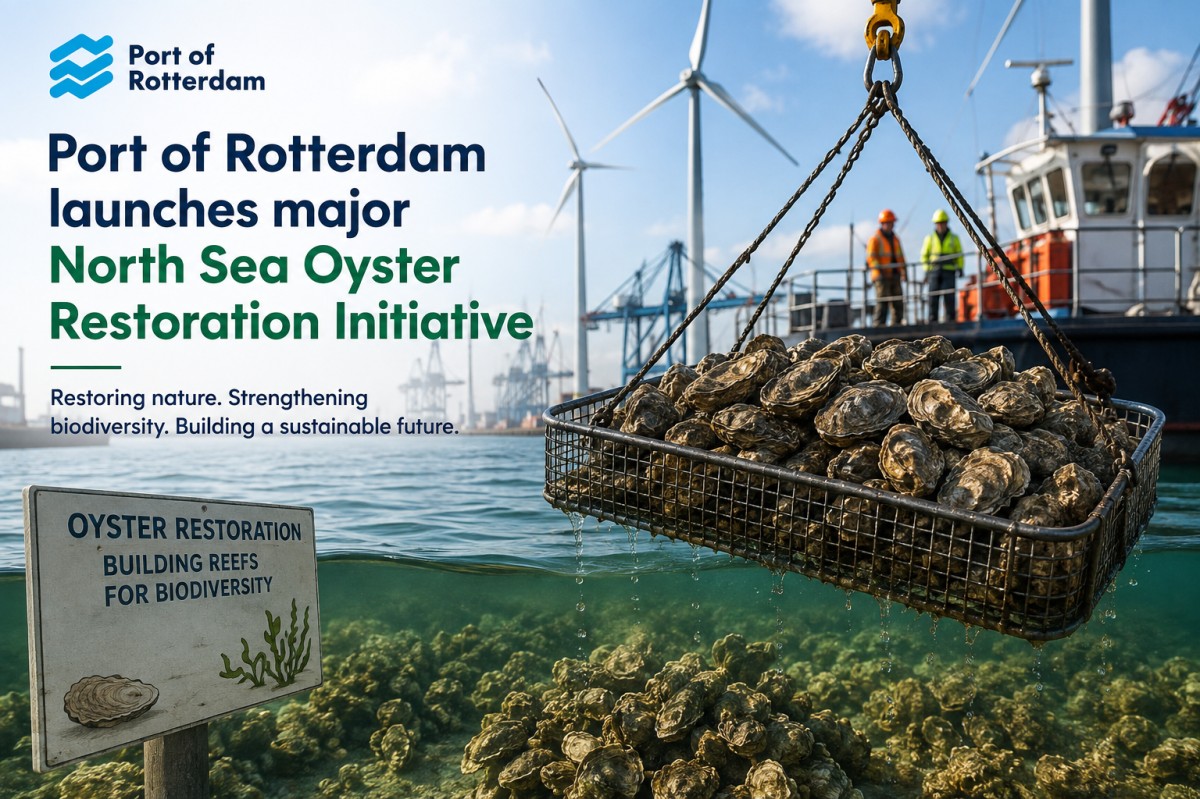
ROTTERDAM : The Port of Rotterdam Authority has announced the launch of an ambitious pilot project to restore European flat oyster reefs in the North Sea, combining large-scale marine ecosystem restoration with the development of offshore infrastructure.
As part of the initiative, the Port Authority will release at least 500,000 European flat oysters into the port on 2 September, marking the first trial of an innovative remote-setting method designed to integrate biodiversity enhancement into maritime infrastructure such as offshore wind turbines, breakwaters, subsea cables and marine platforms.
The pioneering approach involves cultivating millions of oyster larvae in a specialised hatchery before transferring them to a port-based facility, where they are placed in seawater-filled containers containing natural stones. Within a few days, the larvae attach themselves to the stones and develop into juvenile oysters. After several weeks, the oyster-covered stones are transported offshore and deployed as part of marine infrastructure, allowing new oyster reefs to establish naturally on the seabed.
If successful, the modular and scalable method could enable cost-effective restoration of oyster reefs by incorporating oyster-bearing stones directly into the design, construction and maintenance of offshore infrastructure projects, supporting both marine conservation and sustainable blue economy development.
In addition to testing the remote-setting technique, researchers are also investigating whether reef soundscapes influence where European flat oyster larvae settle. The findings could help improve settlement rates and further enhance large-scale reef restoration efforts.
The project aims to address the dramatic decline of oyster reefs in the North Sea, where overfishing, pollution and disease have caused this once-abundant keystone species to disappear almost entirely. Oyster reefs play a vital ecological role by filtering seawater, improving water quality, creating complex reef habitats and providing food and shelter for numerous marine species, thereby enhancing biodiversity and strengthening ecosystem resilience.
Scientists will closely monitor the survival, growth and development of the newly released oysters over the coming months. In 2027, project partners plan to expand the trials by testing the remote-setting method at an offshore TenneT cable crossing, further evaluating its potential for integration with critical marine infrastructure.
The three-year collaborative project brings together nine leading organisations, including Wageningen Marine Research, Wageningen University & Research, ARK Rewilding Netherlands, Stichting Zeeschelp, Waardenburg Ecology, Van Oord’s Ocean Health initiative, TenneT, the Port of Rotterdam Authority, and De Rijke Noordzee, a partnership between Stichting De Noordzee and Natuur & Milieu.
Commenting on the initiative, Pauline Kamermans, Project Lead at Wageningen University & Research, said the remote-setting technique eliminates the need to harvest adult oysters from the wild, enabling millions of oyster larvae to be settled on stones and deployed efficiently, making large-scale reef restoration both practical and sustainable.
Eric van der Schans, Director of Environmental Management at the Port of Rotterdam Authority, highlighted the port’s commitment to balancing industrial development with environmental stewardship, stating that the oyster restoration trial reflects the Authority’s long-term vision of preserving and enhancing biodiversity while supporting sustainable port operations.
The initiative represents an important step toward demonstrating how ecological restoration can be seamlessly integrated into offshore infrastructure development, offering a scalable solution to rebuild one of the North Sea’s most valuable marine ecosystems while advancing nature-inclusive maritime engineering.