



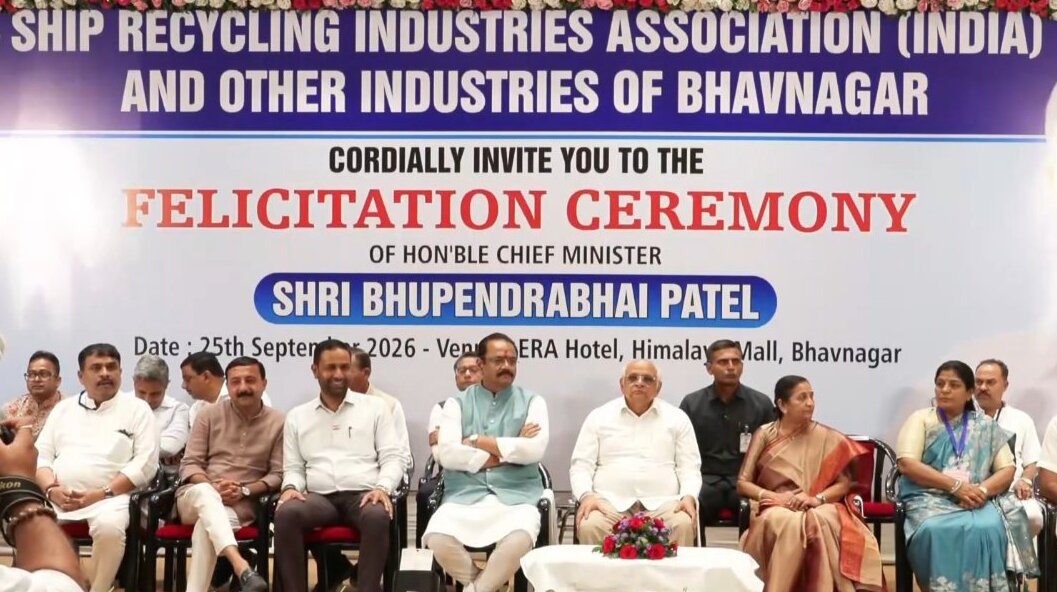
Gujarat CM Bhupendra Patel Highlights 15-Year Plot Permissions, Easier Plot Mergers and Simplified Ownership Transfers
BHAVNAGAR: Gujarat Chief Minister Shri Bhupendra Patel has welcomed the new policy framework introduced by the Gujarat Maritime Board (GMB) for the development of the ship recycling industry at Alang-Sosiya, describing the latest measures as a positive step towards creating a more investor-friendly and business-oriented environment for the sector.
In a post shared on X on Friday, September 25, 2026, Chief Minister Bhupendra Patel said that he attended a special ceremony organised by the Ship Recycling Industries Association in Bhavnagar, where he received greetings from representatives and stakeholders of the ship recycling industry following the announcement of the new policy and the reliefs extended to the sector.
The Chief Minister highlighted several important provisions under the new framework, including the extension of plot utilisation permission to 15 years, easier facilities for merger of plots, simplification of ownership and related transfers, and relief in various charges applicable to ship recycling plot holders.
According to the Gujarat Maritime Board (Conditions & Procedures for Granting Permission for Utilizing Ship Recycling Plots) Regulations, 2026, the permission period for utilisation of ship recycling plots has been prescribed as 15 years from the date of issuance of the permission letter, with renewal possible thereafter subject to the prescribed provisions and Government approval.
Greater Operational Certainty for Alang Recyclers
The extension of the plot permission period is expected to provide greater long-term operational certainty to ship recycling enterprises, enabling them to plan investments, infrastructure upgrades and environmentally compliant recycling facilities over a longer horizon.
The 2026 regulations also provide for adjustment, re-adjustment, alignment, re-alignment and merger or shifting of eligible plots, with the Gujarat Maritime Board empowered to undertake such measures based on technical, safety, environmental and other recorded considerations.
These provisions are particularly significant for an industry where adequate plot configuration and efficient utilisation of available space are closely linked to operational efficiency and the ability of recycling yards to modernise their facilities.
Focus on Ease of Doing Business
Emphasising the broader objective behind the reforms, Chief Minister Patel said that, under the guidance of Prime Minister Narendra Modi, the Gujarat Government is working towards making governmental processes simple, transparent and time-bound for industrialists.
He stated that such measures are intended to encourage entrepreneurs, accelerate industrial activity and contribute to the growth of Gujarat’s economy.
The Chief Minister further emphasised that mutual trust between the government and industrialists is a key strength behind Gujarat’s industrial development, underlining the State Government’s approach of working closely with industry stakeholders while implementing policy reforms.
Alang-Sosiya: A Strategic Pillar of India’s Ship Recycling Sector
The policy measures assume added significance given the strategic role of Alang-Sosiya in India’s ship recycling ecosystem.
According to the Ministry of Ports, Shipping and Waterways, India accounted for 35.4% of global ship recycling volume in 2025, making it the world’s leading ship recycling nation that year. The Alang-Sosiya Ship Recycling Yard accounts for approximately 98% of India’s ship recycling activity, with 128 operational plots and a recycling capacity of around 4.5 million Light Displacement Tonnes (LDT) per annum.
Since its establishment, Alang has recycled more than 8,900 ships aggregating over 71 million LDT, according to Government of India data. The sector also provides direct employment to around 15,000 people and supports more than 1.5 lakh people indirectly through ancillary industries and allied services.
The Government has also highlighted Alang-Sosiya’s contribution to the circular economy through the recovery and reuse of steel and other materials, helping conserve resources and reduce carbon emissions.
Policy Reforms Could Strengthen Alang’s Competitiveness
The latest regulatory framework comes at a time when the global ship recycling industry is increasingly focused on safe, environmentally sound and compliant recycling practices.
The Gujarat Maritime Board’s 2026 regulations have been framed with reference to the Recycling of Ships Act, 2019, the Recycling of Ships Rules, 2021, the Recycling of Ships Regulations, 2026, and the principles of the Hong Kong International Convention for the Safe and Environmentally Sound Recycling of Ships, 2009.
By combining longer plot-use permissions with provisions facilitating plot restructuring and administrative processes, Gujarat is seeking to create conditions that can support continued investment and modernisation at Alang.
For the ship recycling community, the reforms represent an important policy development aimed at reducing procedural complexities while providing greater certainty for business planning.
As Alang continues to remain at the centre of India’s ship recycling industry, the effectiveness of these reforms and their implementation on the ground will be closely watched by ship recyclers, investors, shipowners and other stakeholders across the maritime value chain.