



LONDON : Nuclear propulsion can compete in container shipping only if an effective global emissions policy is in place and reactor costs fall sharply, according to new research from the UCL Energy Institute’s Shipping and Oceans Research Group. It is one of the most detailed total cost-of-ownership assessments of nuclear merchant shipping to date.
The report, Nuclear Reactors for Merchant Shipping: A Total Cost of Ownership Assessment of a Low-Carbon Pathway, compares a large container ship (14,500 to 19,999 TEU) with nuclear propulsion against conventional fuel oil and dual-fuel ammonia vessels. It uses a literature review, interviews with five UK-based experts in law, insurance, classification, technology development and industry representation, and a cost model run with and without the IMO Net-Zero Framework (NZF).
Key findings
- Policy sets the business case. Without the NZF, no nuclear vessel is cheaper than a conventional ship, even at the lowest assumed reactor cost. Under the NZF, nuclear vessels earn income by selling surplus units to other ships, which closes the gap.
- Reactor cost decides the outcome. Published estimates range from about 2,600 to 12,400 USD per kWe, a spread of nearly five times. At the low end, which assumes series production and deep cost reductions, nuclear is the cheapest option from 2040. At the high end, which reflects first-of-a-kind reactors, it is not cheapest in any scenario.
- The window is narrow. Surplus unit income is largest when a vessel enters service and shrinks as the NZF’s fuel targets tighten. Nuclear’s best chance to break into the market is early, not late.
- Faster is not cheaper. At 25 knots, the vessel sails 32% more distance a year but needs more than three times the installed power, and costs rise.
- Non-technical barriers are as large as the technical ones. Existing nuclear liability conventions were designed for fixed, land-based reactors. Interviewees expect no global framework for the first vessels, and a mature insurance regime could take 15 to 20 years.
“Nuclear can compete, but only with much cheaper reactors and a global emissions policy, and neither exists yet. How both develop over the coming years will decide whether nuclear has a place in shipping.” said Farah Bziker, Researcher, UCL Shipping and Oceans Research Group.
Three features of the NZF support nuclear as a maritime energy source: a stringent fuel-intensity limit or steep reduction rate to ensure long-term demand; a stable, high-integrity surplus-unit market with a firm price; and a strong, sustained reward for zero- and near-zero-emission technologies. Policy that is less ambitious or less supportive of these technologies than the NZF will reduce nuclear’s potential.
“Nuclear is not a reason to weaken maritime climate policy. It is one of the technologies that depends on it. Anyone backing reactor programmes should want a stringent international GHG policy and credible global framework,” said Dr Tristan Smith, Professor of Energy and Transport, UCL Shipping and Oceans Research Group.
The authors caution that the results may understate the true cost of nuclear shipping. The model excludes nuclear-specific insurance, reactor maintenance and hull integration, and treats decommissioning as a rough estimate. Vessels with first-of-a-kind reactors are not competitive, and it remains open who would bear their cost. A favourable cost comparison is also not enough: the first vessels will need agreements between states on liability, insurance and regulation.
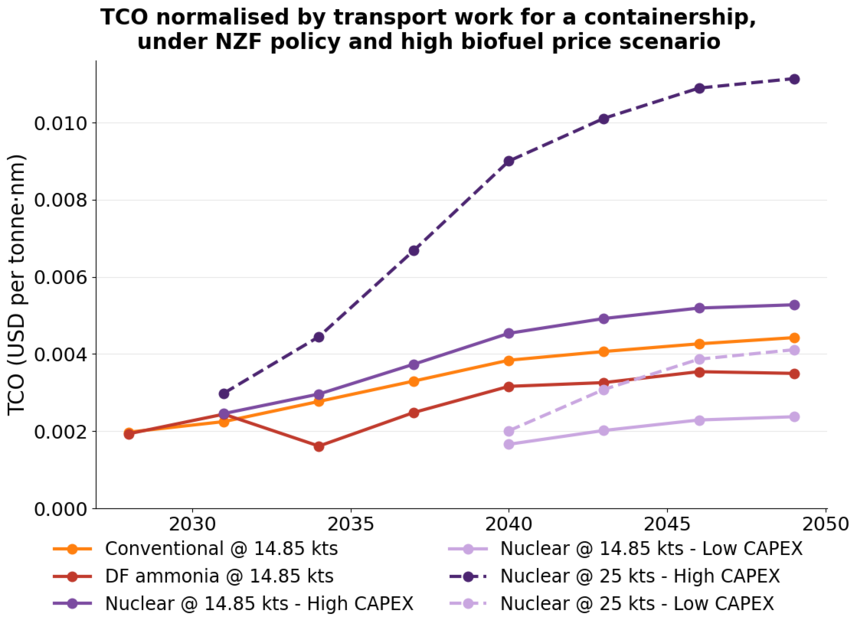
Total Cost of Ownership normalised by transport work for a containership, under NZF policy and high biofuel price scenario
Link to full report: https://www.shippingandoceans.com/post/nuclear-ships-only-pay-off-under-nzf
About UCL Energy Institute The UCL Energy Institute hosts a world leading research group which aims to accelerate the transition to an equitable and sustainable energy and trade system within the context of the ocean. The research group’s multi-disciplinary work on the shipping and ocean system leverages advanced data analytics, cutting-edge modelling, and rigorous research methods, providing crucial insights for decision-makers in both policy and industry. The group focuses on three core areas: analysing big data to understand drivers of historical emissions and wider environmental impacts, developing models and frameworks to explore energy and trade transition to a zero emissions future, and conducting social science research to examine the policy and commercial structures that enable the decarbonisation of the shipping secto