


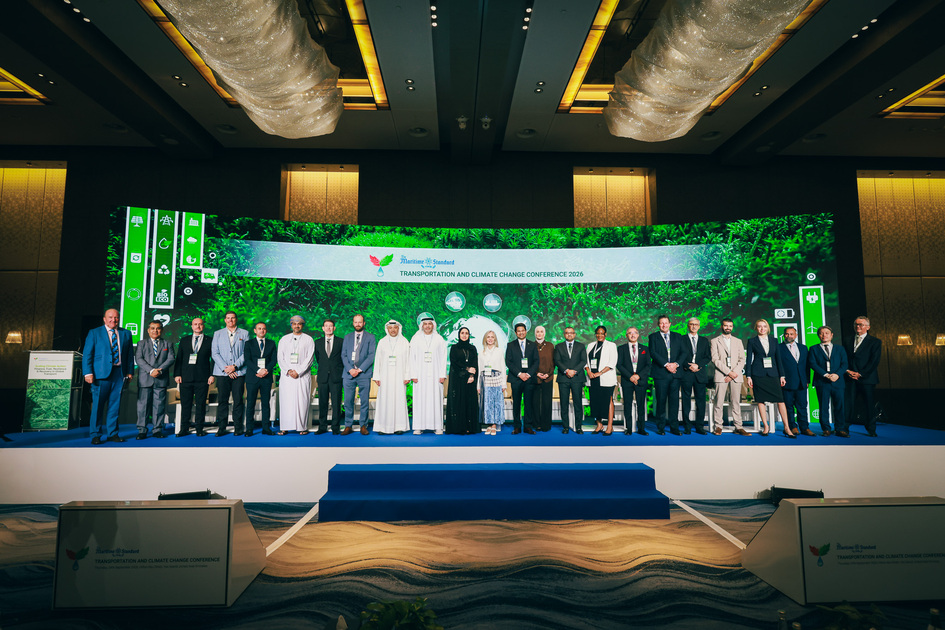
ABU DHABI: The fourth edition of The Maritime Standard Transportation & Climate Change Conference (TMS TACCC) 2026 concluded in Abu Dhabi on 24 September, bringing together senior maritime and transport leaders, policymakers, sustainability specialists, technology experts and industry stakeholders to examine practical pathways for advancing decarbonisation and building more resilient transport systems.
Held at Hilton Yas Island, Abu Dhabi, under the theme “Scaling Climate Action: Finance, Fuel, Resilience & Recovery in Global Transport,” the conference focused on the commercial, regulatory, technological and operational factors shaping the next phase of the industry’s transition. Discussions addressed alternative fuels, sustainable finance, regulatory developments, investment readiness, artificial intelligence, digitalisation, infrastructure, air quality, operational efficiency and maritime resilience.
The conference opened with a welcome address by David Eades, Former Chief Presenter, BBC News, who set the context for the day’s discussions and highlighted the importance of bringing together diverse perspectives from across the transport and maritime ecosystem. David subsequently expertly moderated both sessions, guiding discussions on the challenges and opportunities facing the industry as it moves from climate ambition towards practical implementation.
H.E. Eng. Hessa Al Malek, Advisor to the Minister for Maritime Transport Affairs, UAE Ministry of Energy & Infrastructure, delivered the keynote address, highlighting the UAE’s leadership and contribution to sustainable maritime and transport development. Her address emphasised the UAE Government’s commitment to forward-looking policies, strategic initiatives and investment in sustainable infrastructure, while underscoring the importance of collaboration between government and industry in supporting innovation, investment, cleaner technologies and resilient transport systems.
The first session, titled “Delivering Net-Zero Maritime: Regulation, Markets & Investment Readiness,” brought together senior representatives from shipping, ports, maritime services, finance, sustainability and consultancy to examine the investment and regulatory conditions required to advance maritime decarbonisation. Justin Murphy, Senior Vice President, Corporate Strategy & Business Development, ADNOC Logistics & Services; Dr. Abdullah Sulaiman Al-Abri, Vice President – Sustainability, SOHAR Port and Freezone; Dr Haya Daghlas, Director, Strategic Interface, Abu Dhabi Maritime, AD Ports Group; Franck J. Kayser, Chief Operating Officer, Asyad Shipping; Shrirang Kolaskar, Chief Financial Officer, Drydocks World; James Frew, Business Consultancy Director, Lloyd’s Register; Tony Dagher, Managing Director, TMC Shipping; Pawan Sahni, Vice President, Business Development Director Middle East and Africa, DNV Maritime; and Daniel Gribbin, Director – Sustainability, Deloitte shared their perspectives during the session.
Discussions highlighted the importance of regulatory certainty, demand visibility, infrastructure readiness, financing and collaboration across the maritime value chain. Justin Murphy highlighted the need to align commercial strategy with changing trade flows, fuel availability and fleet readiness, noting that emerging fuel investments such as ammonia require credible offtake, infrastructure, financing and viable trade routes. Dr. Abdullah Sulaiman Al-Abri emphasised that the industry’s challenge is increasingly one of scaling available fuel technologies, requiring infrastructure, demand certainty, investment and partnerships. He also outlined SOHAR Port and Freezone’s work in terminal electrification, biofuels, LNG bunkering, shore power and low-carbon fuel development. Dr Haya Daghlas and other speakers addressed the wider regulatory, investment and operational considerations shaping the transition towards net zero.
The second session, titled “Technology & Infrastructure: Scaling Decarbonized Transport Ecosystems,” examined the role of technology, data, artificial intelligence, environmental intelligence, maritime safety, security and digital infrastructure in supporting more efficient and resilient transport operations. The session featured Poul Hestbæk, Chief Executive Officer, Folk Maritime; Daejin Lee, Global Head of Research, Fertmax FZCO; Xanthos Kyriacou, CEO, Noatum CSM; Oriol Teixidó, Middle East Associate Director, Air Quality, WSP in the Middle East; Vimbai Gwaze, Sustainability Specialist, Monjasa; Ali Shehab, Global Director of Special Projects and Services, DNV Maritime; Katherine Yakunchenkova, General Manager, Al Safina Security Services; Capt. Amarjit Kauchhur, Vice President, Middle East/Regional Director, International Registries, Inc. (U.K.) Limited, Dubai Branch; Dr. Ivano Iannelli, Chief Executive Officer, TRST01 Climate Intelligence; and Captain Zarir Iràni, Managing Director, Constellation Marine Services LLC and Vice President Global, The Nautical Institute.
The session explored how digital technologies, AI, data integrity, fuel traceability, air quality management, maritime security and operational innovation can support future-ready transport ecosystems. Speakers highlighted the importance of reliable data, appropriate infrastructure, regulatory frameworks, skilled people and clear accountability. Daejin Lee focused on the role of human judgement in using shipping data and AI, emphasising the need to assess data sources, understand potential biases and verify information before relying on AI-generated outputs. Poul Hestbækcontributed perspectives on the operational and infrastructure requirements for building more resilient and sustainable maritime transport systems, while the wider discussion addressed air quality, alternative fuels, technology adoption, maritime safety and digitalisation.
Reflecting on the discussions, David Eades noted that the conference provided an important opportunity for the maritime industry to focus on the issues that matter, including net zero, carbon emissions, technology, artificial intelligence, stakeholder engagement, partnerships and collaboration. He highlighted the passion within the industry to make the transition work and stressed the importance of being prepared for evolving regulations, even when regulatory frameworks do not develop as quickly as expected. He said the breadth of presentations and panel discussions demonstrated the industry’s determination to stay ahead of the challenges and prepare for the regulatory and operational changes ahead.
The discussions throughout the conference reinforced the importance of collaboration in addressing the practical challenges of the energy transition, with speakers highlighting the need for investment, infrastructure, regulatory alignment, commercial certainty and stronger coordination across the transport ecosystem. TMS TACCC 2026 also provided a platform for delegates and industry stakeholders to exchange views, explore emerging solutions and strengthen professional relationships, while The Maritime Standard reaffirmed its commitment to supporting constructive industry dialogue and practical knowledge exchange on the future of global transport.