



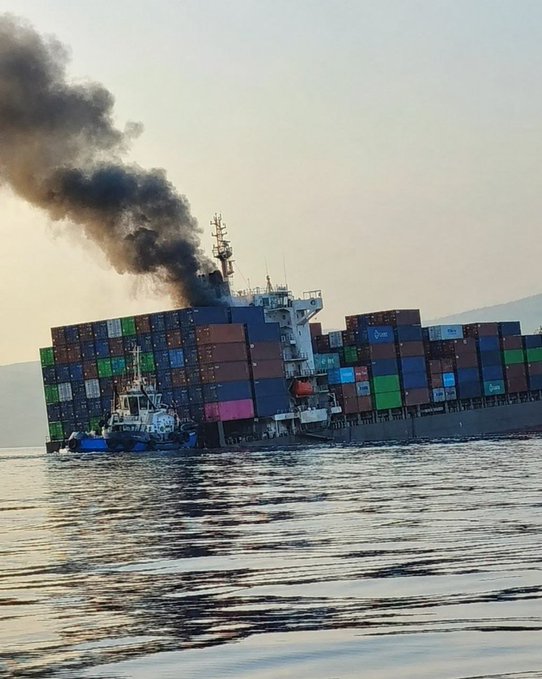
SINGAPORE: The Singapore-flagged container vessel GFS PRIDE, managed by Dubai-based GFS Ship Management FZE, has sunk near the strategically important Strait of Hormuz following a maritime security incident that triggered a fire onboard. The incident has heightened concerns over the safety of commercial shipping in one of the world’s most critical maritime corridors.
Iran’s Islamic Revolutionary Guard Corps Navy (IRGCN) claimed that the vessel struck a naval mine while attempting to navigate what it described as an “unauthorised and dangerous” shipping route through the waterway. According to Iranian reports, the explosion caused a severe fire, and the vessel subsequently sank in waters south of the Strait of Hormuz on October 14.
The vessel was reportedly carrying more than 2,500 containers. However, the specific cargo, including reports of luxury perfumes and iPhones, has not been independently confirmed. The exact value of the lost cargo and the overall financial impact of the incident also remain unknown.
Crew Safely Evacuated as Vessel Sinks
The Maritime and Port Authority of Singapore (MPA) confirmed that GFS PRIDE sustained damage and caught fire before sinking. All 21 crew members were safely evacuated, with no injuries reported. The authority said it was in contact with the vessel’s management company and was closely monitoring developments.
The vessel has been identified as a Singapore-registered container ship with a capacity of approximately 2,824 TEUs (twenty-foot equivalent units). Its loss underscores the growing security risks confronting merchant vessels operating in and around the Strait of Hormuz.
Floating Containers Raise Navigational Concerns
Following the sinking, Iran’s IRGC Navy warned local vessels and fishermen to exercise caution, reporting that containers from the sunken ship were floating on the water’s surface.
Floating containers can create serious navigational hazards for other ships, particularly in congested shipping lanes. The incident may also require further assessment of potential marine pollution, cargo loss and salvage-related challenges, although no confirmed assessment of these impacts was immediately available.
Wider Wave of Attacks on Commercial Shipping
The sinking comes amid a series of attacks on merchant vessels in the Strait of Hormuz and surrounding waters. Maritime security reports have identified several commercial ships targeted by unidentified projectiles, reflecting the widening threat to container shipping, bulk carriers and tankers amid the ongoing US-Iran conflict.
A second Singapore-registered container vessel, GFS GISELLE, was also reported struck by an unidentified projectile on October 14. According to Singapore’s maritime authority, the vessel sustained hull damage but reached a safe anchorage under its own power. All 22 crew members were reported safe, with no injuries.
The incidents have raised fresh concerns among shipowners, operators, cargo interests, insurers and maritime authorities regarding vessel routing, war-risk coverage, crew safety and the continuity of regional trade.
Strait of Hormuz: A Critical Global Shipping Corridor
The Strait of Hormuz connects the Persian Gulf with the Gulf of Oman and the wider Arabian Sea. It is a vital passage for international energy shipments and commercial trade, making any disruption potentially significant for global supply chains.
Continued attacks and navigational restrictions in the region could lead to increased war-risk insurance premiums, higher freight costs, vessel delays and changes to voyage planning. Cargo owners may also face uncertainty over delivery schedules, insurance claims and the recovery of lost consignments.
The sinking of GFS PRIDE highlights the urgent need for enhanced maritime security, effective coordination among coastal and international authorities, and robust emergency-response arrangements to safeguard seafarers and commercial vessels.
The investigation into the precise circumstances of the sinking remains subject to further confirmation. While Iran has attributed the incident to a naval mine, maritime authorities have separately reported that the vessel was struck by an unidentified projectile. The distinction remains important as investigations seek to establish the cause of the incident and assess its wider implications for commercial shipping.