


Double-stack train operations surge 27.43%; average daily train movement rises 22.78%, highlighting enhanced freight capacity and operational efficiency
NEW DELHI: India’s Dedicated Freight Corridor (DFC) network is registering significant growth in freight transportation, with the Dedicated Freight Corridor Corporation of India Limited (DFCCIL) achieving new operational milestones through increased train movements, higher double-stack train operations and record-breaking interchange performance.
The latest performance indicators released by DFCCIL reflect the growing capacity and efficiency of the dedicated freight rail infrastructure, which is playing an increasingly important role in strengthening India’s logistics ecosystem, improving supply chain connectivity and facilitating faster movement of goods across the country.
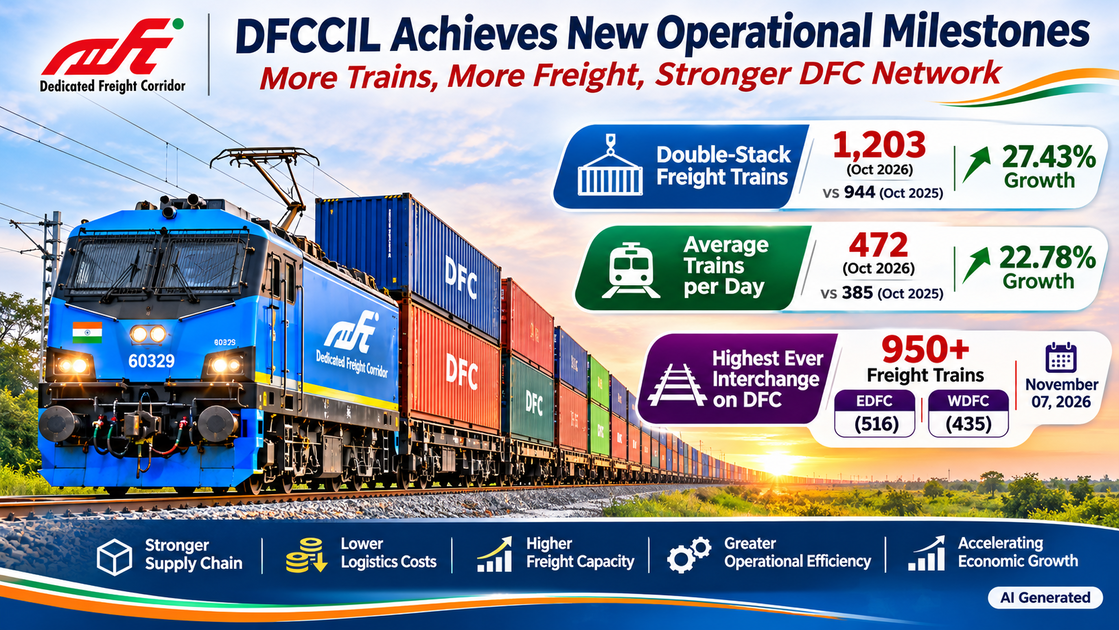
One of the notable achievements is the substantial increase in double-stack freight train operations. During October 2026, DFCCIL operated 1,203 double-stack trains, compared with 944 trains in October 2025, registering an impressive growth of 27.43% year-on-year. The increase demonstrates the expanding utilisation of dedicated freight infrastructure and the growing role of double-stack operations in enhancing freight-carrying capacity.
The organisation has also recorded a significant improvement in the average number of trains operated per day. The average daily train movement increased from 385 trains in October 2025 to 472 trains in October 2026, representing a growth of 22.78%. This increase underscores the enhanced operational capability of the DFC network and its ability to accommodate rising freight demand through improved infrastructure utilisation and efficient train management.
Adding another milestone to its achievements, DFCCIL recorded its highest-ever interchange of more than 950 freight trains on November 7, 2026, across the Eastern Dedicated Freight Corridor (EDFC) and Western Dedicated Freight Corridor (WDFC).
The record interchange comprised 516 trains on the EDFC (514+2) and 435 trains on the WDFC (434+1), taking the combined total to more than 950 freight trains. This achievement highlights the growing operational strength of both corridors and their increasing contribution to India’s freight transportation network.
The consistent rise in freight train operations and interchange volumes reflects the benefits of dedicated rail infrastructure, which enables freight trains to operate with improved efficiency, reduced congestion and better transit planning compared with conventional mixed-traffic railway routes.
Double-stack container transportation, in particular, offers significant advantages by enabling more cargo to be moved in a single train movement, improving asset utilisation and supporting more cost-efficient logistics operations.
The DFC network is emerging as a critical component of India’s multimodal logistics infrastructure, providing enhanced connectivity between industrial centres, logistics hubs, ports and consumption markets. Its growing operational capacity is expected to support EXIM trade, facilitate domestic cargo movement and improve the overall competitiveness of Indian industry.
These achievements reinforce DFCCIL’s commitment to developing a modern, efficient and high-capacity freight transportation system. With rising train volumes and improved operational performance, the Dedicated Freight Corridors are steadily transforming India’s freight logistics landscape, supporting faster cargo movement, stronger supply chains and the country’s broader economic growth objectives.
More trains, more freight and greater efficiency — India’s Dedicated Freight Corridor network is moving the nation towards a stronger and more competitive logistics future.