



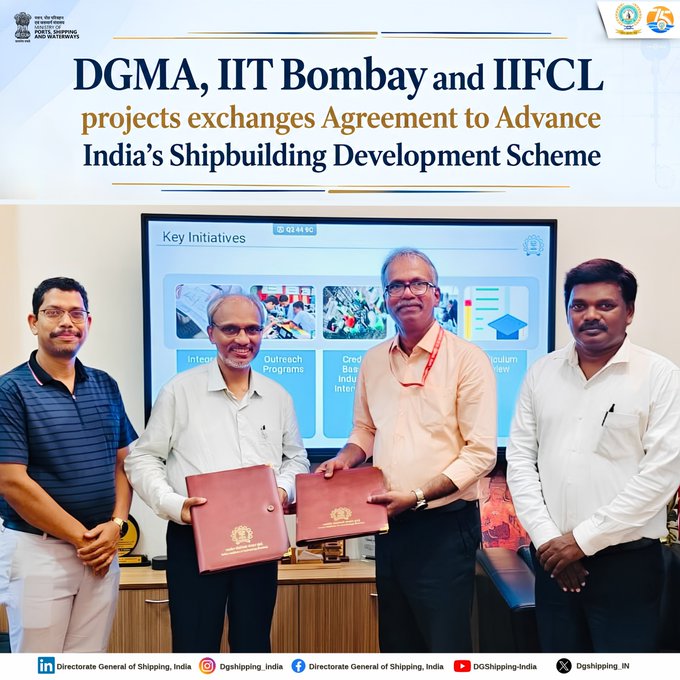
MUMBAI: A significant step towards strengthening India’s domestic shipbuilding capabilities was marked at IIT Bombay with the signing of a Tripartite Project Agreement between the Directorate General of Maritime Administration (DGMA), IIT Bombay and IIFCL Projects Ltd. under the Shipbuilding Development Scheme (SbDS).
The agreement, signed on September 17, 2026, establishes a dedicated Project Management Unit (PMU) to support the appraisal, monitoring, compliance management and implementation of shipyard modernisation projects under the Brownfield Capacity Expansion component of the SbDS.
The agreement was formally exchanged in the presence of senior officials and representatives from the three institutions. DGMA was represented by Shri Pradeep Sudhakar, Chief Ship Surveyor, and Shri Ravi Kumar Moka, Ship Surveyor-cum-Deputy Director General (Technical). IIT Bombay was represented by Prof. Tom V. Mathew, Head, Department of Civil Engineering, and Prof. Manasa Ranjan Behera, Professor, Ocean Engineering. Shri Mehul Krishnakant Patwari, Chief Executive Officer, IIFCL Projects Ltd., represented the organisation at the signing.
The newly established PMU is expected to play a key role in ensuring effective implementation of shipyard modernisation projects by facilitating systematic project appraisal, monitoring progress, ensuring compliance and supporting coordination among stakeholders.
The initiative is aimed at enabling the modernisation of existing shipyard infrastructure and facilitating the expansion of shipbuilding capacity in India. By improving infrastructure and strengthening project implementation mechanisms, the collaboration seeks to create a more efficient and competitive environment for the country’s shipbuilding industry.
The agreement also supports the broader objectives of the Maritime India Vision 2030 and Maritime Amrit Kaal Vision 2047, which envisage a stronger, more self-reliant and globally competitive Indian maritime sector.
The collaboration between DGMA, IIT Bombay and IIFCL Projects Ltd. represents an important institutional step towards developing a more capable and future-ready shipbuilding ecosystem, while creating the foundations for enhanced domestic capacity and technological advancement in the years ahead.