


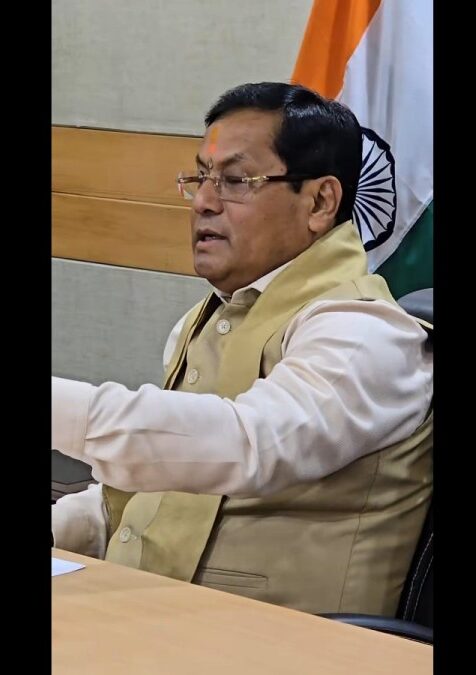
NEW DELHI : The Government is implementing a comprehensive strategy to enhance employment opportunities in the maritime sector while accelerating the development of inland waterways to support economic growth and multimodal logistics, Union Minister of Ports, Shipping and Waterways Shri Sarbananda Sonowal informed the Lok Sabha in a written reply.
The Minister said the Government has adopted a multi-pronged approach to capacity building by expanding training infrastructure, strengthening industry participation, and creating additional onboard training opportunities for maritime professionals. These initiatives are aimed at improving the employability of Indian seafarers and building a skilled workforce to meet the growing demands of the maritime industry.
Recognising that onboard sea-time training is essential for certification and career progression, the Ministry has collaborated with the Shipping Corporation of India (SCI) and the Andaman & Nicobar Administration to create 96 onboard training berths on the passenger vessel MV Swaraj Dweep. The initiative benefits trainees pursuing General Purpose (GP) Rating and Certificate Course in Maritime Catering (CCMC) programmes, providing them with valuable sea-time experience required for certification and employment.
Highlighting the rapid growth of Inland Water Transport (IWT), Shri Sonowal said the Government declared 111 National Waterways—comprising five existing and 106 new waterways—under the National Waterways Act, 2016. Development plans for these waterways have been prepared under Maritime India Vision 2030 and the Maritime Amrit Kaal Vision 2047, with a focus on improving infrastructure, enhancing connectivity, and increasing cargo movement through sustainable transport.
The Minister informed the House that cargo traffic on National Waterways has witnessed remarkable growth, increasing from 18 million tonnes in 2013-14 to 218 million tonnes in 2025-26, reflecting the success of sustained investments in inland water transport infrastructure and policy reforms.
To support this growth, the Government has undertaken extensive infrastructure development across key waterways. These include fairway maintenance through dredging, river training, hydrographic surveys, and channel marking to ensure safe and efficient navigation. Significant terminal infrastructure has also been developed, including 66 community jetties, 20 floating terminals, three Multi-Modal Terminals (MMTs), one Inter-Modal Terminal (IMT), and four Ro-Pax terminals on National Waterway-1 (River Ganga).
Additional infrastructure has been created on National Waterway-2 (River Brahmaputra), including floating terminals, Multi-Modal Terminals at Pandu and Jogighopa, dedicated cruise jetties, and passenger terminals across Assam. Similar upgrades have been carried out on National Waterways 3, 4, 16, 37, 68, 73 and 110, strengthening regional connectivity and promoting passenger and cargo transportation.
The Government has also implemented several policy initiatives to encourage greater adoption of inland waterways. These include a 35% incentive scheme to promote cargo movement on National Waterways, an extension of the tonnage tax regime to inland vessels registered under the Indian Vessels Act, 2021, and the notification of the National Waterways (Construction of Jetties/Terminals) Regulations, 2025, providing a transparent framework for private sector participation in inland waterway infrastructure.
To improve ease of doing business, the Ministry has introduced the Jalyan and Navic digital platforms for online registration of inland vessels and crew, creating a unified national database to streamline regulatory processes and enhance operational efficiency.
The Government is also promoting multimodal logistics through the development of cargo aggregation hubs, including a Multi-Modal Logistics Park (MMLP) at Varanasi and an Integrated Cluster-cum-Logistics Park at Sahibganj. Rail connectivity to major inland terminals is also being strengthened to facilitate seamless cargo movement.
Further, the recently operationalised Indo-Bangladesh Protocol Route 5 and 6 between Maia and Sultanganj is expected to boost cross-border inland water transport once regular services commence following bilateral approvals.
To encourage a modal shift towards waterways, more than 140 Public Sector Undertakings (PSUs) have been requested to identify cargo suitable for transportation through inland waterways and prepare plans to increase the use of this cost-effective and environmentally friendly mode of transport.
Shri Sonowal reiterated that these initiatives form part of the Government’s broader vision to modernise India’s maritime sector, generate employment, reduce logistics costs, promote sustainable transportation, and strengthen the country’s Blue Economy under Maritime India Vision 2030 and Maritime Amrit Kaal Vision 2047.