


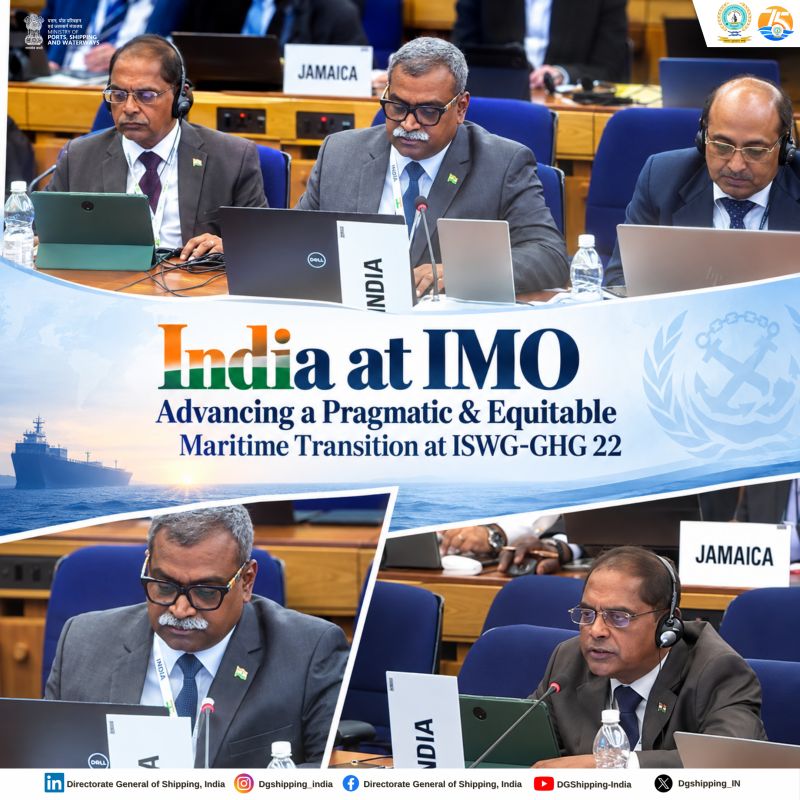
LONDON: India participated in the 22nd Session of the International Maritime Organization’s Intersessional Working Group on Greenhouse Gas Emissions (ISWG-GHG 22), held from 1–4 September 2026, contributing actively to key deliberations concerning the implementation of the IMO Net-Zero Framework and the future pathway for the decarbonisation of international shipping.
The Indian delegation was led by Shri Satish Devdas Kamath, Principal Officer, MMD Kandla, and included Shri C.P.K. Kashyap and Shri Mudit Mehrotra, representing India’s maritime interests during the discussions.
The session brought together IMO Member States to deliberate on critical issues related to the implementation of the IMO’s climate ambitions and the transition of international shipping towards lower and zero greenhouse gas emissions.
During the deliberations, India presented a balanced and pragmatic approach towards the implementation of the IMO Net-Zero Framework. India emphasised the importance of adopting a phased and practical transition that takes into account technological readiness, the availability and affordability of alternative fuels, infrastructure preparedness and the diverse circumstances of Member States.
India’s key interventions focused on the need for a preparatory phase to assess the readiness and practical feasibility of alternative fuels and emerging technologies before the implementation of major measures. Such a phase would help stakeholders better understand the operational, technological and economic challenges associated with the transition to cleaner fuels.
India also advocated for an experience-building phase before the introduction of significant measures. This approach would enable Member States and the shipping industry to gain practical experience, assess implementation challenges and develop informed solutions based on real-world operational experience.
On the issue of future economic measures, India emphasised that such measures should be evidence-based, practical and equitable, while recognising the varying national circumstances, developmental priorities and capacities of Member States. India underlined the importance of ensuring that the global transition towards low- and zero-emission shipping remains inclusive and does not disproportionately impact developing countries.
The session reflected broad support among Member States for the objectives of the 2023 IMO Greenhouse Gas Strategy. India’s constructive interventions and its call for preparatory and experience-building phases received encouraging support from several Member States.
India’s participation at ISWG-GHG 22 reaffirmed the country’s commitment to contributing actively and constructively to international efforts aimed at reducing greenhouse gas emissions from shipping.
As the global maritime industry moves towards a low-carbon future, India continues to advocate for a transition that is practical, inclusive, technologically feasible and equitable. The country remains committed to working closely with the International Maritime Organization and Member States to develop a balanced pathway for the decarbonisation of international shipping while safeguarding the interests and developmental needs of all nations.
India’s engagement at ISWG-GHG 22 highlights its continued commitment to shaping a sustainable and equitable future for global shipping, ensuring that the transition towards net-zero emissions is guided by practicality, collaboration and shared responsibility.