Home Blog Page 708

No addl tariffs by US on Indian pharma, electronics

NEW DELHI : The Government on Tuesday said no additional tariffs have been imposed on Indian exports to the US in sectors like pharmaceuticals, and electronics so far. In a written reply to the Lok Sabha, Minister of State (MoS) for Commerce and Industry Shri Jitin Prasada said reciprocal tariff at the rate of 25 per cent has been imposed on certain goods exported from India to the US, effective August 7.

It is estimated that around 55 per cent of the total value of India’s merchandise exports to the US is subjected to this reciprocal tariff, he said, adding that additional ad valorem rate of duty of 25 per cent with effect from August 27 has been imposed on certain goods exported from India.

“No additional tariffs have been imposed on Indian exports to the US in sectors like pharmaceuticals, and electronics as yet,” Prasada said. He also said the government is engaged with all stakeholders, including exporters and industry, for taking feedback of their assessment of the impact from the reciprocal tariffs imposed by the US.

DTDC expands Leadership Bench to accelerate Vision 2030

MUMBAI : Celebrating 35 years of transforming India’s logistics landscape, DTDC Express Ltd., the country’s first multinational logistics brand, has fortified its leadership bench to deliver on its ambitious Vision 2030, a strategic roadmap aimed at achieving exponential growth by expanding its expertise beyond express parcel delivery and becoming the ‘Most Admired Logistics Partner’ globally.

Over the past three decades, DTDC has ensured consistent growth and profitability through innovation and resilience. Now, with the convergence of seasoned leadership, it gears up to take a bold leap and become a trusted logistics partner, not just a service provider. The new league of leaders will be pivotal in not just scaling but transforming DTDC through focused and extensive partnerships, deepening and strengthening the brand’s footprint, capturing adjacencies and unlocking new frontiers, while also building the social capital.

As part of its ongoing leadership expansion, DTDC has strengthened its management committee, sharpening the focus on scaling its business network. Rishi Sareen, Chief Information Officer, will drive the company’s tech-forward transformation, while Ajay Sukhwani, Vice President – Integrated E-commerce Logistics, will head the rapid commerce initiatives to empower D2C and social commerce brands along with the traditional e-commerce business. Jatinder Sethi, Vice President – Channel Business & Network, oversees a network of 16,000+ channel partners, focusing on a customer-centric growth strategy and enhancing last-mile delivery capabilities. Supporting these strategic pillars is Sonam Paliwa, Director of Operations, who will ensure seamless execution and operational excellence across functions.

Aneel Gambhir, an industry veteran with over  25+ years of experience, will be devising financial and investment strategies as the Chief Financial Officer of DTDC Express Ltd. The efforts to deepen service excellence and customer satisfaction are managed by Arpita C. Mittra, Director – Customer Experience, leveraging her 20+ years of relationship and experience with DTDC’s consumers and operations. Ankita Tiwari, Chief Human Resources Officer, is set to foster an inclusive and future-ready workplace culture tailored for a multigenerational workforce.

“These strategic elevations reflect our unwavering commitment to building a world-class leadership team as we move confidently towards our Vision 2030”, said Mr. Subhasish Chakraborty, Founder, Chairman, and Managing Director, DTDC Express Ltd. “By bringing in some of the best and brightest minds from across the industry, we aim to balance fresh energy and expertise within the organization. Their insights and experience will be instrumental in driving innovation and fulfilling our mission to grow from ‘Xpress to Xponential’.”

“As we chart our course for Vision 2030, a strengthened leadership team will be crucial to sustain our momentum and achieve future goals across technology, compliance, and global expansion”, said Mr. Abhishek Chakraborty, CEO, DTDC Express Ltd. Over the past three decades, we’ve empowered countless entrepreneurs and built lasting networks. With this new leadership team, we are equipped to expand efficiently, while staying true to our legacy.”

Since its establishment, DTDC has set itself apart from the competition through its unique foundation made of 16,000+ channel partners and an unbeatable presence in tier 2-4 cities. Growing global linkages and offices in the UK, the USA, the UAE, Canada, Malaysia, Australia and Singapore, along with key partnerships with e-commerce and D2C players, will continue to be key pillars while the brand enters new frontiers and gears towards Vision 2030. 

Backed by its strengthened leadership and a bold roadmap, DTDC is firmly on track to retain market leadership and drive exponential, future-ready growth.

Lloyd’s Register expands its Advisory services to support the growing complexity of the ports sector

LONDON : Lloyd’s Register (LR) Advisory has expanded its ports team and invested in expertise and leadership to launch LR Ports Advisory – a new centre to support ports as they address the many interconnected challenges faced today.

Geopolitics, sustainability, security, and technology are interlinked, but present opportunities and risks at varying levels from region to port, with many organisations assessing how best to navigate these evolving drivers. 

LR Ports Advisory’s deep domain of regulatory, energy, and maritime knowledge supports its ability to offer advisory solutions across port risk management, performance, investments, energy transition, and asset management. 

The launch comes as many ports globally grapple with the effects of increased maritime traffic. While technological and digital solutions can enhance performance and expand capacity, they also introduce exposure to cyber risks. Meanwhile, physical challenges such as sea level rise and the integration of future fuels into energy supply chains all require strategies and investments to ensure the long-term viability of port assets. As port operators expand into new geographies, they need a partner to support and enable efficient operations.  

Kamran Ul Haq, Senior Vice President – Ports Advisory, joined LR to lead the new LR Ports Advisory team. He said: “LR Ports Advisory understands the increasingly complex landscape that today’s ports operate in. While the challenges may be shared, each port is different, and a tailored approach is needed for a sustainable future. Our deep seam of industry knowledge, drawn from across LR, enables us to provide ports with the insights they need to achieve their ambitions, whether they be attracting and retaining customers or future-proofing assets.” 

James Frew, Director of LR Advisory, commented: “Our new team of port experts, supported by the wider LR Advisory and LR business, are ideally placed to deliver expert advice to the ports industry. Our valued relationships with regulators, intergovernmental agencies and industry players also enable us to deliver actionable plans to our clients, to help ports implement optimised and sustainable operations in line with their commercial realities.” 

About Lloyd’s Register 

Lloyd’s Register (LR) is a global professional services group specialising in marine engineering, technology and digital solutions. We were created more than 260 years ago as the world’s first marine classification society to improve and set standards for the safety of ships.

Today we are a leading provider of classification and compliance services to the marine and offshore industries, helping our clients design, construct and operate their assets to accepted levels of safety and environmental compliance.

Our digital solutions are relied upon by more than 30,000 vessels, following the acquisition of OneOcean in 2022 and Ocean Technologies Group in 2024.

In the race to zero emissions, our research, advisory and technical expertise and industry-firsts are supporting a safe, sustainable maritime energy transition.

Lloyd’s Register Group is wholly owned by the Lloyd’s Register Foundation, a politically and financially independent global charity that promotes safety and education.  

The Launch of a Pure Battery – powered EV Harbor Tugboat Development Project

TOKYO : Tokyo Kisen Co., Ltd. and Marindows Inc. have officially launched Japan’s first pure battery -powered EV harbor tugboat development project.

This EV harbor tugboat which will be operated in the ports of Yokohama and Kawasaki is aiming to contribute to “zero GHG emissions from the ports” in accordance with the Carbon Neutral Port (CNP) policy.

In January 2023, Tokyo Kisen put into service “TAIGA” which was the Japan’s first series-hybrid electric-powered tugboat equipped with a large-capacity 2,486 kWh battery. Building on two and a half years of operating experience with electric-powered tugs, this project advances to the next stage—enabling truly zero-emission (zero CO₂) operations—by developing and constructing a pure battery-powered EV tugboat. This could be possible by the combination of a large-capacity onboard battery system (6.66 MWh) and MW-class fast chargers.

Project and Vessel Overview

Project OwnerTokyo Kisen Co., Ltd.
Project CoordinatorMarindows Inc.
Technical Supporte5 Lab Inc.
Vessel TypeHarbor tugboat
Propulsion SourcePure battery powered
(operates solely on onboard Li-ion batteries)
Scheduled Completion2030 (planned)
Planned Operating AreaPort of Yokohama and Kawasaki
Principal ParticularsSpeed : 14.0 kn (approx. 26 km/h)
Bollard Pull : Max. 53 ton
Propulsion Power : 2 x 1,500kW (total 3,000kW)
Onboard Battery Capacity : 6,660kWh (6.66MWh) – under study
Onshore Battery Capacity : 2 x 2,000kWh – under study
Fast Chargers (Shore to Ship) : 2 x 1,000kW (1,000VDC) fast chargers

Planned Schedule
2025: Detailed feasibility study and concept design.
(Final construction decision will be made based on the results of the detailed FS including the concept design.)
2026: Basic design (vessel, key equipment/systems, fast chargers).
2027: Detailed design (vessel, key equipment/systems, fast chargers).
2028: Construction starts of the vessel and fast-charging pier works.
2030: Commercial service starts at the ports of Yokohama and Kawasaki.

Lok Sabha passes Indian Ports Bill, 2025 ushering in a new era for India’s maritime future

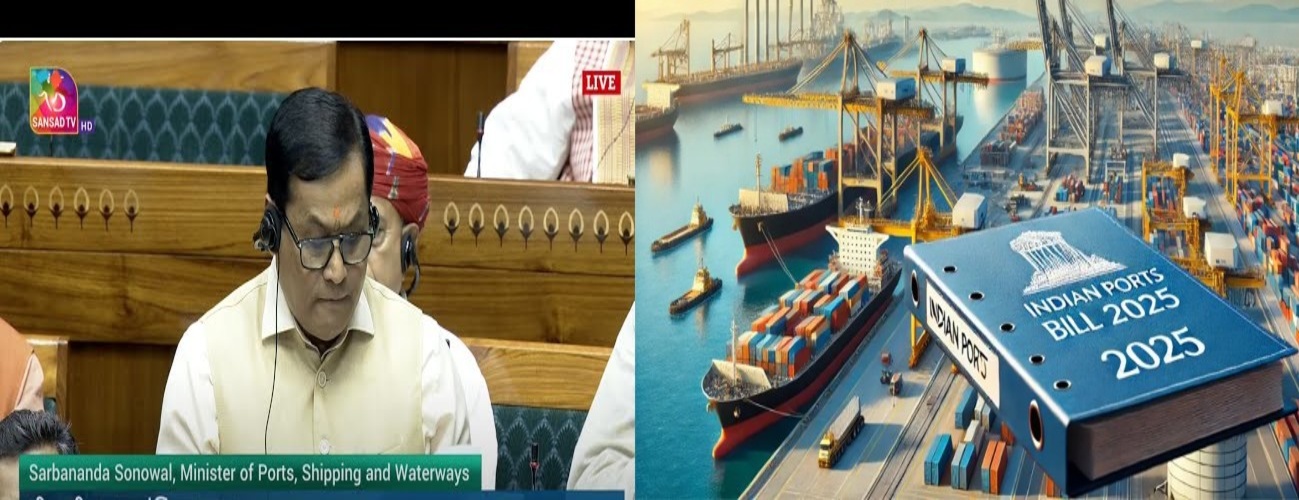
NEW DELHI : In a historic moment, the Lok Sabha passed the Indian Ports Bill, 2025 ushering in a new era of India’s maritime future. The act will modernise India’s port governance, enhance trade efficiency, and solidify India’s position as a global maritime leader. ‘Replacing colonial-era regulations, the bill reflects Prime Minister Shri Narendra Modi’s vision of a self-reliant, world-class maritime sector’, said the Union Minister of Ports, Shipping & Waterways, Shri Sarbananda Sonowal, who introduced the bill earlier.

The bill replaces outdated provisions of the Indian Ports Act, 1908, with modern & contemporary regulations. It aims to simplify port procedures & digitalise operations to enhance ease of doing business (EODB). The legislation also emphasises sustainability, incorporating green initiatives, pollution control, and disaster management protocols for sustainable port development. Furthermore, it seeks to improve port competitiveness through transparent tariff policies and better investment frameworks, while ensuring uniform safety standards and planning across all Indian ports.

The Indian Ports Bill, 2025 will reduce logistics costs by speeding up cargo movement and enhancing connectivity. The bill is also expected to generate significant employment opportunities in port operations, logistics, warehousing, and allied industries. Additionally, the bill outlines strict anti-pollution measures and eco-friendly port practices, contributing to a cleaner environment. Exporters & MSMEs will benefit from streamlined procedures and improved infrastructure, reducing bottlenecks & facilitating smoother operations.

“This Bill marks a decisive step toward making India’s ports globally competitive while safeguarding the environment and empowering coastal communities. It embodies the Honourable Prime Minister Shri Shri Narendra Modi’s vision of ‘Ports for Prosperity’ and ensures our maritime sector remains future-ready,” said the Union Minister Shri Sarbananda Sonowal.

For ports themselves, the bill provides greater autonomy with accountability, allowing ports to set competitive tariffs within a transparent framework. It introduces integrated planning for long-term port development, ensuring cargo growth and improved hinterland connectivity. A boost to coastal shipping is also envisioned, with seamless integration with inland waterways and multimodal transport systems. The bill provides flexibility in funding, making clear provisions for Public-Private Partnerships (PPPs) and foreign investment in port projects.

The bill establishes a strong institutional framework to support its objectives. The Maritime State Development Council (MSDC), comprising representatives from both Central and State governments, will coordinate national port development strategies. State Maritime Boards will have strengthened authority to effectively manage non-major ports, while Dispute Resolution Committees will expedite the settlement of conflicts between ports, users, and service providers.

Speaking on the occasion, the Union Minister Shri Sarbananda Sonowal said, “The bill also aims to boost cooperative federalism as the Maritime State Development Council (MSDC) is aimed at ironing out differences and laying down a smooth way forward for the holistic development of our ports. The bill also provides for the State Maritime Board which helps to effectively manage non major ports, allowing a comprehensive framework for ports development. Under the dynamic leadership of PM Modi ji, we are creating an ecosystem that will empower our ecosystem to spruce up the maritime prowess of Viksit Bharat, propelling India to become one of the top global maritime nations by 2047.”

In terms of sustainability and safety, the bill mandates waste reception and handling facilities at all ports. It also enforces stringent pollution prevention measures in line with international conventions like MARPOL and Ballast Water Management. Emergency preparedness plans for disasters and security threats will be required at every port, while the promotion of renewable energy and shore power systems will help reduce emissions and foster environmental sustainability.

“Under the leadership of Prime Minister Shri Narendra Modi, the Indian maritime sector has been a key driver of India’s economic transformation. The government’s initiatives, such as the Sagarmala Programme and Maritime India Vision 2030, have focused on port-led development, global competitiveness, and environmental stewardship. The Indian Ports Bill, 2025 builds on these efforts, ensuring that India’s ports evolve into engines of sustainable economic growth and global trade,” added Shri Sarbananda Sonowal.

The Indian Ports Bill, 2025 is a transformative piece of legislation that aligns India’s legal framework with global trade practices, best practices, and national priorities. With a focus on efficiency, sustainability, and inclusivity, the bill will position India’s maritime sector for continued success and growth in the global economy for decades to come.

‘Green & Digital Maritime Corridors Dialogue’ at JNPA sets stage for India Maritime Week 2025 in Mumbai

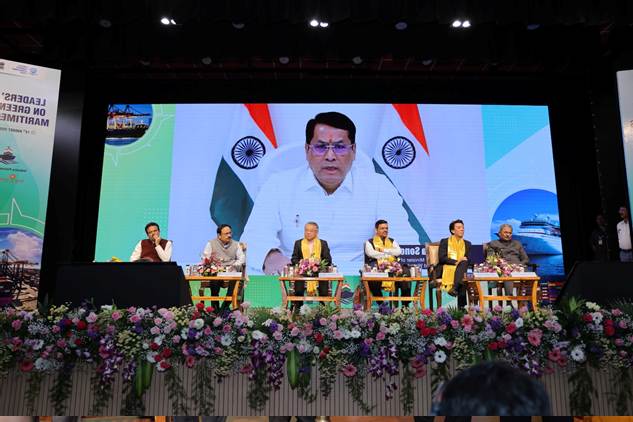
MUMBAI : The Jawaharlal Nehru Port Authority (JNPA) and the Indian Ports Association (IPA), under the aegis of the Ministry of Ports, Shipping and Waterways (MoPSW), organised the “Leaders’ Dialogue on Green & Digital Maritime Corridors” in Mumbai on Tuesday, setting the stage for India Maritime Week in October, 2025. The event brought together over 300 delegates including senior government officials, international dignitaries, industry leaders, key maritime stakeholders from India and abroad.

In a video message, Union Minister of Ports, Shipping and Waterways (MoPSW), Shri Sarbananda Sonowal said, “Under the visionary leadership of our Prime Minister Shri Narendra Modi ji, our bilateral relations with Singapore have expanded across sectors. The India–Singapore Green & Digital Shipping Corridor will accelerate the adoption of low-emission technologies, strengthen digital tools, and transform maritime operations. These corridors are not just trade routes but economic, green, and digital pathways that will redefine global trade dynamics.”

Chief Minister of Maharashtra, Shri Devendra Fadnavis highlighted Maharashtra’s maritime roadmap with goals till 2029, 2035, and 2047, said, “Vadhavan Port is poised to be among the top ten ports globally from the very first day of operations, transforming the maritime infrastructure ecosystem of India.”

Singapore’s Deputy Prime Minister, Gan Kim Yong, lauded the 60-year India–Singapore partnership, noting, “Our collaboration in green shipping, renewable energy, and maritime innovation will accelerate the transition to a sustainable future.” Acting Minister for Transport, Singapore, Jeffrey Siow, said, “India and Singapore are natural allies in the maritime sector. The upcoming MoU on the Green & Digital Shipping Corridor, to be concluded in September 2025, will provide a robust platform for joint work on technology and sustainability.”

WhatsApp Image 2025 08 12 at 9.19.25 PM 1 ‘Green & Digital Maritime Corridors Dialogue’ at JNPA sets stage for India Maritime Week 2025 in Mumbai

Addressing the gathering, T K Ramachandran, Secretary, MoPSW, highlighted the role of international corridors in promoting trade, maritime governance, and regional integration, noting that the India–Middle East–Europe Economic Corridor (IMEEC), International North-South Transport Corridor (INSTC), and Eastern Maritime Corridor (EMC) are “engines of growth, driving global maritime integration and sustainable development.” He added that the India–Singapore Green & Digital Shipping Corridor, formalised through a Letter of Intent in March 2025, aligns with both nations’ priorities in clean energy, smart logistics, and digital innovation.

R Lakshmanan, Joint Secretary (Ports), MoPSW, briefed the gathering on IMW 2025 as the Ministry’s flagship platform to showcase India’s maritime capabilities, innovation, policy vision, and global partnerships, stating, “Uniting Oceans, One Maritime Vision is more than a tagline — it is our commitment to bringing the world’s maritime stakeholders together in the current geopolitical environment.”

WhatsApp Image 2025 08 12 at 9.19.27 PM 1 ‘Green & Digital Maritime Corridors Dialogue’ at JNPA sets stage for India Maritime Week 2025 in Mumbai

Shri Unmesh Sharad Wagh, IRS, Chairman, JNPA and CMD, VPPL, in his welcome address, emphasised JNPA’s pivotal role in driving India’s maritime vision and called for charting a course towards “greener, smarter, more connected corridors.” The day-long dialogue featured thematic sessions on maritime reforms, infrastructure achievements, and international cooperation, followed by panel discussions on resilient and sustainable maritime economic corridors.

Green Digital Maritime Corridors Dialogue 2 1 ‘Green & Digital Maritime Corridors Dialogue’ at JNPA sets stage for India Maritime Week 2025 in Mumbai

India Maritime Week 2025 will convene global and domestic stakeholders to foster innovation, policy dialogue, and investment, contributing to the Maritime Amrit Kaal Vision 2047. The Leaders’ Dialogue concluded with a shared commitment to advancing the India–Singapore Green & Digital Shipping Corridor. The event was supported by ASSOCHAM as Industry Partner and Grant Thornton Bharat LLP as Knowledge Partner.

The India Maritime Week, 2025 begins from 27th October to 31st October, 2025 at Bombay Exhibition Centre, Goregaon in Mumbai. For more details, please visit www.imw.org.in

India signs trade cooperation pact with Zambia to boost cooperative exports

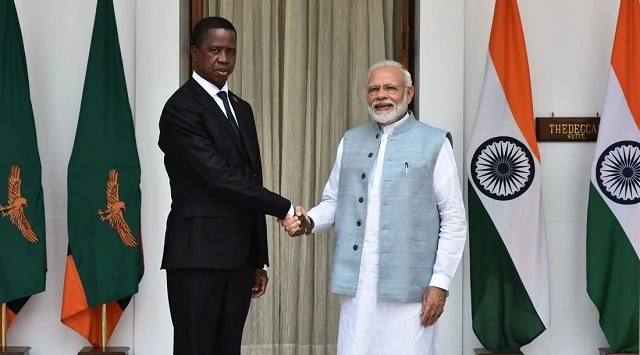
NEW DELHI : India has signed a Memorandum of Understanding (MoU) with Zambia to strengthen trade and cooperation between the cooperative sectors of both nations.

The agreement aims to enhance India’s cooperative exports, opening new opportunities for collaboration in various sectors. Announcing the deal in a written reply to the Lok Sabha, Union Cooperation Minister Shri Amit Shah highlighted that the Ministry of Cooperation is actively working to improve India’s cooperative export framework.

As part of this strategy, Indian diplomatic missions abroad are being engaged to provide vital market intelligence to the National Cooperative Exports Ltd (NCEL) and to help connect Indian cooperatives with overseas importers.

The India–Zambia pact is part of a broader initiative to diversify export destinations and strengthen economic partnerships across continents. In addition to Zambia, NCEL has also signed MoUs with Sinton Vantage Trading in Senegal and PT Sinton Surini Nusantara in Indonesia.

These agreements are expected to facilitate the exchange of goods, services, and technical expertise, giving Indian cooperatives a stronger presence in global markets.

Officials believe such collaborations will not only boost exports but also provide Indian cooperatives with insights into global demand trends, quality standards, and emerging opportunities.

This could help cooperatives become more competitive internationally, particularly in sectors such as agriculture, handicrafts, and processed foods. The Ministry’s approach focuses on leveraging India’s extensive diplomatic network to identify potential markets, connect with credible buyers, and create a sustainable pipeline for cooperative products abroad.

By forging strategic trade partnerships like the one with Zambia, India aims to establish itself as a major player in the cooperative export sector while contributing to the economic growth of partner nations.

India’s farm exports outpace overall goods shipments

NEW DELHI : Union Commerce Minister Shri Piyush Goyal on Friday expressed confidence that India’s exports in the current fiscal will surpass last year’s levels, despite potential headwinds from US President Donald Trump’s recent tariff offensive — including a steep 50% duty on Indian goods.

India’s merchandise exports touched $437.4 billion in 2024-25, marking a marginal 0.1% rise from $437.1 billion in the previous fiscal.

The current fiscal has begun on a slightly stronger note. In April–June 2025, total exports stood at $112 billion, up 1.7% from $110.1 billion in the same period last year.

The real bright spot in this outlook is agriculture. Exports of farm produce grew 6.4% in 2024-25, rising from $48.8 billion to $51.9 billion. The momentum has carried into the new fiscal, with April–June 2025 clocking a 5.8% year-on-year increase.

At this pace, agricultural shipments could scale $55 billion in 2025-26, comfortably exceeding the all-time high of $53.2 billion set in 2022-23. In sharp contrast, overall merchandise exports have been treading water, showing little growth and unlikely to surpass the 2022-23 peak of $451.1 billion this year.

India plans credit guarantees for small firms, exporters hit by US tariffs : Sources

NEW DELHI : India is planning to provide credit guarantees for loans overdue up to 90 days to small businesses and exporters, amid higher tariffs imposed by the U.S., two government sources told Reuters.
The federal finance ministry has proposed to provide 10%-15% credit guarantees to banks for advancing loans to stressed small businesses, with turnover up to 5 billion rupees, that fall under the Reserve Bank of India’s (RBI) so-called special mention accounts (SMA), the sources said.

Loans that have not been repaid for 0-90 days fall under RBI’s SMA 0-2 category, but are not classified as non-performing assets.

India’s small businesses still struggle with limited access to timely and adequate formal credit.

The government will allocate about 40 billion rupees for providing guarantees to banks, both sources said.

The scheme is designed for firms that are stressed due to external factors “beyond their control”, and the eligibility criteria are being firmed up, according to the sources.

The criteria will cover small exporters who are currently facing uncertainties due to higher tariffs imposed by the U.S., a key market for Indian exports, the second source said.

The government estimates that about 55% of its merchandise exports to the United States will be subject to the tariff imposed by President Donald Trump’s administration.

The finance ministry did not immediately respond to an email seeking comment.

Separately, the Indian government is preparing a scheme to provide term loans for small exporters that would be backed by a government guarantee of a maximum 70%-75%, the second source said. The scheme was announced by India’s finance minister in the budget for fiscal 2026.

BANKS GAUGE RISK

Indian banks have begun assessing their portfolios to gauge risks in sectors based on their exposure to the U.S. market, three bankers aware of the matter said.

The assessments are internal and are not done on the directives of the RBI, they added. All three sources requested anonymity as they are not authorised to speak with the media.

Small and medium-sized enterprises in the textile and jewellery sectors are expected to face the most impact, a banker said. While the pharmaceutical segment is currently exempt from tariffs, lenders are exercising caution given that sectors with large exposure to the U.S. market are expected to face the maximum brunt, they added.

Banks are also expecting disruptions to supply chains linked to U.S. trade, which may hamper some of the smaller businesses’ ability to repay loans on time in the short run, a second banker cited above said.
The direct impact of tariffs on India’s banking sector is expected to be limited, but the delay in spending stemming from the uncertainty of how and when these levies will be imposed can be damaging, CS Setty, chairman of India’s largest lender State Bank of India, said on Friday in its post-earnings press conference.

Source : Reuters

US tariff hike to hit earnings of diamond, shrimp, textile, and carpet companies : Crisil

NEW DELHI : The imposition of a 25 per cent tariff on the import of goods from India into the United States (US) will have a significant impact on the earnings of companies in sectors such as diamond polishing, shrimp, home textiles and carpets, said Crisil Ratings in a report.

The move of the US President Donald Trump to impose an additional 25 per cent tariff with effect from August 27, 2025 as a penalty for importing crude oil from Russia will make Indian exports to the US unviable for the aforesaid as well as other sectors including ready-made garments (RMG), chemicals, agrochemicals, capital goods and solar panel manufacturing, which have sizable trade exposure to the US.
The rating agency added that the extent of impact will vary depending on exposure, ability to pass on incremental costs to customers, and relative tariff disadvantage versus competing nations.

A potential second-order impact, including a slowdown in US demand and disparate tariffs across nations that could alter trade dynamics globally, also warrants close monitoring, said the rating agency.

“That said, strong corporate balance sheets, potential bilateral trade agreements with other countries and the possibility of support from the Indian government for the impacted sectors could mitigate the credit impact to some extent,” Crisil Ratings added.

Pursuant to the Executive Order issued by the US, effective August 7, 2025, a 25 per cent reciprocal tariff is applicable to goods imported from India. Furthermore, the US has levied an additional 25 per cent tariff as a penalty, resulting in a total tariff of 50 per cent, which will come into effect on August 27, 2025. These tariffs are in addition to the most-favoured-nation tariff (ranging between 0-14 per cent for the impacted sectors), which is already in place.

In the last fiscal, the US accounted for 20 per cent of India’s merchandise exports and 2 per cent of its overall GDP.

The 25 per cent reciprocal tariff on India, already in effect, exceeds those applicable to many competing Asian countries except China.

As a result, the sectors mentioned earlier – diamond polishing, shrimp and home textiles sectors – may see sales volume decline due to high reliance on US trade and costs rise due to partial absorption of tariffs, ultimately affecting their earnings, the report added.

Crisil analysis highlighted that for diamond polishers, exports to the US accounted for 25 per cent of the total revenue last fiscal. The reciprocal tariff, along with the already tepid demand for natural diamonds in the US and growing demand for lab-grown diamonds, will lead to a sharp dip in revenue, it added.

The analysis further added that the tariff will also put further pressure on the already modest operating margin of the sector due to reduced fixed-cost coverage and the onus to bear the higher tariff cost, as retailers in the US have shown limited inclination to take on the burden. Working capital cycles will elongate as inventory moves slowly and customers stretch payment cycles, the report added.

Indian shrimp exporters, which draw their 48 per cent revenue from US markets, will be severely impacted due to the highest-taxed country.

“This could drag down export volume, even as players look for alternative markets to support their exports,” the report added.

As per the report, the reciprocal tariff will lead to a material decline in revenue and profits for the home textile and carpet sectors despite some advantage against China.

Home textiles and carpets are both significant export-oriented sectors with exports accounting for 70-75 per cent and 65-70 per cent of total sales, respectively, for these sectors; of this, the US accounts for 60 per cent of exports for home textiles and 50 per cent of exports for carpets.

For other sectors such as ready-made garments (RMG), agrochemicals, specialty chemicals, capital goods, etc., the impact of the 25 per cent reciprocal tariff is likely to be more manageable, considering moderate exposure to the US (5-20 per cent of overall revenue) and limited tariff disadvantage that will allow companies to partly pass on the impact to customers.

“However, the additional 25% tariff will have an adverse impact on all the sectors,” Crisil Ratings further added.

For the RMG segment, exports to the US form 10-15 per cent of total revenue and will become completely unviable as the tariff structure will be significantly higher than that of competing manufacturers in China and Vietnam.

Agrochemical exports to the US, which account for 11-12 per cent of the sector’s revenue, will also face challenges, with China being a key competitor and major supplier of agrochemicals to the US. The ability of Indian companies to divert products to alternative markets such as Brazil and other Latin American countries will be limited by the presence of strong Chinese competition there.

For capital goods manufacturers, the fresh order bookings will see a significant impact as India faces stiff competition from other countries. For instance, Mexico holds a prominent position in the US’s import basket and has a significantly lower tariff structure.