Home Blog Page 707

India’s textile industry to meet the global trade headwinds with resilience and a renewed focus on export competitiveness

NEW DELHI : The textile Industry would achieve the target of 100 Billion USD export by 2030 despite all the global challenges.

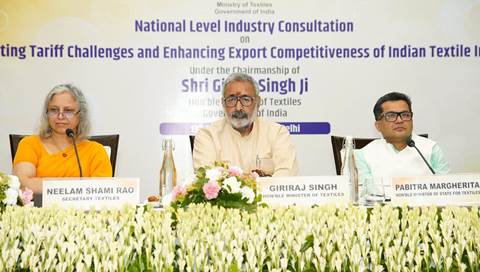
India’s textile industry is poised to meet global trade headwinds with resilience, self-reliance, and a renewed focus on export competitiveness.  Shri Giriraj Singh, Union  Minister of Textiles, along with the Minister of State for Textiles and the Secretary, Ministry of Textiles, today chaired a high-level meeting with leading stakeholders from the textiles and apparel industry to review the evolving global trade situation, including the recent announcement of reciprocal tariffs by the United States, and to chart a confident, future-oriented strategy for the sector.

India’s Position in the Global Textile Trade

India is the 6th largest exporter of Textiles & Apparel in the world, with a 4.1% share in Calendar year by 2024. The textile and apparel sector, including handicrafts, contributed 8.63% to India’s total merchandise exports in 2024–25, valued at USD 37.7 billion. While the USA remains India’s largest export market, accounting for 28.97% of textile and apparel exports, it represents only 6% of the overall Indian textile industry, which is valued at USD 179 billion (  Domestic 142  billion USD and Exports 37 billion USD )  . The sector has also witnessed significant growth in domestic demand over the last decade.

Focus on Diversification and Competitiveness

The Union Minister underscored the need to diversify the export basket, enhance product competitiveness, and tap into new and under-served markets. India has signed 15 Free Trade Agreements (FTAs) with partner countries whose combined textile import demand stands at USD 198.9 billion. The Minister urged exporters to actively explore the European Union market, which collectively imports textiles worth USD 268.8 billion—more than twice the size of the US market. India is actively engaged in FTA negotiations with EU.

Industry–Government Partnership

Industry representatives appreciated the Government’s proactive stance and swift engagement with stakeholders, extending their full support to the collective effort to safeguard India’s trade interests and strengthen its position in the global textile value chain.

The Hon’ble Minister highlighted that this moment presents an opportunity to deepen Aatmanirbharta (self-reliance) by:

Boosting domestic value addition
Advancing sustainable manufacturing practices

Strengthening India’s global brand as a supplier of high-quality textiles
This vision is aligned with the Hon’ble Prime Minister’s “5F” approach – Farm to Fibre to Factory to Fashion to Foreign.
Four Committees to Drive Reforms

The Union Minister announced the constitution of four committees, comprising industry representatives, to submit time-bound recommendations on:

Diversification into new markets

Fiscal and ease of doing business measures
Structural reforms in the textile value chain
Enhancing cost competitiveness and innovation
A Target of USD 100 Billion Exports by 2030
The Union Minister expressed confidence that, despite global challenges, the Indian textile industry will achieve a target of USD 100 billion in exports by 2030.

The Union minister reiterated that with its inherent strengths, robust industry-government collaboration, and relentless focus on innovation, India’s textile sector is well-positioned to turn current challenges into stepping stones for sustained growth in the global marketplace. The Ministry pledged ongoing collaboration with industry bodies to safeguard India’s trade interests and to develop and implement policies that would effectively mitigate the impact of the enhanced tariff regime.
US tariffs will have 50% to 63.9% impact on many Indian merchandise exports : GTRI

NEW DELHI : The cumulative 50 per cent tariffs imposed by US President Donald Trump on Indian goods will come into effect a fortnight from now, unless there is a breakthrough in terms of a trade deal between the two countries.

In addition to a 50 per cent flat tariff on Indian goods, additional most-favoured nation (MFN) duties will also apply to some merchandise goods.

For instance, apparel (knitted) will attract a 13.9 per cent additional MFN tariff on top of 50 per cent tariffs. Apparel (woven) will attract a total 60.3 per cent tariffs, including the 10.3 per cent MFN tariffs.
The exports of apparel, knitted and woven combined to the US were to the tune of about USD 5.5 billion in 2024-25, according to an analysis by Global Trade Research Initiative (GTRI).

GTRI analysis noted that other Indian merchandise goods that will attract tariffs in excess of 50 per cent are diamonds, gold, related products; machinery, mechanical appliances; steel, aluminium, copper; textiles; organic chemicals; carpets; furniture, bedding, mattresses. The effective tariffs on these goods will range between 51-59 per cent.

Smartphones, pharmaceuticals, and petroleum products will have tariff exemptions. Petroleum products’ exports will, however, attract 6.9 per cent MFN tariffs.

Over the past few months, India and the US have been negotiating for an interim trade deal, but there are reservations from the Indian side on the US demand for opening up the agricultural and dairy sectors. Agriculture and dairy are critical for India as these two sectors provide livelihood opportunities to a large section of people.

Initially, President Trump announced 25 per cent tariffs on Indian goods plus an unspecified penalty, even as there were hopes of an interim India-US trade deal that would have otherwise helped avoid elevated tariffs. A few days later, he imposed another 25 per cent tariff, taking the total to 50 per cent, over India’s imports of Russian oil.

India and the US initiated talks for a just, balanced, and mutually beneficial Bilateral Trade Agreement (BTA) in March this year, aiming to complete the first stage of the Agreement by October-November 2025.
On April 2, 2025, President Trump signed an executive order for reciprocal tariffs on various trade partners, imposing varied tariffs in the range of 10-50 per cent.

He subsequently kept the tariffs in abeyance for 90 days, while imposing a 10 per cent baseline tariff. The deadline was to end on July 9, and the US administration later pushed it to August 1.

During the ongoing Monsoon session of Parliament, Commerce and Industry Minister Piyush Goyal made a statement in both Houses, affirming that the government is examining the impact of tariffs and will take all necessary steps to safeguard the national interest.

US targets India’s solar exports in probe that could slam $790 mn trade with heavy duties

WASHINGTON D.C. : The U.S. Commerce Department has launched anti-dumping and countervailing duty investigations into solar cell imports from India, Indonesia, and Laos, a move that could reshape the $1.5 billion supply chain feeding America’s clean energy ambitions.

The investigations target crystalline silicon photovoltaic cells — whether assembled into modules or not — under U.S. tariff codes 8541.42.0010 and 8541.43.0010.

The action follows a petition by the Alliance for American Solar Manufacturing and Trade, a key domestic solar industry group.

The U.S. International Trade Commission (ITC) will now determine whether these imports have harmed or threaten to harm American manufacturers. Its preliminary ruling is expected by 2 September 2025.

If the ITC affirms injury, the Commerce Department will move forward with its two-track probe, with preliminary countervailing duty findings due by 13 October and anti-dumping findings expected by 26 December.

In 2024, India exported an estimated $790 million worth of these solar products to the U.S., Indonesia $420 million, and Laos $340 million — underscoring the potential impact of any future tariffs.

RBI simplifies process for opening special rupee accounts to enable export-import and boost rupee trade

NEW DELHI : The Reserve Bank of India (RBI) has made it easier for banks to open Special Rupee Vostro Accounts (SRVAs), a key step to promote international trade in Indian Rupee.

In a circular issued on August 5, the central bank said Authorised Dealer (AD) banks no longer need prior approval from the RBI to open SRVAs for their overseas correspondent banks. This move aims to speed up the opening and use of these accounts, helping facilitate rupee-based trade settlements.

The RBI highlights that this decision comes after reviewing the previous process, which required AD banks to seek RBI permission before opening SRVAs. The new guideline allows banks to open these accounts independently.

“Based on a review of the procedure involved in opening of the SRVA, it has been decided to do away with the need for seeking RBI approval for opening of SRVA. AD banks can now open SRVAs of correspondent banks without referring to the Reserve Bank of India,” the RBI said in an official release.

The central bank believes this change will significantly quicken the setting up of SRVAs, making it easier to operationalise trade settlements in rupees.

This step is part of the RBI’s broader goal to internationalise the Indian Rupee and reduce reliance on hard currencies such as the US dollar in bilateral trade.

The SRVA mechanism was introduced in July 2022 to enable exporters and importers to invoice and settle trade in Indian Rupees. The earlier rules mandated RBI approval before opening these accounts. The RBI’s July 11, 2022, notification said, “Before putting in place this mechanism, AD banks shall require prior approval from the Foreign Exchange Department of Reserve Bank of India, Central Office at Mumbai.”

However, the RBI has clarified that banks must still follow all existing regulations and due diligence processes under the Foreign Exchange Management Act (FEMA) and Know Your Customer (KYC) norms.

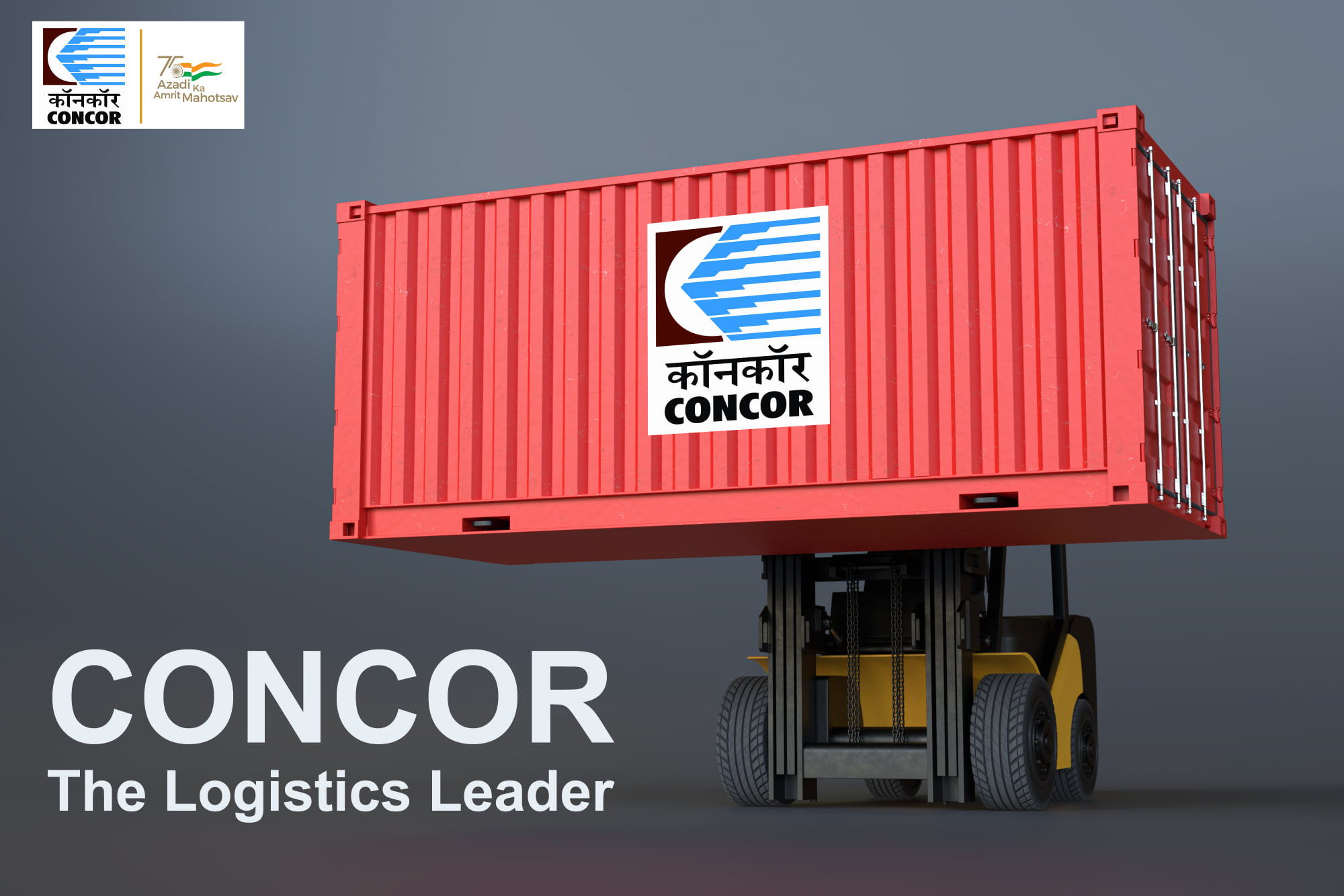
CONCOR provides its own containers for export shipments

NEW DELHI : Container Corporation of India Ltd. (CONCOR), an arm of the Indian Railways, has forayed into a new initiative of providing its containers for export shipments.

Concor currently holds 55,000 domestic containers across metros and major cities. These boxes were available only for domestic shipments. In the first phase under the new initiative, the West Asian countries are included, for which an agreement has been signed with Rais Hassan Saadi Group, said an official at Concor.

The first shipment in the end-to-end international logistics service was dispatched from Mundra to Jebel Ali, and subsequently from Chennai to Jebel Ali. The latest was on August 8 from Concor’s Inland Container Depot, Irugur (Coimbatore), to Jebel Ali via India Gateway Terminal Pvt. Ltd. (IGTPL), in Kochi, the official said. This ensures shippers are not dependent on foreign companies for sourcing containers.

The latest initiative is a major leap in strengthening global trade corridors and providing seamless, end-to-end logistics solutions for shippers in the textile clusters of Coimbatore, Tirupur, Erode, Namakkal, Pollachi and Western Tamil Nadu. With this launch, Concor’s logistics network spans national boundaries, offering end-to-end solutions that now start from Chennai to the world, the official said.

“We are planning to cover East and South East Asian countries soon and thereafter Africa, Europe and the US are planned. Since Concor is operating in all the container terminals in the Indian Ports, it can accept the import to any of these ports and can efficiently balance the empty repositioning of its containers,” the official said.

Shipping industry sources explain that earlier shippers used to bring in empty containers from Kochi/Chennai/Thoothukudi and send their cargo to the port and undertake customs clearance at the port before shipping it out. However, in the current scenario, Concor’s empty containers are already available at ICD/Irugur, said sources.

Mr. Dinesh Krishnan, Founder & MD of the Chennai-based United Shipping Services Pvt Ltd, said Concor’s move to provide containers for global shipments will help in the international shipping of agricultural products from India. “Concor picks up container-loaded agri products from remote ICD across the country and rail to port CFS for export shipping. Shippers can book Concor’s container for shipping from farm to final destination under a single process & costs,” he said.

DNV supports India’s first ESG bond issuance by L&T under New Framework for Sustainable Finance

MUMBAI : DNV, the independent assurance and risk management provider, has issued a Second-Party Opinion (SPO) on L&T’s ESG Finance Framework.

DNV’s Second-Party Opinion confirmed that L&T’s ESG Finance Framework aligns with the rigorous standards laid out in the Securities and Exchange Board of India’s (SEBI) regulatory guidance, ensuring that the framework meets both Indian and international sustainable finance norms.

This independent assessment supports India’s first listed ESG bond issuance by L&T, a landmark INR 500 crore (5 billion INR) deal under SEBI’s newly introduced ESG and sustainability-linked finance framework, marking a significant stride for the country’s sustainable finance landscape.

This milestone not only breaks new ground as the first of its kind but also signals a broader shift in India’s capital markets towards more accountable, transparent and impact-driven financing.

SEBI’s enhanced framework, which was announced on 5 June 2025, requires issuers of ESG and sustainability-linked financial instruments to meet stringent standards around disclosures, sustainability targets, key performance indicators and post-issuance impact reporting.

“This issuance marks a pivotal moment in the evolution of sustainable finance in India and across the region. As a leading provider of ESG assurance, DNV is pleased to work with L&T to contribute to building a more transparent market for responsible investment. Supporting landmark transactions like this not only reflects our commitment to the region’s sustainable development goals but also reinforces the growing importance of credible ESG disclosures in capital markets”, said Percy Lakdawalla, Regional Manager Asia Pacific, India and Middle East, Supply Chain & Product Assurance at DNV.

DNV’s collaboration with L&T on the ESG bond issuance highlights a shared commitment to sustainability and transparency in ESG financing. By providing an independent Second-Party Opinion DNV ensures L&T’s ESG Finance Framework meets high standards of integrity and impact. This milestone sets a precedent for future ESG financing in India and supports businesses in their journey towards credible and sustainable financing.

L&T’s ESG bond issuance arrives at a critical moment as India ramps up efforts to meet its Net Zero commitments and climate-resilient growth targets. As a global quality assurance and risk management leader, DNV is proud to contribute to this evolving landscape by offering rigorous ESG assessments that align with both national and international standards.

“Partnering with DNV brought proven credibility and assurance to our ESG bond issuance,” said an L&T spokesperson. “Independent evaluations like DNV’s Second-Party Opinion are essential to strengthening investor confidence by ensuring that our framework is transparent, traceable, and aligned with global sustainability goals. DNV’s expertise helped us meet SEBI’s new regulatory standards while reinforcing our commitment to responsible and impactful financing”.
 
HSBC was the sole lead arranger for the landmark transaction. L&T’s successful ESG bond issuance comes at a pivotal moment as India advances toward its Net Zero targets and climate-resilient economic growth. As ESG considerations become central to financial decision-making, the issuance demonstrate how standardised, transparent, and credible ESG instruments can unlock sustainable capital at scale.

L&T Energy GreenTech partners with Japan’s ITOCHU for Green Ammonia Project

MUMBAI : L&T Energy GreenTech Ltd (LTEG), a wholly-owned subsidiary of Larsen & Toubro (L&T), has entered into a Joint Development Agreement with ITOCHU Corporation of Japan to develop and commercialise a 300 KTPA green ammonia project at Kandla in Gujarat.

Under the agreement, LTEG and ITOCHU will collaborate on the development of the green ammonia facility, with ITOCHU planning to offtake the product for bunkering applications in Singapore. The partnership marks a significant step in advancing clean energy solutions for the maritime sector and aligns with both L&T and ITOCHU’s commitment to sustainability and decarbonisation.

L&T had last year acquired a sizeable land parcel at Kandla for the development of green hydrogen and green ammonia projects. The latest collaboration supports LTEG’s strategic vision to establish a presence across the green energy value chain and complements ITOCHU’s initiatives to introduce low-carbon ammonia as a zero-emission marine fuel.

Commenting on the collaboration, Mr Subramanian Sarma, Deputy Managing Director & President, L&T, said: “As the global energy landscape shifts decisively towards sustainability, L&T remains deeply committed to driving the clean energy transition through innovation, strategic partnerships, and engineering excellence. The partnership with ITOCHU reflects L&T’s larger vision of enabling a cleaner, greener future through sustainable business focus”.

Mr Hiroyuki Tsubai, Executive Vice President, Member of the Board, President, Machinery Company of ITOCHU Corporation, said: “Through this joint development with one of the largest and most respected companies in India’s private sector, L&T Group, our initiatives to introduce low-carbon ammonia to the maritime sector as an alternative zero-emission fuel will be reinforced. With this collaboration, Kandla, located on the west coast of India, will become the principal production centre of green ammonia for ITOCHU’s bunkering operations in Singapore”.

Owing to its abundant renewable resources and competitive electricity cost, India is uniquely positioned to become a global leader in green hydrogen and its derivatives. India’s National Green Hydrogen Mission envisions a production capacity of at least 5 MMTPA by 2030, attracting investments exceeding USD 100 billion. The initiative is expected to catalyse industrial innovation, create green jobs, and reinforce India’s energy security.

Rhenus Logistics India collaborates with IRS for Technical Feasibility Study of Pusher-Barge Convoy Units on Inland Waterways

MUMBAI : Rhenus Logistics India Pvt. Ltd. (Rhenus India), a leading integrated logistics solutions provider, has partnered with Indian Register of Shipping (IRS), an internationally recognised classification society, to conduct a research-based Technical Feasibility Study of barges and pusher units for various convoy configurations proposed for operations across India’s National Waterways.

The study aimed to assess multiple combinations of barges and pusher units, focusing on their technical viability for efficient operations across different stretches of inland waterways in India across different States. Leveraging its technical expertise and experience, IRS carried out a comprehensive analysis considering navigational constraints, pusher-barge design parameters, hydrodynamic performance and operational requirements.

“We are committed to supporting multimodal logistics solutions that enhance the efficiency of cargo movement in India. Inland water transport holds immense potential, and with this feasibility study, we aim to optimise our operations in alignment with the Government of India’s vision for sustainable logistics,” said Mr Vivek Arya, Regional CEO, Rhenus India.

Mr. P K Mishra, Managing Director, IRS, added: “We are pleased to collaborate with Rhenus India in this forward-looking initiative. The technical study will serve as a valuable input in planning and deploying barge convoys that are both safe and efficient for Indian inland waterway operations.”

The successful completion of the study marks a significant step towards enhancing the role of inland water transport in India’s logistics landscape. Both Rhenus India and IRS remain committed to promoting sustainable, efficient, and technically robust solutions for inland waterway transportation.

Rs 26,000 crore order book : Railway expanding its business by entering the shipbuilding industry

KOLKATA : Titagarh Rail Systems Limited (TRSL) is expanding its business by entering the shipbuilding industry. TRSL’s Board of Directors approved the creation of a wholly-owned subsidiary named Titagarh Naval Systems Private Limited (TNSPL). This involves acquiring TNSPL’s entire share capital of 1,000 equity shares for Rs 10,000. The Board also gave in-principle approval to transfer TRSL’s existing Shipbuilding and Maritime Systems (SMS) Business to TNSPL as a going concern. This strategic move aims to allow TRSL to focus on its core rail systems business while enabling the SMS business to grow independently and attract potential strategic investors.

TNSPL was incorporated on December 2, 2024, with an authorised share capital of Rs 5,00,000 and a paid-up capital of Rs 10,000. As of its incorporation date, it has no turnover. The transfer of the SMS business to TNSPL, a domestic entity, will involve a Business Transfer Agreement to be finalised by a designated committee. This acquisition, which does not require governmental or regulatory approvals, is expected to be completed by the end of August 11, 2025, and is not considered a related-party transaction. TNSPL’s business will encompass the manufacturing, marketing, and selling of naval systems, including shipbuilding and related components.

Earlier, TRSL received a Letter of Acceptance from NCC Limited for a significant domestic contract valued at approximately Rs 1,598.55 crore for the Mumbai Metro Rail Project, Line 6. As a specialised subcontractor, TRSL will be responsible for the design, manufacture, supply, installation, integration, testing, and commissioning of 18 trains, each comprising 6 cars, totalling 108 metro coaches. The contract also includes a two-year Defect Liability Maintenance Period followed by five years of Comprehensive Maintenance, with an initial Design-Build period of 104 weeks.

About the Company

Titagarh Rail Systems Limited stands as a premier comprehensive mobility solutions provider, boasting advanced manufacturing facilities in India and Italy. Their expertise lies in the design and production of a diverse portfolio of world-class rolling stock, encompassing everything from modern semi-high-speed trains and urban metros to comfortable passenger coaches and specialised freight wagons, alongside crucial propulsion systems. Driven by innovation and a commitment to excellence, Titagarh Rail Systems actively contributes to India’s growth as a manufacturing hub and aims to redefine global transportation standards. The company has a market cap of over Rs 12,000 crore.

According to the Quarterly Results, the net sales decreased by 25 per cent to Rs 679 crore and net profit decreased by 54 per cent to Rs 31 crore in Q1FY26 compared to Q1FY25. In FY25, the company reported net sales of Rs 3,867.75 crore and net profit of Rs 276.39 crore.

The order book stands at Rs 26,000 crore as of June 30, 2025, excluding GST and including its share in the Joint venture. The stock gave multibagger returns of 500 per cent in just 3 years and a whopping 1,860 per cent returns in 5 years.

India’s exports surge 67% in a decade from engineering goods to cereals, led by these top 10 products

NEW DELHI : Top 10 products exported from India: India’s export sector is a cornerstone of its economy, sending billions of dollars’ worth of goods around the world each year through some of the busiest ports. The range is vast, with engineering goods, pharmaceuticals, textiles, and refined petroleum making up just a fraction of what leaves the country’s shores.

Exports provide important information about investment objectives, trade patterns, and potential development sectors. In addition to the magnitude of India’s trade surplus, they provide governments, investors, and companies with a real-time indicator of the sectors propelling the country’s worldwide presence.

In 2024, India’s exports from April to December alone was a total around $602 billion. The Ministry of Commerce and Industry recently reported that total exports in 2023–2024 topped $778 billion, nearly 67 per cent higher than the $466 billion recorded a decade earlier. This increase is mostly attributable to the growth of technology-led businesses and a strong industrial foundation.

Merchandise exports were worth $437 billion, fuelled by higher output and stronger demand for electronics, engineering products, and textiles. Service exports contributed another $341 billion, led by information technology, business, and financial services.

The pharmaceutical industry has grown steadily in India, the third-largest manufacturer of medicines in the world, with export values rising from $15.07 billion in 2013–14 to around $28 billion in 2023–24. In the same time frame, agricultural shipments have more than doubled, rising from slightly over $22 billion to $48 billion.

This consistent upward trend highlights India’s growing significance in international trade and paves the way for determining its most lucrative export markets.

The United States was India’s biggest market in 2023–2024, accounting for more than 18 per cent of all merchandise exports from the country. The UAE, the Netherlands, China, and Singapore came in close behind the UK, Saudi Arabia, Bangladesh, Germany, and Italy, which made up the top 10. Fifty-one per cent of India’s entire export revenue came from these markets combined.