NEW DELHI : The Department for Promotion of Industry and Internal Trade (DPIIT), Ministry of Commerce and Industry, signed a Memorandum of Understanding (MoU) with HDFC Capital Advisors Limited to foster innovation and support startups in the affordable housing and PropTech sectors. This strategic collaboration reinforces DPIIT’s commitment to building an inclusive, innovation-driven startup ecosystem aligned with the goals of Atmanirbhar Bharat and Viksit Bharat@2047.
A key element of the partnership is the H@ART Programme (HDFC Affordable Real Estate and Technology Programme), an initiative launched by HDFC Capital to enhance efficiency and reduce costs across the residential real estate development cycle. The programme aims to facilitate growth opportunities through linkages with the affordable housing developer ecosystem, strategic investments in emerging PropTech companies, and mentorship in collaboration with accelerators, academic institutions, and investors.
Joint Secretary, DPIIT, Shri Sanjiv, underlined the significance of engaging with key industry stakeholders such as HDFC Capital Advisors Limited to foster innovation and scale in India’s evolving startup landscape.
Managing Director and CEO, HDFC Capital Advisors Limited, Vipul Roongta stated, “The Indian startup ecosystem has shown remarkable progress, and HDFC Capital is eager to play a pivotal role in accelerating innovation in affordable housing and PropTech, contributing to the nation’s development goals.”
The MoU was formally signed by Director, DPIIT, Mohammad Isharar Ali and Managing Director and CEO, HDFC Capital Advisors Limited, Vipul Roongta, in the presence of senior officials from both organisations.
This partnership marks another milestone in DPIIT’s ongoing efforts to catalyze public-private collaboration for a resilient, self-sustaining, and forward-looking innovation ecosystem.
NEW DELHI : The Department for Promotion of Industry and Internal Trade (DPIIT), Ministry of Commerce and Industry, signed a Memorandum of Understanding (MoU) with Roche Products (India) Pvt. Ltd. to bolster DPIIT-recognized startups working in critical therapeutic areas such as oncology, neurology, ophthalmology, haematology, and rare diseases. Under the MoU, Roche India will provide mentorship from global experts, support pilot and validation studies, and offer access to cutting-edge technologies, infrastructure, and international platforms to help scale promising innovations.
The MoU was formally signed by Director, DPIIT, Dr. Sumeet Jarangal and Managing Director, Roche Products (India) Pvt. Ltd., Smt. Rajwinder Mehdwan, in the presence of senior officials from both organizations.
Joint Secretary, DPIIT, Shri Sanjiv highlighted the importance of industry–startup collaboration in integrating disruptive health innovations into the market. He noted that the partnership would offer guidance on regulatory pathways, intellectual property, and global health standards, along with opportunities for real-world validation. Capacity-building in Health Economics and Outcomes Research (HEOR), Good Clinical Practices (GCP), and patient engagement will also be a key focus area.
Managing Director, Roche Products (India) Pvt. Ltd., Smt. Rajwinder Mehdwan described the MoU as the beginning of a collaborative journey to support Indian healthtech startups in developing patient-centric solutions tailored to India’s healthcare needs.
This MoU underscores DPIIT’s commitment to fostering impactful public-private partnerships that promote inclusive growth and position India as a global hub for health innovation.
NEW DELHI : India’s state-owned oil refiners have not imported Russian crude over the past week as discounts have narrowed and U.S. President Donald Trump warned that buyers of Russian oil could soon face steep tariffs, Reuters reported Thursday, citing industry sources.
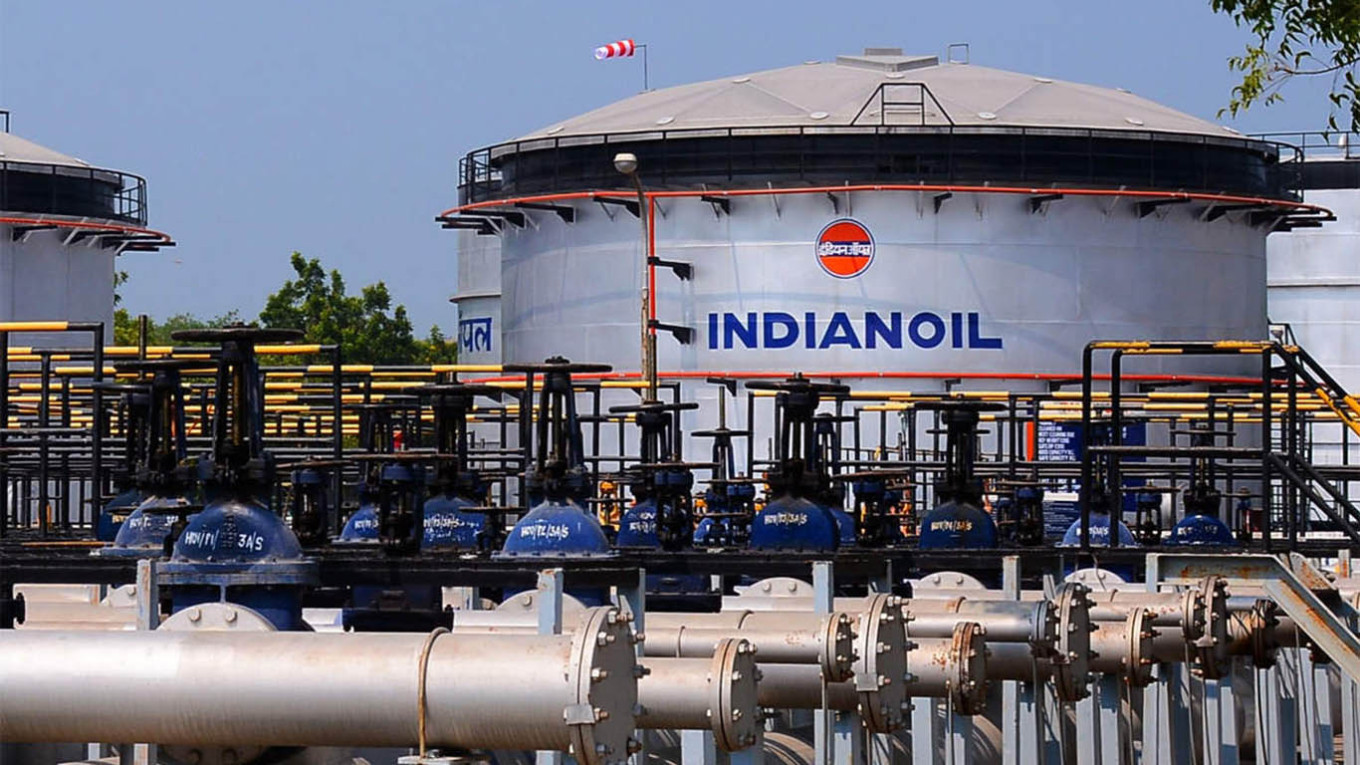
Indian Oil Corporation (IOC), the country’s largest refiner, was among those to halt purchases. IOC operates 10 of India’s 20 refineries, with a combined annual capacity of 60 million metric tons.
Other major state-owned refiners — Hindustan Petroleum, Bharat Petroleum and Mangalore Refinery and Petrochemicals — have also paused Russian oil imports, according to the same sources.
Executives at the affected companies told Reuters that Indian refineries are now turning to the spot market to fill supply gaps, ramping up purchases from Middle Eastern OPEC members and West African producers.
The shift marks a notable reversal for India, which became a major buyer of discounted Russian crude following the Kremlin’s invasion of Ukraine in 2022.
Indian imports of Russian oil surged over the past two years despite pressure from Western governments, helping Moscow offset losses from lost European markets.
Still, India’s privately owned refiners Reliance Industries and Nayara Energy continue to be the country’s top importers of Russian oil.
Nayara, which is partly owned by Russia’s state-run oil giant Rosneft, has come under fresh scrutiny after being named in the EU’s 18th sanctions package.
The pause in state-sector imports follows Trump’s ultimatum for Russia to reach a peace deal with Ukraine by Aug. 8, threatening 100% tariffs on countries that continue purchasing Russian crude if the deadline passes without progress.
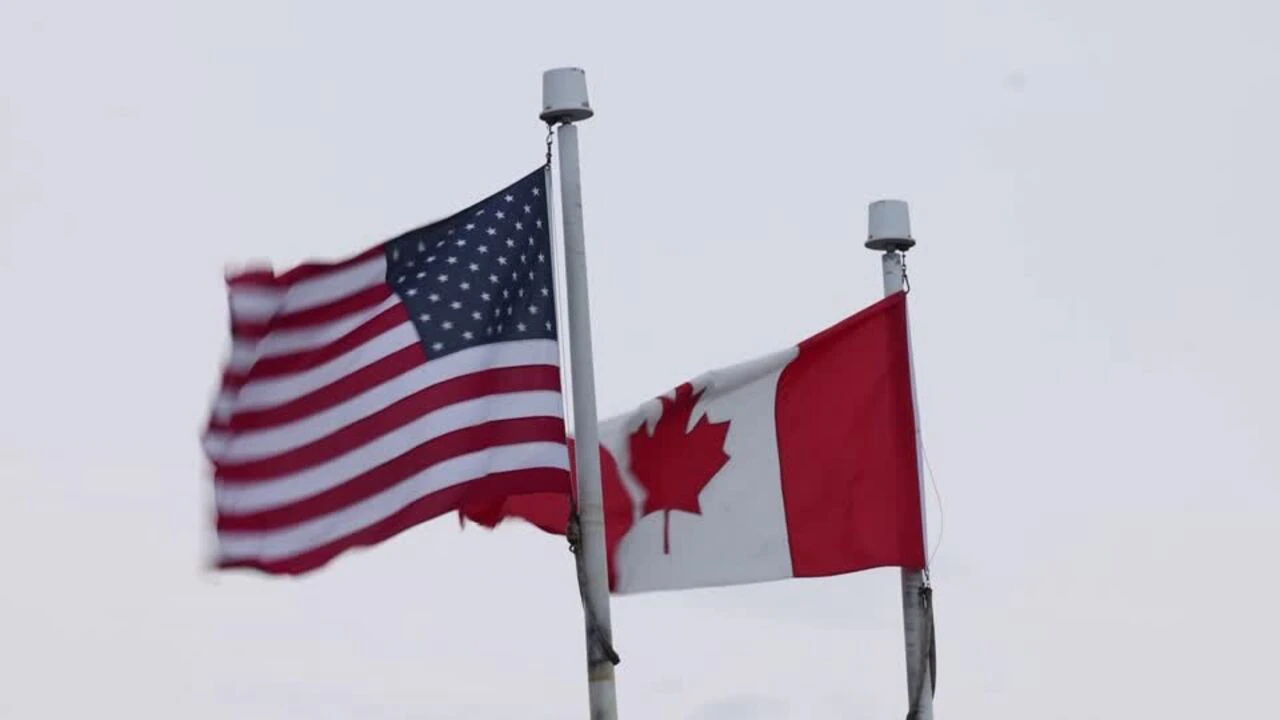
WASHINGTON : U.S. President Donald Trump intensified his trade war with Canada a day ahead of his August 1 deadline for a tariff agreement, saying it would be “very hard” to make a deal with Canada after it gave its support to Palestinian statehood. Trump is set to impose a 35% tariff on all Canadian goods not covered by the U.S.-Mexico-Canada trade agreement if the two countries do not reach an agreement by the deadline.
“Wow! Canada has just announced that it is backing statehood for Palestine. That will make it very hard for us to make a Trade Deal with them,” Trump said on Truth Social.
Canadian Prime Minister Mark Carney previously said tariff negotiations with Washington had been constructive, but the talks may not conclude by the deadline. Talks between the two countries were at an intense phase, he added, but a deal that would remove all U.S. tariffs was unlikely.
Canada is the second-largest U.S. trading partner after Mexico, and the largest buyer of U.S. exports. It bought $349.4 billion of U.S. goods last year and exported $412.7 billion to the U.S., according to U.S. Census Bureau data. Canada is also the top supplier of steel and aluminum to the United States, and faces tariffs on both metals as well as on vehicle exports.
Last month, Carney’s government scrapped a planned digital services tax targeting U.S. technology firms after Trump abruptly called off trade talks saying the tax was a “blatant attack.” Carney followed France and Britain as he said on Wednesday that his country was planning to recognize the State of Palestine at a meeting of the United Nations in September. In announcing the decision, Carney spoke of the reality on the ground, including starvation in Gaza. “Canada condemns the fact that the Israeli government has allowed a catastrophe to unfold in Gaza,” he said. Israel and the United States, Israel’s closest ally, both rejected Carney’s comments. Carney’s office did not immediately respond to a request for comment on Trump’s post.
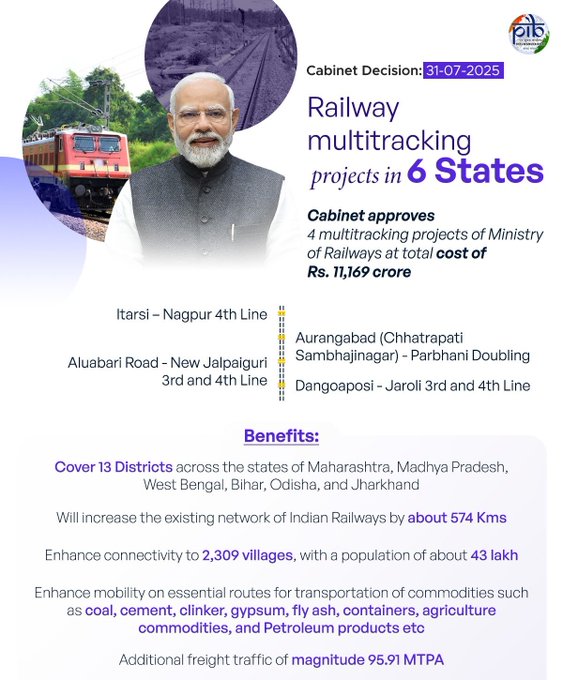
NEW DELHI : The Cabinet Committee on Economic Affairs, chaired by the Prime Minister Shri Narendra Modi, on Thursday has approved 4 (Four) projects of Ministry of Railways with total cost of Rs. 11,169 crore (approx.). These projects include:
(3) Aluabari Road- New Jalpaiguri 3rd and 4th Line
(4) Dangoaposi- Jaroli 3rd and 4th Line
The increased line capacity will significantly enhance mobility, resulting in improved operational efficiency and service reliability for Indian Railways. These multi-tracking proposals are poised to streamline operations and alleviate congestion. The projects are in line with the Prime Minister Shri Narendra Modiji’s Vision of a New India which will make people of the region “Atmanirbhar” by way of comprehensive development in the area which will enhance their employment/ self-employment opportunities.
The projects are planned on PM-Gati Shakti National Master Plan with focus on enhancing multi-modal connectivity & logistic efficiency through integrated planning and stakeholder consultations. These projects will provide seamless connectivity for movement of people, goods, and services.
The 4 (four) projects covering 13 Districts across the states of Maharashtra, Madhya Pradesh, West Bengal, Bihar, Odisha, and Jharkhand will increase the existing network of Indian Railways by about 574 Kms.
The proposed multi-tracking project will enhance connectivity to approx. 2,309 villages, which are having a population of about 43.60 lakh.
These are essential routes for transportation of commodities such as coal, cement, clinker, gypsum, fly ash, containers, agriculture commodities, and Petroleum products etc. The capacity augmentation works will result in additional freight traffic of magnitude 95.91 MTPA (Million Tonnes Per Annum). The Railways being environment friendly and energy efficient mode of transportation, will help both in achieving climate goals and minimizing logistics cost of the country, reduce oil import (16 Crore Litres) and lower CO2 emissions (515 Crore Kg) which is equivalent to plantation of 20 Crore trees.
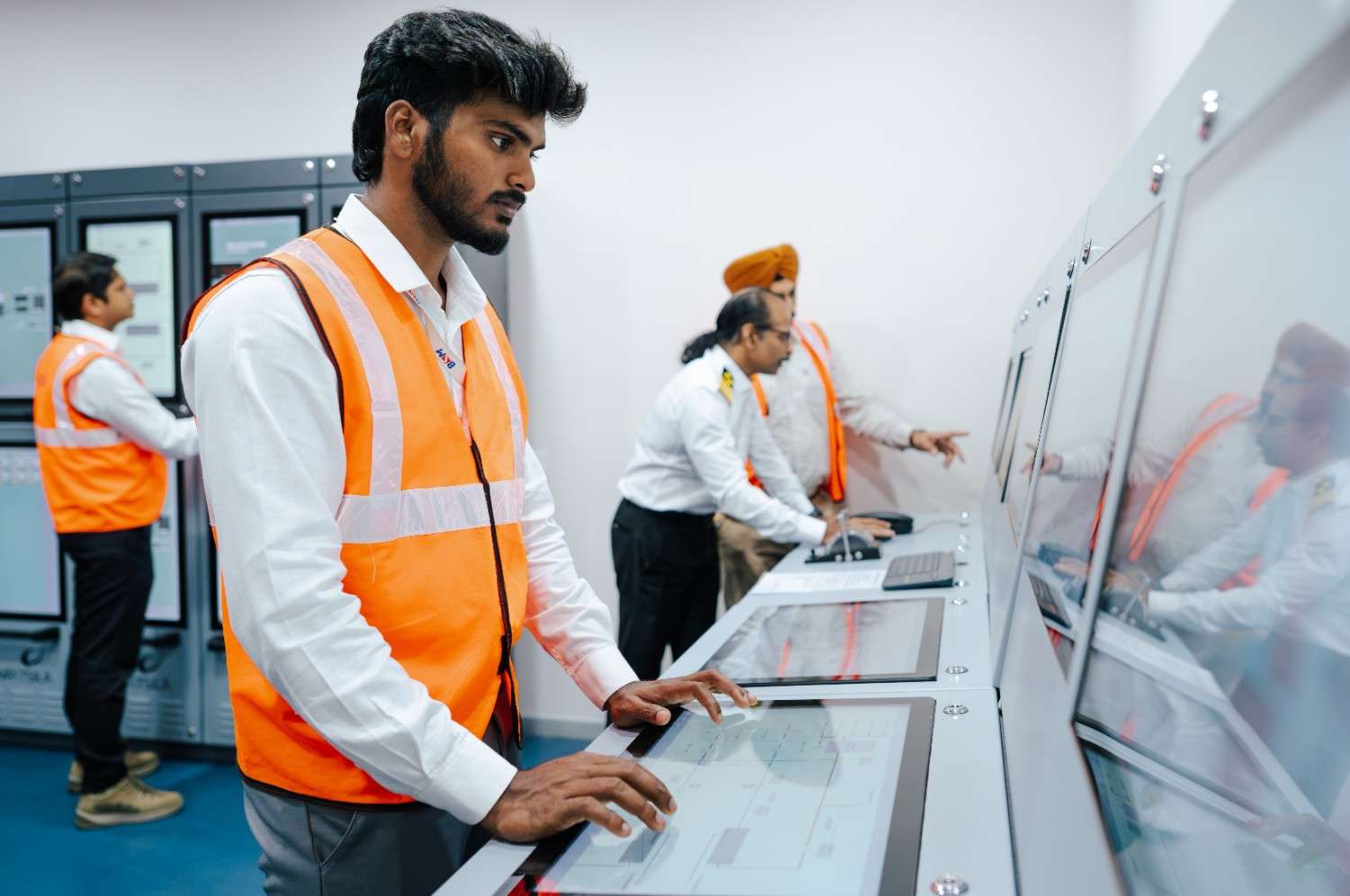
KOCHI : As the global shipping industry moves rapidly toward decarbonisation, Bernhard Schulte Shipmanagement (BSM) has launched its first methanol bunkering simulator at its Maritime Training Centre in Kochi, India, in partnership with maritime technology leader Wärtsilä. This state-of-the-art training platform equips seafarers with essential knowledge and hands-on skills to safely handle methanol as fuel, with an ammonia bunkering simulation module to follow in early 2026.
This initiative is part of BSM’s broader strategy to future-proof its training capabilities and ensure operational readiness and safety for the new generation of low- and zero-carbon vessels. “The maritime decarbonisation depends not just on new technologies, but also on the people who operate them. Their capabilities are the foundation for safe and efficient vessel operations and a successful energy transition,” emphasised Sebastian von Hardenberg, CEO of BSM.
The new simulator in Kochi is just the beginning. By the end of 2025, two additional methanol bunkering simulators will be commissioned at BSM’s Maritime Training Centres in Poland and the Philippines, significantly expanding the company’s ability to deliver high-impact alternative fuel training worldwide.
In Q1 2026, BSM will further enhance its simulator in Kochi with a dedicated ammonia training setup. This is rounding out comprehensive simulation coverage through the already existing LNG hub training as well as methanol and ammonia – the three primary alternative fuels driving maritime decarbonisation.
Preparing for a multi-fuel future
BSM’s proactive investment in simulation technology and crew training is directly aligned with developments of its managed fleet. BSM will take over the management of its first methanol-fuelled ships this year—making this training and upskilling efforts a critical foundation for safe, compliant operations. And it is certain that demand will continue to rise: there are currently around 60 methanol-fuelled vessels in operation worldwide. Based on current orders, more than 350 methanol ships are expected to be in operation by 2030.
“We must be prepared for a multi-fuel future,” said Capt. Gurpreet Singh, Group General Manager, Training and Development at BSM. “The new Wärtsilä simulator will allow our seafarers to train in a realistic, risk-free environment, preparing them for the complexities of methanol, and soon ammonia, bunkering operations with precision. It’s not just technology investment—it’s a commitment to competence and safety.”
“We are proud to support BSM in advancing maritime safety and sustainability,” said Johan Ekvall, Director Simulation and Training at Wärtsilä. “Our simulator provides a realistic and technically accurate environment to prepare crews for methanol operations—and the future of green shipping.”
Train-the-Trainer: building knowledge from the top
Recognising that this transition also requires new skills for instructors, BSM is investing in training its trainers as well, e.g. by participating in the world’s first Train-the-Trainer programme on Alternative Fuels for Sustainable Shipping, held in April in Shanghai and organised by the IMO and World Maritime University (WMU). This ensures that BSM’s in-house experts are aligned with the latest global standards and methodologies and skilled to equip ship crews with the knowledge and practical skills required to safely and efficiently handle methanol and ammonia as marine fuels in line with the IMO’s IGF Code.
In this context, BSM has developed a range of training courses aimed specifically at safe handling of the new fuels. In addition to familiarization courses on methanol and ammonium as a fuel, the programme also includes special methanol firefighting courses and simulation-based bunkering courses.
Simulator capabilities at a glance
The Wärtsilä TechSim 5000, built on the TechSim 9 platform and certified by ClassNK for both basic and advanced IGF Code training features a comprehensive simulation of methanol fuel systems, including:
Dual bunkering stations with liquid and vapor return lines
Real-time monitoring of multiple storage and service tanks
Low-pressure pump skids, nitrogen systems, and fuel valve trains
Integrated Automation System (IAS) with interactive controls
3D visualisation of bunkering stations and prep rooms
Emergency shutdown (ESD) systems and alarm management
A suite of e-Tutor scenarios covering bunkering, troubleshooting, and emergency response
About Bernhard Schulte Shipmanagement
Bernhard Schulte Shipmanagement (BSM) is an integrated maritime solutions provider. Managing a fleet of 670 vessels, 40,000 crew and 2,000 shore-based employees enable the delivery of safe, reliable, and efficient ship management services through a network of 10 ship management centres, 28 crew service centres and six wholly owned maritime training centres across the world. Alongside comprehensive ship management services, BSM offers a suite of complementary maritime solutions that are customised to meet individual customer requirements. As a member of the Schulte Group, BSM benefits from its 140+ years of experience in the shipping industry.
GENEVA : MSC is pleased to announce a new standalone service, Iroko, from China and Singapore to Congo Republic, Nigeria, Benin and Angola commencing 10 September.
This move will provide additional weekly direct connections between Asia and West Africa, strengthening MSC’s commitment to be the logistics partner of choice for Africa.
New Iroko service will offer:
Pointe-Noire: significant improved transit times to Angola, DRC and Namibia with the first call here. Lagos and Onne: MSC’s new direct calls to these locations demonstrate our dedication to supporting growth in the Nigerian market. Cotonou: a direct connection to Cotonou, reinforcing their strong presence in Benin. Lobito: a direct service to China dedicated for the export cargo The service will call at the following ports:
LONDON : In a unique analysis of near 500 incidents involving shore workers over the last twenty-five years, the ICHCA Severe Risks Dashboard details important findings that all in the industry need to be cognisant of every day. Key findings include:
· an almost equal split between on-vessel and onshore risk to port workers
· Three-quarters of incidents occurred during cargo operations
· Crush by cargo has been the leading historic cause of fatalities, accounting for a quarter of all incidents in the dataset
· 23% of high consequence incidents involve vehicle/pedestrian impact, chiefly involving pedestrians and mobile handling equipment, making it the close second highest type of fatal incident
· Falls are the third highest cause of death.
· Incidents occurring in confined or enclosed spaces also stands out as a key hazard
The International Cargo Handling Coordination Association (ICHCA) has used data going back to the year 2000, to research causes of workplace fatalities in the global cargo handling sector. While it is understood that the dataset can’t be comprehensive, it does give a unique insight into the nature of the majority of incidents resulting in a fatality on a worldwide basis.
“Our intention is to raise the level of awareness of these fatal incidents and their primary causes. Together with our members, we believe that safeguarding all workers employed both directly and indirectly in the workplace is the prime responsibility of operating organizations and authorities of cargo terminals. Through this greater awareness and knowledge, we aim to help minimize these risks in the future,” comments Richard Steele, CEO of ICHCA International.
The bare facts and data don’t tell the whole story. Individual circumstances surrounding these unfortunate events are pivotal to causes and outcomes. Trends however can be discerned and point the way to necessary ongoing improvements in safety protocols.
As such, the Dashboard also considers how best to mitigate incidents and their consequences depending on the causal circumstances, beyond the above mentioned crush by cargo and pedestrian accidents, to include fall from height, operating in confined or enclosed spaces, loading and discharge, maintenance and operating of handling equipment and third-party vehicle access. Advising such precautionary steps as:
Re-testing existing management controls for focus, completeness and robustness
Re-affirming that work as designed into procedures to address these essential risks actually translates into work as done on the ground
Engaging with workforces and other stakeholders to seek well-managed, cooperative change and innovation
“Creating a safer, healthier workplace is not just the prime responsibility of those managing our industry, it also makes sound business sense; safe organisations are sustainable organisations,” Steele concludes. “This is the passion of ICHCA and its members. We believe the future of safety is not beyond the horizon but that we can make changes to the way we work right now. ICHCA’s on-going attention to the causes of fatalities is one part of ICHCA’s contribution to these changes.”
Access to detailed graphics illustrating some of the statistics presented are available on request.
About ICHCA International
Established in 1952, ICHCA International is an independent, not-for-profit organisation dedicated to improving the safety, productivity and efficiency of cargo handling and movement worldwide. ICHCA’s privileged NGO status enables it to represent its members, and the cargo handling industry at large, in front of national and international agencies and regulatory bodies, while its Technical Panel provides best practice advice and develops publications on a wide range of practical cargo handling issues.
Operating through a series of national and regional chapters, including ICHCA Australia, ICHCA Japan and plus Correspondence and Working Groups, ICHCA provides a focal point for informing, educating, lobbying and networking to improve knowledge and best practice across the cargo handling chain.
IMABARI : NorthStandard, a leading global marine insurer, has announced the strategic opening of a new office in Imabari, Japan. The expansion significantly strengthens the club’s presence in Asia and shows its deep commitment to serving the dynamic maritime sector in Western Japan.
The new regional office, which is set to commence operations in September 2025, will complement NorthStandard’s well-established presence in Tokyo. It will focus specifically on providing enhanced, localised support to Japanese shipowners in and around the vital Ehime and Hiroshima prefectures.
Nobuhiko Sakamoto, a P&I Claims Director for Asia-Pacific, will relocate to Imabari to manage the new office. This expansion comes in direct response to growing local demand for NorthStandard’s specialised marine insurance services and dedicated claims expertise.
Imabari is a critical hub in the global maritime industry, home to around 70 ocean shipping companies that collectively control a formidable one-third of the entire Japanese fleet. Its prominence is further highlighted by the biennial Bari-Ship Imabari Maritime Fair, which draws approximately 20,000 industry professionals.
“Establishing a dedicated operation in Western Japan unequivocally underscores our long-term commitment to maritime Japan as a whole,” said David Roberts, Head of Asia-Pacific at NorthStandard.“This strategic move allows us to significantly strengthen our claims support for this immensely important group of members. We are delighted to make this additional investment and commitment to Japan at a time when its maritime industry continues to expand and prosper globally.”
Sakamoto added: “NorthStandard is dedicated to delivering unparalleled service excellence at the local level. Our aim is to provide robust support to our members as they navigate the increasing complexities and challenges of the modern maritime landscape. Japan remains a top-three ship-owning nation by value, gross tonnage, and deadweight, making it a pivotal market for NorthStandard’s P&I, FD&D, and specialty lines. Our experience has consistently shown that sustained growth in this market is nurtured by a deep, long-term commitment to tailored service provision and strong relationship-building.”
The Imabari office joins NorthStandard’s well-established and growing network across the Asia-Pacific region, which includes key operations in Singapore, Tokyo, Shanghai, Hong Kong, Seoul, Melbourne, Brisbane, and Nelson.
WASHINGTON : Donald Trump has announced the US will impose a 25% tariff on goods from India plus an extra “penalty” for the country buying arms and energy from Russia amid the war in Ukraine.
Washington has set a 1 August deadline for countries around the world to reach agreements on trade, including India, amid the US president’s sweeping global tariff war.
While saying that Delhi was a “friend,” Trump used his Truth Social platform to criticise India’s trade policies and said the White House would impose a 25% tariff “plus a penalty” of an unspecified amount.
He said the US had a “massive” trade deficit with India – when imported goods outstrip exports – and linked its “vast” purchases of military equipment and energy from Russia to Vladimir Putin’s war in Ukraine.
Criticising Indian tariffs applied to US imports as “far too high”, he also accused Narendra Modi’s government of applying non-monetary barriers to trade that were among the most “strenuous and obnoxious” in the world.
Trump wrote: “They have always bought a vast majority of their military equipment from Russia, and are Russia’s largest buyer of ENERGY, along with China, at a time when everyone wants Russia to STOP THE KILLING IN UKRAINE — ALL THINGS NOT GOOD!
“INDIA WILL THEREFORE BE PAYING A TARIFF OF 25%, PLUS A PENALTY FOR THE ABOVE, STARTING ON AUGUST FIRST. THANK YOU FOR YOUR ATTENTION TO THIS MATTER. MAGA!”
Figures compiled by Washington show the US trade in goods with India were an estimated $129.2bn (£97bn) in 2024, making it the US’s 10th largest trading partner. The US goods trade deficit was worth $45.7bn.
Trump’s criticism of India comes as he ramps up pressure on Moscow amid growing frustration with Putin’s war in Ukraine. Trump had claimed before his inauguration in January that he would be able to end the conflict within 24 hours of taking office.
Dozens of large countries around the world remain locked in negotiations with Washington with only days to go before Trump’s deadline of 1 August to reach agreements on trade. The White House has threatened to unilaterally apply higher tariffs if deals cannot be reached.
Washington and Brussels reached a deal on Sunday to limit an increase in US tariffs on most EU goods to 15%, after Trump had threatened to apply a border charge of 30%. Deals have also been reached with Japan, Vietnam and the UK, while an agreement in principle has been reached to extend talks with China.
Global investors have been monitoring closely amid hopes that damage to the world economy can be avoided after Trump’s 2 April “liberation day” plan sent shock waves through international markets.