Home Blog Page 884

Sallaum Lines selects Inmarsat NexusWave to drive fleetwide digitalisation strategy

LONDON : Inmarsat Maritime, a Viasat company, has signed an agreement with Sallaum Lines, a leading Roll-on/Roll-off (RoRo) cargo shipping company, to upgrade to Inmarsat Maritime’s NexusWave fully managed bonded connectivity service, making it an early adopter in region. As Sallaum Lines expands its global presence, NexusWave will provide secure, ultra-fast connectivity with unlimited data, complemented by Inmarsat’s Care Premium programme for 24/7 support and maintenance.

Reflecting a proactive digitalisation strategy, Sallaum Lines is adopting modern technologies such as IoT sensors and collaborative tools to enhance decision-making and operational efficiency across its fleet. Inmarsat’s NexusWave will deliver the reliability, high speeds, and low latency that Sallaum increasingly relies on to facilitate data collection, analysis, and advanced monitoring across its 14-vessel RoRo fleet, including six newbuilds.

Sallaum Lines is committed to creating a healthy and happy working environment on board its vessels by ensuring crew members can stay connected with their families and friends during rest and off-duty hours. The company places high value on education and development and plans to deploy a fleetwide learning and skills development platform. Thanks to the unlimited, high-speed connectivity provided by NexusWave through network bonding, Sallaum’s crew will have access to communication services and educational tools virtually anywhere in the world – even in connectivity hotspots.

Mr Puneet Arora, Head of Technical, Sallaum Lines, commented: “NexusWave will provide us with fast and reliable connectivity without the worry of outages, latency, or interruptions. This new partnership will also enable us to enhance our remote infrastructure and expand our onboard portfolio with solutions that meet both operational needs and crew welfare requirements. We are proud to be an early adopter of NexusWave.”

Dennis Winterswijk, Regional Director, EMEA, Inmarsat Maritime, said: “Deep understanding of Inmarsat Maritime’s capabilities, and trust in our reliability, were key factors in Sallaum Lines’ decision to select NexusWave. Its  decision to adopt NexusWave highlights the company’s commitment to enhancing operational efficiency and reliability, as well as its position as a forward-thinking, technology-driven company.”

Cargo theft report reveals rapidly shifting criminal tactics and emerging targets

LONDON : The BSI Consulting and TT Club 2024 Cargo Theft Report gives a detailed analysis of targeted commodities, prime locations for theft, regional hotspots and evolving strategies employed across the world. Detailed case studies are outlined and risk mitigation advice proffered.

Of incidents analysed:

·         Food and beverages were most frequently stolen — 22%

·         76% involved trucks, including 21% hijackings and 20% theft of vehicles

·         Nearly half occurred when cargo was in transit

·         Theft from facilities was down from a quarter in 2023 to 18%

·         Hotspots included Brazil, Mexico, India, USA, Germany, Chile and South Africa

·         ‘Strategic’ theft was the standout growth trend

·         Internet-enabled crime also continues as a significant facilitator

While the Report’s statistical analysis of cargo theft types and top commodities stolen year on year (see graphic below) is revealing, it is the qualitative information and insight into the methods used by criminal that is most useful in combatting theft. 

As Tony Pelli, Global Practice Director for Security & Resilience at BSI Consulting, “The growth in strategic crime, defined as that utilizing deception, fraud, and advanced planning is the most remarkable finding in our Report. This weapon in the criminals’ ever-evolving armament now involves impersonation and document forgery as well as leveraging AI technologies to manipulate bills of lading and orchestrate remote operations. The degree of sophistication employed shows that organised crime’s knowledge of supply chain vulnerabilities is deepening.”

Cargo Theft type Cargo theft report reveals rapidly shifting criminal tactics and emerging targets

This strategic methodology was particularly noted in the US where 18% of all incidents were identified as a strategically planned thefts. Indeed, one of the Report’s detailed case studies itemises an organised crime’s campaign of theft from railcars in California and Arizona using such tactics.  Elsewhere case studies help cargo owners and transport operators put real-life flesh on the statistical bones; including metal theft in South Africa, pharmaceuticals targeted in India, violent hijackings in South America and theft from trucks on the move (so-called ‘rollover’ theft’) prevalent in Europe.

Top Countries for Cargo Theft Cargo theft report reveals rapidly shifting criminal tactics and emerging targets

On behalf of TT, Mike Yarwood, Managing Director, Loss Prevention comments, “Our prime focus is to inform providing actionable insight to assist with risk mitigation. In this regard, it is vital to track current trends in criminal activity.  The burgeoning use of the internet, though  available for nefarious action for some years, is constantly spawning new technologies and  should not be overlooked. Techniques such as harnessing AI to create phishing emails, deep fakes, and malware aimed at accessing sensitive freight information and reports of attacks targeting cloud-based storage services are becoming more common.”

“If it is too good to be true, then it probably is” – is the essence of the sound advice offered by BSI Consulting and TT to those in the supply chain open to the risk of theft.  In a concluding section of the Report there is a comprehensive list of strategies to employ in risk mitigation, in particular to protect assets from theft.  These range from care over the security of email and other electronic communication to screening and vetting of third-party contractors; also from monitoring and response through reliable tracking services to keen awareness of alterations to regular delivery and pick-up locations.

“Above all,” emphasises Yarwood, “An overarching strategy to protect against cargo loss must be based on robust due diligence.  To know and trust as much as possible customers, carriers and contractors alike and to be cognisant of the criminals’ intent and level of cunning.”

SI Consulting and TT Club 2024 Cargo Theft Report is available for download free of charge BSI Consulting and TT Club 2024 Cargo Theft Report – TT Club

Baltic Index gains on Stronger Vessel Rates

LONDON : The Baltic Exchange’s Dry Bulk Sea Freight index rose on Wednesday to its highest level in more than a week, as rates increased across all vessel segments.

The main index, which tracks rates for capesize, panamax and supramax shipping vessels, was up 39 points, or 3.1%, to 1,300 points, its highest since April 8.

The capesize index added 71 points, or about 4.3%, to 1,732.

Average daily earnings for capesize vessels, which typically transport 150,000-ton cargoes such as iron ore and coal, increased by $588 to $14,362.

Dalian iron ore futures hit their highest levels in nearly three weeks on Tuesday, underpinned by hopes of U.S.-China trade talks and strengthening seasonal demand for the steelmaking ingredient.

The panamax index rose for the sixth straight session, gaining 41 points, or 3.2%, to 1,333.

Average daily earnings for panamax vessels, which usually carry 60,000-70,000 tons of coal or grain, was up by $367 to $11,996.

Among smaller vessels, the supramax index marked its highest level in over two weeks, adding 10 points, or 1.1%, to 964.

Source: Reuters

JD Vance shares big update–stronger India-US relations as trade talks progress

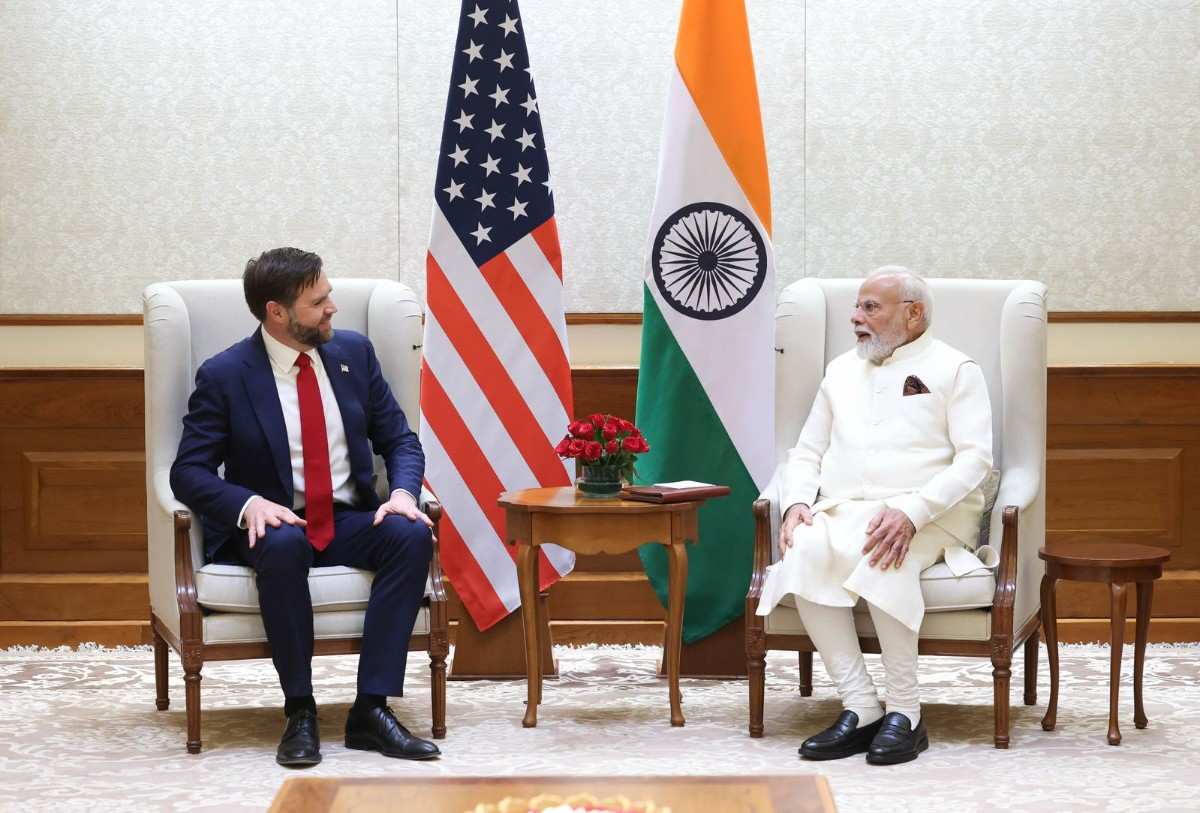
JAIPUR : JD Vance, US Vice President announced some good news amid the ongoing tariff war and said that the US has finalised the outline of a trade agreement with India. Vance landed in New Delhi on Monday for a four-day visit to India with his wife Usha Vance and children.

India and the US need to work together successfully for a “prosperous and peaceful” 21st Century, US Vice-President JD Vance said in a speech calling for closer ties between the countries across sectors.

“America and India have officially finalised the terms of reference for the trade negotiations,” he said, sharing an update on the ongoing trade talks between the two nations after the 26 per cent reciprocal tariffs by President Donald Trump sent jitters across industries.

India is among a number of countries rushing to negotiate trade deals with the US during President Donald Trump’s 90-day pause on higher tariffs, which ends on 9 July.

India was set to face 27% US tariffs before the pause was announced. Since then, Delhi and Washington have been working towards an early conclusion of trade negotiations.

In his speech in Jaipur, Vance said that the two countries had finalised the terms of reference for the negotiation.

“This is a vital step toward realising President Trump and Prime Minister Modi’s vision because it sets a roadmap toward a final deal between our nations,” Vance said.

He also called Modi a “tough negotiator” and someone “who drives a hard bargain”, drawing applause from the audience.

Modi and Trump share a warm personal relationship: the Indian prime minister was among the first global leaders to visit Trump after his second term began. But the US president has repeatedly taken aim at India’s high tariffs, branding it a “tariff king” and a “big abuser” of trade ties.

Even in the statement issued on Monday after Vance’s meeting with Modi, US Trade Representative Jamieson Greer highlighted the “serious lack of reciprocity in the trade relationship with India”.

India has already cut tariffs on a number of goods in the past few months and is reportedly considering more wide-ranging cuts to pacify Trump. But sectors like agriculture – where Washington wants greater access, but India fiercely protects – are still sticking points.

Vance also said in Jaipur that the US is seeking to sell more energy and defence equipment to Delhi. On Monday, in addition to trade, the two leaders had also discussed cooperation in defence, strategic technologies and energy.

The Indian prime minister also said after the meeting that he was looking forward to welcoming Trump to India this year. Delhi is hosting the Quad summit later this year and the US president is expected to attend it.

The bilateral meeting was followed by delegation-level talks and a dinner hosted by Modi for Vance and his family.

Vance arrived in India on Monday morning, accompanied by his wife Usha and their three children. Usha Vance’s parents migrated to the US from the southern state of Andhra Pradesh, and some media reports have said that Vance and his wife are keen to introduce their children to their Indian heritage.

Photographs of the three children wearing Indian-style outfits – the two boys in kurta-pyjamas and three-year-old Mirabel wearing a lehenga – on their arrival in India were splashed across Indian newspapers and websites.

The rest of Vance’s visit is largely personal. After the meeting with Modi, the family visited Jaipur city, where they visited the historic Amer Fort on Tuesday.

The family is also set to visit the iconic Taj Mahal in Agra city on Wednesday before flying to the US the next day.

FM Sitharaman meets US business leaders, Indo-US tech ties, AI on agenda

SAN FRANCISCO : Finance Minister Smt.Nirmala Sitharaman is engaging with senior executives in San Francisco to foster bilateral cooperation in technology, AI, energy, and digital infrastructure. Her discussions aim to enhance investment collaborations between India and the US. Arriving in San Francisco, she began her 11-day tour with a meeting with the Indian diaspora.

During her stay, she has interacted with key figures from Silicon Valley, including venture capital firm a16z and tech company VMware. She suggested that these companies “may like to explore collaboration across sectors” such as AI in education and healthcare, highlighting the “remarkable transformation in technology space” driven by India’s leadership.

SITHARAMAN GOOGLE CLOUD CEO FM Sitharaman meets US business leaders, Indo-US tech ties, AI on agenda

Sitharaman also met Google Cloud CEO Thomas Kurian to discuss the “transformative evolution of India’s digital infrastructure under the #DigitalIndia initiative.” Kurian acknowledged India’s strides in AI and outlined Google Cloud’s ambition to operate entirely on carbon-free energy by 2030.

Sitharaman encouraged Google Cloud to “explore local linkages in India for territorial collaboration,” further promoting the #MakeInIndia initiative. These discussions underscore India’s strategic positioning as a global digital leader.

In another meeting, DataRobot CEO Debanjan Saha expressed interest in India’s AI initiatives, noting the government’s efforts including a Rs 10,300 crore budget for the IndiaAI Mission.

Sitharaman highlighted India’s top global ranking in AI skill penetration and outlined a proposed Rs 1 lakh crore private sector-driven research scheme. Saha recognised India’s potential as an AI superpower and expressed interest in the AI Centre of Excellence, for which Rs 500 crore has been allocated in the recent budget.

Sitharaman continued her engagements with Turing CEO Jonathan Siddharth, discussing India’s policy framework for AI. Siddharth “expressed his desire to see India at the forefront of #AI revolution,” emphasising collaborative efforts with Indian contributors to create a global model for AI.

Additionally, Sitharaman attended a luncheon roundtable with pension fund managers and institutional investors. Participants shared their views on India’s reforms and expressed a commitment to deepening US-India investment collaboration.

Concluding her San Francisco visit, Sitharaman delivered a keynote address at Stanford University on India’s development vision for 2047, framed under the #ViksitBharat initiative. She will proceed to Washington DC to participate in the Spring Meetings of the IMF and World Bank, and other international financial engagements

India-US trade engagement to create new opportunities for workers, farmers, and entrepreneurs: US Trade body

WASHINGTON : The U.S. Trade Representative (USTR) has said that the ongoing engagement between India and the United States for a bilateral trade agreement (BTA) could create new opportunities for workers, farmers, and entrepreneurs in both countries.

Jamieson Greer, U.S. Trade Representative, welcomed the joint statement made by U.S. Vice President Vance and Indian Prime Minister Narendra Modi.

Greer said “These ongoing talks will help achieve balance and reciprocity by opening new markets for American goods and addressing unfair practices that harm American workers. India’s constructive engagement so far has been welcomed and I look forward to creating new opportunities for workers, farmers, and entrepreneurs in both countries”.

The two leaders reaffirmed the importance of the India-U.S. COMPACT — Catalysing Opportunities for Military Partnership, Accelerated Commerce & Technology — and appreciated the progress made in the negotiations for a Bilateral Trade Agreement (BTA).

These negotiations were launched by President Donald Trump and Prime Minister Narendra Modi during Modi’s visit to Washington on February 13, 2025.

Ambassador Greer confirmed that the USTR and India’s Ministry of Commerce and Industry have finalized the Terms of Reference (TOR) to guide the BTA negotiations.

Vice President Vance and Prime Minister Modi have now officially announced the Terms of Reference for the BTA, marking an important milestone since the launch of the COMPACT initiative.

The TOR will provide a roadmap for multi-sector negotiations focused on achieving mutually beneficial outcomes.

The United States aims to increase market access, lower both tariff and non-tariff barriers, and establish additional commitments that bring long-term benefits to both sides.

The announcement also comes in the backdrop of rising concerns over trade barriers between the two countries. In 2024, the U.S. had a goods trade deficit of USD 45.7 billion with India — a 5.1 per cent rise from 2023.

President Trump imposed a 10 per cent tariff on all countries on April 2, 2025 (Liberation Day), with even higher tariffs on nations with large trade surpluses against the U.S.

The USTR noted that the TOR with India marks a significant move forward.

Source : ANI

Saudi Arabia ‘one of India’s most valued partners, a trusted friend and a strategic ally,’ Indian PM Narendra Modi 

JEDDAH : Prime Minister Shri Narendra Modi has praised the “limitless potential” of India’s growing ties with Saudi Arabia as he arrives in Jeddah for a two-day visit, his third to the Kingdom since 2016. In an exclusive interview with Arab News, he described the Kingdom as “a trusted friend and strategic ally,” emphasizing how bilateral relations had expanded significantly since the creation of the Strategic Partnership Council in 2019.

“Our partnership has limitless potential,” Modi said. “In a world full of uncertainties, our bond stands strong, as a pillar of stability.” He praised Saudi Crown Prince and Prime Minister Mohammed bin Salman’s leadership, calling him “a strong advocate of our bilateral ties” and a visionary who has inspired global admiration through the reforms under Vision 2030.

“Every time I have met him, His Royal Highness has left a deep impression on me. His insights, his forward-thinking vision, and his passion for fulfilling the aspirations of his people are truly remarkable,” he said. 

Highlighting shared economic ambitions, Shri Modi noted that trade between the two countries had grown even amid global challenges, with energy, agriculture and fertilizers as key sectors. He welcomed deeper integration of Saudi and Indian businesses, particularly in emerging sectors like green hydrogen and technology. “Indian companies have also maintained a strong presence across various sectors in Saudi Arabia,” he said. 

Shri Modi congratulated the Kingdom for winning the bids to host World Expo 2030 and FIFA World Cup 2034, describing the dual successes as a matter of “immense pride.” He also pointed to growing defense cooperation and landmark joint military exercises as signs of increasing strategic trust. 

On the India-Middle East-Europe Economic Corridor (IMEEC), launched during the G20 Summit in September 2023, Modi said the project would be “a key catalyst of commerce, connectivity and growth in the entire region.”

In a statement, the Indian government said the visit “reflects the importance India attaches to its bilateral relationship with the Kingdom of Saudi Arabia.”

Excerpts from an Interview

Q. Saudi-India ties are on an upswing. How do you assess the progress made in the strengthening of bilateral relations since the establishment of the Strategic Partnership Council in 2019?

A. First of all, I want to thank His Royal Highness Prince Mohammed bin Salman for his kind invitation. I am delighted to be here on my third visit. I take great pride in our relations with Saudi Arabia. The Kingdom of Saudi Arabia is one of India’s most valued partners — a maritime neighbor, a trusted friend and a strategic ally. 

Our connection is not new. It is rooted in civilizational exchanges that go back to centuries. From ideas to trade, there has been a constant flow between our two great nations.

Our relations have been on an upward trajectory since 2014. I fondly recall that in 2016, I had the honor of receiving The Order of King Abdulaziz from His Majesty King Salman. 

The formation of the Strategic Partnership Council in 2019 marked a major milestone. Since then, cooperation between us has expanded across many sectors. And let me tell you, this is just the beginning. Our partnership has limitless potential. 

What anchors our relationship is mutual trust and goodwill. In a world full of uncertainties, our bond stands strong, as a pillar of stability. I truly believe these are promising times for India-Saudi Arabia ties. And, I must say, the Saudi leadership has played a vital role in strengthening this partnership.

India and Saudi Arabia will keep moving forward together — for peace, progress and prosperity, not just for our people, but for the entire world.

Q. Given your previous seven meetings with Crown Prince and Prime Minister Mohammed bin Salman, how would you characterize the personal rapport between the leadership of both countries? Has his rapport influenced the bilateral relationship in any way? 

A. Every time I have met him, His Royal Highness has left a deep impression on me. His insights, his forward-thinking vision, and his passion for fulfilling the aspirations of his people are truly remarkable. 

Under his leadership, Saudi Arabia has undergone tremendous social and economic transformation. The reforms he has undertaken have not just inspired the region, but also caught the attention of the entire world.  One can see the transformational changes in the country under Vision 2030 in a very short period. 

I value the personal warmth and trust we share. And, yes, this personal rapport has naturally translated into how both countries give priority to our partnership. He is a strong advocate of our bilateral ties. He has been a great supporter of the Indian diaspora in Saudi Arabia and our people living in Saudi Arabia deeply admire him. 

When we talk, we focus on making this partnership future-ready. Jeddah has had a special connection with India. For centuries, this famed city has been one of the principal arteries for our trade and people-to-people exchanges. As a gateway to Makkah, for ages, our pilgrims have walked the by-lanes of Jeddah on their holy journey for Hajj and Umrah.

Q. Saudi Arabia is India’s fifth-largest trading partner. What initiatives are being considered to further diversify and expand this economic partnership so that both countries can better face challenges together?

A. Our economic ties are as old as the monsoon winds. Given the proximity of our nations and the complementarity of our economies, there is a natural connect. That is why even during global challenges, our trade ties have not just survived, but they have grown.

While sectors like energy, agriculture and fertilizers are the main areas of our trade, efforts at diversification have borne fruits. Indian businesses and Saudi industry are building stronger connections. 

Building stronger connect between our businesses and industry and enhancing investment partnership is adding resilience to this relationship. Saudi Arabia is a leading energy partner for India. Likewise, India is contributing to food security in Saudi Arabia. I am told people in Saudi Arabia prefer Indian rice! India too loves Saudi dates. 

I also see several complementarities between Saudi Vision 2030 and India’s Viksit Bharat 2047 (Developed India 2047 initiative). 

Bilateral investments between our countries have also been increasing. Today, the Indian growth story offers immense opportunities for Saudi majors to invest and partner, from space economy to global supply chain collaborations. 

Indian companies have also maintained a strong presence across various sectors in Saudi Arabia. They are playing a crucial role in the realization of Saudi Vision 2030.

Our goal is to enhance this connect. 

India and Saudi Arabia are working on a Bilateral Investment Treaty. The proposed Free Trade Agreement between India and GCC has immense potential to transform the economic relationship between India and Saudi Arabia, and the region in general.

Q. With Saudi Arabia’s Vision 2030 emphasizing infrastructure development, what opportunities do you see for Indian companies to contribute to and benefit from these projects, including Riyadh Expo 2030 and Saudi FIFA World Cup 2034?

A. As a close friend, India rejoices in Saudi Arabia’s stellar achievements. I would like to congratulate the people of Saudi Arabia and its leadership for being chosen as the host for World Expo in 2030 and FIFA World Cup in 2034. 

It is a matter of immense pride for any country to host two marquee global events within a span of four years. It speaks volumes of the leadership of His Royal Highness and his vision. 

These mega events will boost the local economy. They offer opportunities for Indian companies as well. Our companies, as you are aware, have built a global reputation for their quality, competitiveness and efficiency. 

I understand that the Indian companies already have a strong participation in Saudi infrastructure and technology sectors. They are also creating value in various mega and giga projects as part of Saudi Arabia’s Vision 2030. 

I also invite Saudi companies to take advantage of the remarkable opportunities in India as part of our Viksit Bharat journey. They can participate in the growth of India’s next-generation infrastructure, logistics, renewable energy, healthcare, utilities, innovation, start-ups and “blue economy” sectors.

Deeper engagements and two-way collaborations between companies of both countries will go a long way in strengthening the bilateral economic partnership.

Q: Given Saudi Arabia’s role as a key supplier of crude oil and petroleum products to India, how do you envision the future of energy collaboration between the two nations, especially in the context of global energy transitions? 

A. Energy has been an important pillar of our economic partnership. Saudi Arabia has been a strong and reliable energy partner for us. It is one of our top suppliers of crude and other petroleum products. As India seeks to become a developed country, our energy demands will continue to grow. And Saudi Arabia will remain a close partner in our energy security. As strategic partners we agree that our energy cooperation is not limited to mere buyer-seller relationships. We are also exploring joint projects in refineries and petrochemicals. 

The world is also witnessing a gradual shift toward cleaner and more sustainable energy resources. India is moving ahead with an ambitious target for green transition. We are confident of achieving 500 GW renewable energy target by 2030. 

Even in this journey, there is an immense scope of collaboration with Saudi Arabia. This includes the areas of supply chains, circular economy, energy efficiency and green hydrogen. As partners in the International Solar Alliance, both countries can work toward innovative solutions for future energy needs. 

During the New Delhi G20 Summit in 2023, along with His Royal Highness, we launched the India-Middle East-Europe Economic Corridor (IMEEC) initiative. We are now working on feasibility studies for electricity grid interconnectivity between India and Saudi Arabia and the wider region. As you can see, we are moving ahead with the vision of a comprehensive energy partnership between our two countries.

Q. Saudi-India defense engagements and joint exercises have been steadily increasing. What are the key areas of focus for defense and security cooperation in the coming years?

A. We consider Saudi Arabia as a force of positivity and stability in the region. As maritime neighbors, India and Saudi Arabia share a natural interest in safeguarding peace and stability in the region. 

The growing defense and security engagement and collaboration between the two countries is a reflection of deep mutual trust. It is also a testament to our shared commitment to regional stability, and our mutual resolve to address the evolving challenges in our extended neighborhood. 

We have seen steady progress in security cooperation. This includes areas such as counterterrorism, combating extremism, disrupting terror financing and tackling drug trafficking. We are also exploring new frontiers of cooperation in cybersecurity, recognizing its growing importance in today’s interconnected world. 

Last year, we achieved an important milestone: the first-ever joint exercises between the two land forces. These were complemented by two successful rounds of the joint naval exercise Al-Mohed Al-Hindi, which were held in 2021 and 2023. 

Both of us support deeper defense-industry collaboration. Over the past decade, defense manufacturing has taken deeper roots in India. Today, there is a strong military industrial complex with the ability to manufacture quality ammunition, small arms, tanks, armored carriers. For the air force, we are building drones, advanced light helicopters and fighter jets.  For the navy, we have the capacity to build patrol boats, submarines, and even aircraft carriers. 

We are not just fulfilling our own needs. India has also emerged as an important supplier of defense equipment to more than 100 countries around the world. 

I am glad that we have been able to meet some needs of the armed forces in Saudi Arabia. We support deeper engagement between private-sector players from both countries. We would welcome Saudi investment into the defense manufacturing sector in India that has been opened for private investment.

Q. The IMEEC initiative that was announced in September 2023 in New Delhi is an ambitious project to connect India and Europe through the Middle East. What are the key elements of IMEEC, and how is India working with Saudi Arabia to achieve the goals envisioned under this initiative?

A. India and Saudi Arabia, along with European Union, the UAE, France, Germany, Italy and the US, jointly launched the India Middle East Europe Corridor initiative in New Delhi in September 2023. 

This corridor will define the future of connectivity in all forms for centuries to come. It will become the key catalyst of commerce, connectivity and growth in the entire region. The corridor will enhance connectivity in all its forms, be it physical or digital. 

It will facilitate development of resilient and dependable supply chains, increase trade accessibility and improve trade facilitation. The corridor will increase efficiencies, reduce costs, enhance economic unity, generate jobs and lower greenhouse gas emission, resulting in a transformative integration of Asia, Europe and the Middle East. 

Both India and Saudi Arabia have a key role to play in the success of this corridor. We are committed to working with our Saudi partners to realize the vision of connectivity, including multi-modal logistic connectivity, data connectivity and electrical grid connectivity. We are working on clean and green hydrogen and related supply chains under this initiative. 

I visualize this initiative has a transformational potential for humanity. It can be the new Silk Route of the 21st century that will bring benefit to the generations to come.

Q. The Indian community of 2.7 million in Saudi Arabia has been praised by you as a binding force in bilateral ties. How does your government plan to further support and engage with the Indian diaspora in the Kingdom? 

A. First of all, let me put it on record that we are deeply grateful to Their Royal Highnesses, King Salman and Crown Prince Mohammed bin Salman, for the patronage they have provided to the Indian community in Saudi Arabia. We can never forget how they took care of the Indians as one of their own during the difficult times of the COVID pandemic. 

Indians have a very important character — whichever country they go, they make it their home. They are law abiding, dedicated and professional to the core. They carry with them the values of empathy, compassion and care. 

This very nature earns them respect of their host country. Saudi Arabia is no exception. Whenever I have met His Royal Highness Crown Prince Mohammed bin Salman, he has praised the Indian community and appreciated their significant contribution to the economic growth of the Kingdom. He has even said that they are part of the Saudi family. These words of praise always fill my heart with pride and joy. 

For my government, the members of the Indian diaspora are the “rashtradoots” (national ambassadors). The 4Cs — Care, Connect, Celebrate and Contribute — is the motto of our engagement with our diaspora. Their safety, welfare and well-being is paramount for us. 

Over the past decade we have launched many initiatives, including insurance schemes, scholarships for their children, and skilling programs. We have established mechanisms for safe and legal migration. The 2.7 million vibrant Indian community in Saudi Arabia is a living bridge connecting our two countries. I commend them for not only preserving their values and traditions, but also promoting them. 

I eagerly look forward to reconnecting with the Indian diaspora during this visit.

Q: How do you see religious tourism, cultural and educational exchanges developing as a component of Saudi-India bilateral relations? Do you foresee India’s IITs and IIMs opening campuses in Saudi Arabia, along the lines of IIT Delhi, Abu Dhabi campus? 

A. Our people have interacted with each other since the days of “Kalila wa Dimna.” The growing cultural connect between our countries is indicative of the understanding and appreciation for each other. 

As far as religious tourism is concerned, as you know we have a large Muslim population and they visit your beautiful country each year for Umrah and Hajj pilgrimage. We are grateful to the Saudi leadership for the continued assistance provided to Indian pilgrims. Yoga has gained considerable popularity in Saudi Arabia over the recent years, thanks to the encouragement and support of the Saudi government. We are also noticing a growing interest in cricket. 

I am told that Arab broadcasters run dedicated channels with Indian content that are very popular in the Kingdom. There is also a wide following for Indian films and actors. India is hosting the first edition of the World Audio Visual and Entertainment Summit in Mumbai during May 1-4. We look forward to a strong participation from Saudi Arabia at the summit so that we can give new wings to our cultural and entertainment collaboration. 

Educational cooperation is another promising area. Indian higher education institutions are recognized globally. They are ready to take up opportunities, as and when those arise in Saudi Arabia as well. 

Finally, let me congratulate Arab News as it completes 50 years of its publication this year. I know Arab News has a special connection with Indians living in the Kingdom. Your media outlet is a strong symbol of our people-to-people ties. My best wishes to you as you continue to nourish India-Saudi Arabia friendship.

Source : ARAB NEWS

CEMS Visakhapatnam launches DGR Pre-Release Course in Port Logistics

VISAKHAPATNAM : Centre of Excellence in Maritime & Shipbuilding (CEMS)Visakhapatnam successfully launched the DGR Pre-Release Course in Port Logistics. Honoured to have Commander Sekhar Tharwani inspire personnel from the Army, Navy & Air Force.

GpIBxkqWIAA1y1d 1 CEMS Visakhapatnam launches DGR Pre-Release Course in Port Logistics

Nepal delegation visits Visakhapatnam Port Authority

VIZAG : A five-member of Nepal delegation led by Dr. Govind Prasad Sharma, Secretary, Ministry of Agriculture & Livestock Department, Government of Nepal, along with the Managing Director of Krishi Samagri Company Ltd., Nepal, and the Assistant CEO of Salt Trading Corporation Ltd., Nepal, visited Visakhapatnam Port Authority (VPA) on 22nd April 2025. The delegation was warmly welcomed by Shri Durgesh Kumar Dubey, IRTS, Deputy Chairperson, VPA.

The visiting team was given a detailed PowerPoint presentation highlighting the port’s infrastructure, operational capabilities, and key facilities.

The main objective of the visit was to explore the possibility of importing urea and other fertilizers such as DAP through global tenders, wherein Indian Potash Limited is a major supplier to these Nepal government entities. Discussions were held on the Indo-Nepal Treaty for the movement of fertilizers, including a proposal to allow bulk movement through Visakhapatnam Port—similar to the current operations at Kolkata Port—with a target of tapping at least two lakh tonnes of additional fertilizer cargo.

The Nepal delegation observed that Visakhapatnam has significant untapped potential, and if enhanced trade facilities are provided, the entire volume of one and a half to two lakh tonnes of cargo could be diverted from Kolkata to Visakhapatnam.

Shri T. Venu Gopal, Secretary, VPA, shared the visit’s details with the media and reaffirmed VPA’s commitment to strengthening international trade ties, especially with landlocked neighboring nations like Nepal.

US pressures India to grant full market access to Amazon, Walmart

WASHINGTON D.C. : The US government intends to press India to give retail giants Amazon and Walmart expanded access to its $125 billion ecommerce sector as part of ongoing trade negotiations, reported the Financial Times. The Donald Trump administration has been pushing for a ‘more equitable environment’ after the US President put his retaliatory tariffs— including a 26 per cent import duty on Indian products — on hold for 90 days. 

Washington is lobbying for fewer restrictions on foreign ecommerce firms in India, advocating for equal treatment in a market where local players currently enjoy greater operational freedom. The US sees India’s ecommerce policies — particularly its restrictions on foreign direct investment and platform ownership — as key obstacles.Top retail executives in play Retail industry leaders, including Walmart CEO Doug McMillon and Amazon’s Jeff Bezos, are reportedly playing a central role in these discussions. McMillon, whose company owns Flipkart, is said to have raised concerns over India’s ecommerce restrictions directly with Trump during private meetings. 

McMillon also attended a White House meeting on Monday alongside other retail executives to discuss tariff-related issues, the Finance

Despite Amazon’s ongoing expansion since its 2013 entry into India, it continues to trail Flipkart in daily active users. Bank of America data showed Amazon had under 40 million daily users late last year, compared to Flipkart’s 50 million.

Both nations have set a goal to increase bilateral trade in goods and services to $500 billion — more than twice the existing volume. As part of the bilateral trade agreement, India is considering significant tariff reductions on over half of its $41.8 billion imports from the US. 

On Monday, Finance Minister Nirmala Sitharaman, who is on a five-day trip to the US, said that India hopes to “positively conclude” the first part of a trade pact with the US by this autumn. She is also scheduled to meet the US Treasury Secretary Scott Bessent and is expected to speak to officials at the US Trade Representative’s office.