


NEW DELHI: Indian Oil Corporation (IOC), India’s largest oil refining and marketing company, is planning to acquire its own crude oil and liquefied petroleum gas (LPG) carriers as escalating geopolitical tensions in West Asia expose the vulnerabilities of India’s dependence on chartered vessels and international shipping markets.
The proposed acquisition is part of the company’s broader strategy to strengthen control over its energy transportation infrastructure, enhance supply-chain security and reduce exposure to sharp fluctuations in global tanker freight rates.
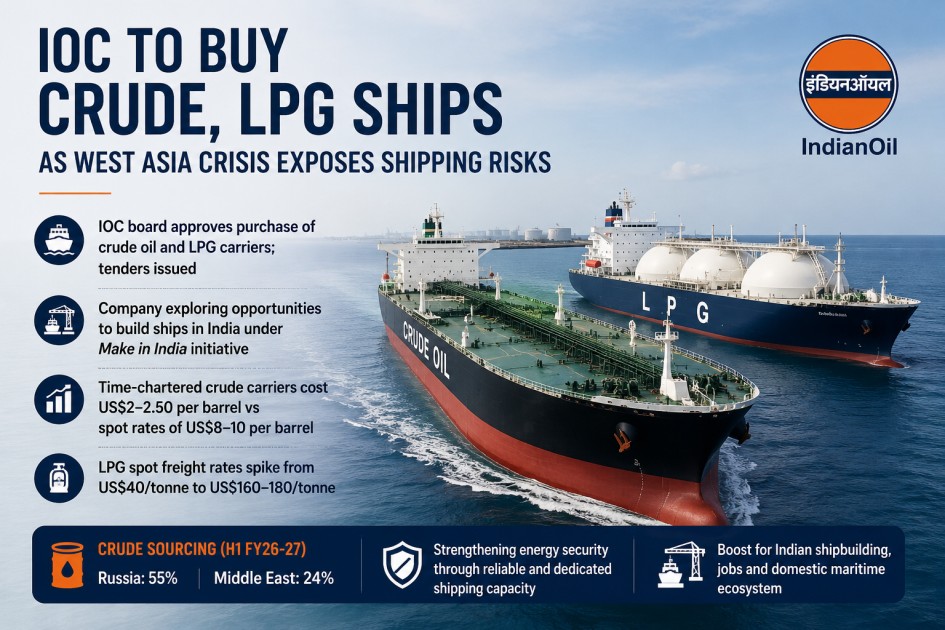
According to a Press Trust of India (PTI) report, IOC’s board has already approved the purchase of a few vessels, while tenders for the proposed acquisitions were issued several months ago. The company is also exploring opportunities to have ships built in India, potentially supporting the government’s ambition to strengthen domestic shipbuilding capabilities and establish India as a competitive maritime manufacturing hub.
Rising Freight Costs Strengthen the Case for Vessel Ownership
The West Asia crisis and disruptions to major maritime routes, particularly around the strategically important Strait of Hormuz, have highlighted the financial and operational risks associated with relying heavily on the international charter market.
IOC currently operates three crude oil carriers and nine LPG vessels under time-charter arrangements. However, the sharp increase in spot-market freight rates has strengthened the economic case for owning vessels rather than depending entirely on externally sourced shipping capacity.
As reported by PTI, time-chartered crude oil carriers cost approximately US$2–2.50 per barrel, compared with spot-market freight rates of US$8–10 per barrel during the period of heightened market volatility.
The LPG shipping market has also witnessed a substantial increase in transportation costs. Spot freight rates, which generally stood at around US$40 per tonne under normal market conditions, have climbed to approximately US$160–180 per tonne.
These developments underline the importance of securing dedicated shipping capacity to ensure more predictable transportation costs and reliable movement of critical energy supplies.
Domestic Shipbuilding in Focus
IOC’s interest in exploring domestic shipbuilding opportunities could provide a significant boost to India’s maritime manufacturing ecosystem.
The proposed vessel acquisitions offer an opportunity to strengthen collaboration between the country’s major oil companies, domestic shipyards, shipping operators and maritime equipment manufacturers.
The initiative also aligns with India’s broader policy objective of expanding indigenous shipbuilding capacity, reducing dependence on foreign-built vessels and developing a stronger domestic merchant shipping fleet.
For Indian shipyards, the potential construction of crude oil and LPG carriers could open up opportunities in specialised vessel manufacturing, engineering, marine equipment, technology development and skilled employment.
Diversification of Crude Oil Procurement
India’s changing crude oil sourcing strategy further reinforces the importance of reliable maritime transportation infrastructure.
According to the PTI report, Russian crude accounted for approximately 55% of IOC’s crude procurement during the first half of FY 2026–27, while supplies from the Middle East contributed around 24%.
The diversification of procurement sources across different geographical regions has increased the importance of maintaining flexible and dependable shipping arrangements, particularly when geopolitical developments disrupt established maritime trade routes.
With India continuing to depend heavily on imported crude oil and LPG to meet its growing energy requirements, the availability of dedicated tankers is becoming an increasingly important component of national energy security.
Strengthening India’s Energy and Maritime Security
IOC’s proposed investment in crude oil and LPG carriers represents a strategic shift towards strengthening the shipping component of India’s energy supply chain.
Beyond the immediate commercial benefits of managing freight expenses, vessel ownership could provide greater operational flexibility, improved control over shipping schedules and better preparedness during periods of international market disruption.
The initiative also brings the energy and maritime sectors closer to India’s long-term vision of developing a robust domestic shipping fleet and expanding indigenous shipbuilding capabilities.
As geopolitical uncertainty continues to reshape global energy transportation, IOC’s proposed vessel acquisitions could mark an important step towards building a more resilient, self-reliant and cost-efficient maritime logistics framework for India’s energy trade.