Home Blog Page 187

Kamarajar Port, Isuzu Motors India sign Five-Year Export Pact to boost Commercial Vehicle Shipments

CHENNAI: Kamarajar Port Limited (KPL) has further strengthened its position as one of India’s leading automobile export gateways by signing a long-term agreement with Isuzu Motors India Pvt. Ltd. (IMIPL) for the export of commercial vehicles through its General Cargo Berth. The strategic partnership is expected to enhance export efficiency, strengthen supply chain resilience, and support India’s growing maritime trade and logistics sector.

Isuzu Motors India has been exporting its popular D-Max and S-Cab commercial vehicle models from its manufacturing facility at Sri City through Kamarajar Port since 2019. These vehicles are shipped to several key markets across the Middle East, including Saudi Arabia, Qatar, Kuwait, Oman, and Jordan. The newly signed long-term agreement builds upon this successful collaboration, reaffirming the mutual confidence and commitment of both organizations towards expanding global trade.

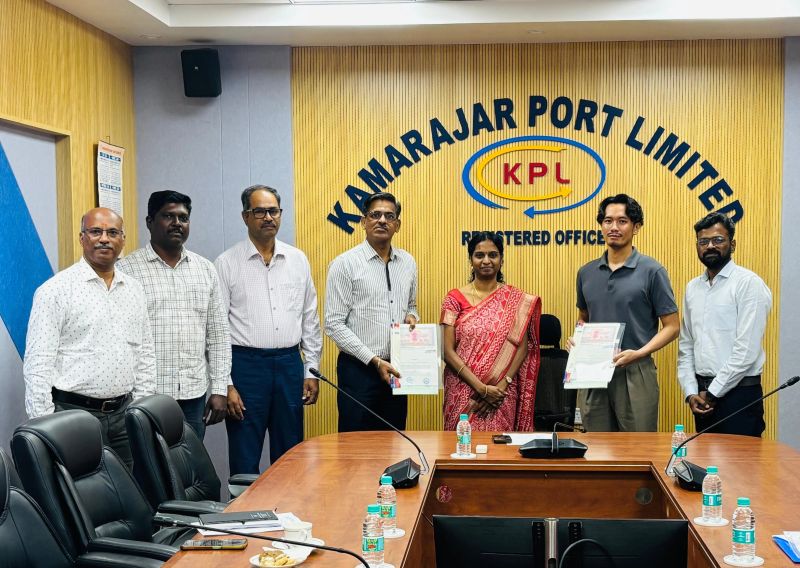
The agreement was formalized in the presence of Smt. J.P. Irene Cynthia, IAS, Managing Director, Kamarajar Port Limited, along with Mr. Hironori Okawa, Assistant General Manager, Isuzu Motors India Pvt. Ltd., Mr. Thirumurugan, General Manager (Operations), Kamarajar Port Limited, and senior officials from both organizations.

As part of the five-year agreement, Isuzu Motors India will receive concessional wharfage rates linked to export volumes, enabling greater cost efficiencies while encouraging higher export throughput. The initiative reflects Kamarajar Port’s customer-focused approach and its commitment to delivering efficient, competitive, and value-driven port services that meet the evolving requirements of global manufacturers.

The partnership represents another significant milestone in strengthening Isuzu Motors India’s international supply chain while further consolidating Kamarajar Port Limited’s reputation as a preferred export gateway for the automobile industry. It also underscores the port’s growing contribution to enhancing India’s maritime infrastructure, export competitiveness, and integrated logistics ecosystem, in line with the nation’s vision of becoming a global manufacturing and export hub.

DP World appoints Aarti Laxmanan as Senior Director – Corporate Communication

DUBAI : Global smart logistics solutions provider DP World has appointed veteran communications leader Aarti Laxmanan as Senior Director – Corporate Communication, Indian Subcontinent.

In her new mandate, Laxmanan will drive the company’s integrated communications strategy across the region, overseeing external and internal communications, media relations and corporate reputation management for DP World’s operations in the Indian subcontinent.

Announcing the move on LinkedIn, Laxmanan said she was looking forward to working with a team that would “keep global trade moving through strategic, best-in-class communication.”

Laxmanan brings over 25 years of experience spanning corporate communications, public advocacy and business journalism. She joins DP World from Vedanta Limited, where she served as Chief Communication & Advocacy Officer – Power.

Her earlier career includes a senior communications role at UFLEX Group’s global operations, following stints in broadcast business journalism with NDTV and CNBC.

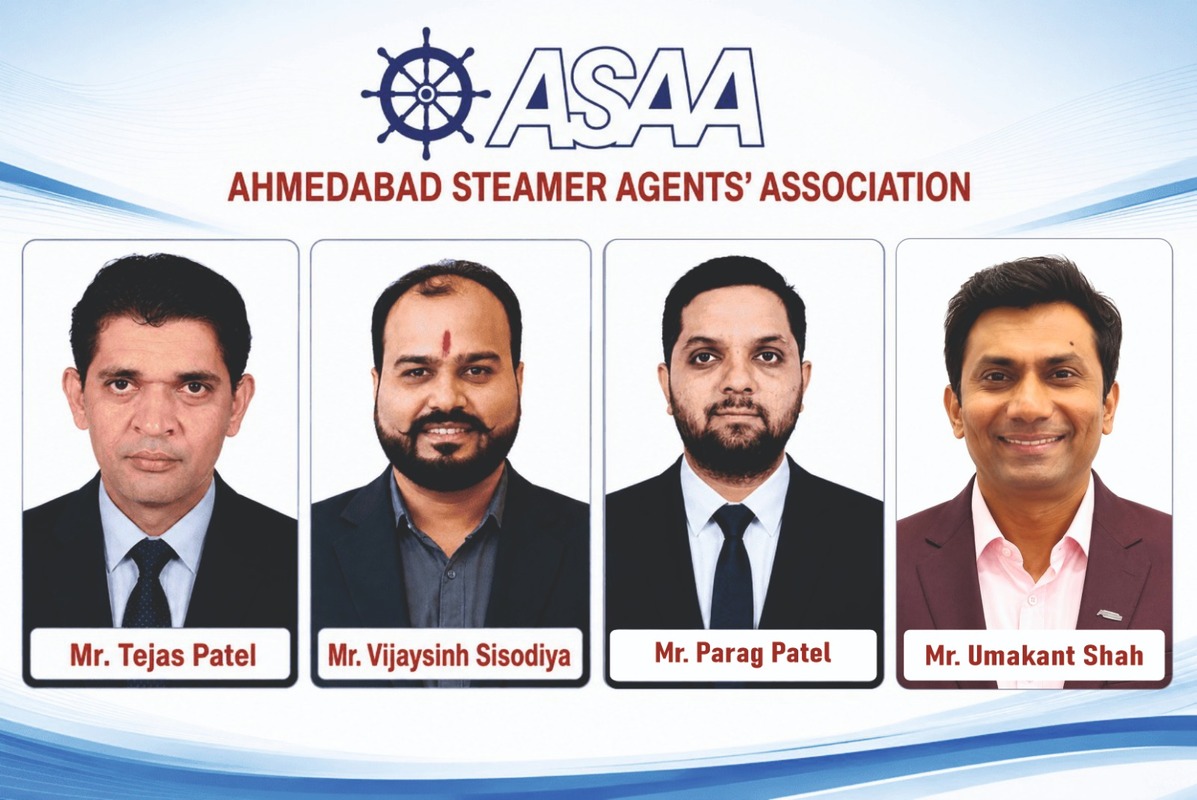
Ahmedabad Steamer Agents’ Association (ASAA) announces New Managing Committee

AHMEDABAD: The Ahmedabad Steamer Agents’ Association (ASAA), one of the oldest and most respected trade associations representing Shipping Lines, Shipping Agents and NVOCCs in Ahmedabad, has announced the formation of its new Managing Committee with effect from July 14, 2026. The newly elected office bearers and committee members will lead the Association in promoting the interests of the shipping and maritime trade while strengthening collaboration among stakeholders across the logistics and shipping ecosystem.

As per the official announcement, Mr. Tejas Patel has been elected as President, Mr. Vijaysinh Sisodiya as Vice President, Mr. Parag Patel as Secretary, and Mr. Umakant Shah as Treasurer. The newly constituted Managing Committee also includes Mr. Jinesh Shah, Mr. Manthan Shah, Mr. Vipul Panchal, Mr. Parth Prajapati, and Mr. Dhiraj Vervani as Committee Members.

The Association stated that all the office bearers and committee members have formally accepted their respective responsibilities and confirmed their appointments by signing the committee formation document. The new leadership is expected to continue ASAA’s longstanding commitment towards addressing industry concerns, fostering professional excellence, and enhancing coordination with government authorities, ports, customs, shipping lines, logistics service providers and other trade bodies.

With a rich legacy of serving the maritime and logistics fraternity in Ahmedabad, the Ahmedabad Steamer Agents’ Association (ASAA) has played a pivotal role in representing the interests of the shipping community for several decades. The newly formed committee is expected to further strengthen the Association’s initiatives in facilitating trade, encouraging industry collaboration, and contributing to the continued growth of India’s maritime, shipping and logistics sector.

New Managing Committee – Ahmedabad Steamer Agents’ Association (ASAA)

  • President: Mr. Tejas Patel – Siyasiza Logistics Pvt. Ltd.
  • Vice President: Mr. Vijaysinh Sisodiya – Maxicon Container Line
  • Secretary: Mr. Parag Patel – Trans Asian Shipping Services Pvt. Ltd.
  • Treasurer: Mr. Umakant Shah – E-Ship Global Logistics India Pvt.Ltd.

Committee Members:

  • Mr. Jinesh Shah – United Liners Shipping Services LLP
  • Mr. Manthan Shah – Winwin Maritime Ltd.
  • Mr. Vipul Panchal – Emirates Line
  • Mr. Parth Prajapati – Kalash Global Logistics Pvt. Ltd.
  • Mr. Dhiraj Vervani – Digrani Shipping & Logistics

Govt. of India announces important measures to revitalize the shipbuilding sectors

NEW DELHI : Shri Sarbananda Sonowal informed that,the Government has reviewed India’s Shipbuilding sector following the announcement of measures under the Union Budget 2025–26 and adopted a 4-pillar strategy to revitalize the shipbuilding sector. The Government has accordingly approved a comprehensive package of ₹ 69,725 crore to strengthen domestic shipbuilding capacity, maritime financing and skilling. The key components of the shipbuilding package include:

Shipbuilding Financial Assistance Scheme (SBFAS), an extension of Shipbuilding Financial Assistance Policy (SBFAP), with outlay of ₹ 24,736 crore to address cost disadvantages of Indian shipyards vis-a-vis global shipyards;

Maritime Development Fund (MDF) corpus of ₹ 25,000 crore for providing long term financing support to shipbuilding and maritime sector comprising a Maritime Investment Fund (MIF) of ₹ 20,000 crore and Interest Incentivisation Fund (IIF) of ₹ 5,000 crore;

Shipbuilding Development Scheme (SbDS) with ₹19,989 crore outlay to expand Indian shipbuilding output capacity to 4.5 million Gross Tonnage annually by setting up greenfield shipbuilding clusters and capacity expansion of the existing shipyards. These targets have been set to position India as a competitive global shipbuilding force in line with the vision contained in Maritime India Vision 2030 and Maritime Amrit Kaal Vision 2047 documents.

Policy reforms have been undertaken to revamp the shipbuilding industry including implementation of classification of large vessels as infrastructure and demand aggregation. The government on 19th September 2025, notified infrastructure status to Indian-flagged commercial vessels with a Gross Tonnage (GT) of 10,000 or above. For vessels constructed in India infrastructure status was accorded to vessels of size 1,500 GT or above. As part of demand aggregation, a fleet acquisition plan of 400+ vessels has been prepared which provides long term order visibility to the Indian shipyards.

The scheme guidelines to operationalize SBFAS have been issued on 26.12.2025 and in-principle approvals for shipbuilding financial support are given in accordance with scheme guidelines. The guidelines for MDF have also been issued on 20.02.2026. Further, SBI Ventures Limited has been appointed as the Fund Manager for MIF on 26.05.2026.

As on-date, under SbDS, Government has accorded in-principle approval for the development of three greenfield shipbuilding clusters at Andhra Pradesh, Gujarat and Tamil Nadu. SbDS provides financial assistance for development of common maritime and land based infrastructure for the greenfield clusters. Further, under SbDS, the India Ship Technology Centre (ISTC) has been established as a Section 8 company to promote the overall development of the Indian shipbuilding sector by enhancing capabilities in ship design, research and development (R&D), skill development, software, and other related areas. As regards skilling development, the details of various steps taken are as under:

11 shipyards have signed MoUs with 34 ITIs across 8 coastal States towards implementation of on the job training (OJTs). As part of this, a 150-hour OJT model has been introduced. 727 trainees have already been trained till date in these yards.

Training of Trainers (ToT) program has been implemented at 2 Industrial Training Institutes (ITIs) in West Bengal by Centre of Excellence in Maritime and Shipbuilding (CEMS).

A preliminary Skill Gap Study has been completed across 9 shipyards.

A total of 92,697 candidates have been trained/skilled/upskilled during the last 3 years.

A Plan of Implementation (PoI) has been signed between MoPSW and Korea International Cooperation Agency (KOICA) for a skill development project in the shipbuilding sector.

As per the latest UN Trade and Development (UNCTAD) report, India’s shipbuilding output increased by 41% from 40,923 GT in 2024 to 57,637 GT in 2025 . The comprehensive shipbuilding package of Government of India has instilled confidence in Indian shipyards, resulting in the placement of several large commercial and export shipbuilding orders to existing shipyards. In the last two years in-principle approvals have been given for financial assistance under SBFAP and SPFAS to the Indian shipyards for a total contract value of ₹15,234 crore. Under the SbDS scheme, so far, in-principle approval has been given to proposals of four shipyards for brownfield capacity augmentation of their facilities for ship-building and ship-repair at a total estimated cost of over ₹2,500 crore. Given the high employment multiplier of 6.4 in the shipbuilding industry, the above developments have catalysed generation of large numbers of direct as well as indirect employment.

Development of Inland Waterways and related projects : MoPSW

NEW DELHI : Union Minister of Ports, Shipping and Waterways, Shri Sarbananda Sonowal, informed in a written reply to the Lok Sabha that, the Government of India has embarked upon a transformational drive to promote Inland Water Transport (IWT) as a key pillar of India’s multimodal transport system under Maritime India Vision 2030 and Maritime Amrit Kaal Vision 2047. The primary objective encompasses creating world-class waterway infrastructure through fairway development, multimodal terminals, community jetties, river cruise terminals, regional centres of excellence, digital navigation tools, and green vessel technologies, coupled with seamless integration under the PM Gati Shakti National Master Plan.

The development and regulation of National Waterways (NWs) are spearheaded by the Inland Waterways Authority of India (IWAI), an autonomous organization under the Ministry of Ports, Shipping and Waterways. To improve the Ease of Doing Business and simplify approvals, IWAI has introduced an array of digital reforms:

PANI: Portal for Asset and Navigation Information to facilitate seamless navigation planning.

Jalyan & Navic Portal: A centralized database and digital portal developed on the lines of ‘Vahan’ and ‘Sarathi’ for nationwide online registration of vessels and crew, enabling accurate tracking and strategic planning.

CAR-D: Cargo Data Portal for real-time tracking and logistics data integration.

Jal Samriddhi Portal: Dedicated portal supporting commercial and operational activities across National Waterways.

Digital Charts and Hydrographic Surveys: Modern hydrographic charts provided digitally to Mariners for enhanced safety.

These infrastructure, digital, and policy reforms have resulted in the operationalization of 32 National Waterways across the country, laying the foundation for a technology-driven, sustainable, and globally competitive IWT ecosystem that reduces logistics costs, promotes green mobility, and accelerates inclusive economic growth.

LOGISTICS EFFICIENCY & ENVIRONMENTAL COMPARATIVE ANALYSIS

Inland Water Transport serves as an economic and environmentally friendly alternate mode of transport to Rail and Road, significantly reducing congestion on existing transport networks.

Economic Freight Cost Comparison (2014 Price Baseline)

Inland Water Transport (IWT): Rs. 1.06 per Ton-Kilometer (TKm)

Railways: Rs. 1.36 per Ton-Kilometer (TKm)

Highways (Road): Rs. 2.50 per Ton-Kilometer (TKm)

  (Source: Ministry of Railways, TTSS, and IWAI)

Environmental Impact & Emission Analysis

Greenhouse Gas (GHG) Emissions: IWT emits 0.0006 Rs/TKm, on par with Railways (0.0006 Rs/TKm) and significantly lower than Roadways (0.0031 Rs/TKm).

Air Pollution Costs: IWT accounts for 0.03 Rs/TKm, compared to 0.0366 Rs/TKm for Railways and 0.202 Rs/TKm for Roadways.

Noise, Soil & Water Pollution: IWT has negligible impact on noise, soil, and water pollution, whereas Road transport incurs 0.0032 Rs/TKm (noise) and 0.005 Rs/TKm (soil/water).

  (Source: 12th Five Year Plan, Planning Commission TTS Study, PIANC)

POLICY MEASURES & SECTORAL REFORMS

Jalvahak Scheme: A scheme providing 35% financial incentive to cargo owners and scheduled operators for cargo movement on NW-1, NW-2, and NW-16 via the Indo-Bangladesh Protocol (IBP) route by Inland & Coastal Shipping Limited (ICSL). Approved at a budget of Rs. 95.42 Crore for 3 years.

Tonnage Tax Extension: Announced in the Union Budget on 01.02.2025, extending the special taxation system under the Indian Vessels Act, 2021 to inland vessels operating on NWs, rivers, and canals. Tax is calculated based on vessel size (tonnage) rather than net profit, ensuring stable, predictable, and lower tax burden.

National Waterways Regulations 2025: Notified to provide a transparent regulatory framework that encourages private sector capital investment in building and operating inland waterways terminals and jetties.

Cargo Aggregation & MMLPs: To resolve multimodality challenges arising from lack of industrial concentration along river banks, Multi-Modal Logistics Parks (MMLP) at Varanasi and Integrated Cluster-cum-Logistics Park at Sahibganj are being developed through NHLML (MoRTH). Rail connectivity to 3 MMTs is assigned to M/s Indian Port and Rail Company Ltd.

PSU Cargo Shift Mandate: Over 140 Public Sector Undertakings (PSUs) across key ministries (Petroleum & Natural Gas, Co-operation, Fertilizer, Food & Public Distribution, Heavy Industries, Steel, and Coal) have been engaged to mandate cargo allocation and modal shift to waterways.

The Coastal Shipping Act, 2025: Enacted to modernize regulation at par with international standards, expand vessel chartering entities, reduce compliance burdens, and foster ease of doing business. Effective from 15.03.2026.

Coastal Cargo Promotion Scheme: Announced in Union Budget 2026–27 to increase the share of Inland Waterways and Coastal Shipping from 6% to 12% by 2047.

IBP Route Operationalization: Indo-Bangladesh Protocol route No. 5 & 6 between Maia and Sultanganj has been operationalized with successful trial movements.

REGIONAL WATERWAYS DEVELOPMENT & NATIONWIDE STATUS

Northeast Region (NER) Waterways (NW-2 & NW-16)

In addition to completed works (MMLP Jogighopa terminal, Bogibeel cargo-cum-tourist terminal, Dhubri & Bogibeel customs/immigration buildings, and NH-27 approach road), key ongoing projects include:

Fairway development via Dredging Corporation of India (DCI) on NW-2 (Rs. 143 Crore).

Ship Repair Facility at Pandu (revised cost Rs. 283 Crore).

Tourist Jetty at Bishwanath Ghat & Cargo-cum-Cruise Terminal at Neamati Ghat (Rs. 158 Crore).

Regional Centre of Excellence at Dibrugarh (Rs. 188 Crore).

Steel Gangway with Yoke System at Pandu (Rs. 2.88 Crore).

Regional Office, MSDC, Guest House & ITAT building at Fancy Bazar (Rs. 50.00 Crore).

Link Road connecting Pandu Terminal with Ship Repair Facility (Rs. 55 Crore).

2 Steel Pontoons (Rs. 3.40 Crore) and 2 SDB Vessels (Rs. 2.88 Crore) for NW-2.

Mathematical Modelling of Bogibeel Approach Channel (Rs. 0.60 Crore) and DPR for Community Jetties (Rs. 5.56 Crore).

Southern Region Waterways (Kerala, Andhra Pradesh & Telangana)

Kerala (NW-3, NW-8, NW-9): Continued fairway development on NW-3, NW-8 & NW-9. Reconstruction of navigation lock at Thrikunnapuzha and single-lane bridge at Kovilthottam entrusted to Kerala Govt on deposit basis. 24-hour navigational aids installed (15 in NW-8, 25 in NW-9) along with 4 HDPE jetties in NW-3.

Andhra Pradesh & Telangana (NW-4): Land acquisition completed at Muktyala and Harichandrapuram; under progress at Ibrahimpatnam. Ro-Ro terminals developed at Muktyala and Harischandrapuram. 4 floating pontoon jetties handed over to APTDC; 3 steel floating pontoon jetties under fabrication for Krishna River in Telangana.

Eastern, Western & Northern Region Waterways

Odisha (NW-5, NW-14, NW-64): Regular thalweg surveys, 10 navigational buoys installed in Mahanadi River (NW-64), Talcher-Dhamra-Paradip stretch (NW-5) developed for coal evacuation, and 3 concrete jetties in NW-14 & NW-64.

Karnataka (NW-51, NW-90): Development of Kabini River (NW-51) and Sharavati River (NW-90) for cruise tourism with 3 concrete jetties.

Goa (NW-27, NW-68, NW-111): Mandovi, Zuari, and Cumberjua rivers developed for cruise tourism; 10 concrete jetties (including 4 floating concrete jetties on NW-68) provided.

Gujarat (NW-73, NW-100): Development in Narmada River (NW-73) and Tapi River (NW-100) with 2 floating concrete jetties installed in Narmada and 2 in Tapi.

West Bengal (NW-44, NW-97): Swaroopnagar single lane bridge across Ichamati River (NW-44) completed in March 2026 and inaugurated by Hon’ble PM. Sundarban Waterways (NW-97) 201 km international route maintained under PIWTT.

UT of Jammu & Kashmir: Onshore facilities, floating concrete jetties, and nav aids initiated for Jhelum (NW-49), Chenab (NW-26), and Ravi (NW-84).

Himachal Pradesh & Punjab: Feasibility studies underway for Beas River (NW-17) and Sutlej River (NW-98).

List of Sagarmala- funded Projects in Andhra Pradesh

IWAI initiated fairway development in the Vijayawada–Muktyala stretch (82 km) of NW-4 in 2014. The IWT terminal at Muktyala (NTR District) is completed, while Harischandrapuram (Guntur District) is underway. Updation of DPR for NW-4 (Kakinada–Puducherry Canal integrated with Krishna & Godavari) is ongoing. The Commamuru Canal (113 km from Vijayawada to Pedaganjam Lock) passes through Bapatla District, connecting NW-4 with the North Buckingham Canal towards Chennai.

Under the Sagarmala Scheme, 9 projects worth Rs. 1,286 Crore have been sanctioned for Andhra Pradesh:

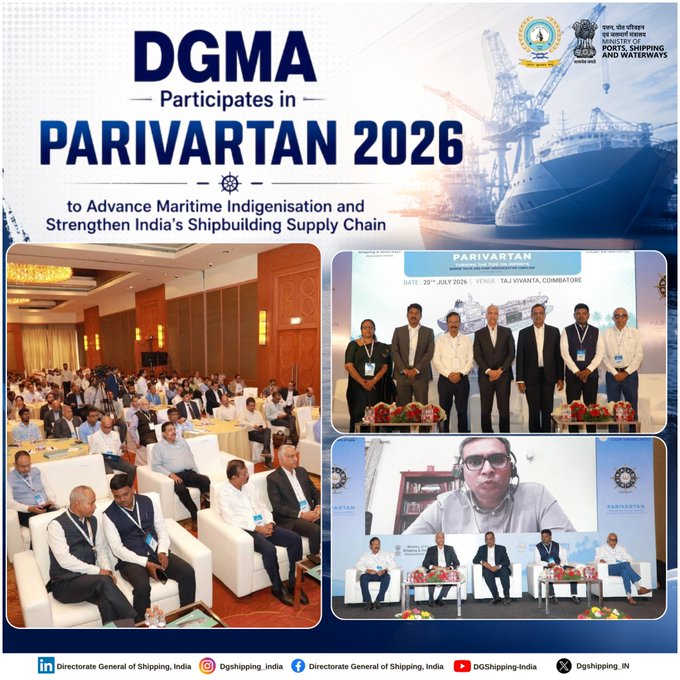
DGMA participates in PARIVARTAN 2026 to advance maritime indigenisation and strengthen India’s Shipbuilding Supply Chain

COIMBATORE : The Directorate General of Maritime Administration (DGMA) participated in PARIVARTAN 2026 – Marine Valves & Pumps Indigenisation Conclave, organised by Cochin Shipyard Limited (CSL) under the aegis of the Ministry of Ports, Shipping and Waterways (MoPSW), reaffirming its commitment to promoting indigenous manufacturing and strengthening India’s maritime industrial ecosystem.

DGMA was represented by Shri Ravi Kumar Moka, Ship Surveyor-cum-Deputy Director General (Technical), who joined senior representatives from shipyards, classification societies, the Indian Navy, industry associations, and leading manufacturers from across the country to deliberate on strategies for enhancing domestic capabilities in the shipbuilding sector.

The conclave focused on the indigenisation of marine valves, pumps, and allied equipment, which are among the critical components of the shipbuilding value chain. Participants explored avenues to accelerate domestic manufacturing, reduce import dependence, and build a resilient and globally competitive maritime supply chain.

Key discussions centred on demand aggregation through Government-supported maritime projects, challenges faced by domestic manufacturers, and policy interventions required to create an enabling ecosystem for indigenous production. Stakeholders also examined measures to improve collaboration between government agencies, industry, and technology providers to strengthen India’s shipbuilding capabilities.

The deliberations placed special emphasis on enhancing supply chain resilience, promoting technology adoption, ensuring certification and standardisation, and increasing the participation of Indian manufacturers in future shipbuilding and ship repair programmes. Participants highlighted that a robust domestic supplier base would be instrumental in improving competitiveness, reducing costs, and ensuring timely availability of critical marine equipment.

The conclave underscored the importance of closer collaboration among regulators, shipyards, classification societies, industry associations, technology providers, and manufacturers to accelerate the development of a self-reliant maritime manufacturing ecosystem.

The discussions are closely aligned with the objectives of the Maritime Amrit Kaal Vision (MAKV) 2047, which envisages India emerging as one of the world’s top five shipbuilding nations, while also advancing the Government of India’s vision of Atmanirbhar Bharat through greater domestic value addition, innovation, and industrial self-reliance.

As India’s apex maritime administration, DGMA reaffirmed its commitment to supporting policies and initiatives that foster indigenous manufacturing, strengthen the domestic shipbuilding supply chain, and create a globally competitive and sustainable maritime sector capable of meeting the country’s future growth aspirations.

SMP Kolkata marks major operational milestone with revival of coastal thermal coal handling at HDC

KOLKATA : Haldia Dock Complex (HDC) of Syama Prasad Mookerjee Port, Kolkata (SMP, Kolkata) has recorded a significant operational revival with the resumption of coastal thermal coal handling at the rejuvenated Mechanical Thermal Coal Handling Facility at Berth No. 3, after an interval of nine months. The vessel is currently loading approximately 27,100 Metric Tonnes (MT) of thermal coal on account of the Andhra Pradesh Power Development Company Limited (APPDCL). This marks the first coastal thermal coal shipment for APPDCL through HDC’s Mechanical Coal Handling Plant in about 9 months. Following its departure from Haldia, the vessel will proceed to Paradip Port before delivering its cargo to its final destination port at Krishnapatnam. This marks an important step in powering up coastal coal logistics through Haldia Dock Complex once again and reinforces HDC’s commitment to supporting the energy requirements of coastal power utilities. The revival of this facility is expected to enhance cargo throughput, improve turnaround time, and strengthen HDC’s position as a key hub for coastal shipping and energy logistics on the Eastern Coast.

Congratulating the team on this operational triumph, Shri Rathendra Raman, Chairperson, SMP, Kolkata, stated that: “The resumption of coastal thermal coal handling at Haldia Dock Complex’s Berth No. 3 is a testament to the dedication, engineering excellence, customer-centric approach and unwavering focus of our team at SMP Kolkata. Rejuvenating this mechanical facility allows us to enhance our logistics capabilities while playing a pivotal role in powering energy needs across India. I extend my heartiest congratulations to the entire team of Haldia Dock Complex led by Managing Director, Shri A. Jayasimha, Trade Partners & Unions whose tireless efforts made this key operational revival possible.”

Shri Raman, further stated that HDC will continue to scale new heights in port efficiency and service delivery

   .
        

Indian Railways sanctions Rs. 440 cr line expansion to support Heavy Freight & Mineral Logistics in Eastern Belt

KOLKATA : Indian Railways has approved the construction of a 14.52-km third railway line between Nimpura West Outer Cabin and Midnapur in South Eastern Railway at an estimated cost of Rs 440 crore.

The project is located on the High Utilisation Network (HUN-2) route. The Nimpura West Outer Cabin–Gokulpur section is currently a single line, while doubling works are underway. The third line is expected to increase capacity and improve operational flexibility on the corridor.

The section handles both passenger and freight traffic, including manganese, iron ore, containers, coal, clinker, pellets, steel, wheat, petroleum products, fertilisers, cement and other commodities.

The route currently handles nearly 23.80 million tonnes per annum (MTPA) of freight and has a line capacity utilisation of 115.71 percent.

The project is expected to accommodate an additional 3.52 MTPA of freight traffic, reduce congestion and improve the movement of essential commodities and passenger trains.

U.S. imposes 10% ‘forced labour’ tariffs on India

WASHINGTON : The U.S. had in February 2026 imposed a temporary 150-day 10% tariff on all of its trade partners, which expired on July 24. In March, the office of the U.S. Trade Representative had also launched two separate investigations under Section 301 of the Trade Act, 1974. Even as the U.S.’ temporary 10% tariffs come to an end, it has announced permanent tariffs related to its investigation into forced labour on 60 of its trading partners, including India. India’s tariff rate remains at 10% instead of the proposed 12.5%.

The second investigation, into whether other economies were using excess manufacturing capacity to export to the U.S. in a manner that was hurting the U.S. economy, is still pending and could result in further tariffs.

“President Trump recognises that decades of moral suasion have not eradicated forced labour from global supply chains,” U.S. Trade Representative Jamieson Greer said in a statement. “The United States has had a forced labour import ban for nearly a century, and rigorously enforces it; it’s well past time for our trading partners to do the same.”

“Today’s action will begin to correct what is both a human rights abuse and a distortive trade practice to improve the welfare of workers everywhere,” he added.

The draft report of investigation, released in June, had proposed a 12.5% tariff on 54 countries, including India, as they had “failed to impose and effectively enforce” prohibitions on the import of goods produced using forced labour. However, earlier this month, the Indian government released a notification banning the import of goods made using forced labour.

“I am encouraged by the trading partners who have moved quickly to adopt forced labour import prohibitions, and look forward to ensuring their effective enforcement,” Mr. Greer said in his statement.

As a result of India’s actions, it has now been included among the countries that will face a 10% tariff instead of 12.5% .These 10% tariffs will apply to countries that impose a forced labour import prohibition, have committed to impose and enforce such a prohibition through a trade agreement with the U.S., or have imposed a partial regime with the effect of preventing the import of certain forced labour goods.

These economies include India, Argentina, Bangladesh, Cambodia, Canada, Ecuador, El Salvador, Guatemala, Honduras, Indonesia, Jordan, Malaysia, Mexico, Pakistan, Sri Lanka, Trinidad and Tobago, and the United Kingdom.

The U.S. will impose a 12.5% tariff on all other countries that it has investigated.About 70% of India’s exports — including engineering goods, textiles and garments, chemicals, machinery, plastics, leather products, gems and jewellery, furniture and most other manufactured goods — will be subject to these 10% tariffs under Section 301 over and above the item-wise most-favoured nation (MFN) tariffs the U.S. levies on all its trading partners.

The Section 301 could potentially increase depending on the findings of the excess capacity investigation.

Products covered by Section 232 of the U.S. Trade Expansion Act, such as steel, aluminium, copper, auto components and certain derivative products, will continue to face 25% or 50% tariffs in addition to the normal U.S. MFN tariffs. These account for about 8% of India’s exports.

The U.S. Trade Representative has also exempted particular items from its latest 10% tariffs. These include raw materials that would become unavailable or cause economy-wide disruptions if the tariffs were imposed, and products that cannot be grown or produced in sufficient quantities or at reasonable prices in the U.S..

Further, certain products of Argentina, Bangladesh, Cambodia, Ecuador, El Salvador, the European Union, Guatemala, Indonesia, Jordan, Malaysia, Switzerland, Taiwan, and the United Kingdom have been exempted as they “would encourage these economies to fulfill commitments regarding forced labor import prohibitions”.

A few Indian industry and exporter bodies have reacted to the 10% tariff, with some saying that this would make Indian goods more expensive, and others saying that even if this were to happen, Indian goods are still competitively taxed and so India will not lose an edge.

“The fact that India has been placed in the lower 10% tariff category, while several competing exporting nations including China, Vietnam, Thailand, Türkiye, UAE, Brazil, South Africa and others face a higher tariff of 12.5%, reflects the recognition by the U.S. of the policy measures taken by the Government of India to strengthen its framework relating to forced labour,” S.C. Ralhan, president of the Federation of Indian Export Organisations said.

“This has helped India secure a relatively favourable position compared to many of its global competitors,” he added.

He added that several of India’s direct competitors in labour-intensive sectors such as textiles, garments, leather and footwear — including Bangladesh, Cambodia, Pakistan, Sri Lanka, Indonesia and Malaysia — have also been subjected to the same 10% tariff as India has.

“Consequently, Indian exporters largely retain their relative competitiveness in these sectors, as competing suppliers will face a similar duty incidence in the U.S. market,” Mr. Ralhan said.

Rajesh Rokde, chairman of the All India Gem and Jewellery Domestic Council is not as optimistic.

“The U.S. government’s decision… will undoubtedly create challenges for our gem and jewellery exporters, making Indian products less price-competitive in one of our largest markets,” Mr. Rokde said. “While the rate is lower than that imposed on some other countries, this measure still places significant pressure on margins and could dent the growth trajectory of our industry.”

India’s Services Exports reach record USD 421.3 Billion in FY 2025-26

NEW DELHI : Government Expands Global Market Access for Indian Service Providers Through FTAs and Trade Promotion Initiatives.

In order to enhance services exports, Government of India follows a multi-pronged strategy. It comprises the following:

Focused strategies for enhancing exports are undertaken for specific markets and sectors.
Domestic sectoral challenges impeding services exports are identified in consultation with the stakeholders and addressed through concerned departments/ ministries.

Through Free Trade Agreements
Government has secured comprehensive market access and national treatment in services to allow Indian service providers to provide services in key sectors on no less favourable terms through different modes such as cross-border (including digital mode), commercial presence in the FTA partner country and temporary movement of professionals to the partner country. India’s recent FTAs have incorporated disciplines on domestic regulation to ensure that authorisation processes for key services are time-bound, predictable, objective, impartial, and transparent. This ensures that Indian service suppliers do not face challenges in partner countries due to opaque, unpredictable or burdensome regulatory procedures. Through FTAs, India has been able to obtain structured, expedited routes that will facilitate temporary mobility of skilled Indian professionals to provide services in foreign markets.
Facilitative provisions for time-bound negotiations of Mutual Recognition Agreements (MRAs) between relevant professional bodies, to facilitate recognition of qualifications and associated licensing requirements. Such MRAs aim to ensure that partner nations accept each other’s certifications, and professionals do not have to go through duplicative local testing, additional training, or lengthy re-certification processes before they can practice.
· Some other beneficial provisions are highlighted below :-

India has secured supportive framework for Students in FTAs with Australia and New Zealand.
Supportive framework related to Social Security Agreements (SSA) to avoid double payments and ensure continuity of social security protection have been secured in recent FTAs such as India-Oman CEPA, the side letter on SSA provisions in India-New Zealand FTA, Double Contribution Convention in India-UK CETA, and in India-EU FTA. Based on the understanding arrived under the India- UK CETA, an agreement on Social Security Contributions was signed on Feb. 10, 2026. This Agreement will ensure that workers will not be required to pay double contributions towards their social security, when they work temporarily in each other’s territory.
Traditional Medicine: Dedicated provisions/ annexes are secured in agreements with Oman and EU.
Double Taxation related provisions negotiated in India-Australia ECTA, securing commitments to eliminate Double taxation on India’s IT services.
Trade promotion through schemes, and participation in and organization of international fairs/ exhibitions
SEPC, set up by the Department of Commerce, plays a key role in services trade promotion and undertakes market development, trade facilitation, policy advocacy, capacity building, buyer-seller engagement, international outreach and export-promotion activities across major services sectors. They are supported in this through financial assistance under the Export Promotion Mission of Government of India. Few of the recent activities undertaken by SEPC are highlighted below:

2nd edition of Medical Value Tourism (MVT) Summit on 4-5 April 2025 organised with Tamil Nadu government, featuring hospitals, wellness centres, AYUSH centres and medical institutions from Tamil Nadu.
Indian Pavilions in association with relevant ministries and departments: at the Arabian Travel Market (ATM) 2025, from 28 April to 1 May 2025 at the Dubai World Trade Centre, Dubai; at Global Education & Training Exhibition (GETEX) held from 30th April 2025 – 2nd May 2025 at Dubai International Convention & Exhibition Centre, Dubai, UAE; at MIPCOM 2025 in Paris, France from 13-16 October 2025 on the theme “Waves Bazaar”; at Malaysia Health & Pharma Expo from 7-9th October 2025 in Kula Lumpur, Malaysia; at Tokyo Games Show from 24-26 September 2025 at Tokyo, Japan; and at GAMESCOM 2025 from 20-24th August 2025 at Cologne, Germany showcasing Indian companies’ capabilities in gaming and entertainment segments.
Organised events such as Future-Ready Logistics in India on 29th August 2025; International Conference on Transforming Higher Education & Skilling towards Viksit Bhat@2024 & Education Excellence Awards 2025 on 19th September 2025; Finolegal Convergence Summit 2025 on 5th December 2025 on the theme: “Regulation. Innovation. Globalization– Building India’s Legal–Fintech Edge”; and a National Dialogue on School Education Building Future- Ready Learners for a Skilled India on 13th December 2025 at New Delhi.