Home Blog Page 205

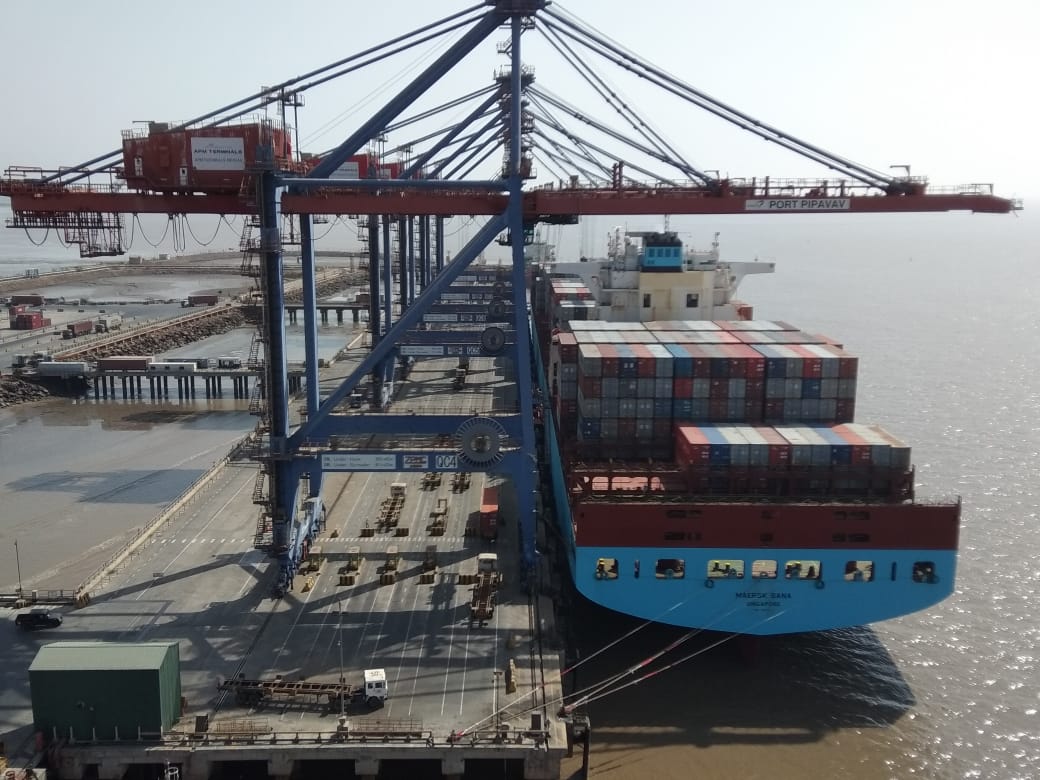
Adani Ports & SEZ, Gujarat Pipavav Port report higher container volumes in Q1 FY27

AHMEDABAD : Container cargo remained resilient at Indian ports in the first quarter of FY27 despite heightened geopolitical tensions in West Asia, with Adani Ports and Special Economic Zone (APSEZ) and Gujarat Pipavav Port reporting growth in container volumes even as the US-Iran conflict raised concerns over shipping through the Strait of Hormuz, one of the world’s busiest maritime trade routes.

The resilience was reflected across the broader port sector, with container volumes at India’s 12 major ports rising 9 per cent year-on-year during the April-June quarter of FY27, indicating steady demand for containerised trade despite concerns over disruptions to global shipping routes.

APSEZ handled 138.1 million metric tonnes (MMT) of cargo during the April-June quarter, up 15 per cent year-on-year, driven by an 18 per cent increase in container volumes and a 12 per cent rise in liquid cargo. During June alone, the country’s largest private port operator handled 46.8 MMT of cargo, a 13 per cent increase over the year-ago period, supported by 18 per cent growth in containers and an 11 per cent rise in liquid cargo.

Gujarat Pipavav Port reported a 2.4 per cent increase in container throughput to 168,000 TEUs during the quarter from 164,000 TEUs a year earlier. However, dry bulk cargo declined to 0.52 million tonnes from 0.55 million tonnes, while liquid cargo nearly halved to 0.22 million tonnes from 0.41 million tonnes.

The port’s roll-on/roll-off (RoRo) business remained a bright spot, with vehicle volumes rising to 65,000 units from 42,000 units in the corresponding quarter last year. The resilience in container volumes came despite heightened concerns over maritime trade as tensions in West Asia increased risks to shipping through the Strait of Hormuz, a critical artery for global trade.

On the logistics side, APSEZ’s rail volumes fell 19 per cent year-on-year to 145,310 TEUs during the quarter. Gujarat Pipavav also reported weaker rail-linked operations, with container trains handled declining to 346 from 447 a year earlier, while containers moved by rail fell to 88,000 TEUs from 99,000 TEUs.

Source : BL

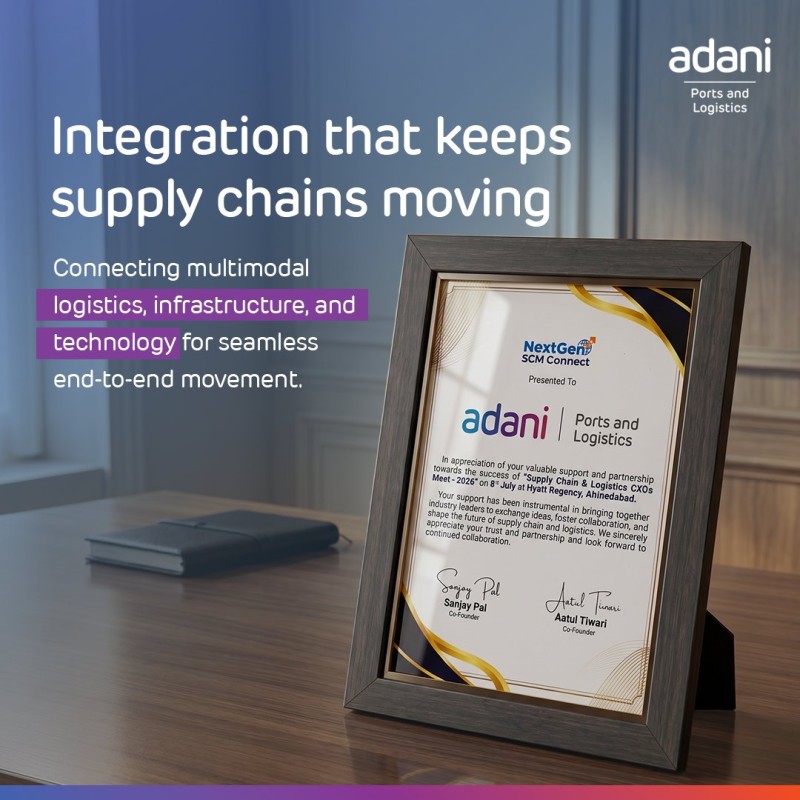
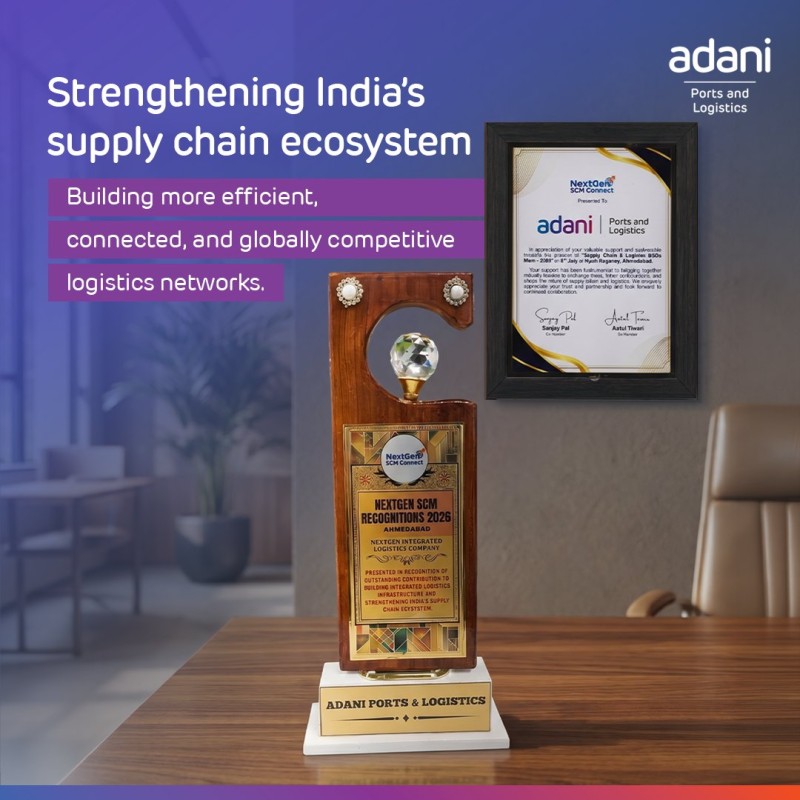
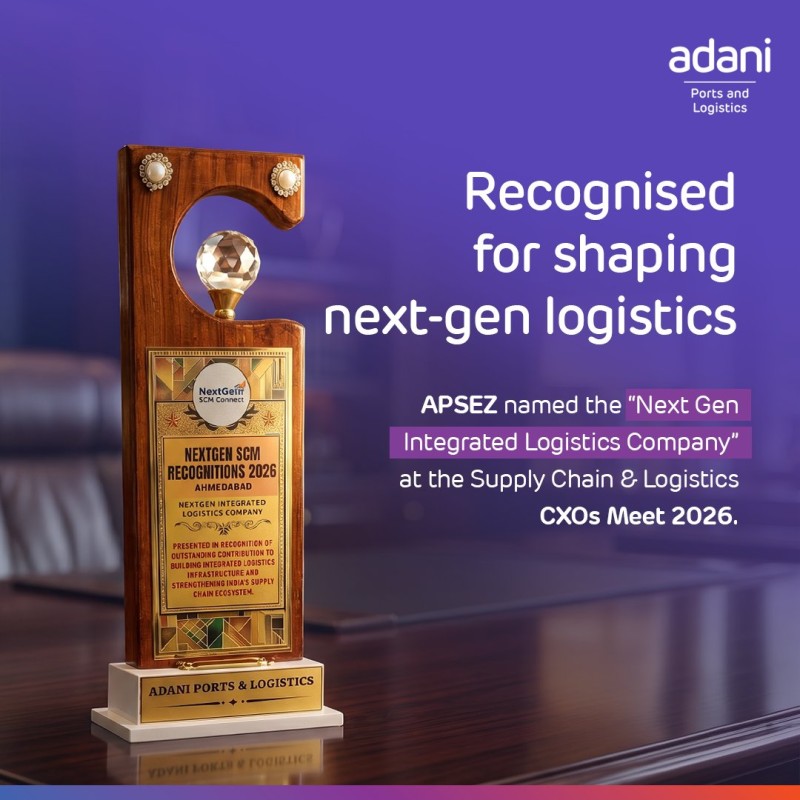
Adani Ports and SEZ recognised as “Next Gen Integrated Logistics Company” at Supply Chain & Logistics CXOs Meet 2026

AHMEDABAD : Adani Ports and Special Economic Zone Ltd. (APSEZ), India’s largest integrated transport utility and the country’s leading private port operator, has been honoured with the prestigious “Next Gen Integrated Logistics Company” award at the Supply Chain & Logistics CXOs Meet 2026 held here.

The recognition highlights APSEZ’s continued efforts to transform India’s logistics landscape through an integrated, technology-driven approach that seamlessly connects ports, logistics parks, rail, road, warehousing, and last-mile cargo movement. The award reflects the company’s commitment to delivering end-to-end supply chain solutions that enhance operational efficiency, reduce transit times, and improve cost competitiveness for customers.

With a rapidly expanding nationwide logistics network, APSEZ has been strengthening multimodal connectivity by integrating port operations with inland logistics infrastructure, container terminals, freight corridors, and value-added logistics services. These initiatives support India’s growing manufacturing and export sectors while contributing to the country’s vision of developing a world-class logistics ecosystem.

Expressing gratitude for the recognition, the company stated that the award is a testament to the dedication of its teams, partners, and customers who continue to drive innovation and operational excellence across the logistics value chain.

The honour further reinforces APSEZ’s position as a leading integrated logistics provider, playing a pivotal role in improving supply chain resilience, facilitating trade, and supporting India’s ambition to become a global manufacturing and export hub.

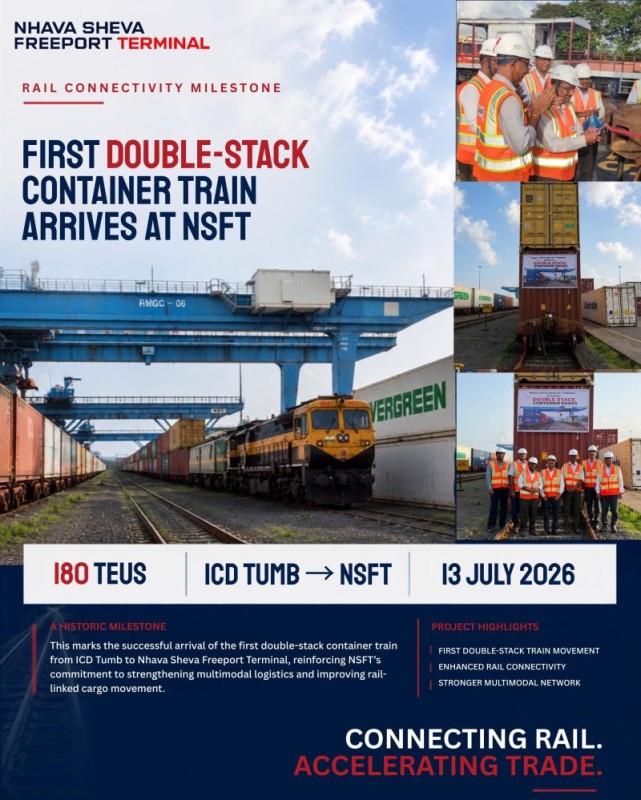
NSFT receives first double-stack container train from ICD Tumb, strengthening rail connectivity

MUMBAI : Nhava Sheva Freeport Terminal (NSFT) has achieved another significant milestone in its rail connectivity journey with the successful arrival of its first double-stack container train from ICD Tumb on 13 July 2026.

The inaugural train carried 180 TEUs, marking an important advancement in the terminal’s efforts to strengthen rail-based cargo evacuation and promote seamless multimodal logistics. The development is expected to enhance supply chain efficiency by enabling faster, more reliable, and cost-effective movement of containers between inland cargo hubs and the gateway port.

The introduction of double-stack rail services reflects the growing emphasis on rail as a sustainable and high-capacity mode of freight transportation. By leveraging India’s expanding Dedicated Freight Corridor (DFC) network and modern rail infrastructure, NSFT is further improving hinterland connectivity while reducing road congestion, transit times, and carbon emissions.

The milestone reinforces NSFT’s commitment to supporting India’s logistics transformation through integrated port-rail operations, improved cargo accessibility, and enhanced service reliability for exporters, importers, and logistics partners. Strengthened rail connectivity also enables smoother cargo flows, increased terminal productivity, and greater operational efficiency across the supply chain.

As India’s trade volumes continue to grow, NSFT remains focused on expanding its multimodal logistics capabilities, strengthening links between inland container depots and the terminal, and delivering faster, smarter, and more sustainable cargo movement solutions.

Connecting Rail. Accelerating Trade.

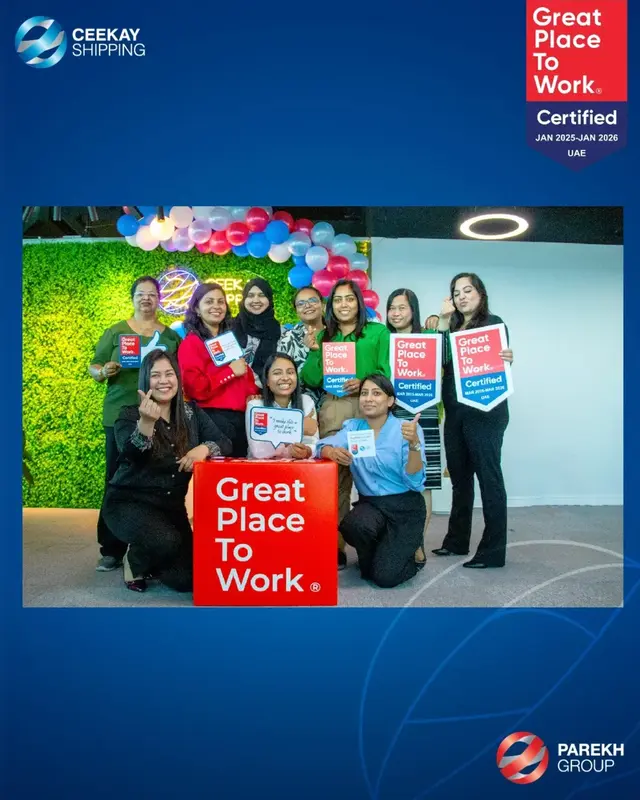
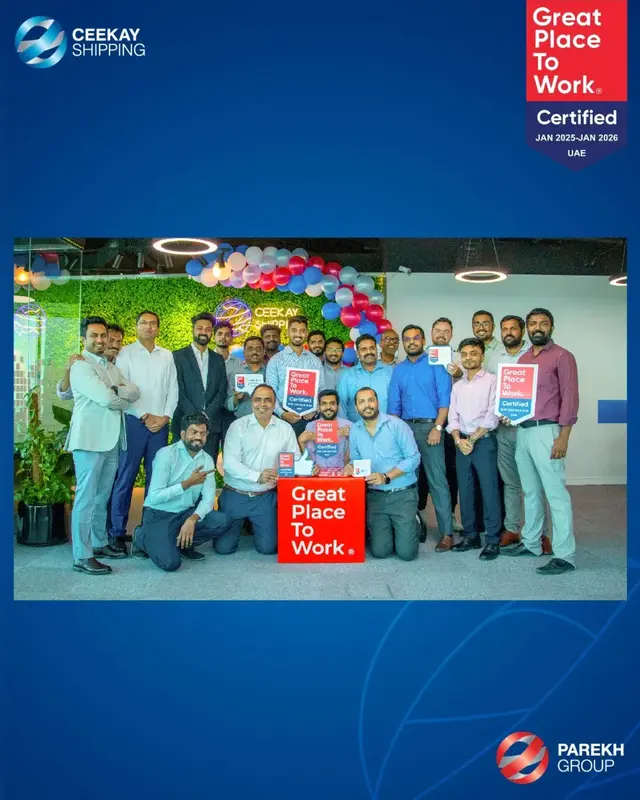
Ceekay Shipping Earns Great Place to Work® Certification, Reinforcing Its People-First Growth Strategy

MUMBAI: Ceekay Shipping, one of the companies under the Parekh Global umbrella, has been certified as a Great Place to Work®, reinforcing its belief that a strong workplace culture is fundamental to long-term business success. The globally recognised certification is based on confidential employee feedback and an independent assessment of workplace practices across parameters such as credibility, respect, fairness, pride and camaraderie.

The recognition reflects Ceekay Shipping’s continued focus on building a workplace culture rooted in trust, collaboration, transparency and professional growth. As the shipping and logistics industry evolves rapidly, organisations are increasingly recognising that investing in people is critical to driving operational excellence, customer satisfaction, innovation and sustainable growth.

In an industry where success depends on seamless coordination, reliability and responsiveness, employee engagement has emerged as a key business differentiator. Ceekay Shipping has consistently focused on creating an environment where employees are empowered to contribute, learn and grow while remaining aligned with the company’s long-term vision and values.

As part of the Parekh Global ecosystem, Ceekay Shipping benefits from a people-centric philosophy that prioritises continuous learning, cross-functional collaboration, leadership development and transparent communication. These efforts have helped foster a workplace culture that supports both individual growth and organisational performance.

Commenting on the recognition, Mr Naresh Parekh, Director, Parekh Global, said, “This certification is a reflection of the trust our employees place in the organisation and the culture we have built together over the years. At Parekh Global, we believe that business success is built on strong relationships, shared values, and empowered teams. As we continue to expand globally, our commitment to creating a workplace where people can learn, grow, and thrive remains unwavering.”

Mr Yogesh Parekh, Director, Parekh Global said, “Sustainable growth is created when people feel trusted, valued, and aligned with a common purpose. This recognition encourages us to continue investing in our workforce and building an organisation that is resilient, future-ready, and focused on delivering long-term value to customers and stakeholders.”

The certification marks an important milestone in Ceekay Shipping’s growth journey and reflects its commitment to creating a workplace where employees feel valued, supported and inspired to perform at their best. As the company continues to strengthen its capabilities and expand its presence, it remains focused on nurturing a culture that enables both people and business to thrive.

Centre to ban import of goods made using forced labour amid US probe

NEW DELHI : India has amended its foreign trade policy to prohibit the import of goods that are produced through the use of forced labour. The move is likely to help address concerns raised by the United States in an ongoing trade investigation, under which it has threatened to impose 12.5 per cent tariffs on imports of goods from India and several other countries.

The Directorate General of Foreign Trade (DGFT) has issued a gazette notification dated July 13, 2026 in this regard. “The import of goods produced or manufactured, wholly or in part, through the use of forced labour is prohibited,” reads the notification, which was made public on Tuesday. The notification will come into force after 30 days.

“The order establishes a legal framework rather than an immediate import ban. Its effectiveness will depend on how the government conducts investigations, the evidence required to establish forced labour, and the products it ultimately targets,” said Ajay Srivastava, Founder of the Global Trade Research Initiative (GTRI).

The move comes as major economies tighten restrictions on goods linked to forced labour. The US has launched Section 301 investigations covering about 60 economies, including India, and has proposed a 12.5 per cent tariff on imports from India and most other countries under review.

The European Union and Pakistan are proposed to face a lower 10 per cent tariff after introducing domestic measures to prohibit imports made with forced labour.

Against this backdrop, India’s notification signals that it is strengthening its domestic legal framework in line with international standards, a step that could strengthen its position in future trade negotiations and market-access discussions.

“India’s notification is a sensible first step, but its credibility will ultimately depend on enforcement. The real challenge is proving that a product is made with forced labour when production spans multiple countries and opaque supply chains,” said Srivastava.

While the notification does not specify particular products or countries, it gives the government the legal authority to act whenever such concerns arise. The step is expected to promote fair trade, protect workers’ rights and ensure that imported goods meet acceptable labour standards.

The US considers products such as cotton, textiles, solar-panel polysilicon, seafood, metals, batteries and electronics vulnerable to forced-labour risks.

13 Indians killed in Middle East since US-Iran conflict broke out in Feb 28; 3 still missing

NEW DELHI : India has summoned the Iranian deputy envoy to lodge a strong protest and demanded an immediate halt to strikes on commercial shipping.

The ongoing conflict and attacks threaten an interim peace deal, while mediators in Qatar are attempting to facilitate negotiations between the US and Iran.

US President Donald Trump said the United States will reinstate the blockade of Iranian ports and impose toll on ships passing through the Strait of Hormuz.

At least 13 Indians have been killed since the deadly US-Iran conflict broke out in February 28, reveals official sources cited by ANI.

This revelation comes as MEA Spokesperson Randhir Jaiswal said that Indian seafarers suffered the highest number of death in attacks on commercial shipping. However, he did not give the exact number of deaths.

In response to the recent deaths of seafarers, India on Tuesday said it is closely monitoring the situation in the Middle East. The MEA has sought safe and unimpeded navigation and flow of commerce through the Strait of Hormuz. This is key for ensuring energy and economic security of people across the world,” Jaiswal said.

One of the ships, MT Al Bahiyah, which came under attack had 12 seafarers on board and one Indian was killed. Another ship, MT Mombasa, had 18 Indians aboard and nine of them were seriously injured.

“We strongly condemn these attacks and acts of violence targeting seafarers and disrupting free and safe navigation through international waterways like the Strait of Hormuz,” the MEA said in a statement.

India has summoned the Iranian deputy envoy to lodge a strong protest, demanding an immediate halt to strikes on commercial shipping. “The Deputy Chief of Mission of the Embassy of Iran in New Delhi was summoned this morning by the Ministry of External Affairs and a strong protest against these attacks was lodged with him,” the MEA said.

US President Donald Trump said the United States will reinstate the blockade of Iranian ports and impose toll on ships passing through the Strait of Hormuz.

The exchange of fire from both sides has threatened the interim peace deal, which is now nearly halfway through the 60-day period during which the negotiators were supposed to reach a final agreement.

Meanwhile, mediators in Qatar are trying to get both Washington and Tehran to return to the negotiating table.

Attacks on commercial vessels “must cease”: India lodges “strong protest” over Hormuz strikes

NEW DELHI: India on Tuesday strongly protested the strikes on commercial ships, describing them as aggressive acts directed at crew members that jeopardise the unhindered and secure passage of shipping traffic across global sea lanes such as the Strait of Hormuz.

The official response was released by the Ministry of External Affairs (MEA) soon after South Block called in the Iranian Embassy’s Deputy Chief of Mission in New Delhi to register a “strong protest” regarding the targeted strike on two ships navigating the Strait of Hormuz, an incident that resulted in the death of one Indian sailor and left multiple crew members wounded.

According to the official release, the MEA conveyed its “deep concern” regarding the restart of maritime strikes and the intensifying friction across West Asia, calling for a swift end to hostilities alongside a return to negotiations and diplomatic engagement to safeguard regional tranquillity, safety and stability.

The ministry further underlined that strikes directed at commercial shipping vessels and non-military installations across the region “must cease” to ensure that unrestricted, unhindered transit and maritime trade across global shipping channels can be restored swiftly, in line with international legal frameworks.

Elaborating on the scale of the incident, the Ministry of External Affairs (MEA) noted that India was “deeply concerned” by the strikes launched against MT Al Bahiyah and MT Mombasa.

The ministry noted that both ships carried an aggregate of 30 Indian sailors out of a total complement of 46 personnel.

Sharing specific casualty data, the MEA reported that one Indian citizen out of the 12 serving on MT Al Bahiyah lost his life, while another sustained injuries.

Out of the 18 Indian nationals deployed on MT Mombasa, nine crew members suffered injuries, with two individuals currently stated to be in a critical condition.

Conveying the government’s sorrow, the ministry offered its “deepest condolences” to the family of the deceased sailor while wishing a speedy recovery to the injured personnel.

The MEA noted that India’s diplomatic mission and consulate in the UAE are monitoring developments closely and remain in constant communication with the Emirati authorities to ensure the delivery of all necessary assistance to the affected Indian sailors.

Highlighting the immediate diplomatic measures initiated by New Delhi, the ministry detailed that India on Tuesday summoned the Iranian Embassy’s Deputy Chief of Mission in New Delhi to lodge a “strong protest” over the missile strike on the two ships transiting the Strait of Hormuz, which caused the death of one Indian sailor and injured several others.

“The Deputy Chief of Mission of the Embassy of Iran in New Delhi was summoned this morning by the Ministry of External Affairs and a strong protest against these attacks was lodged with him,” the statement read.

“Closely monitoring situation”: Indian Embassy in UAE condoles sailor’s death in Hormuz tanker attack

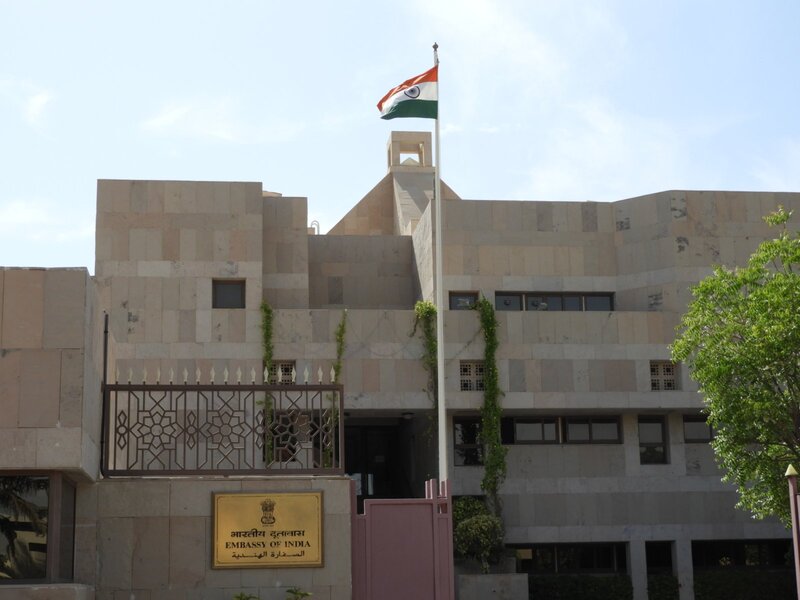
ABU DHABI: Expressing deep grief over the incident, the Indian Embassy in the United Arab Emirates (UAE) condoled the loss of life of the Indian seafarer and said that it is closely monitoring the situation.

In a post on X, the Embassy stated, “We condole the tragic loss of an Indian seafarer in the attacks on two vessels, Al Bahiyah & Mombasa B. We are closely monitoring the situation and are in touch with the local authorities to render all possible assistance to the injured and families.”

Following the incident, India lodged a strong protest with Iran over the attack on Indian seafarers in Hormuz.

India today summoned Iranian diplomats, including Deputy Chief of Mission (DCM) Mohammad Javad Hosseini, following the latest attack on United Arab Emirates (UAE) merchant vessels in the Strait of Hormuz, which killed one Indian and injured several others.

Detailing the casualties, an Indian sailor was killed and six others were injured after a strike by Iran on the UAE oil tankers in the Strait of Hormuz on Tuesday. Following this, the Ministry of External Affairs (MEA) summoned the Iranian envoys to convey New Delhi’s serious concerns.

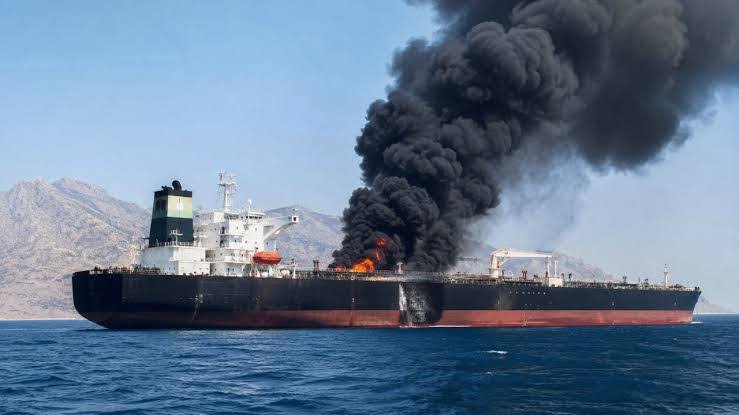
Providing operational details of the strike, maritime reports indicated that two UAE tankers were hit by two Iranian cruise missiles in the Strait of Hormuz in Omani territorial waters. The tankers, Mombasa and Al Bahiyah, were struck while transiting the southern passage of the Strait of Hormuz.

Regarding the impact on the vessels, the UAE’s Ministry of Defence said the attack also caused material damage to both tankers after fires broke out on board. The ministry confirmed that the fires have since been brought under control due to swift emergency responses.

Condemning the aggression, the Ministry of Defence strongly condemned the attack, describing it as a serious violation of international law that threatens regional security and stability. Asserting its sovereignty, the ministry said the UAE reserves the full right to respond to the escalation and will take all necessary measures to protect its territory, people, residents, national interests and strategic assets.

Reiterating its defensive readiness, the ministry added that it remains fully prepared to deal with any threats and urged the public to obtain information only from official sources and refrain from spreading rumours or unverified information.

After Hormuz, Iran turns to Red Sea gateway as new pressure point

BEIRUT : Having choked off shipping through the Strait of Hormuz, Iran is now signaling it could play its most dangerous card yet: using Yemen’s Houthi allies to shut the Bab el-Mandeb Gateway ​to the Red Sea, opening a new front against Washington and putting two of the world’s most vital energy arteries at risk.

As U.S. strikes deepen inside Iran and Houthi attacks ‌escalate in tandem, analysts say Tehran is widening the conflict and seeking to increase pressure on Washington by extending the threat to global trade and energy supplies beyond the Gulf.

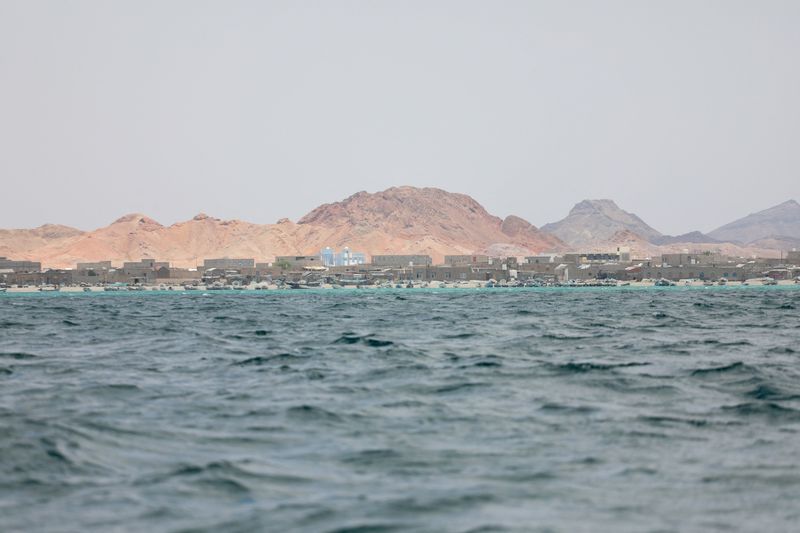
Iran has already demonstrated the power of its most valuable strategic asset by disrupting traffic through Hormuz. Now it appears ready to open a second pressure point at Bab el-Mandeb, the narrow waterway linking the Red Sea to the Gulf of Aden through which Saudi oil exports and a substantial share of global ​shipping pass.
A senior Yemeni official warned on Monday that the country’s armed forces were prepared to close the Bab el-Mandeb Strait – a move he said could send oil prices soaring to $200 ​a barrel – if Saudi Arabia continued to attack Yemen, according to a report on Iran’s Press TV website.

Mohammed al-Farah, a member of the political bureau ⁠of Ansarullah, the Houthi resistance movement, said Washington was inciting Saudi Arabia to strike Yemen and that such a provocation would never be in the interest of the United States.
“If the current situation aggravates, ​the Bab el-Mandeb Strait and the Strait of Hormuz will be closed in an operational alliance. Oil prices would then skyrocket to $200 a barrel in a dreadful shock,” he warned.

If Hormuz is Tehran’s strongest strategic ​lever, Bab el-Mandeb may be its last major reserve, analysts said.
“Iran is willing to go all the way,” Middle East scholar Fawaz Gerges told Reuters. He said Tehran was showing Washington it could threaten both chokepoints simultaneously, transforming the conflict from a bilateral confrontation into a challenge to the sea lanes underpinning global energy trade.

“Now (Tehran) is escalating both near and wide. The message is that not only Hormuz, but Bab al-Mandab, is at risk.”
‘MISSION CREEP’
The danger, analysts say, is less ​an immediate return to all-out war than a slow but relentless “mission creep” in which each side raises the stakes without crossing into direct confrontation.
As the conflict spreads from the Gulf to the Red Sea, ​the growing threat to trade and energy supplies could also increase pressure on Washington and Tehran to return to negotiations before the world’s two most important oil chokepoints become the conflict’s defining battleground.

Dennis Ross, a former U.S. Middle ‌East peace negotiator, ⁠said from Washington’s point of view, “the issue is, how do you change the Iranian calculus to the point where they’re ready, again, to talk, but not just to talk, but actually to work out an arrangement that is … acceptable.”

HOUTHI ATTACKS ON COMMERCIAL SHIPPING
The Houthis have already shown they can choke global commerce through the Bab el-Mandeb. After the Gaza war erupted in October 2023, the Iran-backed group launched attacks on commercial shipping in the Red Sea, saying it was targeting vessels linked to Israel in support of Palestinians.

The campaign forced major shipping companies to reroute vessels around southern Africa, raising transport costs, and prompted U.S. and ​British airstrikes as well as a multinational naval ​mission to protect shipping. Andreas Krieg, a senior lecturer ⁠at King’s College London’s School of Security Studies, described the latest Houthi threat as “another nuclear option” for Iran after Hormuz — one it would deploy only if the Islamic Revolutionary Guard Corps concluded that a return to all-out war had become unavoidable.
But he warned that if Washington intensified strikes on Iran’s critical infrastructure, ​Tehran could respond by using its Yemeni allies to close Bab el-Mandeb, compounding the economic shock already caused by the Strait of Hormuz.

Abdulaziz Sager, chairman ​of the Saudi-based Gulf Research ⁠Center, said Gulf states increasingly believe diplomacy with Iran has reached its limits, despite the high cost that any wider confrontation would impose on the region.
“Both a victorious Iran and a defeated Iran carry consequences for the region,” said Sager, adding that “many Gulf states may consider the costs of the latter to be more acceptable if they lead to a more stable regional security environment”.

He said the Houthis retain the capability to disrupt navigation ⁠through Bab ​el-Mandeb but are unlikely to escalate without clear direction from Tehran. Any Houthi attempt to threaten shipping, he added, could trigger ​a broader military response from the United States and its partners aimed at significantly degrading the group’s capabilities. The war, launched in late February by the U.S. and Israel, has destabilised the Gulf and spread across the region, with Iran attacking U.S. bases in ​multiple countries. Thousands of people have been killed in the war, mainly in Iran and Lebanon.

As BRICS highlights Safer Transport Systems, Kataline showcases Road Safety Infrastructure in Nagpur

NAGPUR: With the successful conclusion of the 3rd BRICS Transport Ministers’ Meeting in Nagpur, discussions on resilient infrastructure, safer mobility and sustainable transport have reinforced the growing importance of investing in road safety infrastructure. The meeting concluded with the Nagpur Declaration, reaffirming the commitment of BRICS nations to build future-ready transport systems through innovation, collaboration and sustainable infrastructure development.

Reflecting these priorities, Kataline Limited has completed comprehensive road safety infrastructure works across several strategic corridors in Nagpur. The project included advanced cold plastic road markings for horizontal signages, speed reduction, driver alert and traffic management solutions designed to improve road visibility, enhance lane discipline and support safer mobility for all road users.

BRICS 2026 BUS STOP 1 As BRICS highlights Safer Transport Systems, Kataline showcases Road Safety Infrastructure in Nagpur

Kataline deployed its high-performance cold plastic road marking system, recognised for its superior durability, excellent visibility and long service life under heavy traffic conditions on high-speed highways and urban road networks where safety and performance are critical.

The discussions during the BRICS Transport Ministers’ Meeting highlighted road safety as a shared priority for rapidly growing economies, emphasizing resilient infrastructure, intelligent transport systems and sustainable mobility solutions. As India’s transport infrastructure continues to evolve, investments in high-quality road markings and traffic management systems remain essential for improving safety, reducing traffic conflicts and supporting efficient mobility.

Quote from Amit Thatte, Managing Director, Kataline Limited

“Safe and efficient transportation begins with well-designed road infrastructure. Road markings, horizontal signages and traffic management systems play a vital role in guiding road users, improving visibility and enhancing overall road safety. As cities continue to modernize and invest in resilient transport networks, the importance of durable and high-performance road safety solutions will only grow. At Kataline, we remain committed to supporting this transformation through innovation, quality and engineering excellence.”

About Kataline Limited

Kataline Limited is a leading road safety solutions company with over 25 years of experience in manufacturing and implementing road marking materials, traffic management systems and road safety products. The company has successfully executed projects across highways, expressways, airports, urban infrastructure and industrial facilities in India and more than 35 countries. Through innovative technologies and high-performance solutions, Kataline continues to contribute towards building safer, smarter and more sustainable road networks.