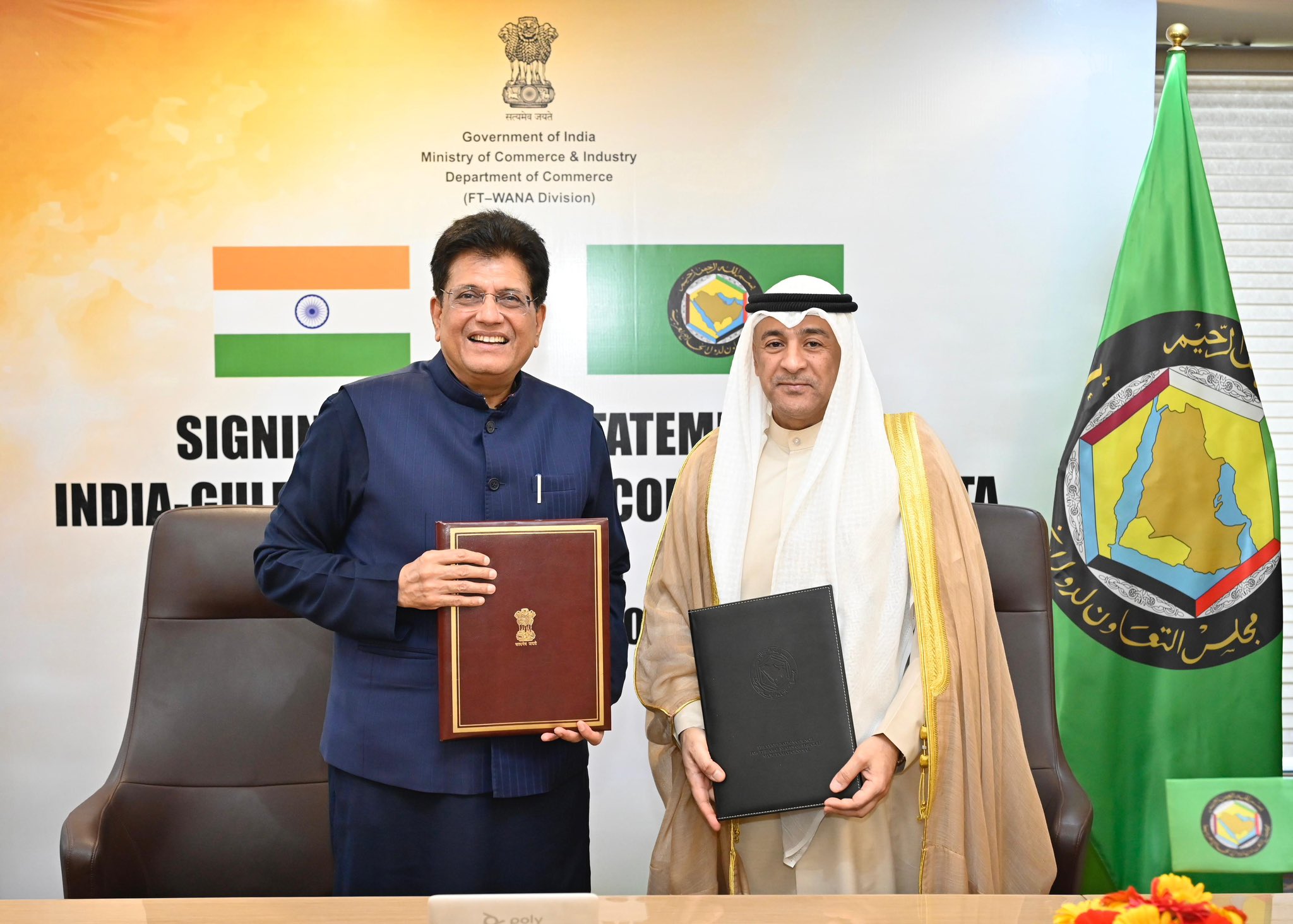
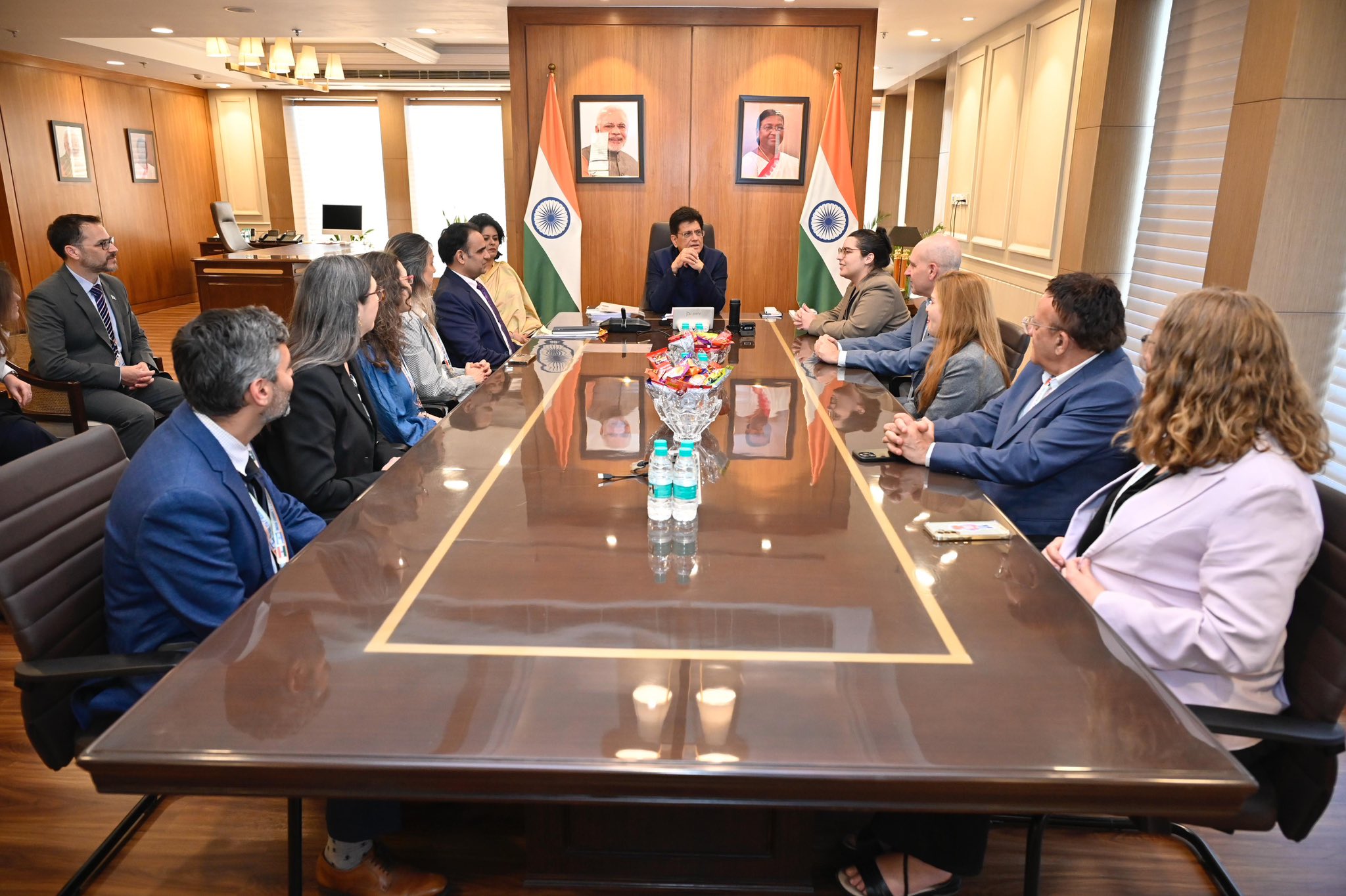
NEW DELHI : The Joint Statement on the India-GCC Free Trade Agreement (FTA) was signed between Shri Piyush Goyal, Union Minister of Commerce and Industry and His Excellency Jasem Mohamed Albudaiwi, Secretary General of the Gulf Cooperation Council on 24th February 2026 in New Delhi formally launching negotiations for a comprehensive and mutually beneficial agreement. The signing took place in the presence of the distinguished delegations and representatives of both the parties.
During the signing, Shri Piyush Goyal emphasized that the Statement along with the Terms of Reference (ToR) for FTA which were signed on 5thFebruary, 2026, mark a significant milestone in the relationship between India and GCC countries. He underscored that the relationship which is deeply rooted in shared history and cultural linkages, would get further impetus from a broad-based and mutually beneficial FTA. Heunderlined that amidst global uncertainties, it is most opportune that discussions are starting on negotiating a robust trading arrangement which would harness mutual synergies and complementarities.
His Excellency Jasem Mohamed Albudaiwi emphasized that FTA will serve as an important tool to further strengthen trade and investment ties between India and GCC countries by infusing predictability and certainty for businesses.
The FTA holds significant potential to unlock and expand trade with an important region, with which India has longstanding historical ties in trade and commerce. GCC is India’s largest trading partner bloc with bilateral trade reachingUSD 178.56 billion (Exports: USD 56.87 billion; Imports: USD 121.68 billion) in FY 2024-25, accounting for 15.42% of India’s global trade. In the last five years, India’s trade with the GCC has expanded steadily, registering an annual average growth rate of 15.3 per cent.
Key exports from India to GCC include engineering goods, rice, textiles, machinery, gems and jewelry. Key sectors of imports from GCC primarily comprise crude oil, LNG, petrochemicals, and precious metals such as gold. Collectively, the GCC countries represent a market of 61.5 million people (2024) and US$ 2.3 trillion in terms of GDP at current prices, ranking 9th globally in this category. The GCC region is also a significant source of FDI for India, with cumulative investments exceeding USD 31.14 billion as on September 2025.
The GCC is also home to nearly ten million members of the Indian community acting as a living bridge between both countries. These strong and enduring people-to-people connections form the foundation of the relationship between India and GCC countries, which is further reinforced by the substantial presence of Indian companies across the region.
The India–GCC FTA is expected to unlock the full potential of trade between India and the GCC upon signing and would be a force multiplier for global good, while facilitating the expansion and diversification of exports and strengthening economic integration between the two sides.
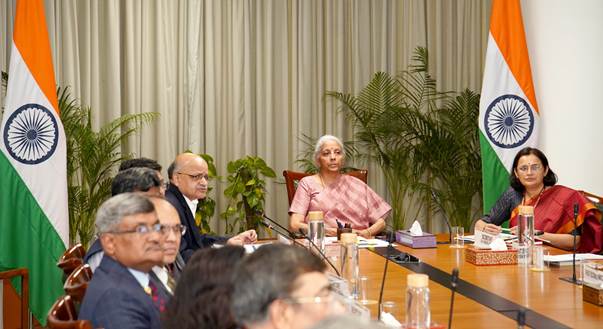
NEW DELHI : Union Minister for Finance and Corporate Affairs Smt. Nirmala Sitharaman launched the second phase of asset monetisation pipeline of Central ministries and public sector entities – ‘National Monetisation Pipeline 2.0 (NMP 2.0)’. The second phase of the pipeline has been developed by NITI Aayog, in consultation with infrastructure line ministries, based on the mandate for ‘Asset Monetisation Plan 2025-30’ as announced in the Union Budget 2025-26.
The NMP 2.0 estimates aggregate monetisation potential of ₹16.72 lakh crore, including private sector investment of ₹5.8 lakh crore under asset monetisation pipeline of Central ministries and public sector entities, over the five-year period from FY 2026 to FY 2030.
NMP 2.0 was released in presence of CEO, NITI Aayog and Secretaries of infrastructure line ministries included under the pipeline — Road Transport and Highways, Railways, Power, Petroleum and Natural Gas, Civil Aviation, Ports Shipping and Waterways, Telecommunications, Tourism, Food and Public Distribution, Mining, Coal and Housing and Urban Affairs — along with the Secretaries of Ministry of Finance, Secretary Law, and the Chief Economic Adviser.
In her address at the launch, the Union Finance Minister complimented all the ministries/ departments of the Government and NITI Aayog for meeting nearly 90% of the target of Rs. 6 lakh crore set for 4 years in the implementation of NMP 1.0.
Smt. Sitharaman said that the NMP 2.0 is aligned with the mission of achieving Viksit Bharat through accelerated infrastructure development and that the NMP has the potential to fuel India’s growth momentum.
The Union Minister of Finance observed that the NMP 1.0 was the first of its kind of pipeline at a large scale, and best practices learnt by the authorities concerned should be leveraged in NMP 2.0. Smt. Sitharaman underscored that the learnings and experiences of NMP 1.0 will serve as a guide to ensure that resources and opportunities are optimised to achieve results in a time-bound manner. The Union Finance Minister exhorted all the departments to focus on process simplification and standardisation so that monetisation becomes a seamless experience.
Smt. Sitharaman also noted that the five-year asset monetisation target has been set at an ambitious Rs. 16.7 lakh crore, over 2.6 times higher than that under NMP 1.0, and added that the Ministries/Departments must aim to surpass the indicated targets through proactive efforts.
Highlighting the significance of asset monetisation, the Union Finance Minister said NMP enables recycling of productive public assets, thereby unlocking resources for reinvestment in new projects and capital expenditure. She noted that this approach facilitates efficient mobilisation of funds for CAPEX in public assets while minimising budgetary outgo of the Government.
NMP 2.0 is a culmination of insights, feedback and experiences consolidated through multi-stakeholder consultations undertaken by NITI Aayog, Ministry of Finance and line ministries. Several rounds of discussion have been held by NITI Aayog with the stakeholders. This is a whole of a government initiative.
An empowered Core Group of Secretaries on Asset Monetisation (CGAM) under the chairmanship of Cabinet Secretary will continue to monitor the progress of the Asset Monetisation programme. The Government is committed to making the asset monetisation programme, a value accretive proposition both for public sector and private investors/developers, through improved infrastructure quality and operations & maintenance.
About National Monetisation Pipeline 2.0
The Union Budget 2025-26, building on the success of the first Asset Monetisation pipeline, identified monetisation of operating public infrastructure assets as a key means for sustainable infrastructure financing. Towards this, the Budget provided for preparation of a ‘National Monetisation Pipeline 2.0 (NMP 2.0)’. NITI Aayog in consultation with infra line ministries has prepared the report on NMP 2.0.
NMP 2.0 aims to provide a medium-term roadmap of the programme for public asset owners; along with visibility on potential assets to private sector. Report on NMP 2.0 is structured as a guidance book, detailing the methodology, and roadmap for monetisation.
Framework: NMP 2.0 shall broadly follow the concept of asset monetisation as laid out in NMP 1.0. Asset monetisation shall comprise elements such as transfer of assets for a limited period, divestment of portions of listed entities to unlock additional capital, securitisation of cash flows or strategic commercial auctions.
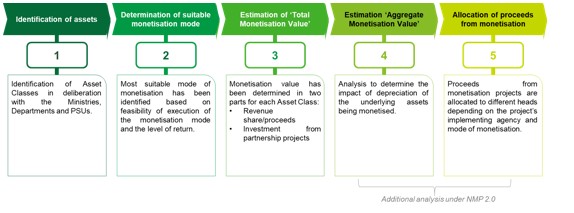
The approach to estimation of monetisation potential under NMP 2.0 is divided into five stages:
The proceeds from asset monetisation projects are allocated to four different heads depending on the implementing agency of the project, as well as the project’s mode of monetisation.
Consolidated Fund of India: Any type of Government revenue from a monetisation project that is implemented by a Central Ministry (for example, revenue share, premium, lease rental, royalty) shall flow to Consolidated Fund of India.
PSU/Port Authorities allocation: Proceeds from monetisation activities undertaken by PSUs shall accrue to the concerned PSU (similar norm shall be followed for Major Port Authorities).
State Consolidated Fund: Certain projects under NMP 2.0 are expected to generate revenues to the State Governments, especially those belonging to the mines and coal sectors (royalty payments). These proceeds shall accrue to State Consolidated Fund.
Direct investment (private): This head shall record the investment by the private sector in monetisation projects that involve construction and/or major maintenance components.
NMP 2.0 award targets: The aggregate asset pipeline under NMP 2.0 over the five-year period, FY 2026-2030, is indicatively valued at INR 16.72 Lakh Crore including private sector investment of INR 5.8 Lakh Crore. The sectors included are highways (including MMLPs, ropeways), railways, power, petroleum and natural gas, civil aviation, ports, warehousing and storage, urban infrastructure, coal, mines, telecom and tourism.
The following tables- Table-1 and Table-2 provide the details of sectoral targets under NMP 2.0 for the entire five-year period and annual phasing of NMP 2.0 targets sector wise respectively.
Table -1: Sector-wise NMP 2.0 Award Targets over FY 2026-30 (in INR Crore)
Sl.
Sector
Total Monetisation Value (TMV)
Percentage of total
1.
Highways, MMLPs, Ropeways
4,42,000
26%
2.
Railways
2,62,300
16%
3.
Power
2,76,500
17%
4.
Petroleum and natural gas
16,300
1%
5.
Civil aviation
27,500
2%
6.
Ports
2,63,700
16%
7.
Warehousing and storage
10,000
1%
8.
Urban infrastructure
52,000
3%
9.
Coal
2,16,000
13%
10.
Mines
1,00,000
6%
11.
Telecom
4,800
0.3%
12.
Tourism
1,200
0.1%
Total
16,72,300
100%
Table 2: NMP 2.0 award phasing of Total Monetisation Value, FY 26 – FY 30
(in INR Crore)
Sl.
Sector
FY26
FY27
FY28
FY29
FY30
Total
1.
Highways, MMLPs, Ropeways
59,140
68,770
91,800
1,04,430
1,17,860
4,42,000
2.
Railways
40,580
58,451
50,464
59,214
53,591
2,62,300
3.
Power
49,900
54,450
62,700
54,725
54,725
2,76,500
4.
Petroleum and natural gas
4,240
4,288
4,658
1,557
1,557
16,300
5.
Civil aviation
–
9,083
5,537
4,034
8,846
27,500
6.
Ports
40,854
55,729
55,729
55,729
55,659
2,63,700
7.
Warehousing and storage
4,318
1,813
1,941
958
970
10,000
8.
Urban real estate
–
5,000
5,000
21,000
21,000
52,000
9.
Coal
31,540
48,170
47,580
45,230
43,480
2,16,000
10.
Mines
18,101
18,986
19,963
20,940
22,010
1,00,000
11.
Telecom
820
875
940
1,035
1,130
4,800
12.
Tourism
–
820
–
–
380
1,200
Total
2,49,493
3,26,435
3,46,312
3,68,852
3,81,208
16,72,300
It is estimated that largest portion of the proceeds under NMP 2.0 shall accrue to Consolidated Fund of India, followed by direct investment (private), PSU or Port Authority allocation and State Consolidated Fund.
The assets and transactions identified under the NMP 2.0 are expected to be rolled out through a range of instruments including direct contractual instruments such as public private partnership concessions, capital market instruments such as Infrastructure Investment Trusts (InvIT) among others. The choice of instrument will be determined by the sector, nature of asset, timing of transactions (including market considerations), target investor profile and the level of operational/investment control envisaged to be retained by the asset owner etc.
The monetisation potential values assessed under NMP 2.0 are indicative and are subject to variation at the time of the actual transaction.
AHMEDABAD : In a significant development reinforcing India’s power security framework, Adani Power has announced that its wholly owned subsidiary, Moxie Power Generation Ltd (MPGL), has received a Letter of Award (LoA) from Tamil Nadu Power Distribution Corporation Ltd (TNPDCL) for the supply of 558 MW (net) of electricity for a period of five years.
The awarded capacity will be supplied under a medium-term power procurement arrangement aimed at strengthening Tamil Nadu’s energy security and ensuring uninterrupted power availability to industrial, commercial, and residential consumers across the state.
Strengthening Tamil Nadu’s Energy Reliability
The 558 MW power supply will play a crucial role in:
Meeting peak power demand requirements
Supporting industrial growth and MSME operations
Ensuring grid stability and reliability
Strengthening long-term energy planning for the state
Tamil Nadu, being one of India’s most industrialised and power-intensive states, continues to witness steady demand growth driven by manufacturing expansion, urbanisation, and infrastructure development. This agreement supports TNPDCL’s efforts to secure dependable and cost-effective power sources.
Enhancing National Energy Security
The contract further consolidates Adani Power’s position as a reliable supplier of competitively priced electricity in India’s evolving power market. Through efficient operations, optimised fuel sourcing, and strong technical capabilities, MPGL will ensure consistent and high-availability power supply under the agreement.
This milestone aligns with the Government of India’s broader vision of ensuring 24×7 power for all, enhancing infrastructure resilience, and accelerating economic growth.
Supporting a Future-Ready India
By strengthening reliable energy access, the project contributes to:
Nation-building through infrastructure stability
Industrial competitiveness and job creation
Sustainable economic development
Energy transition readiness through efficient generation assets
Adani Power continues to play a pivotal role in India’s power generation ecosystem, supporting states with dependable energy solutions while aligning with national growth objectives.
Senior officials from Adani Power and TNPDCL expressed confidence that this partnership will further strengthen cooperative federalism in the power sector and ensure uninterrupted electricity supply to millions of consumers.
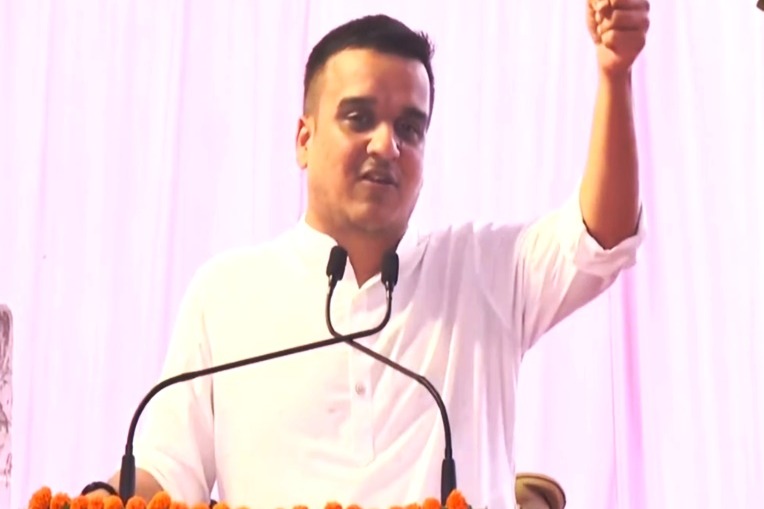
GANDHINAGAR : Gujarat has certified a record 1,00,135 micro, small and medium enterprises (MSMEs), marking what the state government described as a significant milestone for the sector, Deputy Chief Minister Shri Harsh Sanghavi told the Gujarat Legislative Assembly on Monday.
Participating in the Motion of Thanks on the Governor’s address during the eighth session of the Assembly, Sanghavi said the record certification, achieved on February 19, reflected the state’s sustained policy focus on industrial growth and entrepreneurship.
He informed that Gujarat has also been ranked a “Best Performer” for the fifth consecutive time in the national startup rankings, underscoring its position in enterprise development.
“The Governor’s address is not a mere formality but a sacred document reflecting our resolve to build a developed India through a developed Gujarat,” Sanghavi said, describing it as “Gujarat’s feedback of the past and roadmap for the future”.
Highlighting employment generation alongside MSME expansion, he said the government had announced a 10-year recruitment calendar to fill more than two lakh government posts between 2024 and 2033.
By December 2025, 72,128 young people had secured employment through 1,268 recruitment fairs conducted across the state.
On welfare measures, Sanghavi said that under the Pradhan Mantri Garib Kalyan Anna Yojana, free food grains were being provided to 3.18 crore beneficiaries from 75 lakh families.
“The One Nation One Ration Card enables beneficiaries to access subsidised food grains anywhere in the country,” he said.
He added that more than 10 lakh permanent houses had been provided in Gujarat, with a target of 3.15 lakh additional houses this year.
In the health sector, 2.72 crore citizens are covered under the Ayushman Bharat–MA card scheme, entitling them to cashless treatment of up to Rs 10 lakh.
Referring to agriculture, Sanghavi said the state had moved from “tanker raj” to “Narmada raj”.
He said, “Under the Kisan Suryoday Yojana, farmers receive daytime electricity supply, while funds under the PM Kisan Samman Nidhi are directly credited into the accounts of 60 lakh farmers.”
He added that a relief package of Rs 11,000 crore had recently been announced to support farmers affected by natural calamities.
He also criticised the Opposition’s approach, stating that while it believed in the “politics of protest”, the government followed the “politics of development”, and said Gujarat’s development journey would continue with the mantra of “Sabka Saath, Sabka Vikas”.
NEW DELHI : The first round of negotiations for the India-Israel Free Trade Agreement (FTA) commenced on 23 February 2026 in New Delhi, and is scheduled to take place until 26 February 2026. The Terms of Reference (ToR) was signed in November 2025 establishing a structured framework for discussions on identified areas to enhance trade, and economic cooperation.
Total merchandise trade between the two countries stood at USD 3.62 billion in FY 2024-2025. India and Israel share complementarities across several sectors, and the FTA will be a catalyst to further enhance the bilateral trade by providing certainty and predictability to businesses, including MSMEs.
During this round, technical experts from both sides will engage in sessions covering various aspects of FTA such as trade in goods, trade in services, rules of origin, sanitary and phytosanitary measures, technical barriers to trade, customs procedure and trade facilitation, intellectual property rights, among others.
During the opening session, Commerce Secretary, Shri Rajesh Agrawal, underscored that the FTA negotiations had begun at an opportune moment of Hon’ble Prime Minister Shri Narendra Modi’s visit to Israel from 25-26th February, 2026. Shri Agrawal underscored the significant opportunities available to both sides in sectors such as innovation, science and technology, artificial intelligence, cybersecurity, high-tech manufacturing, agriculture, and services. He emphasized that the FTA will enable both countries to harness and fully leverage these opportunities.
Chief Negotiator of India, Shri Ajay Bhadoo, Additional Secretary, Department of Commerce, reiterated the significance of this engagement for the two countries and encouraged both sides to work on a balanced agreement to build a forward looking framework for an evolving partnership. Chief Negotiator of Israel for the FTA, Ms. Yifat Alon Perel, Senior Director Trade Policy & Agreements and Deputy Trade Commissioner, Foreign Trade Administration, Ministry of Economy and Industry, Israel, expressed that the two countries shared a close relationship, and that the FTA has the potential to strengthen supply chains, enhance cooperation and open new markets for both countries.
This engagement highlights the strategic importance of India-Israel bilateral relationship, and reinforces India’s commitment to strengthen economic partnerships in line with national priorities and global aspirations. Both sides are working towards concluding a balanced and mutually beneficial agreement.
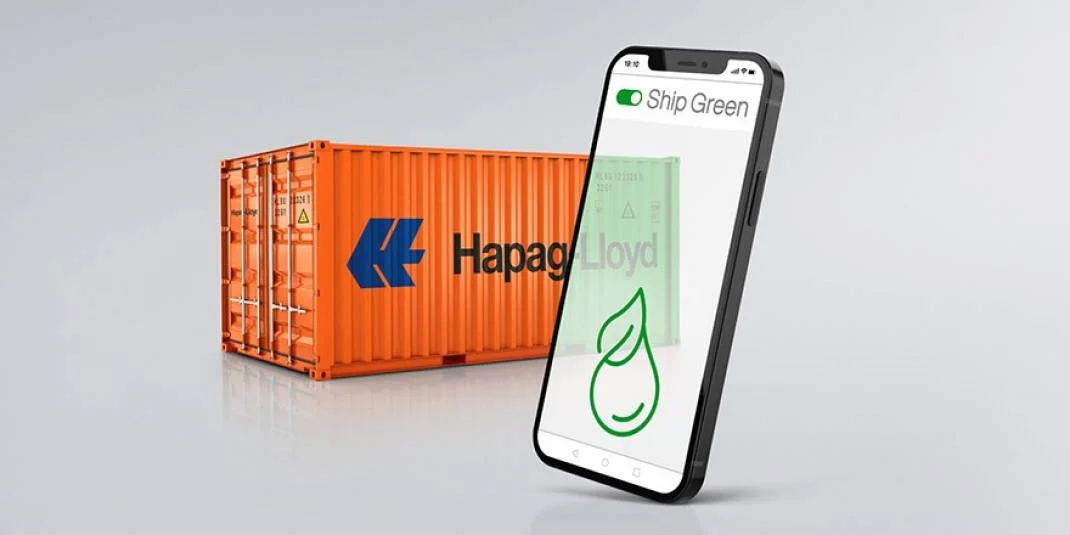
HAMBURG: Hapag-Lloyd and DSV have signed a two-year Ship Green framework agreement for the purchase of Scope 3 greenhouse gas (GHG) emission reductions. The reductions will be generated through the use of sustainable marine fuels within Hapag-Lloyd’s fleet.
The expansion of the partnership comes on the back of an already successful cooperation between DSV and Hapag-Lloyd on sustainable marine biofuels, which was implemented back in 2022.
Under the new agreement, DSV has contracted a total of 18,000 tonnes of CO₂e emission reductions on a well-to-wake (WTW) basis. The contracted period starts in 2026, during which the emission reductions will be generated using second-generation biofuels produced from waste- and residue-based feedstocks supporting tangible and verifiable progress toward net-zero ocean transport.
In addition to second-generation biofuels, the agreement allows for the inclusion of other sustainable fuel sources, making it the first of its kind. Through this agreement, Hapag-Lloyd and DSV are sending a strong signal to the market and reinforcing their shared commitment to accelerating scalable, future-ready decarbonization solutions for ocean freight.
“We are very pleased to further strengthen our collaboration with DSV through this agreement,” said Danny Smolders, Managing Director Global Sales at Hapag-Lloyd.“Both companies share a clear ambition to accelerate the decarbonization of global supply chains. By working closely together, we can turn this ambition into action. This agreement demonstrates how carriers and forwarders can jointly drive meaningful progress and scale lower-emission shipping solutions.”
“This agreement is an important step in our joint efforts to decarbonize global shipping at a crucial time for the green transition. Sustainable marine fuels are a tangible and scalable solution to reducing CO2 emissions, and through close collaboration with Hapag-Lloyd, we are enabling our customers to decarbonise their supply chains,” said Michael Hollstein, Head of Ocean Product at DSV.
The agreement is based on a book-and-claim chain-of-custody mechanism that allows customers to claim verified emission reductions, regardless of the physical fuel allocation to specific vessels or routes. Only emissions avoidance from biofuel that has already been used in Hapag-Lloyd’s owned and operated fleet is allocated to DSV. This model enables scalable climate action while sustainable marine fuels remain limited in availability.
Both companies are committed to ambitious climate goals. Hapag-Lloyd aims to achieve net-zero fleet operations by 2045, while DSV has committed to reaching net-zero emissions across its own operations and value chain by 2050. Offering sustainable logistic solutions to customers is a key lever to achieve these goals.
Hapag-Lloyd has used second-generation biofuels for several years and expanded its sustainable fuels portfolio to include biomethane in 2024. Through Ship Green, Hapag-Lloyd offers customers the possibility to claim verified emission reductions by using sustainable marine fuels instead of conventional fossil marine fuel oil (MFO).
Biofuels currently represent the most available and scalable option in sea freight. As a global leader in transport and logistics, DSV actively works with customers to increase their uptake of biofuels, thus accelerating the transition.
By working together and leveraging sustainable marine fuels and the book and claim approach, DSV and Hapag-Lloyd are contributing to the shipping industry’s transition toward a more sustainable future.
KOCHI : The proposed venture, being structured with equal participation from both sides, signals a potential breakthrough in India’s long-standing ambition to emerge as a serious shipbuilding nation alongside established leaders such as China, South Korea and Japan.
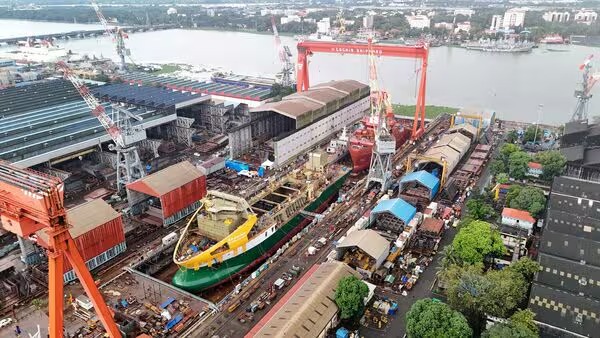
Cochin Shipyard Limited is in advanced talks with South Korea’s HD Hyundai Group to establish a $500-million shipbuilding joint venture in Kochi, marking the first time a global shipbuilding major is directly investing in core shipbuilding infrastructure in India, Mint reported on Tuesday.
The proposed venture, being structured with equal participation from both sides, signals a potential breakthrough in India’s long-standing ambition to emerge as a serious shipbuilding nation alongside established leaders such as China, South Korea and Japan, Mint said. The timing is significant, with Asian shipyards currently operating at full capacity and order books stretching years ahead.
Mint said the partnership will involve HD Korea Shipbuilding and Offshore Engineering (HD KSOE), the shipbuilding arm of the HD Hyundai Group. CSL chairman and managing director Jose VJ told Mint that a CSL delegation is set to visit South Korea this month to finalise discussions. Representatives from HD Hyundai have already conducted site inspections and preliminary evaluations in Kochi.
Jose said the agreement is expected in the second half of 2026, with an initial investment of about Rs 4,500-5,000 crore to build a ship block fabrication facility near CSL’s existing yard, Mint reported. The planned facility will be located close to CSL’s 310-metre dry dock in Kochi.
A block fabrication facility produces large hull sections that are later assembled in a dry dock. Mint reported that the proposed unit will come up on around 80 acres leased to CSL by Cochin Port Trust in Kerala. With a projected annual output of 120,000 metric tonnes, the facility is expected to create about 2,000 direct jobs, while also supporting substantial indirect employment across MSMEs, logistics networks and ancillary industries.
By combining Hyundai’s design expertise, advanced production systems and global order access with CSL’s infrastructure, the venture aims to enable construction of larger and more sophisticated vessels, Mint said. These would include cargo ships, container vessels, tankers, dry bulk carriers, MR tankers, Panamax vessels and multipurpose ships.
Mint reported that very large crude carriers (VLCCs) are not part of the initial blueprint due to current infrastructure limitations. However, the segment could be considered later, depending on market dynamics and capacity expansion.
CSL plans to utilise its recently commissioned 310-metre dry dock – capable of handling ships up to 300 metres in length – to build larger vessels such as Suezmax tankers, container ships and Capesize bulk carriers. The dry dock, inaugurated by Prime Minister Shri Narendra Modi in January 2024, can accommodate construction of up to six large vessels annually, Mint noted.
A senior CSL executive told Mint that the collaboration is expected to deliver the scale and technological capabilities required for high-volume hull manufacturing using thousands of tonnes of steel. The goal is to move toward double-digit annual ship production to cater to both domestic and international markets.
The report added that the initiative aligns with a broader push by the government to strengthen India’s shipbuilding ecosystem through international partnerships. Discussions are also ongoing with other companies in Japan and South Korea to explore similar ventures in different regions. Queries sent by Mint to HD Hyundai Group and the ministry of ports, shipping and waterways remained unanswered at the time of publication.
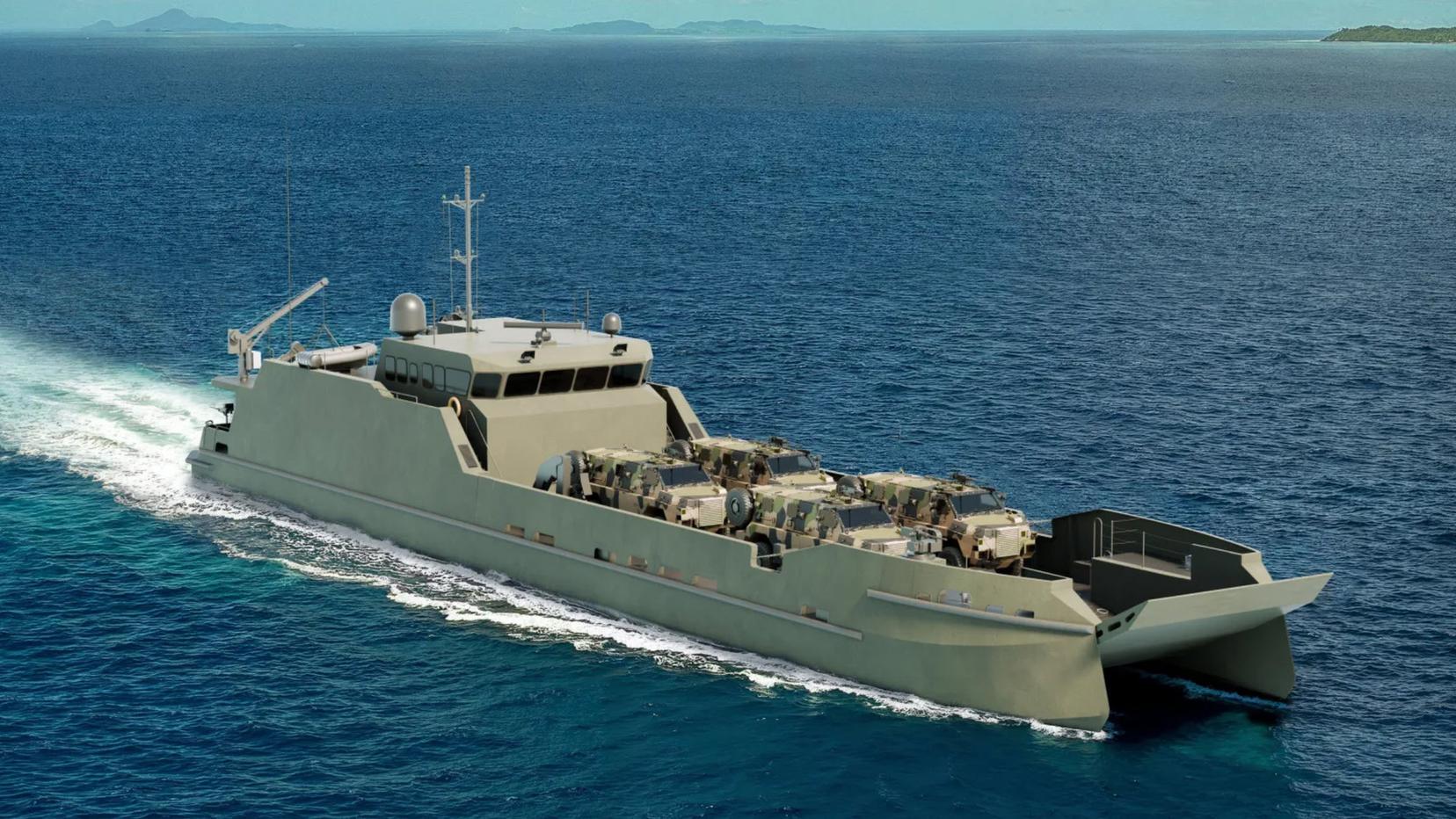
HENDERSON : Australian shipbuilder Austal secured a A$4 billion ($2.82 billion) government contract on Friday, cementing its role as a core partner in the federal government’s naval modernisation drive.
The contract is the second major defence award Austal has bagged under Australia’s Strategic Shipbuilding Agreement with the company, following the A$1.03 billion Landing Craft Medium deal in December.
“This contract generates a record order book for Austal, provides a long-term demand signal for our supply chain and provides the incentive to invest in uplifting our capability,” said CEO Paddy Gregg.
Shares of the company closed 5.5 per cent higher after rising as much as 7.5 per cent earlier in the day. “Austal is unique in the listed Australian defence sector and the highest quality in the peer group,” said Richard Ivers, portfolio manager at Prime Value Asset Management.
“It’s smart of the government to provide this certainty for Australia’s defence manufacturing base and underpins the long-term outlook for Austal which is good for shareholders.”
Under the deal, Austal Defence Shipbuilding Australia, the company’s private defence shipbuilding arm, has been tasked with the construction of eight 100-metre landing craft heavy (LCH) vessels, using both its own infrastructure and common-user facilities at Henderson.
Construction works for the vessels are scheduled to begin this year and the final vessel is slated for delivery in 2038. Meanwhile, the shipbuilder’s US unit is also building up to 12 smaller landing craft utility vessels for the US Navy at its shipyard in Mobile, Alabama.
LONDON: NorthStandard has entered a partnership with Signol to offer its members exclusive discounts on their crew led, behaviour change service. NorthStandard recognises the critical role of crew in ensuring safety on board and firmly believes that crew play an equally critical role in driving decarbonisation. Under the two-year agreement, Signol will cover onboarding costs and offer preferential rates on its monthly software as a service (SaaS) subscription.
Drawing on over six years of research into the barriers crew face when it comes to fuel saving on-board, Signol’s crew-centric approach to decarbonisation is designed to encourage seafarers to make fuel efficient and sustainable choices part of their daily duties.
With leading commercial and cruise ship owners among its clients, using existing data and existing processes, Signol has empowered crew to consistently achieve 3%-8% reductions in fuel consumption and emissions, for ship owners, charterers and managers alike.
“This is a highly innovative new benefit for members,” said Mark Smith, Loss Prevention Director – NNE and Decarbonisation, NorthStandard. “With Signol, a seafarer will see, for example, the positive impact they can have when they shut down an under-utilised auxiliary engine, or focus on keeping the ship within trim parameters. By reinforcing the positive impact of routine, day-to-day tasks that are within the control of crew, Signol helps enhance the fuel saving culture onboard and ultimately drive decarbonisation.”
Smith said the Signol service also motivates crew by recognising effective actions. “When goals are met, successes can be rewarded, for example by funding privileges such as upgraded gym equipment or by making donations to nominated crew charities.”
Harriet Hunnisett Johnson, Head of Maritime, Signol said: “We are delighted to be partnering with NorthStandard, brought together by our shared belief that seafarers are central to shipping’s green transition. As the industry invests heavily in new fuels, technologies and digitalisation, there is a huge opportunity that cannot be missed: the professional seafarers making fuel-related decisions every single day.
“At Signol, we transform fuel efficiency from a compliance topic into a source of professional pride, empowering crews with fair goals, timely feedback and positive recognition so that sustainability becomes part of the culture onboard. We know seafarers gain real satisfaction when their impact is visible and quantifiable, and they feel like true partners in the transition. Our partnership with NorthStandard allows us to bring that experience to many more crews and shipping companies.”
Smith said that the new agreement demonstrated NorthStandard’s strong focus on easing its members’ sustainability burdens. The partnership with Signol could be seen as an environmental equivalent to products in its ‘Get Set!’ digital portfolio for vessel safety. Further NorthStandard products and services focusing on maritime decarbonisation would follow through 2026, he added.
OSLO: StormGeo is strengthening its Voyage Intelligence offering with the launch of a new Premium Fleet Performance Center Service that will help shipowners and managers turn vessel data into actionable insights to achieve measurable operational and compliance improvements.
The Premium Service was announced at the IME(I) Annual Event in India by StormGeo, reinforcing the company’s commitment to supporting the Indian shipping community and wider global maritime industry.
Navigating complexity
Building on established Fleet Performance Center services within StormGeo’s Voyage Intelligence framework, the new service adds a structured, expert-led advisory layer to existing alert-based monitoring in s-Insight delivered by the global leader in weather intelligence and maritime decision-support solutions.
“Shipping companies are navigating an increasingly complex environment – from tightening emissions regulations to rising fuel costs,” Petter Andersen, VP Shipping at StormGeo, said.
“While digital platforms provide valuable insights, many operators need dedicated expertise to translate data into action and savings. With our Premium Fleet Performance Center Service, we provide proactive quarterly reviews of both data quality and vessel performance and tailored recommendations that help customers close performance gaps and strengthen compliance.”
Boosting performance
The Premium Service is designed to ensure that clients take the right actions based on the available data and insights to achieve fuel saving reduction targets over time.
The s-Insight advisory layer adds value by combining data quality monitoring and vessel performance analytics with quarterly expert-led reviews and tailored recommendations.
Using performance gap analysis and benchmarking methodologies, StormGeo provides customers with customized advisory reports aligned with their vessel types and operational priorities.
Enhancements with the new service include:
Data quality reviews: Quarterly reviews led by StormGeo project managers to support improvements in emission compliance reporting, including IMO DCS, CII, EU MRV, EU ETS, and FuelEU Maritime.
Vessel performance reviews: Structured analysis of vessel technical performance, identifying optimization opportunities related to auxiliary engine usage, trim, boiler efficiency, and main engine consumption.
“The enhanced service layer provides a deeper level of expert engagement and structured follow-up, helping customers move from alerts to actionable improvement strategies,” Andersen explained.
Strong regional presence
The Premium Service complements StormGeo’s existing Fleet Performance Center offering, which includes daily data quality and performance alerts. The Premium Fleet Performance Center Service is available globally as an add-on to the s-Insight solution.
The announcement at IME(I) reflects StormGeo’s strong regional presence across India and the broader Asia-Pacific maritime market, according to Espen Martinsen, Chief Commercial Officer at StormGeo.
“By combining global standards, advanced data quality, and hands-on advisory expertise, StormGeo supports shipowners and operators seeking reliable, performance-driven partnerships in an increasingly competitive environment,” Martinsen said.
“The decision to launch our new service at the IME(I) Annual Event demonstrates our ambitions to grow in India, becoming the preferred voyage and vessel performance optimization partner for the country’s shipowners and managers,” he concluded.