Home Blog Page 636

Andhra Pradesh charts course for shipbuilding growth as Garuda Aerospace commits ₹250 Cr investment

VISAKHAPATNAM : Andhra Pradesh is positioning itself as a key hub for shipbuilding and shipbreaking, with the state government in active discussions with the Union Ministry of Ports, Shipping and Waterways to establish a mega shipbuilding cluster.

Responding to questions in the Assembly from MLAs Nadukuditi Eswara Rao and Kamineni Srinivas on Thursday, State Investments and Infrastructure Minister B.C. Janardhan Reddy announced that the government has rolled out the AP Maritime Policy to accelerate shipbuilding and allied industries. The policy offers a wide range of fiscal incentives aimed at attracting investments, fostering industrial growth, and creating employment opportunities in the maritime sector.

The state’s move comes at a time when India is seeking to strengthen its shipbuilding capacity and reduce reliance on foreign-built vessels, positioning Andhra Pradesh as a potential hub for both domestic and international players.

The policy provides up to 25% capital subsidy on investments, 10-year SGST reimbursements, an additional 20% SGST reimbursement for the first five ships built, and production-linked incentives covering up to 25% of costs. Exemptions on stamp duty, electricity duty, and subsidies on utilities are also being offered, along with long-term land leases via the AP Maritime Board and single-window clearances.

To encourage innovation and sustainability, the government has announced 75% reimbursement on feasibility study costs and 100% reimbursement for environmentally friendly ship technologies.

The Centre, meanwhile, is developing a shipbuilding cluster at Dugarajapatnam in Tirupati district, with modalities for a Special Purpose Vehicle (SPV) between the Centre and state currently being finalized. Once operational, the industry is expected to create nearly 1.48 lakh direct and indirect jobs in Andhra Pradesh.

In a parallel boost to industrial growth, Chennai-based Garuda Aerospace has proposed a ₹250 crore investment to set up a large-scale drone manufacturing unit in the state. Company representative Shyam Kumar met Minister Janardhan Reddy at the Secretariat to outline the expansion plans.

Welcoming the proposal, the minister said Andhra Pradesh is fast emerging as a preferred investment destination and expressed confidence that ventures like Garuda’s will generate employment and livelihood opportunities for the state’s youth.

Russia bans fuel exports; How does it affect India?

MOSCOW : In a major development, Russia has announced a partial ban on diesel exports and an extension of an existing ban on gasoline exports to all countries until the end of this year.
The decision comes as petrol pumps across the country and in its occupied territories continue to run dry.
The move is largely seen as a response to Ukraine’s intensified drone attacks on Russian refineries in recent months.

Russia’s decision to halt fuel exports until year-end could ripple into India’s energy landscape, even though New Delhi primarily imports Russian crude oil rather than refined fuels. The move may tighten global supply, pushing up international fuel prices and indirectly raising India’s import costs.
With Russia now India’s largest crude supplier, higher benchmarks can squeeze refiners’ margins and consumer prices. To cushion the blow, India may need to diversify sourcing, tap strategic reserves, or negotiate more favorable terms with Moscow.

Pakistan eyes Saudi-linked Port, shipping projects to boost Gulf–China connectivity

KARACHI : Pakistan is planning Saudi-linked port and shipping projects, including new gateway terminals, direct shipping routes and green ship recycling yards, as part of efforts to become a logistics bridge between the Gulf, Central Asia and China, the maritime ministry said on Friday.

Officials say Pakistan’s location at the mouth of the Arabian Sea gives it a strategic advantage in connecting Gulf energy exporters with China and the landlocked markets of Central Asia.

With Gulf–China trade volumes rising and regional shipping routes expanding, Islamabad is seeking to position its ports as key nodes in emerging transport corridors.

According to a statement from the maritime ministry, Technical Adviser for Maritime Affairs Muhammad Jawad Akhtar proposed several new projects with Saudi Arabia.

These included “Karachi–KSA and Gwadar–KSA Gateway Terminals, expansion of the Pakistan National Shipping Corporation fleet under Saudi partnership, start direct shipping lines from Karachi to Jeddah and Gwadar to Dammam, and establish 20 green ship recycling yards at Gaddani,” the maritime ministry statement said.

Karachi Port and Port Qasim — Pakistan’s two largest and busiest seaports handling most of the country’s container and cargo traffic — along with Gwadar Port, a Chinese-developed deep-sea port near the mouth of the Arabian Gulf, are seen as key to these plans.

Maritime Affairs Minister Muhammad Junaid Anwar Chaudhry said the effort was part of a broader plan to integrate Pakistan’s ports and logistics infrastructure with regional trade routes.

“We are not merely compiling lists of projects; we are shaping a national roadmap for logistics and connectivity,” he said.

“Pakistan performs best under compressed timelines, and this is one such moment.”

Chaudhry said Karachi Port, Port Qasim and Gwadar Port would be central to the plan, which aims to link them to regional transport corridors through rail, road and air networks.

He highlighted the importance of the long-delayed ML-1 railway modernization project — a planned multi-billion-dollar upgrade of Pakistan’s 150-year-old main railway line from Karachi in the south to Peshawar near the Afghan border — expected to boost freight and passenger traffic from the northwest province of Khyber Pakhtunkhwa to southern ports.

He said Pakistan must align its development agenda with the connectivity needs of partner countries.

Chaudhry added that a joint working group bringing together the maritime, communications, railways and defense ministries would hold its first meeting next week to shortlist priority projects for rapid funding and development.

Other ministries outlined their own connectivity priorities. The communications ministry called for laying fiber optic cables along railway lines, expanding submarine cable networks and speeding up completion of the M-6 motorway — a 394-km section of Pakistan’s north–south highway network linking the port city of Karachi to Sukkur in interior Sindh province — described as a missing link in the China–Pakistan Economic Corridor (CPEC), a multibillion-dollar infrastructure and energy program that is part of China’s Belt and Road Initiative.

The communications ministry also highlighted plans for an M-10 motorway extension through the Khirthar mountains in southern Pakistan to complement existing road infrastructure.

A petroleum ministry representative said a $300 million feasibility study was underway for a new merchant oil terminal at Hub, an industrial town near Karachi, as part of Pakistan State Oil’s infrastructure expansion strategy.

Chaudhry urged ministries to deliver a clear, investment-ready roadmap that would attract international financing and cement Pakistan’s role as a “central bridge” connecting the Gulf with Central Asia and China.

CEO of Hong Kong firm alleges ₹15-crore cargo fraud

TRIVANDRAM : A major cargo fraud, involving nearly ₹15 crore, came to light at a Container Freight Station (CFS) in Vallur near Kattupalli Port, after B. Subramanyan, 62, Chief Executive Officer (CEO) of Hong Kong-based Cosmoss Vu Limited, an export-import firm, lodged a complaint with the Avadi City Police.

According to the complaint, the company had shipped 90 containers of PVC resin, through three carriers, from Tianjin Xingang and Qingdao ports in China to Kattupalli Port in Chennai. The consignments, imported by Rishabh Triexim LLP and Kanchan Polymers, were moved to the CFS operated by SICAL Multimodal and Rail Transport Limited.

As per trade practice, the carriers issued bills of lading in favour of the shipper. They serve as documents of title for the goods, and are required to be produced by the importer to secure their release.

The complainant said that the importers had not made the payment for the shipments. Consequently, the original bills of lading remained in his lawful possession, preventing legal delivery of the goods to the importers. However, Mr. Subramanyan alleged, the SICAL CFS unlawfully released the consignments to the importers without the original bills of lading or valid Delivery Orders.

Larger conspiracy
The CEO alleged that his subsequent inquiries revealed a larger conspiracy involving 21 individuals, including representatives of the import firms, shipping companies, and officials of the CFS. He said they acted with a common intention — dishonestly releasing and diverting the consignments, thereby causing a wrongful loss to his company and gain to themselves.

“The accused hatched a criminal conspiracy, and looted goods valued at approximately ₹15 crore. The unlawful proceeds were shared among them,” the complainant said.

Based on the complaint, the Avadi City Police registered a case for cheating and criminal breach of trust. The case has been taken up for further investigation.

Source: The Hindu

Huawei launches the SMART Logistics & Warehousing Solution to Unlock All Intelligence

SINGAPORE: Huawei unveiled its SMART Logistics & Warehousing Solution at HUAWEI CONNECT 2025’s transportation summit titled “Creating a Digital & Intelligent Foundation for Comprehensive Transportation and Logistics.”

Ma Yue, Vice President of Huawei and CEO of Huawei’s Smart Transportation BU, stated that Huawei remains committed to technological innovation and will deepen joint innovation in communications networks, computing power, AI, and talent cultivation to advance sustainable development of transportation.

Kumpol Boonchom, Deputy Chief of State Railway of Thailand, said that they aim to create an integrated network to help Thailand become the central hub of Southeast Asia. The construction of the Thailand-China Railway is an opportunity for SRT to develop a strategic rail logistics hub in the region.

Guo Shuangqing, Assistant CMO of SF Technology, said that SF Technology and Huawei will maximize respective strengths to expand capabilities in coordinating multiple airports, thus leading to a substantial efficiency increase across the entire air logistics sector.

Jiang Xingxiang, Assistant to General Manager of Yunnan Construction and Investment Holding Group, shared insights on integrated supply chain operations. Looking ahead, YCIH Logistics will continue to prioritize digital and intelligent supply chain to support its collaborative development.

Yang Bin, Chairman of Shandong Port Technology Group, said that they have successfully developed a digital foundation featuring one network, one cloud, and one security system based on Huawei’s strong technical support. The group works with partners to develop integrated smart port solutions covering both physical infrastructure and digital services.

“With its comprehensive ICT intelligent foundation and innovative technologies, Huawei is turning concepts like Mobility as a Service and Logistics as a Service into reality—unlocking the full potential of digital intelligence,” said Rachad Nassar, Huawei’s Global Business & Strategic Partners Director.

Qiu Shikui, Vice President of Huawei’s Smart Logistics and Warehousing BU announced the launch of the innovative SMART Logistics & Warehousing Solution. The solution focuses on five core capabilities: platform-based services, digitalized operations management, intelligent allocation, automated relocation, and unattended transportation.

Huawei has served more than 100 ports and over 200 logistics and warehousing enterprises; over 300 urban rail lines in more than 70 cities and over 180,000 km of railways; a road network exceeding 200,000 km; over 300 cities for urban transportation; and more than 210 airlines and air traffic management bureaus worldwide.

Onboard Carbon Capture and Storage highlighted as possible climate technology solution

LONDON: Onboard Carbon Capture and Storage (OCCS) is emerging as a potential technology to reduce greenhouse gas (GHG) emissions from shipping. To explore the latest developments and operational experiences, IMO’s Future Fuels and Technology Project hosted a Technical Seminar on OCCS Systems at IMO Headquarters.

OCCS applies Carbon Capture and Storage (CCS) technology directly on ships. It captures CO₂ emissions before they enter the atmosphere, stores them temporarily on board ships and later offloads them for transport for utilisation or permanent storage. CCS itself, which captures CO₂ and stores it safely underground for permanent isolation, is increasingly recognised as a key tool to mitigate climate change.

Opening the event, IMO’s newly appointed Director of the Marine Environment Division, Mr. David Osborn, set the scene: “This seminar aims to improve understanding of the latest developments in OCCS technology and its role in decarbonizing international shipping. It will also explore infrastructure readiness, as well as environmental, safety, and human-element considerations.”

Presentations covered insights from ongoing projects on ships and safety and operational considerations, including around the delivery of captured carbon in port and its transportation to possible users. Industry experts shared experiences with technologies installed on ships, discussed innovations like turning CO₂ into limestone and examined lessons learned from large-scale demonstrations. Experts also provided recommendations on how to address current regulatory gaps in IMO’s ongoing regulatory work on OCCS.

Up to 400 international participants attended the event, where they also learned about the carbon value chain, from capture and offloading to transport for utilisation and permanent storage, and the role OCCS could play as an interim measure while alternative fuels are scaled up.

“IMO is actively working on developing the regulatory framework enabling the safe and sustainable use of OCCS technology,” said IMO Head of Clean Air and Climate Action Mr. Roel Hoenders. He outlined IMO’s plans to develop a regulatory framework for the use of OCCS, including guidelines for the testing, survey and certification of OCCS.

The London Protocol (LP) under IMO is the only international treaty providing a legal framework to regulate and enable the safe injection and storage of CO₂ in sub-seabed geological formations for permanent isolation.

The seminar also called for collaboration as OCCS technology advances as a potential temporary solution that can play a valuable part in global efforts to mitigate climate change.
Source: IMO

“India ranks among top 3 global suppliers of seafarers with 3 lakh workforce”: Sarbananda Sonowal

CHENNAI : Union Minister of Ports, Shipping and Waterways Shri Sarbananda Sonowal addressed the 10th convocation of the Indian Maritime University (IMU) in Chennai on Friday, highlighting the remarkable transformation of India’s maritime sector under the visionary leadership of Prime Minister Shri Narendra Modi and the employment opportunities now available to youth entering the sector.

Congratulating the 2,196 graduating students, Shri Sarbananda Sonowal said, “You are entering a sector that has been revitalised over the past decade and is central to India’s economic, strategic, and global ambitions. Careers in shipping, ports, shipbuilding, logistics, research, and green maritime technologies have never been more diverse or in demand as we move towards becoming one of the global leaders in the maritime sector under the dynamic leadership of Prime Minister Shri Narendra Modi .”

Since 2014, India’s ports have undergone extensive modernisation and mechanisation, resulting in a “turnaround time” of just 0.9 days, surpassing ports in advanced maritime nations such as the USA, Australia, Belgium, Canada, Germany, and Singapore. Nine Indian ports now rank among the top 100 globally. Construction of Vadhavan port, with an investment of ₹76,000 crore, will be one of the world’s largest container ports. Cargo movement via inland waterways has increased sevenfold, and coastal shipping volumes have risen over 150% in the last decade.

The ‘Maritime Amrit Kaal Vision 2047’ provides a long-term roadmap for India’s maritime resurgence. Investments totalling ₹80 lakh crore are being directed toward port infrastructure, coastal shipping, inland waterways, shipbuilding, and green shipping initiatives. The government has established green corridors, green hydrogen bunkering at major ports, and promoted methanol-fuelled vessels to encourage sustainable maritime operations.

The government has also launched a historic ₹70,000 crore package to revitalise shipbuilding and ship recycling. The Maritime Development Fund (MDF) with a corpus of ₹25,000 crore will provide long-term financing to boost India’s tonnage and shipbuilding capabilities. A revamped Shipbuilding Financial Assistance Scheme (SBFAS) addresses cost disadvantages in domestic shipbuilding, including credit notes for ship-breaking, while the Shipbuilding Development Scheme (SbDS) supports greenfield clusters, brownfield yard expansions, and risk coverage. The Indian Ship Technology Centre (ISTC) at Visakhapatnam, with a ₹305 crore investment, will serve as a hub for design, R&D, engineering, and skill development.

India’s seafarer workforce has grown from 1.25 lakh a decade ago to over three lakh today, placing the country among the top three global suppliers of trained seafarers. This creates vast opportunities in navigation, ship operations, logistics, and allied maritime industries both in India and abroad.

Shri Sarbananda Sonowal emphasised the employment potential of these initiatives, stating, “These transformative measures are expected to generate 25–30 lakh direct and indirect jobs in shipbuilding, ports, shipping, logistics, and allied industries. India’s maritime resurgence is not only about economic growth, but also about creating meaningful careers for our youth in a Viksit Bharat and an Atmanirbhar Bharat.”

He added, “Graduates stepping into this sector carry the responsibility of upholding ethics, embracing innovation, and navigating technological and environmental challenges, contributing directly to India’s emergence as a maritime powerhouse and a global leader in the blue economy.”

Union Minister Sonowal inaugurates India’s first Maritime Simulation Centre at AMET University

CHENNAI : Union Minister of Ports, Shipping & Waterways, Shri Sarbananda Sonowal, on Friday inaugurated India’s first-of-its-kind Maritime Simulation Centre at AMET Knowledge Park, Maersk’s Centre of Excellence, Thenpattinam near Chennai. Also present at the inauguration ceremony was Shri Shyam Jagannathan, IAS, Director General of Shipping, Mr Peter Winther-Schmidt, Head of Trade and Innovation, Consulate General of Denmark, Bangalore, senior delegates from A.P. Moller – Maersk, and hundreds of budding seafarers.

Image 4 Union Minister Sonowal inaugurates India's first Maritime Simulation Centre at AMET University

The cutting-edge facility has been established through a strategic partnership between the Academy of Maritime Education and Training (AMET), a Deemed-to-be University, and A.P. Moller-Maersk. The facility has been established with an investment of INR 13.5 Crore, including support from the A.P. Moller Foundation, which contributed approximately INR 6.5 Crore (USD 750,000) to the project, further strengthening the 25+ year collaboration between AMET and Maersk.

The Maritime Simulation Centre features state-of-the-art technology, including Full Mission Simulators for Deck and Engine operations, Electronic Chart Display and Information Systems (ECDIS), and advanced Augmented Reality/Virtual Reality (AR/VR) laboratories. These systems will provide cadets with immersive, hands-on training in critical maritime skills, including watchkeeping and steering, collision avoidance, navigation light identification, and engine troubleshooting.

Speaking at the inauguration, Honourable Union Minister Shri Sonowal commended the collaborative efforts, stating: “AMET University and Maersk have demonstrated exceptional commitment to nurturing India’s maritime talent. This world-class facility will empower our young professionals with the advanced skills needed to excel in the global shipping industry. Such initiatives are crucial for strengthening India’s position as a maritime nation and developing the next generation of skilled seafarers.”

Dr J. Ramachandran, Founder & Chancellor of AMET University, emphasised the institution’s long-standing commitment to maritime excellence: “For over three decades, AMET has been at the forefront of maritime education in India. From our humble beginnings with just 14 cadets, we have grown into a globally recognised institution. This Maritime Simulation Centre represents our continued dedication to developing world-class maritime professionals. It stands as a testament to our vision of making AMET a global maritime knowledge hub that produces competent seafarers ready for the challenges of modern shipping.”

Ms Nynne Norman Scheuer, Senior Director – Head of Marine People & Culture at Maersk, reinforced the company’s commitment to industry development: “Our partnership with AMET reflects Maersk’s unwavering commitment to career development and giving back to the maritime industry. By investing in advanced simulation technology and training infrastructure, we are not just developing skilled professionals for our own operations but contributing to the growth of the entire maritime sector. This facility will help bridge the gap between academic learning and real-world application, ensuring that graduates are truly ready for the challenges of modern shipping.”

The Maritime Simulation Centre enables cadets to engage in realistic maritime scenarios within a controlled academic setting, significantly improving their skills before transitioning to real sea operations. Through highly authentic simulations, students will acquire exceptional practical experience and understand the complexities of modern maritime tasks, adhering to the high standards expected in the global maritime sector.

This inauguration further consolidates AMET’s reputation as India’s premier maritime education institution. It underscores the success of its strategic partnership with Maersk—a collaboration that continues to pioneer innovative educational models and shape the future of seafaring at both national and international levels.

About A.P. Moller – Maersk

A.P. Moller – Maersk is an integrated logistics company working to connect and simplify its customers’ supply chains. As a global leader in logistics services, the company has 100,000+ customers, operates in almost 130 countries and employs 100,000+ people. Maersk is committed to reaching net-zero emissions by 2040 across the entire supply chain with new technologies, new vessels, and alternative energy solutions. 

FFFAI elects New Leadership, Showcases India’s Trade Reforms at 62nd Annual General Meeting

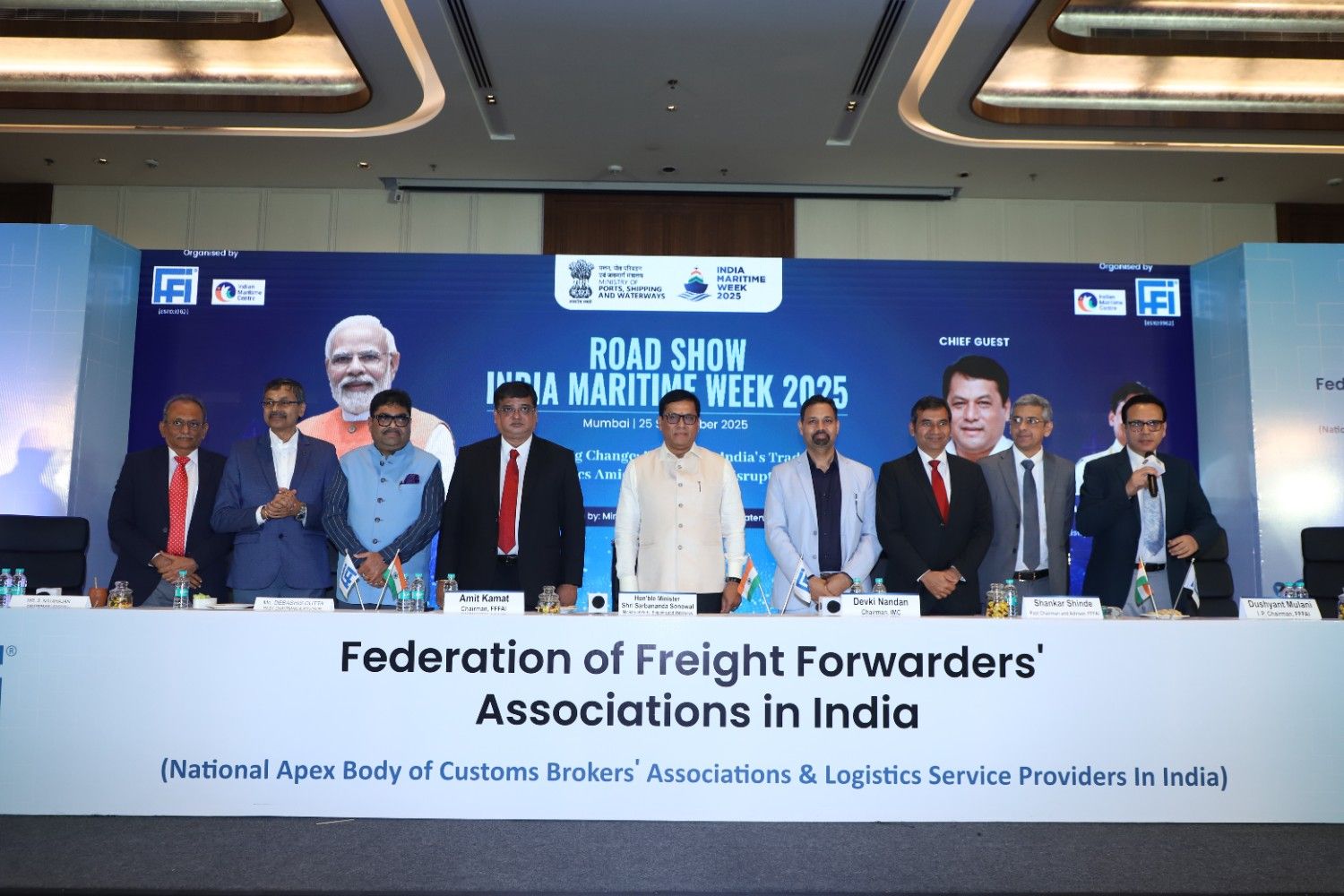
MUMBAI: The Federation of Freight Forwarders’ Associations in India (FFFAI) held its 62nd Annual General Meeting and 1st Executive Committee Meeting or the term 2025-27 on September 24 & September 25, 2025, at Hotel Aurika Hotel & Resorts, Mumbai.

In the 1st Executive Committee Meeting, the Executive Committee elected new Office Bearers for the term 2025–2027.

LMrAmitKamatChairmanFFFAIandRMrDushyantMulaniImmediatePastChairmanFFFAI 2 FFFAI elects New Leadership, Showcases India’s Trade Reforms at 62nd Annual General Meeting

Mr. Amit Kamat, who was Chairman-Elect for the term 2023–2025, has taken over as Chairman, FFFAI for the term 2025-27.

The elected Office Bearers of FFFAI for the term 2025–2027 are:

  • Chairman-Elect – Mr. S. Natarajan: Chennai
  • Vice Chairman – Mr. Vinod Sharma: Pune
  • Vice Chairman – Mr. Rajesh Verma: Ludhiana
  • Vice Chairman – Mr. Dinesh Gupta: Kandla
  • Vice Chairman – Mr. S. Anil Kumar: Hyderabad
  • Vice Chairman – Mr. Kartik Pancholi: Ahmedabad
  • Vice Chairman – Mr. Sudhir Agarwal: Nagpur
  • Honorary Secretary – Mr. Sudip Dey: Kolkata
  • Honorary Treasurer – Dr. Nirav Thakker: Mumbai

Mr. Dushyant Mulani who was Chairman of FFFAI for the term 2023-25 is now the Immediate Past Chairman for the term 2025-27, while Mr. Shankar Shinde, who was Immediate Past Chairman for term 2025-27 has now joined Board of Advisors of FFFAI as Advisor – Past Chairman.

The Federation of Freight Forwarders’ Associations in India (FFFAI) is the Apex body of Customs Brokers Associations and Freight Forwarders in India, comprising 31 Customs Brokers Associations as Ordinary Members and more than 6,500 Associate & Allied Members across the country.

As the national representative body of Customs Brokers’ Associations, FFFAI consistently takes up significant policy issues concerning Customs Brokers and Logistics Stakeholders and engages with Government authorities to strengthen India’s EXIM trade ecosystem.

mantrijiwithEC 1 FFFAI elects New Leadership, Showcases India’s Trade Reforms at 62nd Annual General Meeting

During the term 2023–2025, the Federation actively worked with the Central Board of Indirect Taxes and Customs (CBIC) to support and advance multiple trade facilitation and outreach initiatives. Key contributions included:

  • Progressive suggestions for digitization and improvements in the Faceless Assessment process.
  • Advocacy for the protection of Customs Brokers and their role in compliant trade.
  • Active engagement in integration with Partnering Government Agencies (PGAs).
  • Pursuit of digitization initiatives such as:
    • Online payment module for voluntary payment of Customs Duty.
    • Online refunds and facilitation measures.
    • Introduction of “Ekal Anubandh”, represented by FFFAI at national forums including NCTF and CCG.

KCBA and MCBA congratulates Dinesh Gupta being elected as FFFAI Vice Chairman

GANDHIDHAM : The Kandla Custom Brokers’ Association (KCBA) and the Mundra Custom Brokers’ Association (MCBA) proudly extend their heartiest congratulations to Shri Dinesh Gupta, President of both KCBA and MCBA, on being elected as the Vice Chairman of the Federation of Freight Forwarders’ Associations in India (FFFAI).

This prestigious achievement is a reflection of Shri Gupta’s unwavering dedication, visionary leadership, and invaluable contributions to the logistics and customs brokerage industry. His election to this esteemed post not only brings pride to KCBA and MCBA but also reaffirms the trust and confidence the trade fraternity places in him.

Both associations firmly believe that under his dynamic leadership, FFFAI will achieve new heights, driving innovation, strengthening industry practices, and contributing significantly to the growth of India’s trade and logistics sector.

The entire KCBA and MCBA fraternity join in celebrating this remarkable milestone and convey best wishes to Shri Dinesh Gupta for continued success in all his endeavors.