Home Blog Page 686

Baltic Index climbs on higher Capesize and Supramax Rates

LONDON: The Baltic Exchange’s main sea freight index, which measures rates for ships carrying dry bulk commodities, edged up on Friday due to higher rates in capesize and supramax vessel segments.

The main index, which tracks rates for capesize, panamax and supramax shipping vessels, rose 8 points, or 0.4%, to 2,025 points, logging a weekly gain of 4.2%, its best week since 21 July.

The capesize index gained 41 points, or 1.4%, to 2,925 points. The index logged a weekly gain of 4.7%, but fell about 9.7% in the month.

Average daily earnings for capesize vessels, which typically transport 150,000-ton cargoes such as iron ore and coal, rose $339 to $24,257.

Iron ore futures traded in a narrow range on Friday, but were set for a weekly gain, supported by steady demand from top consumer China and falling inventories.

The panamax index was down 27 points, or 1.4%, at 1,847 points, but gained 4.4% for the week and 11.3% for the month.

Average daily earnings for panamax vessels, which usually carry 60,000-70,000 tons of coal or grain, fell $242 to $16,623.

Among smaller vessels, the supramax index climbed 4 points, or 0.3%, to 1,465 points, up for the fourth straight week and logging a weekly gain of 2.9%.
Source: Reuters

PM Modi departs for Japan and China visit amid Trump Tariff tension

NEW DELHI: Prime Minister Shri Narendra Modi departed from New Delhi on Thursday for a two-day official visit to Japan, scheduled from August 29 to 30, to attend the 15th India-Japan Annual Summit. This marks his first standalone visit to Japan in nearly seven years.

The visit comes at the invitation of Japanese Prime Minister Shigeru Ishiba. During his visit, PM Modi will hold the annual summit meeting with his Japanese counterpart. Following the Japan visit, the Prime Minister will travel to China from August 31 to September 1 to attend the Shanghai Cooperation Organisation (SCO) Summit in Tianjin.

Ahead of his departure, Prime Minister Modi issued a statement highlighting the importance of the trip. He stated that India and Japan will focus on “next phase” of thier Special Strategic and Global Partnership, which has seen steady progress over the past 11 months.

“We would endeavour to give new wings to our collaboration, expand the scope and ambition of our economic and investment ties, and advance cooperation in new and emerging technologies, including AI and Semiconductors. The visit will also be an opportunity to strengthen our civilizational bonds and cultural ties that connect our peoples,” PM wrote.

The Indian diaspora in Japan is brimming with excitement as PM Modi is set to visit the country.
During the summit, both Prime Ministers will conduct an in-depth review of their ties, take stock of progress over the last few years across multiple domains, and, as usual, exchange views on regional and global issues of mutual interest.

The summit will provide an opportunity to launch new initiatives aimed at building greater resilience in the India-Japan relationship and addressing emerging global challenges. The program includes a visit outside Tokyo, which will again be something to look forward to for the two leaders.

The visit also includes interactions between PM Modi and several other political leaders from Japan, as well as with the Friends of India in Japan. PM Modi will also participate in a business leaders’ forum with captains of the Japanese and Indian industry. These interactions aim to deepen the important trade, investment, and technology relationship between the two countries.

This visit marks Modi’s first standalone trip to Japan in nearly seven years and his first annual summit with Ishiba.

PM Modi last visited in 2018 for the Annual Summit. Since then, he has visited Japan, but these visits have been for multilateral engagements and other ceremonial events. This visit will be fully dedicated to the bilateral agenda between India and Japan. This is also PM Modi’s eighth visit to Japan since he took office in 2014, and reflects the very high priority that this particular relationship has in our foreign relations.

Notably, the high-level engagements between India and Japan include several significant visits and meetings. In 2007, Japanese Prime Minister Shinzo Abe delivered the “Confluence of the Two Seas” speech in the Indian Parliament, marking a significant milestone in the bilateral relationship. Six years later, in 2013, Emperor Akihito and Empress Michiko became the first Japanese imperial couple to visit India, strengthening cultural and diplomatic ties between the two nations.

In 2014, Prime Minister Abe was honoured as the Chief Guest of the Republic Day in India, further solidifying bilateral relations. The relationship continued to grow, with President Ram Nath Kovind attending Emperor Naruhito’s enthronement ceremony in 2019, showcasing India’s respect for Japan’s imperial traditions.

In recent years, the engagement between the two countries has intensified. In March 2022, Japanese Prime Minister Kishida visited India and pledged JPY 5 trillion (approximately USD 42 billion) in investment. During this visit, the Clean Energy Partnership was launched, and the Industrial Competitiveness Partnership was advanced. Additionally, an exchange of notes was signed for seven yen loan projects worth over JPY 300 billion (USD 2.7 billion), demonstrating Japan’s commitment to supporting India’s development.

Prime Minister Kishida returned to India in March 2023, where the fourth tranche of Official Development Assistance (ODA) worth JPY 300 billion (approximately INR 18,000 crore or USD 2.2 billion) was signed for the Mumbai-Ahmedabad High-Speed Rail Project. New initiatives in tourism and the environment were also launched during this visit, further expanding cooperation between the two nations.

In May 2023, Prime Minister Modi attended the G7 Summit in Hiroshima, Japan, where he unveiled a statue of Mahatma Gandhi near Peace Park, symbolising India’s commitment to peace and non-violence. Later, in September 2023, Prime Minister Kishida visited India again for the G20 Summit, where both leaders coordinated G7-G20 priorities and highlighted the concerns of the Global South.

The relationship continued to strengthen with the meeting of PM Modi and Japanese PM Kishida at the G7 Summit in Italy in June 2024, marking 10 years of the Special Strategic Partnership between India and Japan.

In October 2024, PM Modi met with Prime Minister Ishiba in Vientiane during the ASEAN Summit, further reinforcing the bilateral ties. More recently, in September 2025, the two leaders met during the Quad Summit in Wilmington, Delaware.

The goodwill between the two leaders was also evident when PM Ishiba called PM Modi in April 2025 to express condolences following the Pahalgam terror attack, demonstrating the strong personal rapport between the leaders of the two nations.

Beyond summits, Foreign Ministers, Defence Ministers, and NSAs meet regularly, with the latest 2+2 Ministerial (New Delhi, 2024) and Foreign Ministers’ Strategic Dialogue (2024).

Furthermore, both countries have a robust trade and investment relationship, with bilateral trade between the two countries reaching USD 22.8 billion in 2023-24. India’s imports from Japan outweigh its exports, with the main items exported to Japan including chemicals, vehicles, aluminium, and seafood. In contrast, imports from Japan primarily consist of machinery, steel, copper, and reactors.

In the first nine months of the 2024-25 fiscal year, bilateral trade totalled USD 21 billion, indicating stability in trade relations. Japan is India’s fifth-largest source of foreign direct investment (FDI), with a cumulative investment of USD 43.2 billion up to December 2024. Annual FDI inflows from Japan have been strong, with USD 3.1 billion in 2023-24 and USD 1.36 billion in 2024-25 (April-December).

Japanese companies have consistently ranked India as a promising long-term investment destination. There are approximately 1,400 Japanese companies with nearly 5,000 establishments operating in India, while over 100 Indian companies work in Japan. Profitability rates and expansion plans for Japanese companies in India remain high.

The two countries are also exploring emerging areas of cooperation, including digital cooperation in semiconductors and startups, clean energy, supply chain resilience, industrial competitiveness, and skill development.

Overall, the visit will consolidate our long-standing friendship. It will open fresh avenues of cooperation and reaffirm our shared commitment to peace, prosperity, and stability, both for the two countries and in our shared Indo-Pacific region and beyond, according to the MEA.


India reaches out to 100 nations for ₹10 trillion shipping investment

NEW DELHI : In a bid to drive investments worth ₹10 trillion into India’s shipping, ports, and shipbuilding sectors, the Ministry of External Affairs and Ministry of Ports, Shipping and Waterways has reached out to over 100 countries for the India Maritime Week, proposed to be held in October.

With India enforcing a host of fiscal and legislative reforms over the past seven months, Prime Minister Shri Narendra Modi will personally interact with global CEOs of leading global shipping companies at the maritime week, said R Lakshmanan, Joint Secretary at the shipping ministry, while addressing ambassadors and delegates of various nations in Delhi.

“These opportunities open up to $1 trillion maritime investment roadmap, with strong potential for joint ventures in developing ports and cargo terminal operations, multi-modal terminals, maritime services, shipbuilding, ship recycling and ship repairs, green hydrogen hubs, and sustainable shipping solutions,” Shipping Minister Shri Sarbananda Sonowal said at the Ambassadors’ Roundtable Meet.

According to a presentation made by the shipping ministry, 25 global CEOs and around 10 regional business leaders will meet the Prime Minister in October.

Ambassadors of several countries sought discussions on the proposed India Middle East Europe Economic Corridor (IMEEC), while landlocked countries sought deliberations on the future of the Chabahar Port, which is proposed to be a gateway to Central Asia.

The deliberations focused on India’s core maritime priorities, including strengthening shipbuilding capacity and port-led development to position the country as a global hub. Delegates also highlighted the scope of the blue economy, stressing sustainable growth and livelihoods through responsible use of ocean resources, the shipping ministry said.

The government has showcased its commitment to fostering maritime growth on the back of its Maritime Amrit Kaal Vision 2047, which proposes investments of ₹80 trillion over the next 22 years, including a ₹54 trillion investment in shipbuilding, where India aims to become one of the top five manufacturing nations.

KICT achieves 4 Million Tonnes Cargo Milestone – Ahead of Schedule

GANDHIDHAM: In a noteworthy achievement, the Kandla International Container Terminal (KICT) at Deendayal Port has successfully handled 4 million tonnes (MMT) of cargo in the current fiscal year 2025–26, reaching the milestone more than two months earlier than last year’s date of 31 October 2024 informs a communique.

This accomplishment highlights Deendayal Port Authority (DPA)‘s exceptional operational speed, precision, and performance—attributes that are at the core of the port’s mission. The terminal’s ability to meet such a high cargo volume within just four months of the fiscal year is a clear indicator of effective planning, resource mobilization, and seamless execution.

The milestone follows a record-breaking performance in fiscal 2024–25, when DPA handled a staggering 150.16 million metric tonnes (MMT) of cargo—marking a 13% year-on-year growth, the highest among India’s major ports.

Moving forward, the port authority has set an ambitious 170 MMT cargo-handling target for FY 2025–26. This goal is being backed by several infrastructure and operational upgrades, including a ₹57,000 crore investment plan featuring mega projects such as a shipbuilding complex, new jetties, and a drive toward greener operations.

APM Terminals Pipavav emerges as India’s First Port to export Maruti Suzuki EVs

PIPAVAV: India’s electric vehicle (EV) journey reached a major milestone this week with the inauguration of Maruti Suzuki’s state-of-the-art EV manufacturing plant in Gujarat by Prime Minister Shri Narendra Modi, who also flagged off the first batch of made-in-India electric vehicles destined for over 100 global markets.

In a significant boost to India’s position in the global EV supply chain, APM Terminals Pipavav Port has become the first port in the country to handle exports of Maruti Suzuki’s cutting-edge electric vehicles. The port dispatched 1,534 units of the eVITARA model to the UK and Germany in August 2025, marking the beginning of a new chapter in India’s green mobility push.

Speaking on the development, officials at APM Terminals Pipavav highlighted the port’s role as a strategic logistics hub, supporting India’s ambitions to become a leading player in the EV sector. “This milestone reinforces Pipavav’s position as a critical enabler of sustainable exports and a trusted partner for automotive manufacturers,” the port authority stated.

Strategically located on Gujarat’s western coast, Pipavav Port offers a seamless and efficient gateway for automotive exports, aligning with India’s vision of becoming a global hub for electric mobility. With its modern infrastructure and eco-friendly operations, the port is set to play a pivotal role in meeting rising international demand for Indian-made EVs.

This achievement not only strengthens India’s credentials as an innovation-driven export powerhouse but also underscores the growing importance of sustainable logistics in driving the country’s green transformation.

Adani Vizhinjam Port achieves big feat in 9 months of commercial operations

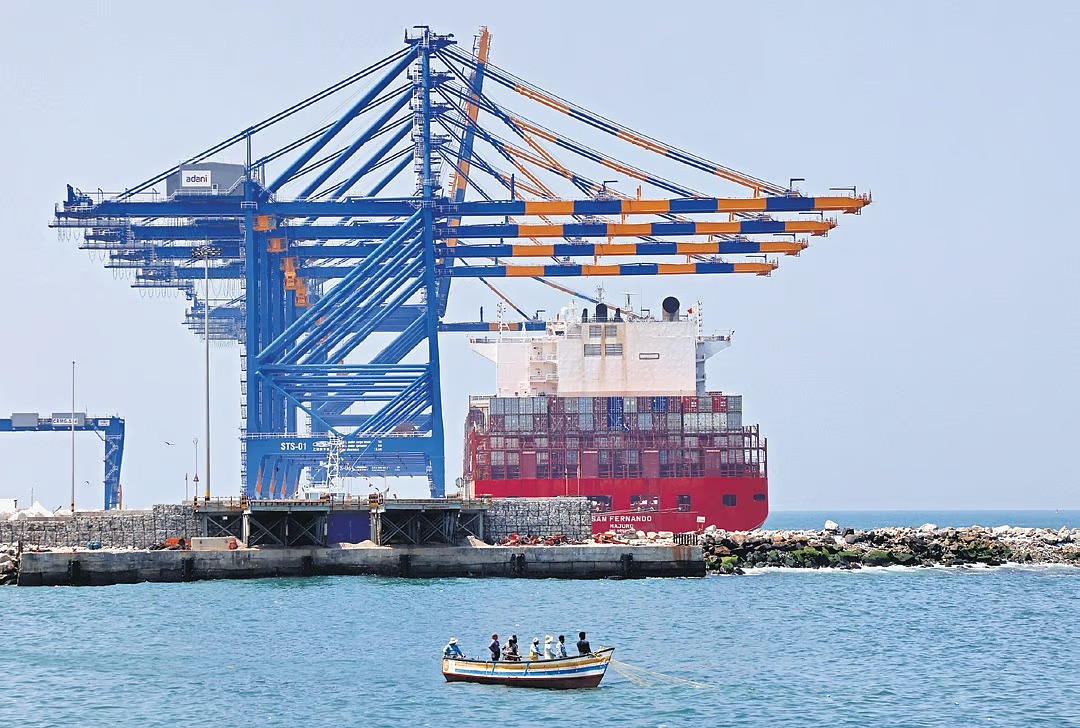
THIRUVANANTHAPURAM : In under nine months since commencing commercial operations, Adani Group’s Vizhinjam International Seaport has achieved a significant milestone of handling over 1 million twenty-foot equivalent units (TEUs). The achievement by the port operated by Adani Ports and Special Economic Zone (APSEZ) not only surpasses initial projections but has also redefined India’s maritime map.

At a ceremony held at the port to commemorate the milestone, Kerala’s Minister for Ports VN Vasavan said the Vizhinjam Port had handled 1 million TEUs within just nine months of beginning commercial operations. “This is a proud moment for Kerala and India as an emerging maritime power.”

Second phase of the port project will begin soon, he said, adding railway and road connectivity will also be built soon.

Launched on December 3, 2024, Vizhinjam has already welcomed over 460 vessels, including 26 ultra-large container vessels (ULCVs) measuring up to 399.99 metres. The port was originally expected to handle only 30 per cent of its 1 million TEU capacity in its first year under the concession agreement. Instead, it has exceeded expectations by achieving full-scale throughput in record time.

This feat was made possible through close collaboration between the government, local communities and APSEZ. It highlights both the port’s structural advantages and the Adani Group’s operational expertise. More importantly, it signals India’s ability to reshape global trade flows long dominated by regional hubs like Colombo and Singapore.

Vizhinjam’s performance is on par with some of the world’s top ports, particularly in its ability to handle larger parcel exchanges per vessel compared to Indian benchmarks. A notable example is the MSC Paloma, where the port achieved a record-breaking exchange of 10,576 TEUs – setting a new benchmark in India.

This, port officials say, reflects meticulous planning, optimized crane deployment, and high berth utilisation, all of which are crucial for sustaining growth in container traffic. Backed by APSEZ’s track record of operational discipline, Vizhinjam is quickly becoming Southern India’s largest container terminal by TEUs handled within its very first year.

Vizhinjam’s success is rooted in both geography and technology. Located close to the main East-West shipping routes, it allows vessels to reduce transit times and costs significantly. Its natural draft of 18.5 metres means even the largest ULCVs can dock without the need for dredging – a rarity among global deep-water ports.

Complementing its natural advantages is a robust technological backbone. The port operates with 8 STC (ship-to-shore) cranes and 24 automated CRMG (cantilever rail mounted gantry) cranes, supported by AI (artificial intelligence)- and IoT (Internet of Things)-enabled systems for real-time cargo tracking. Full automation ensures precision, faster vessel turnaround times, and scalability to absorb future growth without major upgrades.

Industry sources said the rapid scale-up at Vizhinjam is shifting trade dynamics. By offering direct connectivity to Europe, the US, Africa, and the Far East, the port eliminates the need for Indian cargo to be transshipped through foreign hubs. This directly enhances India’s self-reliance in maritime logistics while lowering costs and shipping times for exporters and importers.

With EXIM (export-import) operations set to commence in the fourth quarter of this financial year, the port is poised to unlock new trade opportunities, further boosting its role as a southern gateway for global commerce.

On sustainability, officials said Vizhinjam has been designed with eco-conscious infrastructure, integrating renewable energy solutions and adhering strictly to the Ministry of Environment, Forest and Climate Change (MoEFCC)safeguards. These initiatives place Vizhinjam at the forefront of India’s Green Shipping Revolution, setting an example for future maritime developments.

By reducing emissions from port operations, prioritizing energy efficiency, and embedding sustainability into its growth model, Vizhinjam proves that scale and environmental responsibility can go hand in hand.

Crossing 1 million TEUs in record time is just the beginning. As EXIM operations scale and green initiatives deepen, Vizhinjam is positioned to become a template for deep-water ports worldwide—a model of how India can build infrastructure that is both world-class and future-proof, officials said.

First Made-in-India chip to roll out from CG semi facility in Gujarat : Ashwini Vaishnaw

AHMEDABAD : The first made-in-India chip will be rolled out soon from CG Semi’s pilot line, said Union Electronics and Information Technology Minister Shri Ashwini Vaishnaw on Thursday. Vaishnaw’s remarks came during the inauguration of CG Semi’s OSAT, or Outsourced Semiconductor Assembly and Test facility in Gujarat’s Sanand.

Backed by the central and state government support, and in collaboration with Renesas and Stars Microelectronics, CG Semi is investing nearly Rs 7,600 crore over five years to develop two state-of-the-art facilities in Sanand, Gujarat.

The minister added that there is also significant progress at the semiconductor facility set up in Sanand by the local arm of US semiconductor company Micron Technology.

Vaishnaw had, earlier this year in an interview with NDTV Profit, said that the first made-in-India semiconductor chip is expected to be rolled out in 2025.

The minister, who heads the India AI Mission had stressed that the country’s plans to benefit from this emerging technology are on track. The government is currently working on the next phase of its AI mission, which revolves around two goals: having an indigenous AI model and getting a homegrown AI chip designed.

The India AI Mission is also expected to achieve three other key objectives in 2025, which includes the creation of common compute facility of 10,000 GPUs, he said. “Second is to have that very strong talent pipeline. Third is to basically focus on getting the applications in.”

US tariffs to impact Indian exports in short term; Govt fast-tracking export promotion measures: Commerce Ministry

NEW DELHI: The Commerce Ministry on Thursday said the recent imposition of 50 per cent tariffs by the United States will have a short-term impact on India’s exports, particularly in sectors such as textiles, chemicals, and machinery. However, it asserted that the long-term effect on overall trade and GDP will remain limited.

“It is understood that 50 per cent tariffs are going to impact trade, especially the sectors on which tariffs are there. They will suffer some trade loss in the US. There will be an impact on textiles, chemicals, machinery, etc. for the short run, but it will not be a very long-term loss,” a senior Commerce Ministry official told ANI.

The official acknowledged that industry bodies have expressed concern over liquidity constraints due to slowing orders and delayed payment cycles. “In the short run, their orders will slow down. The money that they have to get back from their exports will also slow down. So they will face some liquidity crunch and will be under financial strain to run their operations,” the official said.

According to the official, several industry players have urged the government to consider measures similar to those introduced during the COVID-19 crisis to address immediate financial challenges. “There is a very positive work going on to see how best we can implement their suggestions. The government is seized of the issue and their concerns are on our agenda,” the official added.

The government is prioritising an accelerated rollout of the Export Promotion Mission (EPM) to cushion the impact of the tariff hike. “Fast rollout of EPM will fill this void and give some impetus and support to the industry. That is something we are focusing on,” the official added.

Highlighting the need for resilient supply chains, the official termed the tariff situation as a “wake-up call” for all stakeholders. “Every little challenge or crisis is a new opportunity. It’s a wake-up call for industry and governments to see how we can diversify our exports, both in terms of the products we offer and the geographies where we sell,” the official said.

The government is also working to boost exports through e-commerce platforms, which it believes can help Indian exporters tap global markets faster. “Through our embassies and market access initiatives, we will support industry delegations to create more B2B connections and open up new market opportunities,” the official added.

On the Bilateral Trade Agreement (BTA) with the US, the official clarified that formal negotiations are not underway at present. “Negotiations and retaliation cannot go hand in hand. Talks have not been taken off the table, but right now we are not discussing the next formal round,” said the official, adding that any trade agreement would need to address the additional 25 per cent tariffs first.

Despite the tariff hike, the Commerce Ministry expects the impact on India’s GDP to remain minimal.

Source: ANI

CONCOR enhances EXIM Trade efficiency with seamless Double-Stack Rail Connectivity via Varnama

VADODARA: In a significant boost to India’s multimodal logistics network, the Container Corporation of India (CONCOR) has introduced regular double-stack container train services via its Varnama Terminal in Vadodara, strengthening cargo movement between northern hinterlands and western ports.

The new connectivity on the ICD Dadri – Varnama – JNPT corridor ensures uninterrupted EXIM cargo transportation, even before the direct Dedicated Freight Corridor (DFC) link becomes operational. By facilitating the movement of both reefer and dry containers, CONCOR is enabling faster, more economical, and sustainable logistics solutions for trade stakeholders.

Highlighting the milestone, Shri Sanjay Swarup, CMD, CONCOR stated on LinkedIn: “Varnama connectivity is ensuring uninterrupted EXIM movement even ahead of the DFC link, with faster evacuation, double-stack efficiency, and eco-friendly rail solutions.”

Key Benefits of the Service:

  • Faster & cost-effective cargo evacuation
  • Enhanced capacity through double-stack handling
  • Reliable and efficient connectivity to JNPT
  • Eco-friendly rail-based logistics solutions

This initiative highlights CONCOR’s strategic commitment to boost India’s EXIM competitiveness by optimizing transit times, reducing costs, and promoting sustainable logistics practices. With this development, the Varnama Terminal emerges as a critical hub, bridging northern markets with western ports and supporting India’s growing trade ecosystem.

Green Shift in Logistics: CONCOR integrates EVs at MMLP Dadri

NEW DELHI: In a significant step towards advancing sustainable and smart logistics, Container Corporation of India Ltd. (CONCOR) has commenced the trial deployment of Electric Vehicles (EVs) at its flagship Multi-Modal Logistics Park (MMLP) in Dadri. The initiative is aimed at reducing carbon emissions and promoting eco-friendly freight movement across the supply chain.

Under the trial, EVs will be used for transportation between factory locations and MMLP Dadri, while double-stack container trains will ensure seamless cargo movement from Dadri to gateway ports. This integrated approach is designed to enhance operational efficiency, reduce dependence on fossil fuels, and accelerate the transition to green logistics solutions.

Highlighting the strategic significance of the move, Shri Sanjay Swarup, CMD, CONCOR, stated: “The integration of Electric Vehicles at MMLP Dadri marks a defining step towards a cleaner, smarter supply chain — from the factory gate to the gateway port. CONCOR remains committed to promoting sustainable multimodal logistics while leveraging technology-driven solutions for the future.”

CONCOR has indicated that EV deployment will be scaled up soon after successful trials, aligning with the company’s long-term vision to lead India’s green logistics transformation. The initiative is part of CONCOR’s broader strategy to integrate smart mobility solutions across its network of multimodal hubs, enabling cost-efficient, environment-friendly, and seamless cargo movement.

With India’s logistics sector rapidly evolving, CONCOR’s latest step at MMLP Dadri underscores its role as a frontrunner in driving the green shift and supporting the nation’s sustainable growth agenda.