Home Blog Page 723

Over half of Indian exports to US unaffected by new tariffs

NEW DELHI : More than half of Indian Exports to the United States are expected to remain unaffected by the newly announced US tariffs, sources told .

As per the think tank GTRI, India’s exports exempted from US tariffs include finished pharmaceutical drugs, active pharmaceutical ingredients (APIs); energy products like crude oil, refined fuels, natural gas, coal, and electricity; critical minerals; semiconductors; and electronic products like computers, tablets, smartphones, solid-state drives, flat panel displays, and integrated circuits.

Pointing to the use of animal feed in the US dairy sector, sources cited “religious sentiments” as a reason why dairy and agriculture are considered red lines in all Free Trade Agreements (FTAs) by India. Sources added that the 25% tariffs on India’s exports worth $40 billion are expected to have little impact on the nearly $4 trillion Indian economy with 140 crore consumers.

Yesterday, sources had indicated that the US announcement of 25% tariffs on goods from India is being analysed, and that India will wait and watch, choosing to present its response at the negotiating table rather than opt for immediate retaliation. Assuring that the US tariff announcements are not a “cause for worry”, sources told CNBC-TV18 that India is unlikely to “jump the gun” before having clarity on the evolving situation.

Sources also said there is still no clarity on the penalties and associated duties until formal notifications are issued by the US government. For now, the sixth round of negotiations is scheduled for 25th August for the first tranche of a Bilateral Trade Agreement (BTA) between India and the US. Meanwhile, bilateral trade discussions are expected to continue virtually.

In fiscal year 2024-25, India and the United States recorded bilateral trade worth $131.8 billion, with India’s exports valued at $86.5 billion and imports at $45.3 billion.

Addressing both houses of Parliament yesterday, India’s Commerce and Industry Minister said the Ministry is engaged with all stakeholders, including exporters and industry, to gather feedback and assess the situation. Stating that the government gives utmost importance to protecting and promoting the welfare of farmers, workers, entrepreneurs, exporters, MSMEs, and all sections of the industry, Goyal said India has already signed mutually beneficial trade agreements with the UAE, UK, Australia, and EFTA countries in an increasingly protectionist world, and remains committed to similar trade agreements with other countries.

India’s trade surplus with the US rose to $41 billion in FY24-25, from $35.32 billion in FY23-24 and $27.7 billion in FY22-23. In 2024, India’s key exports to the US included drug formulations and biologicals worth $8.1 billion, telecom instruments worth $6.5 billion, precious and semi-precious stones worth $5.3 billion, petroleum products worth $4.1 billion, vehicle and auto components worth $2.8 billion, gold and other precious metal jewellery worth $3.2 billion, ready-made garments of cotton worth $2.8 billion, and iron and steel products worth $2.7 billion.

Imports from the US during the fiscal year included crude oil worth $4.5 billion, petroleum products worth $3.6 billion, coal and coke worth $3.4 billion, cut and polished diamonds worth $2.6 billion, electric machinery worth $1.4 billion, aircraft, spacecraft and parts worth $1.3 billion, and gold worth $1.3 billion. India has called for the removal of the 26% tariff, as well as easing of 50% tariffs on steel and aluminium exports and 25% tariffs on auto exports. India also reserved the right under WTO norms to impose retaliatory duties over the imposition of unilateral tariffs.

On April 2, 2025, the US President issued an executive order on reciprocal tariffs, imposing additional duties ranging from 10% to 50% on imports from its trading partners. A baseline duty of 10% has been effective since 5th April 2025. The additional duty on India was announced at 26%, including the baseline tariff.

Originally, the full country-specific additional duty was to be effective from 9th April 2025, but was postponed for 90 days on April 10, 2025 and further extended up to August 1, 2025. India and the US entered negotiations for a fair, balanced and mutually beneficial Bilateral Trade Agreement (BTA) in March 2025, targeting completion of the first tranche by fall 2025.

The two sides finalised the Terms of Reference (ToR) for BTA negotiations on March 29, 2025 during the first physical round of discussions held in New Delhi. Since then, four physical rounds of negotiations have been held between the two sides, in New Delhi and Washington D.C., in line with the agreed ToR. In addition, multiple virtual meetings have taken place.


FinMin amends rules governing customs & excise settlement commission ; existing officers to vacate posts with compensation

NEW DELHI : The Ministry of Finance has notified amendments to the rules governing the Customs and Central Excise Settlement Commission, mandating that all existing members, including the Chairman and Vice-Chairmen, vacate their positions effective from a date to be specified by the Central Government.

The changes will retrospectively apply from April 1, 2025, and modify Rule 7 of the Customs and Central Excise Settlement Commission (Recruitment and Conditions of Service of Chairman, Vice-Chairmen and Members) Rules, 2015.

The new proviso states that any person holding the office of Chairman, Vice-Chairman, or Member immediately before the notified date shall cease to hold that position from such date.

Those affected by the premature termination of their tenure will be entitled to a compensation not exceeding three months’ pay and allowances.

The amendment has been given retrospective effect from April 1, 2025, as authorized under Section 106 of the Finance Act, 2025.

No Adverse Impact on Any Individual, Government Says

An Explanatory Memorandum included in the notification certifies that the amendment will not adversely affect the interests of any individual, likely aiming to pre-empt legal challenges from outgoing officials.

https://drive.google.com/file/d/1kXdEcZgRRiW79tJBHblEJz5wGO6dquJa/view?usp=sharing

Rs 44 Cr Customs Duty evasion involving undervalued walnut imports : Bombay HC allows Anticipatory Bail

NEW DELHI : In a recent case, the Bombay High Court allowed anticipatory Bail in case of Rs 44 Cr of Customs Duty evasion involving undervalued walnut imports. The applicants have demonstrated their willingness to pursue the statutory remedy of compounding the alleged offence.

Dipakkumar Dharamsinhbhai Kakadiya, the applicant, apprehends arrest and coercive action in connection with allegations involving both compoundable and non-compoundable offences punishable under Sections 132 and 135 of the Customs Act, 1962. These apprehensions arise in the course of an ongoing investigation being conducted under File No.DRI/MZU/F/INT-32/Enq 17/2025/RA No.485 of 2025, by and/or at the instance of the respondent/ Directorate of Revenue Intelligence.

The investigation pertains to alleged acts of misdeclaration in the importation of goods, primarily walnuts, which are classified as freely importable items. These imports were mainly routed through the Nhava-Sheva Port. The DRI accuses the applicants of deliberately undervaluing the imported goods by submitting manipulated and fabricated invoices to evade customs duties. The transactions in question were carried out in the names of several entities: M/s Deepak Trading Company, M/s Angel Enterprises, M/s Deepak Kirana Stores, and M/s BV FEB.

Search and seizure operations were conducted in February 2025 in relation to the said allegations. It is submitted that applicant No.1 is the individual managing the affairs of the firms as mentioned above. Applicant No.2 is the nephew of applicant No.1, and applicant No.3 is the mother of applicant No.1.

Kakadiya Sneh Deepakbhai, son of applicant No.1, was arrested in connection with the present matter vide Remand Application No.485 of 2025. He has since been released on bail. The Remand Applications filed in the case alleged evasion of customs duty to approximately Rs.44 Crores, and copies of the said applications have been annexed to the present application for reference.

The Directorate of Revenue Intelligence (DRI) have filed the detailed replies opposing the anticipatory bail application. The DRI has raised preliminary objections on the issue of maintainability and is contesting the application on merits. In support of its opposition, the DRI has also placed reliance on an ex-parte order dated 3 July 2025 issued by the compounding authority, wherein the compounding application filed by the applicants was rejected as being premature.

The primary allegation in the case pertains to large-scale undervaluation in the import of ‘Inshell Walnuts’. It is alleged that the modus operandi involved the submission of manipulated and fabricated invoices issued by Dubai-based entities to Indian Customs authorities, to suppress the true transaction value and thereby evade customs duties.

ecrets of HUF Formation & Taxation – Strengthen Your Legacy Today! Click here

It is further alleged that Sneh Deepakbhai Kakadiya, in his capacity as an authorised representative of the Dubai-based entity, had personally signed the aforementioned manipulated invoices. Additionally, actual invoices issued by a Chile-based supplier were recovered from Sneh Deepakbhai Kakadiya’s email account, clearly indicating a significant discrepancy and deliberate under-invoicing. The estimated customs duty evaded in this manner is said to exceed Rs 44 Crores.

According to the respondent, similar practices are being adopted by multiple importers. The DRI also contended that applicant No.1 had previously sought and was granted time to appear in response to various summonses issued during the investigation. However, rather than complying with those summonses, the applicants have now chosen to approach the Court for anticipatory bail. It is further stated that the co-accused, Sneh Deepakbhai Kakadiya’s statements were recorded under CCTV surveillance, and the alleged retraction of such statements is argued to be an afterthought.

The respondent has also raised concerns regarding noncooperation by the applicants, expressing apprehension that the applicants may abscond, tamper with evidence, or attempt to influence witnesses.It is submitted that, as a general rule, applications for anticipatory bail should first be made before the Court of competent Sessions Court.

The remand applications were filed before the Additional Chief Metropolitan Magistrate, Esplanade, Mumbai, even though no specific allegation of mis-declaration has been made in Mumbai. The customs declarations in question were primarily made at Nhava-Sheva, located in District Raigad, with some declarations made at Mundra Port in Gujarat. Under such circumstances, the applicants cannot be expected to jeoparadise their liberty by engaging in protracted arguments over territorial jurisdiction, specifically, whether the matter falls under the jurisdiction of the Sessions Court at Mumbai (where remand proceedings of co-accused are being conducted) or the Sessions Court at Panvel District-Raigad, where the alleged offence was committed. Given these peculiar and complex jurisdictional facts, the applicants have exercised their right to approach this Court, which has concurrent territorial jurisdiction over both District Raigad and District Mumbai.

Secrets of HUF Formation & Taxation – Strengthen Your Legacy Today! Click here

Furthermore, the applicants have filed a joint compounding application dated 1 July 2025 under Section 137(3)of the Customs Act, 1962, as a one-time statutory remedy prior to the initiation of prosecution, with the intention of avoiding multiplicity of proceedings, evading the rigours of prolonged litigation, and safeguarding their liberty. Through this application, the applicants have expressed their willingness to cooperate fully with the compounding authority and to pay the compounding fee as may be determined, along with any customs duty, interest, and penalty found due in accordance with law.

It was also held therein that the alleged offence was bailable, bail was granted accordingly, and it was further directed that any interrogation of the applicant be conducted in the presence of his advocate, positioned at a visible but not audible distance, with the entire process being videographed.

The applicants have demonstrated their willingness to pursue the statutory remedy of compounding the alleged offence. In this context, they may be directed to cooperate with the investigation, subject to appropriate conditions to allay the concerns of the investigating authority.

A single bench of Justice R.N. Laddha considering the applicants’ willingness to comply with compounding provisions, the stage of the investigation, absence of prior criminal record, the documentary nature of the evidence, the willingness on the part of the applicants to jointly deposit a total amount of Rs.5 Crores with the respondent allowed the application subject to the conditions.

AI-Powered detection delivers improved Safety to Offshore Operators

EDINBURG : The offshore energy industry has started adopting AI-based advanced detection technology to improve safety and operational oversight, with operators now trialling and installing intelligent detection systems to reduce the risk of man overboard (MOB) incidents.

Among the systems gaining attention is ZOE, developed by Edinburgh-based technology firm Zelim. The company’s intelligent detection and tracking system has now been installed on a second jack-up rig, following over a year of successful operation on a North Sea rig operated by a leading offshore drilling contractor.

ZOE combines camera hardware with proprietary AI software that automatically detects when a person falls overboard and tracks their position in real time, enabling faster, more accurate response. Its deployment on another rig signals a broader interest across the offshore energy sector in using machine learning to support both personnel safety and asset security monitoring.

Zelim’s CEO and founder, Sam Mayall, explains that the system was developed specifically to operate in the maritime environment, which presents different technical constraints from traditional object detection systems used on land. “The first challenge in a man overboard incident is knowing when and where it happened. The second challenge is keeping track of the person in the water, particularly in variable sea states. ZOE provides real-time visual tracking and geo-location data to coordinate an effective response.”

The first installation provided a relatively fixed operating environment for ZOE to prove its capabilities. The more recent deployment is on a rig that frequently relocates to new locations, requiring the system to adapt to different weather conditions, sea states, and lighting environments.

ZOE uses machine learning models trained on a bespoke maritime dataset. Zelim began building its own visual library in 2020 during development of its Guardian unmanned rescue vessel. As part of that process, the company used drone-mounted cameras to capture footage of people in the water from different angles and under various conditions. These images were manually annotated and used to train the algorithms behind the intelligent detection system. The resulting dataset now includes more than 7[AG1]  million labelled images, which is claimed to be the most extensive of its kind in maritime search and rescue.

According to Mayall, the quality and specificity of the dataset is critical. “A person in the water may be wearing dark clothing, face down, partially submerged, or obscured by foam or spray. These aren’t fixed profiles. We had to ensure the system could recognise a human target from a range of angles and distances, under real-world conditions. That meant building a dataset that reflected how people actually appear in the water, not how they’re modelled in ideal circumstances.”

ZOE integrates with a rig or vessel’s existing infrastructure, including surveillance, navigation and emergency response systems. The package includes processing hardware to enable detection and alerting to occur locally, without dependence on remote or cloud connectivity.

The software architecture behind ZOE has also been adapted into other modules. Watchkeeper is an option that supports bridge teams by acting as a visual lookout, identifying navigational hazards or approaching vessels. Another module, Shield, extends the same detection capability to support rig security, alerting crews to suspicious activity or unauthorised vessels within restricted zones around offshore sites. Both modules are built on the same core AI engine, but are designed for different operational roles.

Mayall says that the ability to detect and classify objects consistently and in real time opens up wider use cases. “If you can reliably detect a person in the water, you can also detect other objects or risks. The same system can support navigation, perimeter monitoring, or safety watchkeeping. That’s where we see this technology heading – not just detection, but situational understanding.”

Zelim has collaborated with the US Coast Guard on testing and validation. One of the drivers for this collaboration was the Coast Guard’s own research, which found that visual spotting by trained search crews remains inconsistent, with detection probabilities sometimes below 20 percent depending on conditions. Mayall notes that AI systems bring consistency. “AI doesn’t fatigue, doesn’t blink, and doesn’t overlook what’s in plain sight. That consistency makes it a reliable component in a broader safety system.”

The use of AI for detection and alerting is increasingly viewed not as a replacement for human judgment, but as an augmentation of it. In a setting where rapid recognition and response are critical, the ability to reduce the detection window from minutes to seconds can have a direct impact on outcomes. Operators are beginning to see these systems not only as tools for emergency response, but also as part of their broader approach to safety and operational assurance.

Zelim’s work over the past five years reflects a shift towards intelligent, consistent monitoring that supports human decision-making and improves reaction time. For offshore operators, that capability is now becoming part of the standard toolkit. As deployments continue and new modules are brought online, systems like ZOE may come to define the next generation of offshore safety technology – not as standalone interventions, but as integrated components of modern marine operations.

Xeneta Weekly Container Shipping Market: Transpacific Rates on the decline

OSLO : Xeneta analyst insight – Transpacific – “Average spot rates on the major fronthauls from the Far East to US have been falling hard and are now at the lowest level since December 2023. With further decreases expected in August, freight rates are now closing in on pre-Red Sea crisis levels, especially into the US West Coast.

“The US is striking multiple trade deals, but this is unlikely to spark a cargo rush in the remainder of 2025 and prevent further softening of rates. Carriers are trying to manage capacity, but they may be fighting a losing battle and have no choice but to accept lower freight rates.

“If the forecast for the remainder of 2025 is challenging for carriers, it will also be tough for shippers. They may benefit from falling freight rates, but this will not come close to offsetting the financial impact of tariffs.” said Emily Stausbøll, Xeneta Senior Shipping Analyst.

Xeneta analysis insight – Europe – “With no sign of a peak season that would have traditionally pushed spot rates up in Q3, there is further bad news for carriers on trades from Far East to North Europe and Mediterranean. Carriers will have expected this downturn, but it will not make it any easier to manage given the significant overcapacity in the global fleet.

“Average spot rates from Far East to Mediterranean will continue their descent in August while rates into North Europe hold a little a little stronger. This means the spread in spot rates on these trades will close in on parity in August, which is a dramatic shift since it stood at USD 1720 in mid-July.”

Xeneta weekly market update chart 31.07.25 Xeneta Weekly Container Shipping Market: Transpacific Rates on the decline

Market average spot rates – 31 July 2025:
o Far East to US West Coast: USD 2264 per FEU (40ft container)
o Far East to US East Coast: USD 3775 per FEU
o Far East to North Europe: USD 3358 per FEU
o Far East to Mediterranean: USD 3662 per FEU
o North Europe to US East Coast: USD 1993 per FEU

• Market average spot rate on the Transpacific trade from Far East to US West Coast increased 10% mid-month on 15 July, but has declined steadily in the second half of the month to stand at USD 2264 per FEU.
• Average spot rates from Far East to US West Coast are now down 59% since the market peak on 5 June and are expected to fall further at the beginning of August, moving towards USD 2000 per FEU.
• Market average from Far East to US East Coast has fallen 46% since the peak on 15 June to stand at USD 3 775 per FEU. Looking ahead to August and spot rates are expected to drop below USD 3 500 per FEU.
• Average spot rates on both trades from Far East to US East Coast and US West Coast are now at the lowest level since December 2023, with US West Coast in particular now closing in on pre-Red Sea Crisis levels.
• Average spot rates from Far East to North Europe have flattened at USD 3358 per FEU after increasing 78% between 31 May and 1 July.
• Average spot rates from Far East to Mediterranean have declined 11% since 1 July to stand at USD 3662 per FEU.
• The spread in average spot rates on the Far East trades to North Europe and Mediterranean is now USD 304. The is the narrowest spread between these trades since November 2024 and has decreased from USD 1720 on 15 June.
• Looking ahead to August and the average spot rates to North Europe are expected to hold strong while rates into the Mediterranean will move down toward USD 3 400 per FEU. This means the spread between these trades will be closing in on parity in August.

Drewry: World Container Index down 1% last week

LONDON : Drewry’s World Container Index decreased 1% to $2,499 per 40ft container this week.

Drewry’s detailed assessment for Thursday, 31 Jul 2025

  • Drewry’s World Container Index (WCI) declined only 1% this week, and continued to stabilise after a volatile period. The unpredictability began after US tariffs were announced in April, which caused rates to surge from May through early June. Subsequently, the market saw a heavy decline until mid-July, after which the downward trend lost momentum and the rate of decrease slowed considerably.
  • Transpacific spot rates fell this week, as rates on Shanghai–Los Angeles were down 2% ($2,632/feu) and those on Shanghai–New York also slid 2% ($4,135/feu). With a temporary halt on higher US tariffs for Chinese products ending in mid-August, shipping lines are cutting back on services across the Pacific by cancelling more sailings. Since the big rush to ship cargo before the tariff increase is now over, Drewry expects spot rates to remain less volatile in the coming week.
  • Drewry’s Container Forecaster expects the supply-demand balance to weaken again in 2H25, which will cause spot rates to contract. The volatility and timing of rate changes will depend on Trump’s future tariffs and on capacity changes related to the introduction of US penalties on Chinese ships, which are uncertain.

Source: Drewry

Baltic Index records Worst Week in more than a Month

LONDON : The Baltic Exchange’s main sea freight index, which measures rates for ships carrying dry bulk commodities, edged higher on Friday but logged its worst week since early-June, weighed down by lower rates across all vessel segments.

The main index, which tracks rates for capesize, panamax and supramax shipping vessels, rose 15 points, or 0.75%, to 2,018 points, though it posted a weekly loss of more than 10%, marking its worst performance since June 16.

The capesize index gained 57 points, or 1.8%, to 3,296, however logged a weekly fall of nearly 14%.

Average daily earnings for capesize vessels, which typically transport 150,000-ton cargoes such as iron ore and coal, increased $473 to $27,331.

Iron ore futures prices traded little changed on Friday but were set for weekly losses, as expectations of more stimulus from top consumer China for the struggling property sector faded, dimming demand prospects for the steelmaking ingredient.

The panamax index fell 15 points, or 0.9%, to 1,644, and was down over 10% for the week, marking its worst week since April.

Average daily earnings for panamax vessels, which usually carry 60,000-70,000 tons of coal or grain, was down by $131 to $14,798.

Among smaller vessels, the supramax index was up 1 point, or 0.08%, to 1,269, marking its second consecutive weekly decline.
Source: Reuters

“India ramps up shipbuilding capability to realise PM Modi’s vision of Viksit Bharat”: Sarbananda Sonowal

NEW DELHI : India’s shipbuilding industry is undergoing a transformational shift, as the Union Government under Prime Minister Shri Narendra Modi accelerates efforts to build a world-class maritime ecosystem—paving the way for a Viksit Bharat by 2047, asserted Shri Sarbananda Sonowal, the Union Minister of Ports, Shipping & Waterways (MoPSW). The Union Minister was responding to a starred question by Dr Rajeev Bharadwaj, MP from Kangra LSC at the ongoing monsoon session of the Lok Sabha.

In line with the Maritime India Vision 2030 and the long-term strategic roadmap of Amrit Kaal, the Union Budget 2025 has announced a series of reforms and investments aimed at significantly enhancing the capacity and competitiveness of Indian shipyards. These initiatives are expected to strengthen India’s position as an emerging global maritime power, expressed Sonowal.

Highlighting the government’s commitment, Sarbananda Sonowal underlined the“The Shipbuilding Financial Assistance Policy which is being revamped to address cost disadvantages,” thereby helping Indian shipyards compete on equal footing with their international counterparts. The inclusion of credit notes for ship breaking in Indian yards reinforces the push towards a circular and sustainable maritime economy.

To boost infrastructure financing, large ships above a specified size will now be classified under the Infrastructure Harmonised Master List, making them eligible for long-term, low-interest funding. Simultaneously, the government will facilitate the development of integrated shipbuilding clusters, equipped with modern infrastructure, skill development centers, and advanced technologies. This, the Budget notes, is aimed at “increasing the range, categories and capacity of ships” built in India.

In a landmark move to address the industry’s need for long-term capital, the government has proposed a ₹25,000 crore Maritime Development Fund, with up to 49% government contribution. This fund will mobilise private and port-led investments to expand and modernise India’s shipbuilding and repair capabilities.

Recognising the long gestation nature of the industry, tax exemptions on Basic Customs Duty (BCD) for raw materials and components used in shipbuilding and ship-breaking have been extended for another 10 years. “Our commitment to empower and enable our maritime sector is absolute and it is with this intent we are working under the dynamic leadership of Prime Minister Shri Narendra Modi ji,” said Sarbananda Sonowal.

These budgetary interventions come on top of ongoing reforms that are already reshaping the sector. Indian shipyards currently benefit from financial assistance for contracts signed between April 1, 2016, and March 31, 2026. The grant of infrastructure status to shipyards has unlocked access to institutional finance at favorable terms, and the ability to issue infrastructure bonds—critical enablers for capacity enhancement.

To give Indian shipbuilders a competitive edge in public procurement, the government has extended the Right of First Refusal (ROFR) for tenders floated by public sector units. As per the Public Procurement (Preference to Make in India) Order 2017, vessels valued under ₹200 crore must be procured from Indian yards, thereby reinforcing the goal of self-reliance in maritime assets.

“In line with Prime Minister Modi’s call for efficiency and standardisation, five standardised tug designs have been released for use by major ports. These designs, to be built exclusively in Indian shipyards, are expected to streamline procurement processes and improve cost-effectiveness,” said Sonowal.

On the ship repair front, Cochin Shipyard Limited has inaugurated a ₹970 crore International Ship Repair Facility (ISRF) in Kochi. This facility marks a significant upgrade in India’s maritime infrastructure, reducing dependency on foreign repair docks and positioning India as a regional hub for ship maintenance, Sonowal responded.

Capacity-building is a core pillar of capability enhancement. Both CSL and Mazagon Dock Shipbuilders Limited (MDL) are registered under the Prime Minister’s Internship Scheme, offering young Indians hands-on exposure to the latest in shipbuilding and marine engineering.

Speaking on the significance of these initiatives, Union Minister of Ports, Shipping and Waterways Sarbananda Sonowal said, “Prime Minister Narendra Modi ji’s vision for Viksit Bharat places the maritime sector at the heart of India’s economic resurgence. A strong, self-reliant shipbuilding industry will not only generate employment but will also enhance our strategic and commercial standing on the global stage. India is not just building ships; we are building a resilient future. These reforms will unlock new opportunities for investment, innovation, and international collaboration in the maritime domain.”

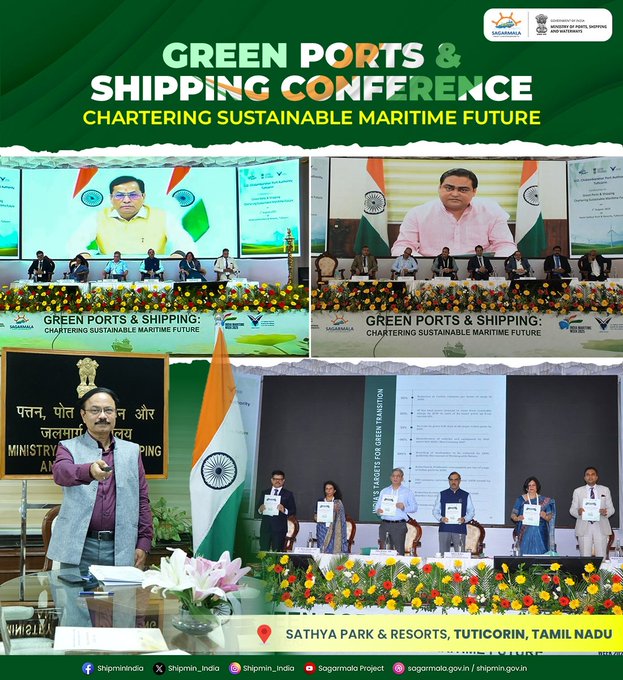
Green Ports & Shipping Conference : Chartering sustainable maritime future

TUTICORIN : Ministers of Shipping, dignatories Industry leaders, policymakers, innovators, and environmental advocates converged this week at the Green Ports & Shipping Conference, an influential summit focused on steering the global maritime industry toward a more sustainable and resilient future. Held at Tuticorin, on 1st August, the event brought together stakeholders from across the shipping and port logistics sectors to address urgent climate challenges and explore actionable solutions for decarbonizing maritime operations. With the theme “Chartering a Sustainable Maritime Future”, the conference featured keynote speeches, expert panels, and technology showcases highlighting next-generation green port infrastructure, alternative fuels such as ammonia and hydrogen, and digital innovations aimed at reducing carbon footprints.

At the Green Ports & Shipping Conference under NAVIC Cell 3 of MoPSW, key discussions unfolded on clean energy, marine pollution control and green port infrastructure. This marks a significant step in the realisation of Hon’ble PM Shri Narendra Modi’s Maritime Amritkaal Vision 2047

Shri Sarbananda Sonowal, Hon’ble Union Minister of Port Shipping & Waterways connected virtually to the event, stated that MoPSW is wholly committed to Hon’ble PM Shri Narendra Modi’s ‘Net Zero by 2070 vision‘, a key ingredient of a greener and Viksit Bharat! He also highlighted how VoC Port Authority Tuticorin stands as a lighthouse, guiding India’s maritime sector towards a sustainable future.

Shri Shantanu Thakur, Hon’ble Minister of State, PS&W, also connected virtually highlighted that India is steadily progressing towards a greener maritime future, guided by the visionary leadership of Hon’ble Prime Minister Shri Narendra Modi. Speaking of the India Maritime Week 2025, he said that the global platform will showcase India’s sustainable maritime initiatives and serve as a platform for greater international collaboration in the sector.

Shri T.K. Ramachandran (IAS), Secretary, MoPSW in a virtual meeting, emphasized on the need to adopt sustainable practices across the maritime sector. He further stressed on how this conclave will help chart a clear roadmap for a greener future, aligning with the nation’s long-term vision of a sustainable Maritime Sector.

Shri Susanta Kumar Purohit, IRSEE, Chairperson, VoC Port Authority_Tuticorin, emphasized that the Green Ports & Shipping Conference will act as a platform to discuss actionable ideas and innovations aimed at shaping a more sustainable maritime sector. He also highlighted how the event shall serve as a precursor to the India Maritime Week 2025

Dr. Malini V. Shankar, IAS (Retd.), Vice Chancellor of Indian Maritime University spoke of how India must lead from the front in a world where green shipping initiatives are gaining momentum. She also highlighted that adopting such practices are key in realising Hon’ble PM Shri Narendra Modi’s Maritime Amritkaal Vision 2047.

Shri Vijay Kumar (IAS), Chairman, Inland Waterways Authority of India, underscored the essential nature of sustainable shipping practices for the future of the maritime sector. He also highlighted that the effective and structured implementation of green initiatives are crucial for realising a sustainable maritime ecosystem.

Key topics included in the conference were :

  • Green Port Development: Innovations in electrification, shore power, and smart logistics systems.
  • Zero-Emission Vessels: Progress in hybrid, electric, and hydrogen-fueled ship technologies.
  • Regulatory Frameworks: Updates on IMO targets, EU Fit for 55, and ESG compliance requirements.
  • Financing the Transition: Investment strategies for sustainable maritime infrastructure and innovation.

The conference also showcased a Green Innovation Pavilion, where start-ups and tech companies demonstrated breakthrough solutions in emission monitoring, green propulsion, and AI-powered port optimization.

Notable attendees included representatives from Ministry of Shipping and Ports alongwith Governmental Agencies, and International bodies like the IMO and UNCTAD. As global trade continues to evolve, the Green Ports & Shipping Conference signals a unified push toward achieving net-zero targets and ensuring that maritime transport remains a key driver of a greener global economy.

Sarbananda Sonowal informs Modernization of Ports under Maritime India Vision 2030

NEW DELHI : Union Minister of Ports, Shipping and Waterways, Shri Sarbananda Sonowal informed in a written reply to the Lok Sabha that, Maritime India Vision 2030 envisions Chennai-Kamarajar-Cuddalore cluster to become Mega Port in the eastern coast by 2047. This cluster is targeted to achieve a cargo handling capacity of over 300 million tonnes per annum by the year 2047.

Under the Port Modernization pillar of Sagarmala Programme, a total of 234 projects at cost of Rs. 2,91,279Cr. have been undertaken for implementation and out of 234 projects, 104 projects worth Rs. 32,654Cr. have been completed and 55 projects worth Rs. 74,725 Cr. are under implementation.

The key initiative of Government includes Port Modernisation of Chennai, Ennore (Kamarajar), and Tuticorin (VO Chidambaranar) ports, and investment in infrastructure connectivity such as rail and road linkages. Further, strategic location, deep-draft ports, and policy support aim to position Tamil Nadu as a key maritime hub in Asia.