Home Blog Page 835

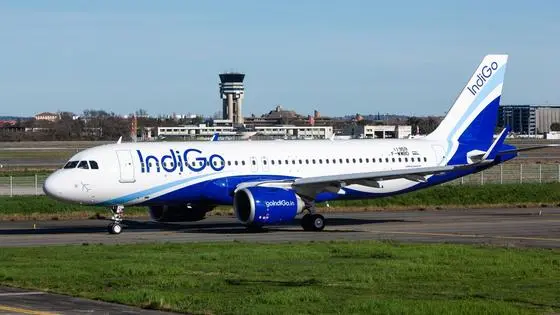
IndiGo eyes major cargo expansion on India-Europe routes

NEW DELHI : IndiGo sees significant opportunity for cargo movement between India and Europe as it launches its maiden service from Mumbai to Amsterdam and Manchester from July. The airline will operate a wet leased Boeing 787 on the routes which can carry up to 18-20 tonnes of cargo in each direction.

“The opportunity for cargo for us is significant. It nicely coincides with the Make in India campaign which is becoming more and more prominent in terms of India becoming the global production hub,” IndiGo’s Chief Executive Officer Pieter Elbers said in a post fourth quarter result conference call.

Indian airports handled over 3.7 million tonnes of cargo in FY25, a growth of 10.5 per cent over the previous year. While domestic freight traffic grew 5.6 per cent, international freight handled by airports rose by 13.7 per cent in the period.

Yet, the share of Indian carriers in overall international freight traffic from/to India is in single digits and Elbers believes the introduction of new European service will help in growing overall share of Indian carriers. “That will be our focus,” he said.

Growth in fleet, improved utilisation of freighters and international tie-ups has helped IndiGo grow its cargo business. The airline added 67 aircraft to its fleet (including wet leased planes) taking the total count to 434 as of March. Partnerships with Air France-KLM and FedEx have also helped grow traffic. The tie up with Air France-KLM would be particularly useful as IndiGo starts its flights to Amsterdam, which is the primary hub of KLM.

While Delhi was the first choice for launch of the European flights as it offers more onward connections, the airline opted for Mumbai after closure of Pakistan airspace for Indian carriers.

Elbers conceded that the airline’s connecting network in Mumbai is not as strong as compared to Delhi but there are some good connections to South India (from Mumbai) with traffic flows from Europe. “We made the evaluation and figured that it was a good way to start our operations,” he said.

IndiGo has leased one Boeing 787 aircraft from Norse Atlantic and expects to receive another five in second half of FY26. Elbers said with the Boeing 787 aircraft would allow the airline operations to Europe from any of its Indian hub and still has the time to finalise operations of remaining five aircraft.

Asked about brand awareness in Europe, Elbers said IndiGo gets customers from its code share partners Air France-KLM, British Airways and Virgin Atlantic on its domestic flights. “I am sure our competitive fares from Amsterdam and Manchester will stimulate demand from Europe into India and even beyond,” he added.

ONE revises Japan-Korea1 Service to boost efficiency

SINGAPORE : Ocean Network Express (ONE) has announced a revision to its Japan Korea 1 (JK1) service, aiming to improve operational efficiency, service reliability, and environmental performance.
As part of the update, the Tokyo port call will be replaced with a call at Kawasaki.

The revised service rotation will take effect with the MV Confidence voyage 218E/218W, departing Pusan on 12 June.

Updated JK1 Service Rotation:

Current: Pusan – Shimizu – Tokyo – Nagoya – Pusan
New: Pusan – Shimizu – Kawasaki – Nagoya – Pusan

Escalating Port Congestion strains Container Shipping Flows : Drewry

LONDON : Port congestion across key Northern European hubs is intensifying, with Bremerhaven particularly affected by labour shortages during the recent holiday period. Compounding the situation, low water levels on the Rhine are limiting barge capacity, particularly out of Antwerp and Rotterdam—further straining inland logistics.

Major gateways including Antwerp, Rotterdam, Hamburg, and Bremerhaven are now grappling with escalating backlogs, as containerships face mounting delays. At the Port of Antwerp-Bruges, operations were further strained by a nationwide strike on 20 May, which temporarily disrupted vessel traffic. Kallo and Boudewijn Locks were affected, with Boudewijn Lock later restored to full operation by the evening. Although the impact was short-lived, it added pressure to already congested conditions across the region.

Figure 1: Average containership waiting time – Week 13 vs Week 20 (hours) 

Drewry 1 1 Escalating Port Congestion strains Container Shipping Flows : Drewry

As illustrated in the chart above, berth waiting times at Antwerp have risen from 32 hours in Week 13 to 44 hours in Week 20—a 37% increase. Similarly, Hamburg has seen a 49% surge, with waiting times climbing from 34 to 50 hours, while Bremerhaven saw 77% increase, over the same period.

This growing congestion is having a cascading effect across the supply chain:
• Supply chain reliability is deteriorating
• Logistics costs are rising
• Inland transport is becoming increasingly complicated
The issue isn’t limited to Europe. Similar patterns are emerging in Shenzhen, Los Angeles, and New York, where the number of containerships awaiting berth has been increasing since Week 17. Peak congestion figures show Shenzhen with up to 50 ships waiting, Los Angeles with 42, and New York with 14, as seen in the chart below.

Figure 2: Number of containerships waiting outside key ports, by week

Drwry Tab 2 Escalating Port Congestion strains Container Shipping Flows : Drewry

Port delays are stretching transit times, disrupting inventory planning, and pushing shippers to carry extra stock. Meanwhile, carriers are rerouting vessels and introducing congestion-related surcharges. For example, MSC will introduce a congestion surcharge from 1 June on all cargo moving from Northern Europe to the Far East, adding to rising shipping costs.

Adding to the pressure, the Transpacific eastbound trade is showing signs of an early peak season, fuelled by a 90-day pause in US–China tariffs, set to expire on 14 August.

As a result:
• Container spot rates on transpacific routes have surged 27% since early May, as shown in the chart below tracking the sharp rise in Drewry World Container Index (WCI). Rates from Shanghai to Los Angeles climbed from $2,590 on 1 May to $3,197 by 22 May, while rates to New York jumped from $3,500 to $4,527 over the same period, reflecting intensified demand and successful general rate increases.
• General Rate Increases (GRIs) were successfully implemented on 15 May
• Additional GRIs and Peak Season Surcharges (PSSs) are planned for 1 June

Figure 3: Drewry World Container Index (US$/40ft container), by week

Drewry WCI Tab 3 Escalating Port Congestion strains Container Shipping Flows : Drewry

The situation reveals the exposure of container shipping to disruption and underscores the urgent need for resilient, adaptive supply chain strategies.

In such a volatile environment, access to up-to-date market insights, including operational metrics such as port congestion, cancelled sailings, and capacity, is essential in helping cargo owners make informed decisions, mitigate risks, and navigate ongoing uncertainty more effectively.

Source: Drewry

SHIPPING: Asia-US container rates rise; carriers bring back capacity amid tariff pause

LONDON : Asia-US rates for shipping containers rose this week, leading ocean carriers to rush to ramp up capacity to handle an expected surge in bookings.

Rates from online freight shipping marketplace and platform provider Freightos rose by 3% to both US coasts, while rates from supply chain advisors Drewry showed a 2% increase on rates from Shanghai to Los Angeles and a 4% rise in rates from Shanghai to New York, as shown in the following chart.

Following the latest US-China trade developments, Drewry expects an increase in spot rates in the coming week as carriers are reorganizing their capacity to accommodate a higher volume of cargo bookings from China.

Kyle Beaulieu senior director, head of ocean Americas at Flexport, said during a webinar this week that carriers who initiated blank sailings and discontinued services to the US are now resuming services.
Beaulieu said there were 10 China-US services that were halted, and as of today, six are planning to resume from Week 22 to Week 24.

Drewry WCI SHIPPING: Asia-US container rates rise; carriers bring back capacity amid tariff pause

Beaulieu said ports in the Pacific Northwest have been the biggest beneficiaries so far as that is the shortest route to the US.

Alan Murphy, CEO, Sea-Intelligence, said carriers who were reducing transpacific capacity due to the decrease in bookings from China amid 145% tariffs are now working to ramp up capacity prior to the 14 August deadline.

This means that typical peak season volumes now must be shipped no later than mid-July.

Judah Levine, head of research at Freightos, said there is still confusion on whether July and August deadlines mean goods need to be loaded at origins by those dates – as was the case with the 9 April tariff deadline – or that goods must arrive in the US by then.

“The latter would significantly shorten these lower-tariff windows,” Levine said. “Ocean shipments from Asia would have to move in the next week or two to arrive before 9 July.”

Levine noted that carriers have separately come out with mid-month general rate increases (GRIs) from $1,000-3,000/FEU (40-foot equivalent unit) and have similar GRIs planned for 1 June and 15 June with aims to get rates up to $8,000/FEU.

“If successful, rate levels would be about on par with the Asia – US West Coast 2024 high reached last July,” Levine said. “Daily transpacific rates as of Monday have already increased about $1,000/FEU to the East Coast and $400/FEU to the West Coast to about $4,400/FEU and $2,800/FEU, respectively.”

Container ships and costs for shipping containers are relevant to the chemical industry because while most chemicals are liquids and are shipped in tankers, container ships transport polymers, such as polyethylene (PE) and polypropylene (PP), are shipped in pellets. Titanium dioxide (TiO2) is also shipped in containers.

They also transport liquid chemicals in iso tanks.

LIQUID TANKER RATES HOLD STEADY

US liquid chemical tanker freight rates as assessed by ICIS held steady this week despite upward pressure for several trade lanes.

There is upward pressure on rates along the US Gulf-Asia trade lane as charterers are seeking to send cargos to the region following the pause on tariffs. The announcement caused a significant uptick in spot activity.

The increase in interest should be significant but almost certainly short lived as cargoes rush to arrive prior to the 90-day expiration date. Several parcels of monoethylene glycol (MEG) and methanol were seen quoted in the market.

Similarly, rates from the USG to Rotterdam were steady this week, even as space among the regular carriers remains limited. Contract tonnage continues to prevail and given the limited available space; spot demand remains relatively good. Several larger sized cargos of styrene, methanol, MTBE and ethanol were seen in the market.

Several outsiders have come on berth for both May and June, adding to the available tonnage for completion cargos. Easing demand for clean tankers has attracted those vessels to enter the chemical sector.

For the USG to South America trade lane, rates remain steady with a few inquiries for methanol and ethanol widely viewed in the market. Overall, the market was relatively quiet with fewer contract of affreightment (COA) nominations, putting downward pressure on rates as more space has become available.

On the bunker side, fuel prices have declined as well, on the back of lower energy prices, as a result week over week were softer.

Source : ICIS

US Port fees on foreign ships to shake up trade flows, freight markets

NEW YORK : The US Trade Representative (USTR) has announced additional port fees on foreign vessels and marine equipment that mainly target Chinese shipping, which are set to alter trade flows and freight market dynamics.

The measures, unveiled following a yearlong Section 301 investigation, aim to boost US shipbuilding and counter China’s dominance in global maritime sectors amid trade tensions between the world’s two largest economies.

“We view the USTR 301 port fees proposal as both significant and symbolic, indicating that China’s growing maritime influence is finally under scrutiny by the US,” S&P Global Commodity Insights analysts said. “Should the port fees be implemented, the consequences are likely to severely disrupt global trade, particularly affecting US EXIM trade.”

US energy and agricultural producers, as well as many other market players, have pushed back on the USTR, arguing those fees would result in higher import and exports costs for American companies and hurt the economy.

The USTR published its first proposal on the port fees in February before watering them down significantly last month, having received some 600 public comments, most of them negative.

The fees will come into force on Oct. 14 based on the current proposal, and the USTR has suggested they are not subject to further review aside from those on Chinese-made cargo-handing equipment.

But in hearings earlier this month, some trade groups, including the International Chamber of Shipping, still called on the government agency to rethink the proposal as the US and China could find trade resolutions in summer.

Without further revisions, Chinese shipowners and operators are expected to stop trading in the US due to high costs, while third-country shipping firms deploy non-Chinese-built ships to the US.

Prices
Wet bulk
• USTR port fees will likely affect freight costs for US crude and fuel oil imports from Brazil, Argentina, West Africa, Middle East and Asia on Aframaxes, Suezmaxes and VLCCs, according to analysts.
• Platts assessed the VLCC rate on the Arab Gulf-US Gulf Coast route at $13.09/mt and the Suezmax rate on the West Africa-USGC route at $17.98/mt May 21.
• For clean trades, Scorpio Tankers estimates only 7% of US exports and 9% of US imports on LRs and could be affected by the measures.
• The LR1 rate for shipping 55,000 mt of refined products from the Persian Gulf to the US Atlantic Coast was assessed at $66.36/mt and LR2 rate for shipping 75,000 mt was at $59.33/mt May 21, according to Platts.

Dry bulk
• The USTR proposal is set to cover Kamsarmaxes, Capesizes or larger ships transporting goods like steel and cement to US ports.
• The Platts Capesize T4 Index was $14,336/d and KMAX 9 Index for Kamsarmaxes was $11,582/d for non-scrubber ships on May 21.
• Overall impact on freight markets could be limited as the US only accounts for 2% of global dry bulk imports, of which 90% on ships below 80,000 dwt, according to consultancy Maritime Strategies International.

Container
• Container lines overwhelmingly oppose the USTR proposal, which will cover the main global trade lanes to and from the world’s largest economy, aside from shortsea feeder trades.
• Even for non-Chinese firms, S&P Global Market Intelligence estimates the fees on average could push up freight rates by 9% on the Asia-US Atlantic Coast route, 6.2% on the Asia-US West Coast, and 10.5% between the US Atlantic Coast and Europe.
• Platts assessed the North Asia-North America East Coast rate at $5,000/FEU, the North Asia-North America West Coast rate at $3,800/FEU, and the North Continent-North America East Coast rate at $1,700/FEU on May 20.

Trade flows
Wet bulk
• Commodity Insights data shows 22% of US crude oil exports and imports and 19% of refined products were carried on Chinese-built tankers in 2024, when total international oil flows reached 12.3 million b/d.
• US oil loadings on Chinese-built tankers grew from 900,000 b/d in 2020 to 1.4 million b/d in 2024, while US discharges rose from 700,000 million b/d to 1.1 million b/d.
• Total seaborne LPG exports from the US amounted to nearly 66 million mt in 2024, of which 7.2 million mt on ships owned or operated by Chinese companies.

Dry bulk
• US seaborne dry bulk exports in 2024 reached 300 million mt, of which 46% were carried by ships built in China, according to Commodity Insights.
• Chinese-built ships were responsible for 45% of US agricultural exports, 52% of coal exports, and 42% of minor bulk last year.

Container
• The World Shipping Council’s figures suggest 988 containerships with 6.54 million TEU as of March were deployed to international services to or from US ports, of which 278 ships with 1.45 million TEU were built in China.
• Chinese-built cranes, containers and chassis made up 32.2% of US imports of those goods in 2024, increasing by 5.5% year over year, according to Market Intelligence.

Infrastructure
Wet bulk
• Global oil tanker fleet — when Handysize ships and larger were taken into account — comprised over 7,400 ships as of March, and Chinese-built ships accounted for 23% of their gross tons, according to Commodity Insights.
• The order book for oil tankers amounted to almost 1,040 ships with 51.5 million gross tons, of which 70% under construction in China.
• The LPG/LNG tanker fleet comprised over 2,468 ships, and Chinese-build ships made up 9% of their gross tonnage.
• Gas carriers’ order book reached 635 ships with almost 53 million gross tons, including 34% being built by Chinese yards.

Dry bulk
• The world’s dry bulk fleet was composed of 12,700 ships as of March, Commodity Insights data shows. Chinese-built ships accounted for 48% of their gross tonnage.
• Dry bulk order book amounted to 1,142 ships with over 52 million gross tons, of which 70% in China.

Container
• Global container fleet consisted of more than 6,400 ships as of March, with Chinese-built tonnage accounting for 28% of their gross tonnage, Commodity Insights figures suggest.
• Nealy 700 containerships with 76.8 million gross tons were on order, of which 68% being built in China.

0aaf7800 3713 11f0 bbe3 0182d6179e96 US Port fees on foreign ships to shake up trade flows, freight markets

Source : Platts

Baltic Dry Index logs Weekly Loss on weaker Panamax, Supramax Rates

LONDON : The Baltic Exchange’s Dry Bulk Sea Freight index, which tracks rates for ships carrying dry bulk commodities, dipped on Friday and posted a weekly loss on declining rates for panamax and supramax vessels.

The main index, which monitors rates for capesize, panamax and supramax shipping vessels, lost 1 point, or 0.1%, to 1,340, to register a weekly loss of 3.5%.

The capesize index rose 18 points, or 1%, to 1,990, its highest since May 16. However, the index posted a weekly loss of 1.4%.

Average daily earnings for capesize vessels, which typically transport 150,000-ton cargoes such as iron ore and coal, gained $152 to $15,757.

Iron ore futures prices fell and posted weekly losses on persistent property weakness in China as well as slowing demand for the steelmaking ingredient.

The panamax index lost 23 points, or 1.8%, to 1,246 and was down 3.4% for the week.

Average daily earnings for panamax vessels, which usually carry 60,000-70,000 tons of coal or grain, receded $201 to $11,218.

Among smaller vessels, the supramax index was down 3 points at 983. But it still registered a third straight weekly gain.

Source: Reuters

Indian Coast Guard issues high alert for Kerala Coast as hazardous cargo drifts ashore after cargo ship ‘MSC ELSA 3’ mishap off Kochi; rescue operation underway

THIRUVANANTHPURAM : The Indian Coast Guard (ICG) has issued a high-alert warning to the state of Kerala following the detection of hazardous cargo and oil drifting toward its coastline. 

The alert was raised after the ICG identified multiple dangerous objects floating in the Arabian Sea, suspected to have fallen from a ship navigating international waters.

According to official sources, the materials—described by the Coast Guard as “hazardous”—were spotted in deep-sea areas and are believed to be slowly moving toward the Kerala shore. 

The Kerala State Disaster Management Authority (KSDMA) confirmed receipt of the alert and acknowledged the high possibility of hazardous cargo and oil traces reaching the shore in the coming days. 

In response, the agency has issued strict advisories to district administrations, coastal police units, and port authorities to raise public awareness and prepare for emergency response measures.

“The public, especially coastal residents, fishermen, and tourists, are advised not to touch or handle any unidentified containers or suspicious floating objects that may wash ashore,” the KSDMA said in a statement. 

“Any sightings of such objects or signs of oil spills must be reported immediately to the nearest authorities or disaster response teams.”

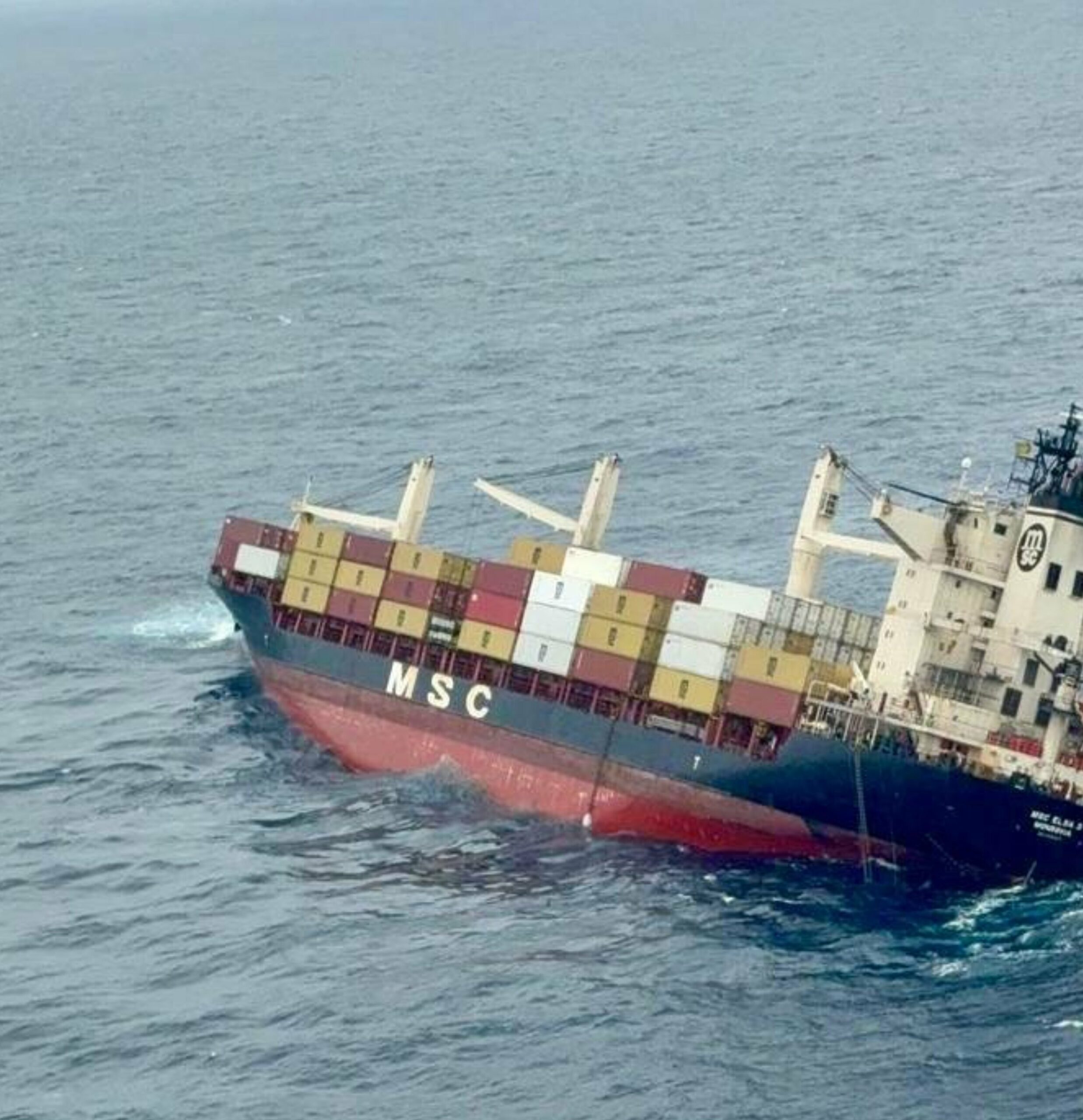
It has been learned that the cargo ship MSC ELSA 3 was involved in an accident approximately 38 nautical miles southwest of Kochi, leading to the loss of hazardous cargo at sea. 

Earlier reports had indicated that an unidentified vessel lost part of its load in the Arabian Sea; it is now confirmed that MSC ELSA 3 was carrying 367.1 metric tonnes of Very Low Sulfur Fuel Oil (VLSFO) and 84.4 metric tonnes of Marine Gas Oil (MGO) when the incident occurred.

While the exact quantity of cargo lost remains uncertain, the situation has prompted heightened vigilance from maritime safety agencies. 

The Indian Coast Guard (ICG), in coordination with state and central authorities, has stepped up surveillance and deployed patrol vessels to track drifting containers and monitor for any oil slicks approaching the Indian coastline.

The Coast Guard said that efforts have been made to rescue the crew after the ship capsized. 

The ship was sailing from Vizhinjam to Kochi. Nine crew members on board escaped using life jackets. Efforts are being made to rescue the rest

The ICG is actively working to prevent potential environmental damage and safety hazards, maintaining close coordination with the Kerala State Disaster Management Authority and other stakeholders.

The KSDMA stated that the hazardous cargo could potentially wash ashore anywhere along the Kerala coast. Increased vigilance is advised along the Thrissur-Kochi-Alappuzha stretch, with Kollam and Thiruvananthapuram now also on alert.

The Indian Coast Guard has launched a major maritime rescue operation off the Kochi coast. The 184-metre-long MSC ELSA 3, sailing under the Liberian flag, reported a 26-degree list around 1:25 PM on Saturday, approximately 38 nautical miles southwest of Kochi. The ship, operated by MSC Ship Management, had departed Vizhinjam Port on May 23 and was en route to Kochi when the crew raised an alarm and requested urgent assistance from Indian authorities.

Responding swiftly, the Indian Coast Guard deployed ships and aircraft to the site. So far, 21 out of the 24 crew members have evacuated the vessel using liferafts, while rescue operations for the remaining 15 are ongoing. Indian Navy and Coast Guard vessels are on scene, and ICG Dornier aircraft have dropped additional liferafts near the distressed vessel.

The Directorate General of Shipping, in coordination with the Coast Guard, has instructed the ship’s managers to immediately arrange salvage operations. Authorities are closely monitoring the situation to ensure crew safety and prevent any environmental threats.

From its last known position, the container vessel MSC ELSA 3 was located approximately 74 km from Kochi (Ernakulam), 62 km from Alappuzha, and 104 km from Kollam, according to official estimates.

PM to Chair 10th Governing Council Meeting of NITI Aayog today

NEW DELHI : In line with his commitment to take all the states together as “Team India” for a Viksit Bharat, Prime Minister Shri Narendra Modi will chair the 10th Governing Council Meeting of NITI Aayog on May 24, 2025, at Bharat Mandapam, New Delhi. This year’s theme is ‘Viksit Rajya for Viksit Bharat@2047’, with the central focus on states and thereby making India a developed nation. The Governing Council Meeting will discuss the approach on Viksit Rajya for Viksit Bharat @2047.

As India progresses towards becoming a developed country, it is essential that States leverage their unique strengths and drive transformative changes at the grassroots, ensuring that the aspirations of 140 crore citizens translate into tangible outcomes on the ground.  The idea of Viksit Rajya for Viksit Bharat is a call for States to craft bold, long-term, and inclusive vision documents aligned with national priorities yet grounded in local realities. These visions must include time-bound targets. States must leverage their unique geographic and demographic advantages while focusing on human development, economic growth, sustainability, technology, and governance reforms. The focus can be on data-driven processes and outcome-based transformation, supported by Project Monitoring Units, ICT-enabled Infrastructure and Monitoring & Evaluation Cells to ensure accountability and midcourse correction.

The 10th Governing Council meeting provides a platform to the Centre and States / Union Territories to deliberate on development challenges facing the nation and building consensus on how States can be the building blocks for making India a developed nation, i.e., Viksit Rajya for Viksit Bharat. Measures for promoting entrepreneurship, enhancing skilling, and creating sustainable employment opportunities across the country, will also be deliberated in the meeting.

The Governing Council of NITI Aayog will also focus on building a consensus on the themes of the 4th National Conference of Chief Secretaries held during 13-15 December, 2024. Secretaries from the Government of India and Chief Secretaries from all States and UTs were part of the consultative process towards defining the framework and providing suggestions for the agenda of ‘Viksit Bharat@2047’. Under the overarching theme of ‘Promoting Entrepreneurship, Employment and Skilling- Leveraging the Demographic Dividend’, recommendations were made during 4th National Conference of Chief Secretaries on the following six key themes:

1.      Creating enabling Ecosystem – focus on Tier 2, 3 cities: Manufacturing;

2.      Creating enabling Ecosystem – focus on Tier 2, 3 cities: Services;

3.      MSME & Informal Employment: Rural Non-Farm;

4.      MSME & Informal Employment: Urban;

5.      Opportunities in Green Economy: Renewable Energy; and

6.      Opportunities in Green Economy: Circular Economy

The 10th Governing Council Meeting will be attended by Chief Ministers and Lieutenant Governors of States and Union Territories, Union Ministers, and the Vice Chairman, Members and the CEO of NITI Aayog.

Prime Minister inaugurates Rising North East Investors Summit 2025

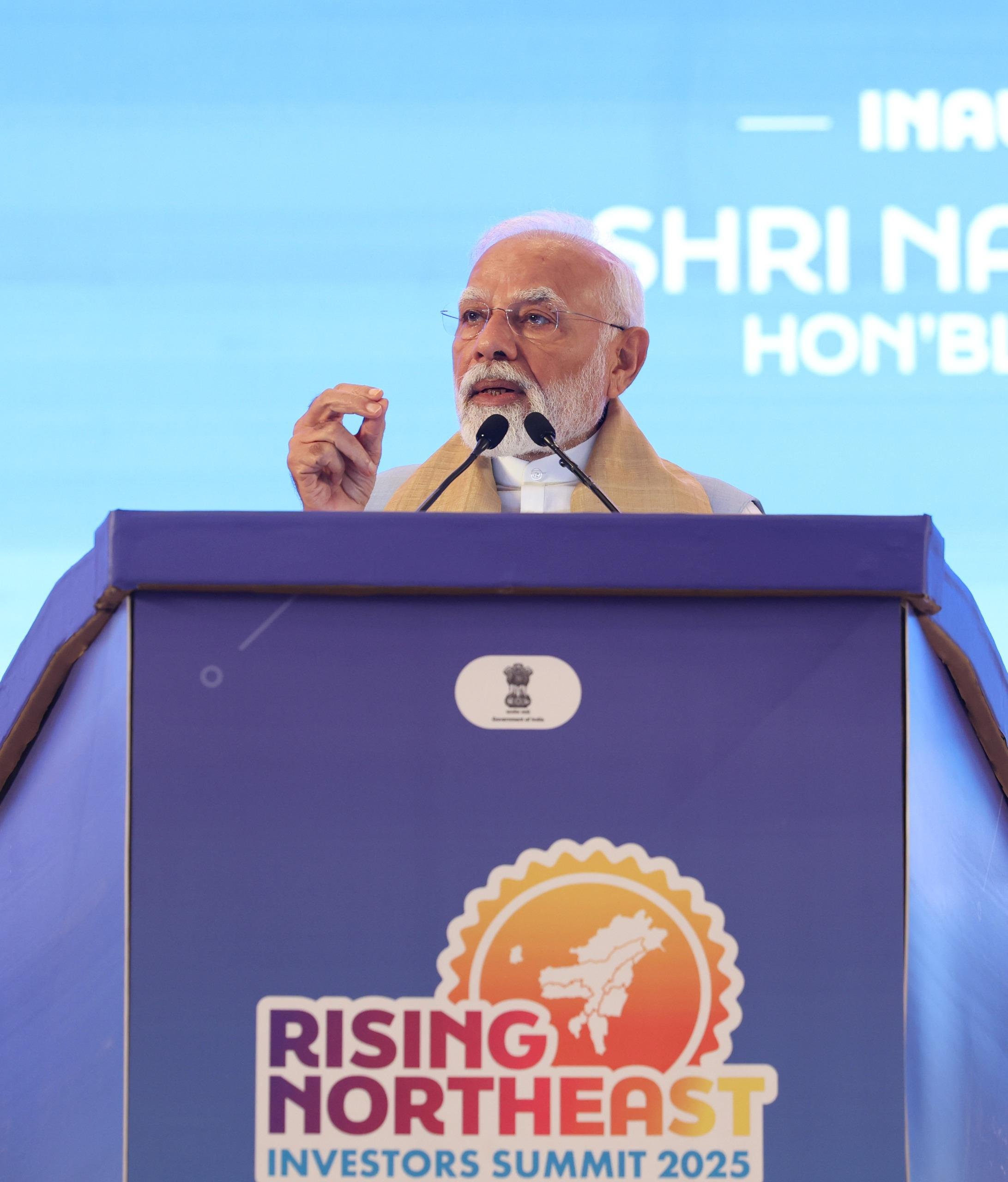
NEW DELHI : The Prime Minister Shri Narendra Modi inaugurated the Rising North East Investors Summit 2025 at Bharat Mandapam, New Delhi on Friday. Extending a warm welcome to all the dignitaries to the event, the Prime Minister expressed pride, warmth, and immense confidence in the future of the North East region. Conveying his best wishes, Prime Minister lauded the Northeast Rising Summit, reaffirming his commitment to the region’s continued growth and prosperity.

Underscoring India’s status as the world’s most diverse nation, Shri Modi said, “the Northeast is the most diverse region of our diverse nation”. He emphasized the vast potential spanning trade, tradition, textiles, and tourism, stating that the region’s diversity is its greatest strength.

Emphasizing the critical role of Eastern India in achieving a Viksit Bharat, the Prime Minister underscored the Northeast as its most vital component. “For us, EAST is not just a direction but a vision—Empower, Act, Strengthen, and Transform—which defines the policy framework for the region”, he stated, highlighting that this approach has placed Eastern India, particularly the Northeast, at the center stage of India’s growth trajectory.

Rising Northeast Investor Summit 2025 Prime Minister inaugurates Rising North East Investors Summit 2025

He reaffirmed the shift from Look East to Act East, stating that this proactive approach is yielding visible results. “While the Northeast was once regarded merely as a frontier region, it is now emerging as a front-runner in India’s growth story”, he added.

Underlining that robust infrastructure plays a key role in making the tourism sector attractive and instilling confidence among investors, Shri Modi highlighted that well-developed roads, power infrastructure, and logistics networks form the backbone of any industry, facilitating seamless trade and economic growth.

He remarked that infrastructure is the foundation of development and that the government has initiated an Infrastructure Revolution in the Northeast. He acknowledged the region’s past challenges but asserted that it is now emerging as a Land of Opportunities. He stated that thousands of crores have been invested in enhancing connectivity, citing projects such as the Sela Tunnel in Arunachal Pradesh and the Bhupen Hazarika Bridge in Assam. Shri Modi also highlighted key advancements in the past decade, including the construction of 11,000 kilometers of highways, extensive new railway lines, a doubling of airport numbers, the development of waterways on the Brahmaputra and Barak rivers, and the installation of hundreds of mobile towers. He further noted the establishment of a 1,600-kilometer-long Northeast Gas Grid, ensuring a reliable energy supply for industries. Shri Modi underscored that highways, railways, waterways, and digital connectivity are all strengthening the Northeast’s infrastructure, creating a fertile ground for industries to seize the First Mover Advantage. He affirmed that over the next decade, the region’s trade potential will multiply significantly.

He further pointed out that India’s trade volume with ASEAN currently stands at approximately $125 billion and is expected to exceed $200 billion in the coming years, positioning the Northeast as a strategic trade bridge and gateway to ASEAN markets. He reiterated the government’s commitment to accelerating infrastructure projects to enhance regional connectivity. Stressing the importance of the India-Myanmar-Thailand Trilateral Highway, which will provide direct access from Myanmar to Thailand, strengthening India’s connectivity with Thailand, Vietnam, and Laos, Shri Modi highlighted the government’s efforts to expedite the Kaladan Multimodal Transit Project, which will link the Kolkata Port to Myanmar’s Sittwe Port, providing a crucial trade route through Mizoram. He stated that this project will significantly reduce the travel distance between West Bengal and Mizoram, enhancing trade and industrial growth. 

Highlighting the ongoing development of Guwahati, Imphal, and Agartala as Multi-Modal Logistics Hubs, the Prime Minister noted that the establishment of Land Custom Stations in Meghalaya and Mizoram is further expanding international trade opportunities. He emphasized that these advancements are positioning the Northeast as a rising force in trade with Indo-Pacific nations, unlocking new avenues for investment and economic growth. 

Underscoring India’s vision of becoming a Global Health and Wellness Solution Provider, the Prime Minister stated that the Heal in India initiative is being developed as a worldwide movement. He highlighted the Northeast’s rich biodiversity, natural environment, and organic lifestyle, describing it as a perfect destination for wellness. The Prime Minister urged investors to explore the Northeast as a critical component of India’s Heal in India mission, reaffirming that the region’s climate and ecological diversity offer immense potential for wellness-driven industries.

Shri Modi stressed on the growing global demand for organic food, stating that his vision is for an Indian food brand to be present on every dining table worldwide. He highlighted the Northeast’s pivotal role in realizing this dream. He said that over the past decade, the scope of organic farming in the Northeast has doubled, with the region producing high-quality tea, pineapples, oranges, lemons, turmeric, and ginger. He affirmed that the exceptional taste and superior quality of these products have led to rising international demand. He also encouraged stakeholders to capitalize on this growing market, recognizing the Northeast’s potential as a key driver of India’s organic food exports.

“Rising Northeast is more than just an investors’ summit—it is a movement and a call to action”, emphasised the Prime Minister, stating that India’s future will reach new heights through the Northeast’s progress and prosperity. The Prime Minister expressed full confidence in the business leaders present, urging them to unite in driving growth. Concluding his address, he called upon stakeholders to work together in transforming Ashtalakshmi—the symbol of Northeast’s potential—into a guiding force for a Viksit Bharat. He expressed confidence that by the next Rising Northeast, India would have propelled way ahead. 

The Union Minister for Development of North Eastern Region, Shri Jyotiraditya M. Scindia, Governor of Manipur, Shri Ajay Kumar Bhalla, Chief Minister of Assam, Shri Himanta Biswa Sarma, Chief Minister of Arunachal Pradesh, Shri Pema Khandu, Chief Minister of Meghalaya, Shri Conrad Sangma, Chief Minister of Mizoram, Shri Lalduhoma, Chief Minister of Nagaland, Shri Neiphiu Rio, Chief Minister of Sikkim, Shri Prem Singh Tamang,  Chief Minister of Tripura, Shri Manik Saha, Union Minister of State for Development of North Eastern Region, Dr. Sukanta Majumdar were present among other dignitaries at the event.

New Bharat dawns with a Resurgent Northeast: Sarbananda Sonowal

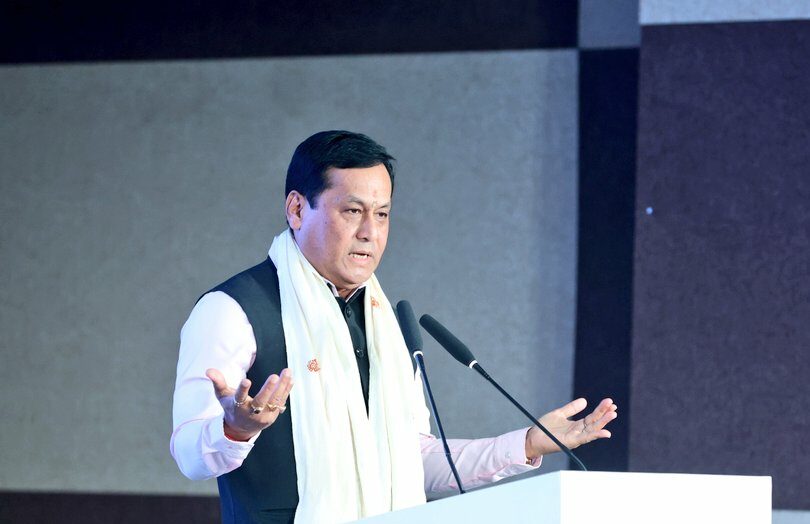
NEW DELHI : In a compelling call to action, Union Minister of Ports, Shipping and Waterways, Shri Sarbananda Sonowal, on Friday invited global and domestic investors to explore the unprecedented growth potential of Northeast India. 

Speaking at the Riding Northeast Investor Summit at Bharat Mandapam in New Delhi, Shri Sonowal emphasised that a “New Bharat is dawning with a resurgent Northeast at its heart.”

Addressing the summit’s thematic discussion topic “Unlocking Capital for NE Infrastructure,” Shri Sonowal highlighted the transformation of the Northeast Region (NER) over the last decade, attributing this resurgence to the sustained leadership of Prime Minister Shri Narendra Modi.

“Under the visionary leadership of Prime Minister Narendra Modi ji, the Northeast has undergone an era-defining transformation. What was once perceived as remote and isolated is now rapidly becoming India’s gateway to Southeast Asia,” Shri Sonowal said. “The region is not just a part of India’s growth story—it is now a major chapter in it.”

Shri Sonowal pointed to a landmark figure that more than 700 visits by Cabinet Ministers to the Northeast in the past decade, as proof of the government’s sustained focus on the region’s development. Shri Sonowal stressed up on the government’s commitment to inclusive infrastructure, particularly in maritime and inland waterways, which are reshaping the economic landscape of the region.

“Inland waterways are one of the most promising frontiers of development for the Northeast,” Shri Sonowal said. “We now have more than 20 notified National Waterways in the region. The Jalvahak scheme is being promoted to catalyse multi-modal connectivity, create logistics hubs, and boost cargo movement. Infra development along these waterways will unlock new corridors of economic activity and generate large-scale employment.”

Highlighting India’s logistics advantage, the Union Minister noted that 90% of the country’s trade by volume and 70% by value moves through shipping, With Inland Waterways under the IBPR (Indo-Bangladesh Protocol Route) and Sittwe Port in Myanmar will act as an emerging game changers in unfolding transformative transportation unlocking value.

In a nod to the region’s rich talent pool, Shri Sonowal detailed new initiatives in maritime skill development targeting youth from the Northeast, preparing them for careers in port operations, vessel management, and logistics. He also emphasised the immense potential for “Heal in India” medical tourism in the NER, leveraging the region’s natural serenity, wellness traditions, and rising healthcare infrastructure.

“The market potential of the Northeast is not limited to domestic consumption,” Shri Sonowal said. “It connects directly with ASEAN and BBIN nations, offering investors unparalleled access to over 600 million consumers in neighbouring economies.”

The summit witnessed participation from major domestic and international investors, development agencies, and policy leaders. Shri Sonowal’s address served as a clarion call to align investments with the government’s infrastructure thrust, particularly in sectors such as waterways, logistics, tourism, wellness and healthcare.

With its newfound connectivity, abundant natural resources, and youthful demographic, Northeast India is now poised to become a key driver of India’s growth story—ushering in a truly inclusive and integrated New Bharat.