Home Blog Page 907

Settlement between JNPA and NSICT finalised: Boost to PPP in the port sector

MUMBAI : The Jawaharlal Nehru Port Authority (JNPA)—recognized as India’s Best Performing Port—has finalised a tariff settlement with NSIC, part of DP World (DPW), an UAE Government company. NSICT operates a container terminal in JNPA.

Background

JNPA and UAE government owned port and terminal operator DPW have finalised the conciliation agreement, the broad contours of which the board had earlier approved. With this a long-standing issue for the past many years involving lengthy legal battles has been resolved amicably to the satisfaction of both parties. This will also be a positive signal to PPP in the port sector. The details of the settlement are being worked out. Broadly this will involve additional cargo commitment by NSICT which will enable them to become eligible for volume discounts which will kick in once the volumes touch certain levels. Given that the volumes had gone down to more than half of what they were prior to the tariff dispute this is expected to result in substantial increase in cargo volumes.  The claims of the operator will be partly recovered by them over the remaining period of the concession through the discounts that they obtain against the enhanced traffic.

In 1997, JNPA awarded a terminal concession to DP World. NSICT, DP World’s Special Purpose Vehicle (SPV), entered into a 30-year concession agreement with JNPA. This marked the first such Public-Private Partnership (PPP) agreement in India’s port sector.

The dispute arose in 2005 when full royalty as a cost was disallowed, leading NSICT to file claims totalling approximately Rs 2653 Crore against JNPA. Following arbitration proceedings and conciliation process a compromise formula was agreed. The settlement determined Rs. 705 Cr as amount adjustable through future volume-based royalty discounts until the remaining period of the concession. This settlement structure protects JNPA’s revenue while requiring NSICT to increase future volumes to claim volume-based discounts, making it a win-win solution for both parties. This is expected to significantly boost traffic at JNPA, generating higher revenues to the port from vessel-related charges, berth hire, and royalties.

This settlement provides substantial benefits to the port, resolves a long-standing dispute and sends a positive signal regarding the robustness and success of the PPP model in India.

About JNPA:

The Jawaharlal Nehru Port Authority (JNPA) is one of the premier container-handling ports in India. Since its inception on May 26, 1989, JNPA has transformed from a bulk cargo terminal into the premier container port in the country.

Currently, JNPA operates five container terminals – NSFT, NSICT, NSIGT, BMCT and APMT. The Port also has a Shallow Water Berth for general cargo. A Liquid Cargo Terminal present at the JNPA Port is managed by the BPCL-IOCL consortium and the additional liquid cargo terminal developed by JNPA will be operated by M/s JSW – JNPT Liquid Terminal Pvt. Ltd. . Additionally, the newly constructed coastal berth links other Indian ports and facilitates enhancing the traffic of coastal containers.

Nestled across 277 hectares of land, JNPA also operates a meticulously designed multi-product SEZ, with state-of-the-art infrastructure, to boost export-oriented industries in India.

JNPA is also developing an all-weather, deep-draft, greenfield port at Vadhvan, the 13th Major Port of India in Maharashtra. It is poised to be among the top 10 ports globally and will be a 100% green port since its inception.

Piyush Goyal confers ‘Startup Maharathi’ Awards at Startup Mahakumbh 2025

NEW DELHI : Union Minister of Commerce & Industry, Shri Piyush Goyal conferred the ‘Startup Maharathi’ Awards on the concluding day of Startup Mahakumbh 2025 in New Delhi on Saturday. Addressing a packed audience of entrepreneurs, innovators and ecosystem enablers, the Minister lauded all participants, stating that each one of them is a “Maharathi”—a skilled warrior and vital contributor in India’s startup revolution.

“Maharathi is every one of the 2,400 participants of this grand challenge. Every one of the 3,000 exhibitors at Startup Mahakumbh is on the path to success,” said Shri Goyal, as he acknowledged the immense talent and potential of India’s startup ecosystem.

He encouraged young founders to set ambitious goals and rise beyond the limitations of the present. “The potential you hold will make you a great contributor to India’s journey in this Amrit Kaal. Let the Startup Mahakumbh ignite aspirations that go beyond the current realm of reality,” he added.

Comparing the scale of the event with previous years, the Minister informed that while last year saw around 3,000 visitors, this year the Mahakumbh witnessed a record footfall of 2.3 lakh visitors, underlining India’s exponential growth trajectory in the innovation space.

Shri Goyal also shared that 40% of the applicants for the Maharathi Grand Challenge were from Tier 2 and Tier 3 cities, and many were women-led startups. “Women are taking a lead in India’s development and contributing with great enthusiasm,” he remarked.

The Minister emphasised that the Government is creating an enabling environment for startups through landmark reforms in Ease of Doing Business. “Over 40,000 compliances have been simplified or removed, and many laws have been decriminalized so that startups can work freely and fairly,” he said.

Announcing a key initiative, Shri Goyal revealed that a dedicated Startup India Desk will be set up in the Ministry of Commerce & Industry to serve as a helpline for startups across India, accessible via a simple 4-digit toll-free number in regional languages.

He also said that the Second Fund of Funds for Startups (FFS) with a corpus of ₹10,000 crore, has been approved by Hon’ble Prime Minister Shri Narendra Modi. This year, ₹2,000 crore will be disbursed to SIDBI as the first installment. A significant portion of the fund will be reserved for seed funding of small startups and to support deep-tech innovation.

“Through this fund, we aim to foster the development of cutting-edge technologies like AI, robotics, quantum computing, machine learning, precision manufacturing and biotech,” he stated.

The objective is to provide early-stage financial support to budding entrepreneurs who often face challenges in accessing traditional forms of capital. This allocation will empower startups working on disruptive technologies by enabling them to scale prototypes, undertake research and development, and accelerate go-to-market strategies.

The fund will especially focus on startups operating in cutting-edge domains such as artificial intelligence, machine learning, quantum computing, robotics, precision manufacturing, biotech, and semiconductor design, where long gestation periods and high capital requirements often pose hurdles. By mobilising patient capital, the Government aims to build a strong pipeline of indigenous technology solutions that can address national priorities and position India as a global innovation leader.

This initiative reflects the Government’s commitment to nurturing a self-reliant and forward-looking startup ecosystem, where young innovators from every corner of India have equal access to resources and opportunities.

Shri Goyal further urged SIDBI to establish at least one support centre in every state to provide basic infrastructure and shared facilities for early-stage entrepreneurs. Recalling his interaction with a startup that had invested in its own 3D printer due to the lack of shared facilities, the Minister stressed the importance of accessible prototyping resources.

“We must unlock India’s full potential through facilitation, not regulation. The Government is here to support your journey, not control it,” he concluded.

Shri Goyal called upon India’s youth to lead the way in emerging sectors like AI, semiconductors and deep-tech, and shape the nation’s path to Atmanirbhar Bharat.

GeM Showcases Startup Power at Startup Mahakumbh 2025, Unlocks New Growth Avenues for Innovation-Driven India

NEW DELHI : The Startup Mahakumbh 2025 concluded in New Delhi on Saturday, marking significant participation and highlighting the growing strength of India’s entrepreneurial ecosystem. Among the key participants was the Government e Marketplace (GeM), which showcased its role in supporting startup growth and underlined the potential of public procurement as a tool for promoting innovation and inclusive development.

As a strategic presenting partner, GeM engaged with a wide range of startups, investors, policymakers, and industry leaders during the event. Its participation reflected an ongoing effort to support the growth of Indian startups by facilitating access to government markets, encouraging new opportunities, and contributing to the broader vision of an Atmanirbhar Bharat.

The event saw sector-focused pavilions that celebrated India’s strength in DeepTech, AgriTech, BioTech, MedTech, Artificial Intelligence, Gaming, and more. GeM’s presence underscored its mission to bridge the gap between innovators and government buyers, enabling faster scale, market validation, and meaningful contribution to India’s global innovation standing.

GeM’s impact at the Mahakumbh was further amplified through a high-energy panel discussion that drew a packed audience and featured sharp insights from GeM leaders, industry experts, and policymakers. The panel covered key themes such as:

  • Charting India’s Growth Story
  • Boosting State Procurement Through Startups
  • Emerging Technology as a Service
  • Driving Startup Growth via GeM Categories
  • Unlocking Opportunities with Central Government Buyers

The sessions reinforced GeM’s role in transforming public procurement into a launchpad for India’s next generation of entrepreneurs.

Speaking on the theme of government-startup collaboration, CEO, Government e Marketplace (GeM), Shri Ajay Bhadoo said, “Let’s work together and unlock the true potential of public procurement in driving startup growth, inclusive development, and Atmanirbhar Bharat.”

His keynote address underlined the transformative potential of platforms like GeM in scaling innovative homegrown solutions and supporting startups with policy-driven opportunities.

During the three-day event, GeM responded to over 2500 startup queries, facilitated 1000+ startup registrations and cataloguing, and hosted more than 1500 interactive sessions—including one-on-one mentoring and group engagements—focused on onboarding and skilling through GeM’s Learning Management System (LMS).

GeM’s Pavilion hosted over 70 innovative startups, including 30 startup pods awarded free of cost to winners of GeM’s Start-o-nauts Challenge. So far, GeM has enabled over ₹38,500 Crore in transactions for 30,000+ startups, reinforcing its position as a true catalyst in India’s innovation ecosystem.

Prime Minister inaugurates India-assisted Rail Infrastructure Projects in Sri Lanka

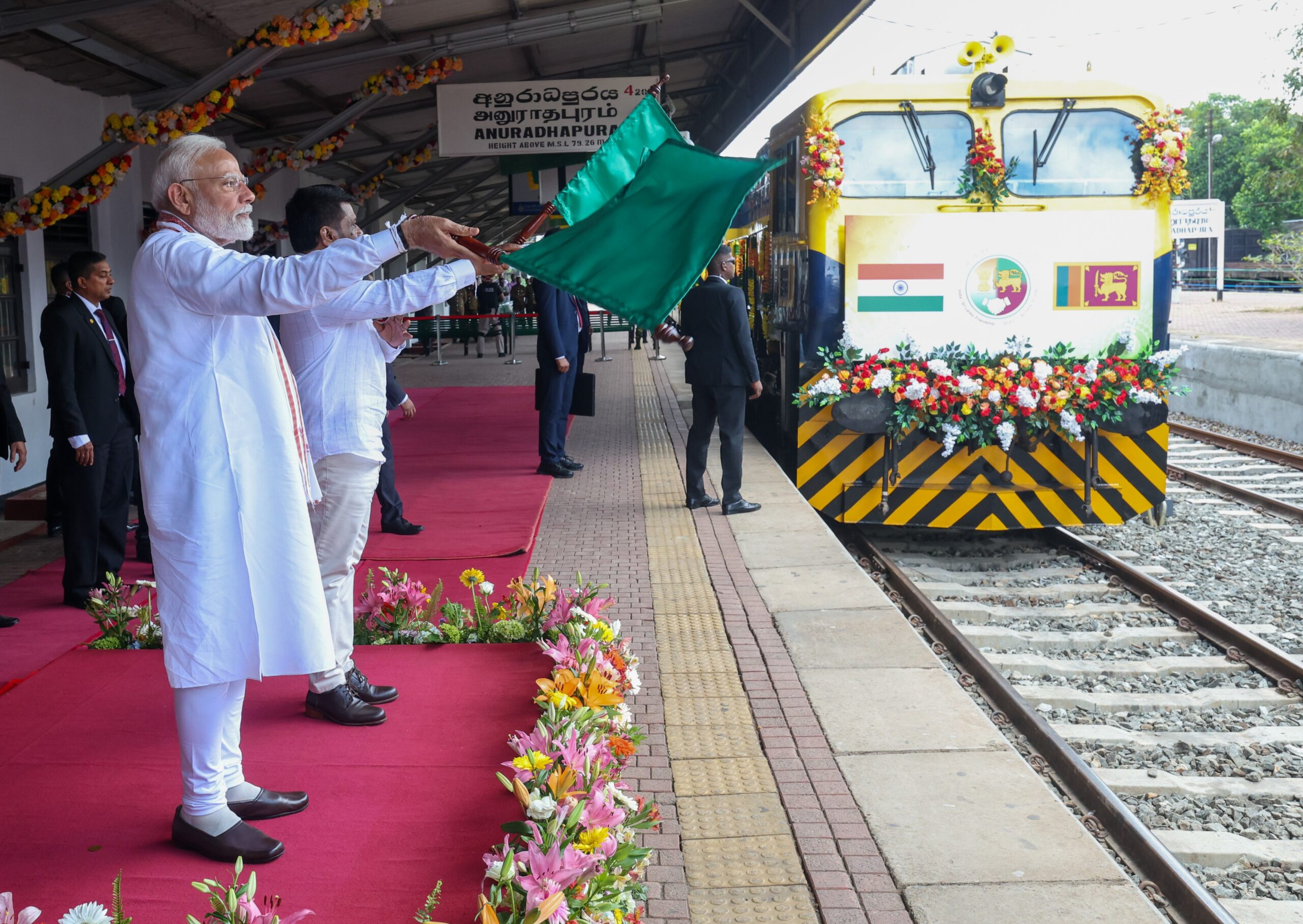
COLOMBO : Prime Minister Shri Narendra Modi, accompanied by the President of Sri Lanka, H.E. Anura Kumara Disanayaka, on Sunday participated in a ceremony to inaugurate and launch two railway projects built with Indian assistance in Anuradhapura.

The leaders inaugurated the 128 km Maho-Omanthai railway line refurbished with Indian assistance of USD 91.27 million, followed by the launch of construction of an advanced signaling system from Maho to Anuradhapura, being built with Indian grant assistance of USD 14.89.

These landmark railway modernisation projects implemented under the India-Sri Lanka development partnership represent a significant milestone in strengthening north-south rail connectivity in Sri Lanka. They would facilitate fast and efficient movement of both passenger and freight traffic across the country.

Prime Minister holds bilateral talks with President of Sri Lanka

COLOMBO : Prime Minister Shri Narendra Modi had a productive meeting on Saturday with the President of Sri Lanka, H.E. Anura Kumara Disanayaka, at the Presidential Secretariat in Colombo. Ahead of the talks, Prime Minister was accorded a ceremonial welcome at Independence Square. Prime Minister is the first foreign leader to pay a State visit to Sri Lanka since President Disanayaka took office in September 2024.

India Sri Lanka Bilateral Talk Prime Minister holds bilateral talks with President of Sri Lanka

​The two leaders held detailed discussions in restricted and delegation level format on further deepening the special and close bilateral ties that are rooted in shared history and driven by strong people-to-people linkages. They reviewed cooperation in the fields of connectivity, development cooperation, economic ties, defence relations, reconciliation and fishermen issues. Prime Minister reiterated Sri Lanka’s importance in India’s Neighbourhood First Policy and Vision MAHASAGAR. He conveyed India’s continued commitment to assist in Sri Lanka’s economic recovery and stabilization.

InaugurationofProjectsinSriLanka Prime Minister holds bilateral talks with President of Sri Lanka

​Following the talks, the two leaders virtually inaugurated several projects. These include 5000 solar rooftop units installed at religious places across Sri Lanka and a temperature-controlled warehousing facility at Dambulla. They also virtually participated in the ground-breaking ceremony for the launch of the 120 MW Sampur Solar power project.

India Sri Lanka MoU Prime Minister holds bilateral talks with President of Sri Lanka

The two leaders witnessed the exchange of seven MoUs in the fields of energy, digitization, defence, health and multi-sectoral assistance in the Eastern Province. Prime Minister announced support for the development of the Thirukoneswaram temple in Trincomalee, the Sacred City project in Anuradhapura and the Sita Eliya temple complex in Nuwara Eliya. In the areas of capacity building and economic support, a comprehensive package for training an additional 700 Sri Lankan citizens annually, and the conclusion of Bilateral Amendatory Agreements on Debt Restructuring were also announced. In keeping with the shared Buddhist heritage of the two countries, Prime Minister announced that Holy Relics of Lord Buddha from Gujarat would be traveling to Sri Lanka for the International Vesak Day celebrations. List of MOUs and announcements may be seen here.

RBI proposes new regulations for export, import transactions under FEMA

NEW DELHI : The Reserve Bank on Friday came out with revised draft regulations that cover export and import transactions under FEMA with an aim to promote ease of doing business. 

As per the revised draft, if the export proceeds of an exporter remain unrealised for a period beyond two years from the due date and the cumulative unrealised export proceeds of that exporter exceeds Rs 25 crore, he shall undertake further exports only against receipt of full advance or an irrevocable letter of credit. 

On import of gold and silver, the RBI has proposed that no advance remittance for the import of gold and silver shall be permitted by an authorised dealer, said the ‘Regulation of Foreign Trade under Foreign Exchange Management Act (FEMA), 1999 — Draft Regulations and Directions’.

In July last year, the RBI had issued the draft, and based on the feedback received from the public and subsequent further consultations with various stakeholders, the proposed regulations and directions have been further revised. 

“The emphasis of revised regulations is on enhancing the ease of doing business and bringing all instructions onto a single document,” the RBI said. 

The proposed regulations incorporate instructions issued to authorised dealers, including the processes to be followed by the authorised dealers for handling transactions related to export and import, which are at present issued separately as directions to authorised dealers. 

The central bank has sought comments and feedback on the draft regulations and directions by April 30, 2025. 

Source : PTI

Wagon production hits record 41,929 units in FY 2024-25, marking a 11% YoY growth and a threefold surge over 2004-14 average

NEW DELHI : Indian Railways has achieved a historic milestone in wagon production, reaching an all-time high of 41,929 wagons in FY 2024-25, surpassing the 37,650 wagons produced in FY 2023-24. This marks a remarkable leap from the annual average of 13,262 wagons produced between 2004-2014, showcasing a significant boost in manufacturing capacity and efficiency.

This growth is expected to reduce freight bottlenecks and enhance Rail cargo movement. The numbers suggest a significant increase in the annual wagon production, highlighting the government’s vision of not only increasing domestic manufacturing but also improving its freight movement that will enhance convenience and also provide a major boost to the Indian economy, empowering India towards its goal of becoming an economic prowess.

PeriodProduction
2004-2014 (Average)13,262
2014-2024 (Average)15,875
2022-202322,790
2023-202437,650
2024-202541,929
Total production in last three years1,02,369

Economic Boost

This surge in wagon production is expected to have a profound economic and environmental impact. With more wagons available, transport bottlenecks will be significantly reduced, ensuring faster cargo movement and improved efficiency for industries reliant on bulk transportation, such as coal, cement and steel. By reducing dependence on road freight, this shift will also lower fuel consumption and emissions, contributing to sustainability goals. Additionally, the improved efficiency in freight movement will help curb transportation costs, ultimately benefiting businesses and consumers by mitigating inflationary pressures.

Strengthening India’s Industrial Sector

As Indian Railways continues to expand its freight capacity, it is playing a crucial role in strengthening India’s industrial infrastructure and economic resilience. This growth aligns with India’s broader vision of boosting domestic manufacturing and trade competitiveness, reinforcing the country’s path toward becoming a global economic powerhouse.

India’s overall exports can cross $800 billion in FY26 despite Trump tariffs

NEW DELHI : India is hopeful that its overall exports will grow in the current financial year despite the impact of US President Trump‘s reciprocal tariffs, a senior government official said on April 5

“Overall exports should surpass FY25 levels and come in at over $800 billion in the current fiscal. Merchandise exports too should either rise in FY26 or stay at the same level,” this official said.

India will continue to bet on its services exports that has been growing despite global trade disruptions, the official added.

India’s cumulative exports (merchandise and services) during April- February of 2024-25 is estimated at $750.53 billion, as compared to $706.43 billion in the same period of 2023-24, an estimated growth of 6.24 percent.

The official added that for the previous financial year of 2024-25, overall exports are likely to touch $800 billion. India’s commerce ministry will detail the trade figures for March 2025 on April 15.

As per the latest available data, merchandise exports during April- February of the previous fiscal year stood at $395.63 billion as compared to $395.38 billion during the same period of 2023-24, while goods imports came in at $656.68 billion versus $621.19 billion.

US President Donald Trump’s reciprocal tariffs could cause a contraction of around 1 percent in global merchandise trade volumes in 2025, the World Trade Organization’s (WTO) chief Ngozi Okonjo-Iweala said.

“While the situation is rapidly evolving, our initial estimates suggest that these measures, coupled with those introduced since the beginning of the year, could lead to an overall contraction of around 1 percent in global merchandise trade volumes this year,” Ngozi Okonjo-Iweala added.

While, Trump slapped 10 percent import duties on all nations, he imposed additional levies on a slew of countries, including 16 percent more on India.

Gujarat’s Kesar Mango exports surge, boosting global recognition

JUNAGADH : Gujarat’s iconic Kesar Mango is making a bold impact on the global stage, with exports reaching an impressive 689.5 metric tonnes in 2023-24. Revered for its deep saffron hue, rich sweetness, and irresistible aroma, the GI-tagged mango continues to strengthen its presence in international markets. As demand skyrockets, Gujarat solidifies its status as a key player in India’s mango export industry.

Mango cultivation in Gujarat dates back centuries, but it was in 1931 that the Kesar mango was officially introduced in Junagadh’s Gir region. The fruit derives its name from its distinctive saffron-colored pulp, with the Nawab of Junagadh famously naming it “Kesar” for its golden-orange glow. The state boasts over 177,514 hectares of mango orchards, covering key regions such as Valsad, Navsari, Gir-Somnath, Surat, and Kachchh.

Gujarat’s mango production has been on a steady rise. In 2024, the state produced 1.08 million metric tonnes, up from 960,000 metric tonnes in 2023, according to the Gujarat Horticulture Department. Experts credit the region’s ideal climate and soil composition for the fruit’s premium quality.

Unlike Alphonso mangoes that thrive in coastal regions, Kesar mangoes are uniquely suited to Gujarat’s semi-arid conditions. The combination of sandy loam and black cotton soil, coupled with hot summers and moderate rainfall, enhances the fruit’s natural sugars. “The high temperature and mineral-rich soil contribute to the mango’s distinct sweetness and flavor,” explains Dr. Ramesh Patel, an agricultural scientist from Junagadh Agricultural University.

Madurai milestone achievement in Moringa Export – a TN Govt initiative

MADURAI : India fulfills 80% of the global demand for moringa, with Tamil Nadu leading in moringa cultivation within the country. According to the 2023-24 data from the Department of Horticulture and Plantation Crops, moringa is cultivated in an area of 20,741 hectares, producing 841,807 metric tons, making it the top producer in India.

To increase moringa exports from Tamil Nadu and develop the necessary infrastructure, the Hon’ble Minister for Agriculture and Farmers’ Welfare declared the “Moringa Export Zone” as part of the 2021-22 Agricultural Budget. This zone, comprising nine districts, with the establishment of “Moringa Special Export Service Center” at Madurai, which is administered by the Tamil Nadu Food Processing and Agricultural Export Development Corporation (TNAPEx) under the Micro, Small and Medium Enterprises Department.

According to the Agricultural and Processed Food Products Export Development Authority (APEDA), the global moringa export market is estimated to be worth 1,000 crore USD in 2025. This includes products like moringa leaf powder, oil & seeds, and moringa tea, in which moringa leaf powder contributing 600 crore USD.

To meet the global demand for moringa leaf powder, approximately 11,000 acres of unique moringa leaf cultivation are required. Organically grown moringa leaf powder has significant market potential.
Currently, around 35 export companies in Tamil Nadu cultivate unique moringa leaves over 600 to 800 acres, producing about 720 metric tons of moringa leaf powder annually, valued at approximately ₹30 crore.

The moringa leaf cultivation faces challenges such as unique cultivation methods, world-class processing centers, export market linkage, and local market opportunities. To address these challenges, the Tamil Nadu government’s Moringa Special Export Facilitation Center has implemented various initiatives, including awareness meetings, technical training, market linkage, and financial assistance through several
schemes etc., On 10.09.2024, a meeting was held in Navvaladi village, Thisayanvilai block, Tirunelveli district, to establish market linkage between farmers of the Thamiraparani Farmers Producers Organization and a private company. As a result, market linkage was established for organic moringa leaf
cultivation over 20 acres, and 60 metric tons of fresh moringa leaves were procured from farmers at a stable price, producing 6 metric tons of moringa leaf powder for export, valued at ₹20 lakh.

On March 24, 2025, a small gratitude meeting was held at a private company premises in Rosmiyapuram village, Radhapuram taluk, Tirunelveli district, to celebrate the success of market linkage done by Moringa Export Facilitation Centre, Maduari. The meeting was presided by Dr. K. Alagusundaram, Managing Director and Chief Executive Officer of TNAPEx.

In that meeting, Thiru. Ilango, Deputy Director of Horticulture from Directorate of Horticulture and Plantation Crops, Thiru. Deline, Assistant Director of Horticulture, Thiru. Anandan, Chief Executive Officer, Thamiraparani Farmer Producer Organization, Thiru. Vijaya perumal and Thiru sudarsan, Private firm Proprietor of Green Health Industries.

Thiru. Bastin Raj Leading Exporter, Benefitted Farmers, Thiru M. Suresh Kumar, Export Consultant, Moringa Export Facilitation centre, Madurai and Thiru S. Oliyarasan, technical Coordinator are participated.

Additionally, a request was submitted to establish market linkage for 50 metric tons of organically grown moringa leaf powder for the 2025-26 year. Furthermore, TNAPEx has received requests from other private companies for market linkage for approximately 200 tons of moringa leaf powder annually. These market linkages will be implemented through a tripartite agreement between TNAPEx, private companies, and farmers.

Hence. Tamil Nadu Government is warmly welcome all Farmer Producer Organizations, Progressive Farmers and private processing companies interested in organic moringa leaf cultivation and Processing to contact the TNAPEx Chennai office at md.tnapex@tn.gov.in and the Moringa Special Export
Facilitation Center, Madurai office at mefcmdu.tnapex@tn.gov.in to get assured market linkage and stable income for throughout the year.