Home Blog Page 906

Regional Container Lines partners with Lloyd’s Register OneOcean to drive fleet optimisation and emissions reduction

SINGAPORE : Regional Container Lines (RCL) partners with Lloyd’s Register OneOcean to drive fleet optimisation and emissions reduction

The partnership will enhance Regional Container Lines’ (RCL’s) fleet efficiency, reduce fuel consumption, and support its commitment to operational excellence and sustainability.

RCL has partnered with Lloyd’s Register OneOcean (LR OneOcean) to enhance the efficiency and sustainability of its fleet operations.

Under the agreement, RCL has subscribed to LR OneOcean’s voyage optimisation platform, which provides real-time voyage planning, dynamic weather routing, and intelligent speed management.

By integrating this advanced route optimisation technology, RCL aims to significantly reduce fuel consumption, cut carbon emissions, and improve cargo delivery reliability —all while ensuring compliance with tightening environmental regulations.

LR OneOcean’s solution equips ship operators with the intelligence needed to make data-driven decisions that improve fuel efficiency and operational reliability. The solution will also enable Thailand-based RCL to manage voyage budgets more effectively, ensuring cost control and optimised fleet scheduling across its 38-vessel operation.

Jeff Mattick, Customer Success Director, LR OneOcean, said: “We are proud to support RCL in their digital transformation journey. Our voyage optimisation platform provides the insights and intelligence needed to make strategic, real-time decisions that improve fuel efficiency, enhance voyage planning, and optimise overall fleet performance. We look forward to working with RCL to drive sustainable and profitable operations.”

Captain Phakphum Meejaroen, Regional Container Lines, said: “At RCL, we are dedicated to delivering reliable, efficient, and sustainable shipping solutions. As one of our strategic steps, partnering with LR OneOcean allows us to leverage advanced technology to optimise our fleet’s performance, reduce fuel costs, and enhance our service offering to customers. This collaboration is one of our key steps in our commitment to operational excellence.”

LR OneOcean’s solution draws on more than 15 years of route optimisation and vessel performance expertise through the acquisitions of C-Map and GreenSteam, providing clients with trusted solutions that deliver measurable environmental and commercial benefits. About Lloyd’s Register OneOcean

Lloyd’s Register OneOcean is the digital solutions platform providing actionable intelligence to maritime professionals worldwide.

As an integral part of Lloyd’s Register, we exist to create a seamless connection between each and every vessel and voyage, stakeholder, and supply chain to truly unite the digital journey between ship and shore.

Our easy-to-use, secure platform brings market-leading compliance, management, and performance software together to help shipowners, operators, charterers, and crew drive stronger growth and efficiency in a safe, sustainable way.

With years of global maritime expertise, innovation, and experience across 22,000 vessels, we aim to be the most trusted digital platform for enhancing people, profits, and the planet.

Trump’s tariffs will reshape trade and international transport : Drewry

LONDON : Huge US tariffs on imports from China, Vietnam, Cambodia, Taiwan, the European Union and other countries will reshape trade and international transport. But to what extent?

Drewry has looked at the impact of the previous US tariffs against China by the first Trump administration. This chart shows that the 2018 tariffs froze the volume of China-to-US goods shipped in containers (0% net increase in six years), whereas Vietnam, free of such tariffs, benefited from a 45% jump in volumes in the same period.

According to a 2024 study (Haberkorn et al) on US tariff increases against China in 2018-19, a 1% increase in US tariffs resulted in a 1% decline in trade, one year after tariff imposition. This shows the sensitivity of trade to tariffs.

How about tariffs under Trump 2.0, which take effect almost immediately?

The tariffs announced by Trump on April 2 apply to nearly all trading partners but their application is very uneven.

The new tariffs are very high both on China (34% tariff on top of the previous 20% – i.e. 54%), in line with Trump 1.0 tradition, but now also on Vietnam (46%), which had benefited from Trump 1.0.

Asian countries treated more favourably under these new US tariffs include the Philippines (tariff of “only” 17%), Malaysia (24%) and South Korea (25%).

Much higher US tariffs on Chinese goods will prompt favoured Southeast Asian nations like the Philippines and Malaysia to prepare for an influx of factories relocating. Countries with a good positioning in a global value supply chain (such as Vietnam, Thailand, Malaysia, Indonesia, and the Philippines) were already positioning themselves to attract investments, particularly in electronics and automotive manufacturing.

China and the European Union have said that they will retaliate, indicating that the trade between these countries and the US will be hit in both directions.

The US’s new radical trade policies will cause pain to some economies and businesses, but others may gain because of shifts in trade flows. The potential disruptions to the shipping container industry may also have an asymmetric impact on carriers and shippers in the short run. This has been particularly true in recent years, with Covid-19 and Suez Canal disruptions, alongside sustained demand, leading to supernormal profits for carriers.

The Trump 2.0 tariffs will, in Drewry’s opinion, reshape international trade and transport.

Carriers (shipping lines and airlines alike) will need to rethink their strategies and business models – adapting to new realities prioritising protectionism, regional trade and strategic alliances over the previously unfettered flow of goods and services across borders.

Whereas last time tariffs shifted trading patterns around while volumes continued to grow, a tariff-fuelled US recession could also see ocean volumes dip.

So, to conclude, we’d highlight the following:

The US tariffs, potential counter-tariffs and potential US penalties on Chinese ships will reshape trade and the freight markets.

“Favoured” trading partners will continue to see growing transport volumes, but trade from the countries now hit by the highest tariffs may stall or decline.

Freight rates, carrier service and port coverage will experience changes due to changes in volumes, transport capacities and new US port penalties (if implemented).

Shippers, forwarders and carriers have to do a lot of work to address the disruptions and adapt to higher trade barriers.

Source : Drewry

BIMCO: Dry Bulk Market to Take a Hit from China’s 34% Tariffs on US Goods

LONDON : BIMCO expects to take a hit from China’s response to the US earlier slap of new tariffs.

Chief Shipping Analyst, Niels Rasmussen, on the 34% tariffs on US goods announced by China on Friday: “On Friday, China announced a tariff increase of 34% on all US imports, in retaliation to the new tariffs announced by US President Donald Trump. These are in addition to tariffs implemented in February and March, focusing on goods such as grains, coal, LNG and crude oil.”

“In 2024, China was the third largest importer of US exports (measured by value), accounting for 7% of US exports. Chemicals, computer & electronic products, agricultural products, transportation equipment and oil & gas made up 18%, 14%, 13%, 13% and 9% of the value of US exports to China.”

“We expect that these will negatively impact trade between both economies and hurt their economic growth. The US agricultural sector is expected to be significantly impacted, as it exported USD 18.2 billion worth of goods to China, or equivalent to 23% of US exports.”

“We expect the dry bulk market to be negatively impacted by these tariffs, affecting primarily the panamax and supramax segments. In terms of volume, grains, coal and petcoke are the largest exported commodities. As these cargoes become comparatively more expensive, China will likely boost imports from other trade partners, such as Brazil, Ukraine, Indonesia, Russia, Australia and Mongolia. Conversely, US exporters may seek alternative markets for their goods.”

“The tanker trade may not be greatly impacted by these tariff increases. China can turn to OPEC and Brazil to replace the oil so far bought in the US and the US should also be able to find other willing buyers.”

“There is naturally a risk that the compound effect of all recent tariff increases will cause economic activity to slow and we may therefore see negative impacts that stretch beyond those caused directly the tariff increases.”

Baltic Index extends falls to hit One-Month Low

LONDON : The Baltic Exchange’s Dry Bulk Sea Freight Index extended declines to a one-month low on Monday, as rates across various vessel segments declined amid fears of recession following latest tariff actions.

The main index, which factors in rates for capesize, panamax and supramax shipping vessels, dropped to its lowest point since March 7, at 1,401.

U.S. President Donald Trump showed no sign of backing away from his sweeping tariff plans. Major stock indexes plunged on Monday as Trump told reporters that investors would have to take their “medicine” and he would not do a deal with China until the U.S. trade deficit was sorted out.

“No shipping segment can escape the negative impacts of a global recession. So long as the equity markets grapple with the risk of an economic slowdown, shipping equities are likely to remain pressured,” said investment bank, Jefferies, in a note.

The capesize index ( (.BACI)) fell by 202 points, or 9.1%, to 2,017, marking an over-one-month low.

Average daily earnings for capesize vessels (.BATCA), which typically transport 150,000-ton cargoes such as iron ore and coal, decreased by $1,676 to $16,728.

Iron ore futures prices sank earlier today, impacted by tit-for-tat tariffs between the U.S. and top consumer China that have widened the global trade war.

The panamax index (.BPNI) continued its decline for the fifth consecutive session, losing 69 points or 4.8% to 1,356.

Average daily earnings for panamax vessels (.BPWT), which usually carry 60,000-70,000 tons of coal or grain, was down $623 at $12,201.

Among smaller vessels, the supramax index (.BSIS) shed 6 points to 965, its lowest since March 17.

Source: Reuters

Wilson Sons presents new technological and operating solutions for Brazil’s port industry and the global logistics chain, at Intermodal 2025

RIO DE JANEIRO : Recognized for its extensive experience of more than 187 years, Wilson Sons offers comprehensive solutions to over 5,000 clients, including shipping companies, importers and exporters, the offshore energy industry, renewable energy projects, the agribusiness sector, and other players across various economic segments. The company is constantly adopting new technologies to support sustainable development in Brazil. It will exchange information, make new connections, strengthen relationships with stakeholders, and present its portfolio at its F050 exhibition stand at Intermodal South America 2025 from April 22nd to 24th, in Anhembi District, São Paulo (SP).

Its business diversification includes two container terminals (in Bahia and Rio Grande do Sul), more than 80 tugboats operating along the Brazilian coast, a shipyard in Guarujá (São Paulo), more than 20 offshore support vessels flying the Brazilian flag, two offshore support bases in Guanabara Bay (Rio de Janeiro), a bonded logistics centre in Santo André (São Paulo), and a shipping agency.

Wilson Sons COO Arnaldo Calbucci says that it is part of Wilson Sons’ DNA to lead the way in adapting to change by creating stakeholder-oriented solutions that reinforce the company’s commitment to safety and investment in operations.

“Participating in Intermodal, the largest event in Latin America, is an excellent opportunity to showcase the strength of our operating model and the effectiveness of our strategy, supporting the development of Brazil and facilitating trade flows. We remain committed to seeking long-term sustainable growth,” Calbucci says.

Container terminals

Wilson Sons’ two terminal facilities are able to operate the largest ships in the world. Rio Grande Container Terminal, based in Rio Grande do Sul, is Brazil’s most automated facility. It is equipped to operate as Southern Cone’s maritime & port hub, while Salvador Container Terminal ranks second in the World Bank and S&P Global Market Intelligence ranking, and is the world’s sixth-best 500,000 TEU container terminal.

New building project for tugboats with sustainable technology

In 2025, Wilson Sons starts building a new range of three super-powerful tugboats with sustainable technology at its shipyard in Guarujá. The ASD 2312 (23 metres long and 12 metres wide) tugs have azimuth propulsion and 70 tons of bollard pull and can support 366-metre container ships in the country’s main ports. The new tugs follow the IMO TIER III standard established by the International Maritime Organization, which attests to the reduction of up to 70% of nitrogen oxide, like the six 2513-make (90 tons) tugs delivered over the previous building project. Their Damen Shipyards twin-fin hull design leads to reduced greenhouse gas emissions and about 14% lower consumption of fossil fuels, supporting the improvement of air quality in the ports where they operate.

Innovation, sustainability, and people management

Wilson Sons saw early on how technology can improve port operations while ensuring safety and propelling the development of shipping infrastructure. Partnering with other companies, in 2022, the company led the foundation of Cubo Maritime & Port, Latin America’s first maritime & port hub dedicated to promoting an innovation ecosystem and the development of new technologies. 

In 2024, the company was recognized, for the third year in a row, as a leader in open innovation in the Transportation and Logistics category, according to the 100 Open Startups Ranking. Wilson Sons is among Brazil’s 150 most innovative companies on a PwC survey. The company is among the Top-5 Transport & Logistics companies, according to the Valor Inovação Brasil Yearbook based on a detailed survey carried out by Strategy, PwC’s strategic consulting firm, in collaboration with the newspaper Valor Econômico.

In 2022, Wilson Sons was the first company in Latin America to join TIC 4.0, a global committee for port industry innovation that includes global terminal operators, manufacturers, and suppliers of state-of-the-art port equipment and technology.

Regarding sustainability, in 2023, Wilson Sons was awarded for the third consecutive year a Golden Seal under the GHG Protocol. The program encourages corporations to prepare and publish greenhouse gas (GHG) emission inventories. This certification recognises corporations that transparently report their independently audited emission sources. It is a key step towards combating climate change.

Last year, with roughly 3,900 employees, the company renewed its Great Place to Work (GPTW) certification. GPTW is a global reference in the rating of the best companies to work for.

About Wilson Sons

Recognized for its extensive experience of more than 187 years, Wilson Sons has a national reach and offers comprehensive solutions to over 5,000 clients, including shipping companies, importers and exporters, the offshore energy industry, renewable energy projects, the agribusiness sector, as well as other players across various economic segments.

ClassNK awards first Technology Qualification statement to JAPAN MARINE SCIENCE’s ‘Advanced Routing Simulation and Planning’

TOKYO : ClassNK has completed the Technology Qualification (TQ) process for the ‘Advanced Routing Simulation and Planning: ARS’, developed by JAPAN MARINE SCIENCE INC, and issued its first statement. The statement demonstrates the software has been verified to have safety equivalent to that of technologies designed under existing regulations, marking an important step toward the practical installation of autonomous navigation systems on actual vessels.

Technologies related to maritime autonomous surface ships (MASS) are being actively developed to reduce human error, ease crew workloads, and address labor shortages. To support the implementation of such technologies, ClassNK has published its ‘Guidelines for Technology Qualification’*1, which enable the safety assessment of novel technologies not covered by existing regulations. The TQ process identifies potential risks and challenges and reviews safety measures to confirm that the technology functions safely and reliably within a defined scope.

‘ARS’ is software that predicts the future behavior of a vessel and surrounding ships, and develops action plans to avoid collisions and groundings. It is one of the core technologies for autonomous ship operations and is scheduled to be adopted in demonstration projects in Japan using a container vessel and a remote island passenger ferry.*2

ClassNK examined ‘ARS’ based on its ‘Technology Qualification Guidelines’ and ‘Guidelines for Automated/Autonomous on ships (Ver.1.0)’*3, including novelty evaluation, risk assessment, simulation testing, and qualification validation. Upon confirming that core functions for achieving autonomous navigation meet the requirements, ClassNK issued the statement.

ClassNK will continue supporting the implementation of automated/autonomous operation technologies by setting standards and technical verification.

*1. Related Press Release: ClassNK releases AiP & GDA Guidelines and Technology Qualification Guidelines 
https://www.classnk.or.jp/hp/en/hp_pressrelease.aspx?id=7643&layput=1

*2. The Nippon Foundation MEGURI2040 Fully Autonomous Ship Program
*3. .Related Technical News:
Release of the “Guidelines for Automated/Autonomous Operation on ships (Ver. 2.0)”
https://www.classnk.or.jp/hp/en/hp_news.aspx?id=32102&layout=1

India’s growth will be significantly driven by our Blue Economy and the world can see Tamil Nadu’s strength in this domain: Prime Minister

RAMESHWARAM : The Prime Minister Shri Narendra Modi laid the foundation stone and dedicated to the nation various rail and road projects worth over Rs 8,300 crore in Rameswaram, Tamil Nadu on Sunday. Earlier, he inaugurated the new Pamban Rail Bridge – India’s first vertical lift sea bridge and flagged off a train and a ship from the road bridge and witnessed the operation of the bridge. He also performed darshan and pooja at Ramanathaswamy temple at Rameswaram.

PMinauguratesRailSeaBridgeinRameshwaram India's growth will be significantly driven by our Blue Economy and the world can see Tamil Nadu's strength in this domain: Prime Minister

“I feel blessed to have prayed at the Ramanathaswamy temple today”, said Shri Modi, adding that on this special day, he had the opportunity to hand over development projects worth ₹8,300 crore. He stressed that these rail and road projects will significantly boost connectivity in Tamil Nadu. He congratulated the people in Tamil Nadu for these transformative initiatives.

Noting that Rameswaram is the land of Bharat Ratna Dr. Kalam, whose life demonstrated how science and spirituality complement each other, the Prime Minister said, “the new Pamban bridge to Rameswaram symbolizes the union of technology and tradition”. He emphasized that a town thousands of years old is now connected by a 21st-century engineering marvel. He expressed gratitude to the engineers and workers for their dedication and hard work. Shri Modi highlighted that this bridge is India’s first vertical lift railway sea bridge, allowing big ships to sail underneath while enabling faster train travel. He mentioned flagging off a new train service and a ship earlier today and congratulated the people of Tamil Nadu for this remarkable project.

Underlining that the demand for this bridge had persisted for many decades, Shri Modi said that, with the blessings of the people, the privilege of completing this work was achieved. He emphasized that the Pamban bridge supports both Ease of Doing Business and Ease of Travel, positively impacting the lives of lakhs of people. The Prime Minister underscored that the new train service will enhance connectivity from Rameswaram to Chennai and other parts of the country. He added that this development will benefit trade and tourism in Tamil Nadu, while also creating new job and business opportunities for the youth.

“In the past 10 years, India has doubled the size of its economy”, mentioned Shri Modi, highlighting that one of the key reasons for this rapid growth is the country’s remarkable modern infrastructure. He stressed that in the last decade, the budget for infrastructure such as railways, roads, airports, ports, electricity, water, and gas pipelines has increased nearly sixfold. “Today, mega projects are progressing rapidly across the country”, he exclaimed pointing out that in the North, the Chenab Bridge in Jammu and Kashmir, one of the world’s tallest rail bridges, has been constructed. He added that in the West, Mumbai is now home to the country’s longest sea bridge, the Atal Setu. He further added that in the East, the Bogibeel Bridge in Assam stands as a testament to progress, while in the South, the Pamban Bridge, one of the world’s few vertical lift bridges, has been completed. The Prime Minister further highlighted that the Eastern and Western Dedicated Freight Corridors are nearing completion. He emphasized that work is progressing rapidly on the country’s first bullet train, while modern trains like Vande Bharat, Amrit Bharat, and Namo Bharat are making the rail network more advanced.

Stressing that when every region of India connects with one another, the path to becoming a developed nation strengthens, Shri Modi said that this has been the case in every developed nation and region across the world. He emphasized that as every state in India connects, the full potential of the country is being realized. He noted that this connectivity is benefiting every region of the nation, including Tamil Nadu.

“Tamil Nadu plays a significant role in India’s journey toward becoming a developed nation”, exclaimed the Prime Minister, underscoring that as Tamil Nadu’s potential grows, India’s growth will accelerate further. He emphasized that over the past decade, the central government has allocated three times more funds for Tamil Nadu’s development compared to the period before 2014. He noted that this increased funding has greatly contributed to Tamil Nadu’s economic and industrial growth.

Underlining that infrastructure development in Tamil Nadu is a priority for the Government of India, Shri Modi highlighted that over the past decade, Tamil Nadu’s railway budget has increased more than sevenfold. He added that before 2014, rail projects in Tamil Nadu received only ₹900 crore annually, while this year, the railway budget for Tamil Nadu exceeds ₹6,000 crore. He further highlighted that the Government of India is modernizing 77 railway stations in the state, including the Rameswaram station.

Pointing out the significant progress that has been made in the development of rural roads and highways over the last ten years, the Prime Minister highlighted that since 2014, with the support of the central government, 4,000 kilometers of roads have been constructed in Tamil Nadu, adding that the elevated corridor connecting Chennai Port will be another example of remarkable infrastructure. He further mentioned that today, foundation stones were laid and inaugurations were conducted for road projects worth approximately ₹8,000 crore. He said that these projects will enhance connectivity across various districts of Tamil Nadu and also improve links with Andhra Pradesh.

The Prime Minister noted that modern public transport systems like the Chennai Metro are enhancing ease of travel in Tamil Nadu, emphasising that extensive infrastructure development leads to the creation of new jobs across various sectors.

“India’s blue economy will play a significant role in the country’s growth, and Tamil Nadu’s strength in this sector will be recognized globally”, exclaimed Shri Modi. He highlighted the hard work of Tamil Nadu’s fisheries community and emphasized that the central government is providing all necessary support to strengthen the state’s fisheries infrastructure. He noted that over the past five years, Tamil Nadu has received substantial funds under the PM Matsya Sampada Yojana, stressing the government’s efforts to provide modern facilities for fishermen, including investments worth hundreds of crores in seaweed parks, fishing harbors, and landing centers. Shri Modi further highlighted the government’s commitment to the safety and security of fishermen, mentioning that over the past decade, more than 3,700 fishermen have been brought back from Sri Lanka, including over 600 in the past year alone.

The ocean connects us not just to trade, but to opportunity, growth, and national progress:” Sarbananda Sonowal

NEW DELHI : The Ministry of Ports, Shipping and Waterways (MoPSW) celebrated the 62nd National Maritime Day across the country with great enthusiasm and reverence, honouring India’s rich maritime heritage and the exceptional contribution of seafarers to the nation’s growth and global connectivity.

This year’s theme, “Prosperous Seas – Developed India and Youth for Blue Economy and Green Growth,” reflected the importance of sustainable growth in the maritime sector and the critical role of youth in driving innovation and environmental stewardship.

The National Maritime Day Celebration Committee (NMDCC), Delhi chapter, under the aegis of the Directorate General of Shipping, MoPSW, organised the central celebration at the Vinay Marg Sports Ground in New Delhi today. The function was graced by the Union Cabinet Minister for Ports, Shipping and Waterways, Shri Sarbananda Sonowal, as the Chief Guest.

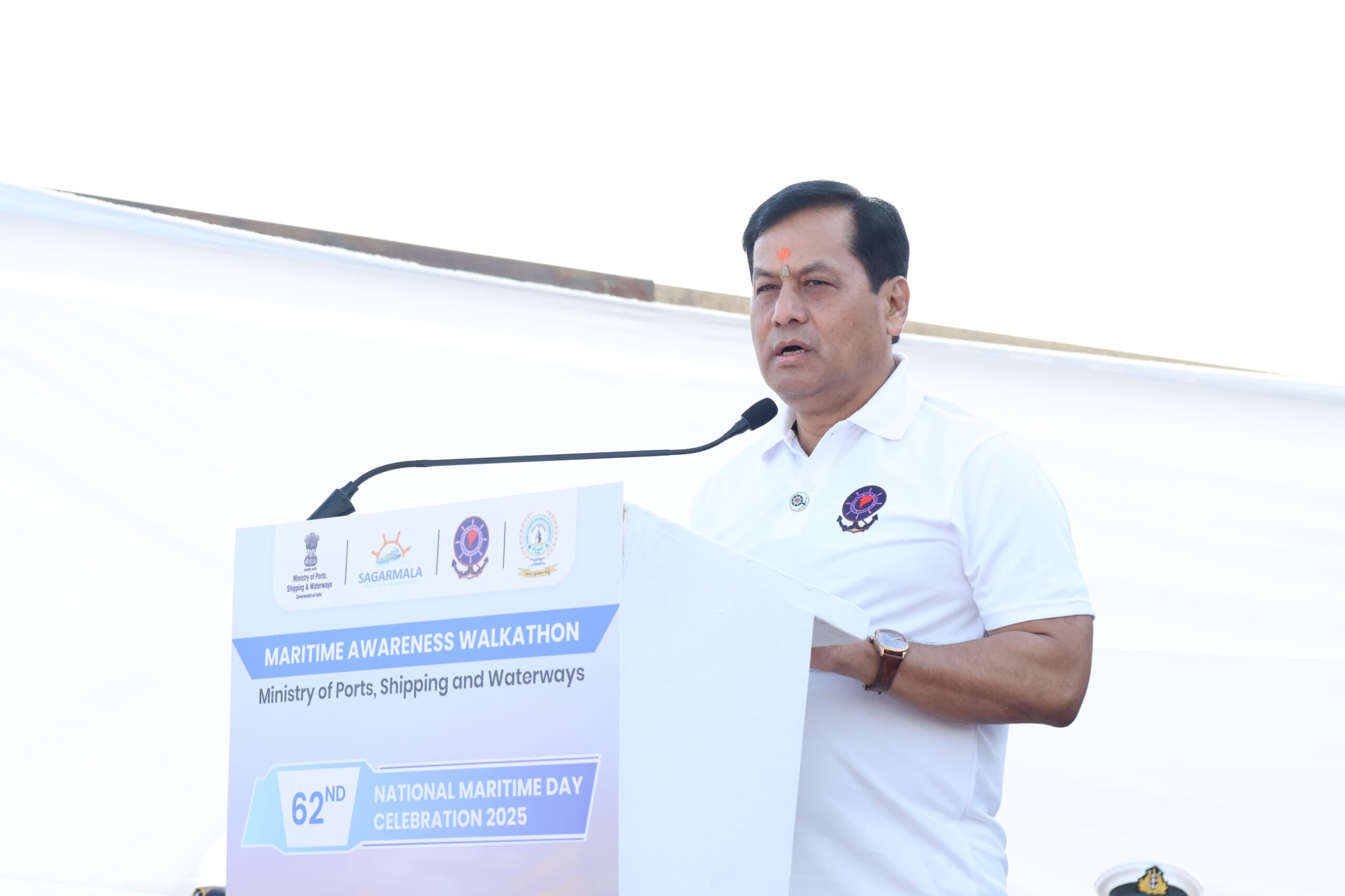
Speaking on the occasion, Union Minister Shri Sarbananda Sonowal said, “On National Maritime Day, we honour the unwavering spirit of our seafarers and the maritime community who keep India’s economy sailing forward. Under the visionary leadership of Prime Minister Shri Narendra Modi ji, we continue to strengthen our ports, empower coastal shipping, and embrace innovation. We reaffirm our commitment to making India a global maritime leader. The ocean connects us not just to trade, but to opportunity, growth, and national progress.”

Week-long celebrations were held across the maritime sector, including flag pinning ceremonies for the Hon’ble Prime Minister and Governors of maritime states, blood donation camps, wreath-laying ceremonies to honour fallen seafarers, and national-level seminars on maritime development and the future of the Blue Economy.

Adding further, Shri Sarbananda Sonowal said, “Under the visionary leadership of Hon’ble Prime Minister Shri Narendra Modi ji, India’s maritime sector is undergoing a historic transformation. With our vast Blue Economy, cutting-edge port infrastructure, and future-ready shipping ecosystem, the sector is emerging as a powerful force multiplier in our journey towards a ‘Viksit Bharat’. National Maritime Week is a celebration of our seafarers, our coastal communities, and our unwavering commitment to building a sustainable, secure, and globally competitive maritime future for India.”

S Sonowal at 62nd NMD Celebration The ocean connects us not just to trade, but to opportunity, growth, and national progress:” Sarbananda Sonowal

During the event, Shri Sonowal interacted warmly with the cadets during the refreshment session, engaging in meaningful conversations about their aspirations and training. The Union Minister interacted with female cadets, encouraging them to lead from the front in shaping the future of India’s maritime landscape. Shri Sarbananda Sonowal said, “Interacting with the young cadets on the sidelines of National Maritime Week was truly inspiring — their passion and commitment reflect the bright future of India’s maritime journey. I wished them best of luck and commended them for their most important role as the nation builders via a strong, vibrant, modern and efficient maritime sector.”

To foster community engagement and promote a healthy maritime spirit, sporting events such as football, cricket, volleyball, javelin throw, relay races, and sprints were organised with active participation from maritime professionals. These activities underscored the values of teamwork, resilience, and camaraderie that are hallmarks of life at sea.

The Ministry also recognised the outstanding services of individuals and organisations in the maritime sector by conferring awards and commendations to honour their dedication and achievements. The event was also attended by the Secretary (Shipping), Joint Secretary (Ports), Directors, and Under Secretaries from the Ministry, reflecting the strong institutional presence and commitment to maritime advancement. Around 510 trainees and faculty members participated in the event.

The 62nd National Maritime Day not only honoured the legacy of India’s maritime pioneers but also reaffirmed the nation’s commitment to a greener, more inclusive, and innovation-driven maritime future. National Maritime Day commemorates the historic voyage of ‘S.S. Loyalty’, the first Indian-owned steamship, which sailed from Mumbai to London on April 5, 1919. This momentous event marked India’s foray into international shipping and laid the foundation for the nation’s proud maritime journey.

DPA Kandla achieves historic milestone — Crosses 150 MMT mark in cargo handling for FY 2024-25

GANDHIDHAM : In a landmark achievement that cements its legacy as India’s leading maritime gateway, Deendayal Port Authority (DPA), Kandla has crossed the historic 150 Million Metric Tonnes (MMT) mark in cargo handling for the financial year 2024-25, achieving an unprecedented 150.16 MMT—the highest-ever cargo volume handled in its history.

Best Performer: Leading with the all-time highest cargo throughput.

Unmatched Growth: Achieved a 13% year-on-year growth rate, the highest among all Major Ports. This monumental feat is a testament to the relentless efforts of the port’s leadership, employees, dock workers, trade unions, PPP operators and all stakeholders who have contributed to making DPA a beacon of operational excellence and national pride.

Celebrating the Milestone:

To commemorate this remarkable milestone, celebrations were held across multiple locations:

  • A part of the celebration, port officials & employees gathered in a spirited atmosphere to acknowledge their hard work and shared success.
  • As a mark of appreciation, around 4,500 workers and labourers were provided with food kits and essential daily-use items, ensuring that the milestone was shared with those who made it possible.
  • Meals were also arranged for all worker & labours at the port, creating a sense of inclusion and camaraderie.
WhatsApp Image 2025 04 05 at 7.16.10 PM 2 DPA Kandla achieves historic milestone — Crosses 150 MMT mark in cargo handling for FY 2024-25

Speaking on the occasion, Shri Sushil Kumar Singh, Chairman, Deendayal Port Authority, extended his heartfelt gratitude to all stakeholders—port users, trade unions, employees, and workers—for their unwavering commitment and tireless efforts in making this historic accomplishment a reality.

“This achievement is not just a number—it reflects the strength of our partnerships, the dedication of our people and the limitless potential of Deendayal Port Authority. Together, we are shaping the future of India’s maritime growth”.

These initiatives reflect DPA’s commitment to the “Viksit Bharat 2047” vision of our Hon’ble Prime Minister Shri Narendra Modi and reinforce its role as a crucial pillar in India’s maritime and economic growth.

As we step into the new fiscal, Deendayal Port Authority has set its sights on a transformative goal of System Improvement, with a strategic focus on enhancing operational efficiency across the board. At the heart of this initiative is the ambitious target of achieving ‘Berthing on Arrival’, ensuring that vessels face no waiting time upon reaching the port. This seamless berthing strategy is expected to significantly boost productivity, reduce vessel turnaround time and accelerate cargo evacuation processes.

With these efforts, DPA is not just modernizing its systems, but also aligning with the vision of a future-ready maritime India.

In line with the Government of India’s Green Hydrogen Mission, Shri Sarbananda Sonowal, Hon’ble Minister for Ports, Shipping & Waterways recently flagged off India’s first indigenous electrolysers, for setting-up of 1 MegaWatt Green Hydrogen Plant at Kandla—marking a major leap in sustainable port operations.

Under the green initiative, Deendayal Port’s Centre of Excellence for Green Hydrogen & Bio-Methanol is the state-of-the-art facility driving research, development, and large-scale implementation of hydrogen-based fuels. With cutting-edge technology and world-class infrastructure, this centre will serve more than just a milestone.

Additionally, a Mega Shipbuilding project worth ₹30,000 crore is set to transform the region into a global maritime powerhouse, along with a new Cargo Terminal coming up outside Kandla Creek with a massive investment of ₹27,000 crore—adding 135 Million Tons per annum to Kandla Port’s capacity. These landmark projects are a true realisation of Hon’ble Prime Minister Narendra Modi ji’s vision of “Make in India, Make for the World”.

Deendayal Port Authority, Kandla — a symbol of speed, scale, skill and sustainability, is all geared up to implement the vision of Hon’ble Prime Minister to position our maritime sector as a leader on the global map.

Kandla Port to begin Green Hydrogen production by August : DPA Chairman

GANDHIDHAM : Chairman of Deendayal Port Authority (DPA) Kandla, Shri Sushil Kumar Singh IRSME stated on Saturday that the authority will begin the production of green hydrogen by the end of August this year.

“Under the National Green Hydrogen Mission, an ecosystem is being developed in Kandla for green hydrogen, green ammonia, and methanol. We have allocated space to major industry partners to set up giga-scale plants here. Kandla Port will also set up a 1-megawatt demonstration plant for green hydrogen,” Singh said.

He added, “With the support of L&T, we have started setting up a plant here. We aim to begin green hydrogen production by the end of August. We have signed an MoU with NTPC, under which eleven hydrogen-powered buses will replace diesel buses. This initiative will make Kandla a significant contributor to the goal of achieving net-zero greenhouse gas (GHG) emissions set by the International Maritime Organization.”

Singh further stated, “We are working to position ourselves as a methanol bunker point for the Rotterdam-Singapore corridor. This would make Kandla Port the first in India to feature in the world’s green shipping corridors.” He also highlighted the port’s operational achievements, saying that DPA has surpassed its cargo-handling target for the financial year 2024-25.

“We have achieved our target of 150 million tonnes for this year. We closed FY 2024-25 at 150.16 million tonnes, registering a 13 percent year-on-year growth — a significant leap compared to other major ports in the country,” Singh said. Highlighting the port’s efficiency , Singh noted that these results were achieved using existing infrastructure without any additional capacity expansion.

“This performance has been delivered using our existing infrastructure, without any new capacity building. We made swift decisions to unlock the potential of our assets by actively engaging with users. Now, our focus is on utilizing the remaining capacity of the existing infrastructure. One major step in this direction will be offering a ‘berthing on arrival’ facility to vessels,” he added.

Source : ANI