Home Blog Page 141

CULines launches JSM Service to Strengthen Japan–India, Middle East and Red Sea Connectivity

SHANGHAI: CULines has announced the launch of its new JSM (Japan–Straits–Malaysia) Service, further strengthening its intra-Asia network and creating more efficient connectivity between Japan and key emerging markets across the Indian Subcontinent, the Middle East and the Red Sea.

Commencing September 5, the new service will be operated through a slot-exchange cooperation with Ocean Network Express (ONE) and is designed to provide customers with a reliable and efficient shipping solution linking major Japanese gateways with strategically important markets to the west.

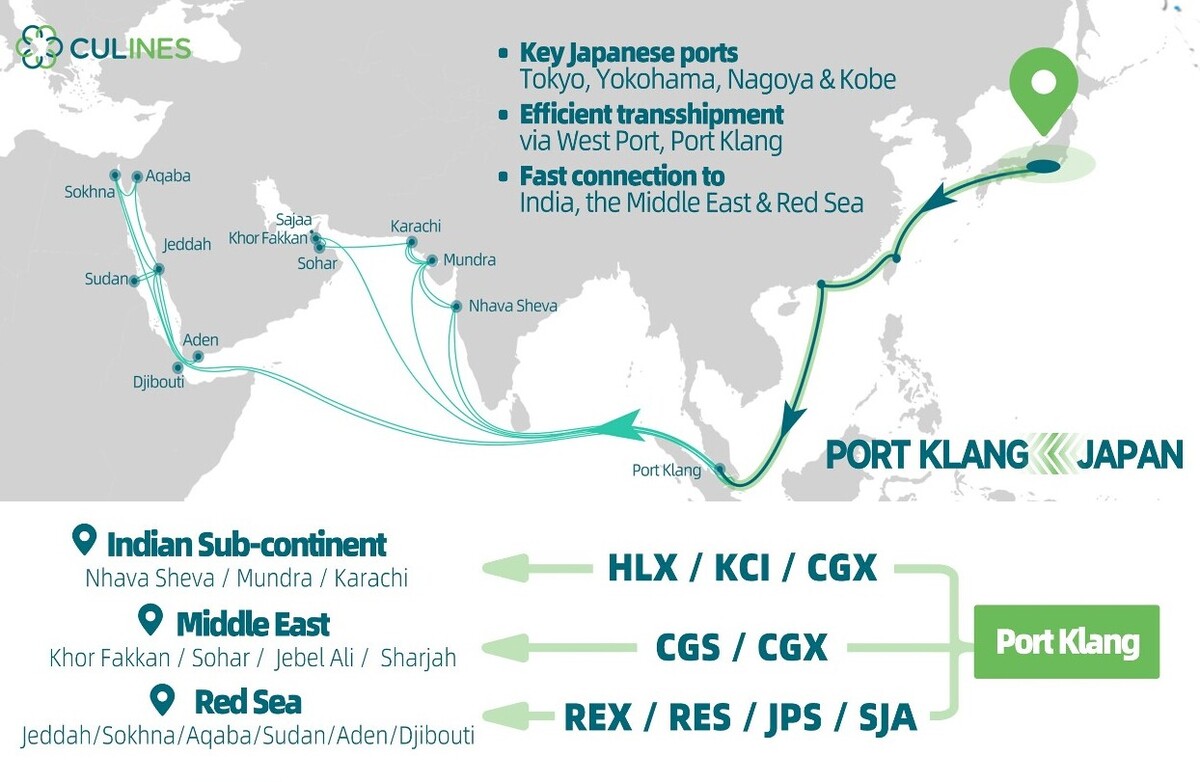
The JSM service rotation will cover Tokyo – Yokohama – Nagoya – Kobe – Keelung – Hong Kong – West Port Klang – Singapore – Tokyo, connecting four of Japan’s key ports and major regional hubs across East and Southeast Asia.

A key feature of the service is its efficient transshipment connectivity through West Port, Port Klang, enabling cargo originating in Japan to connect seamlessly with markets across the Indian Subcontinent, Middle East and Red Sea. The network will provide connections to important destinations including Nhava Sheva, Mundra and Karachi in the Indian Subcontinent; Khor Fakkan, Sohar, Jebel Ali and Sharjah in the Middle East; and Jeddah, Sokhna, Aqaba, Sudan, Aden and Djibouti in the Red Sea region.

The new service is expected to offer customers faster transit options, improved network flexibility and greater access to key trade lanes, particularly as trade between Japan, South Asia, the Middle East and Red Sea markets continues to evolve.

As part of its commitment to strengthening local customer support, CULines has also established a local branch in Japan, focusing on the Japanese market and providing professional, localized services. In addition, the company has created a dedicated Cargo Flow Team to closely monitor vessel connections and cargo movements throughout the transshipment process.

According to CULines, these initiatives will help ensure smoother and more reliable operations while delivering stable, efficient and hassle-free cross-border shipping solutions to customers.

The launch of the JSM service marks another step in CULines’ efforts to enhance its intra-Asia network and provide more competitive and dependable connectivity between Japan and the rapidly developing trade corridors of South Asia, the Middle East and the Red Sea.
Maersk Hamburg receives MPA Award for outstanding search and rescue contributions

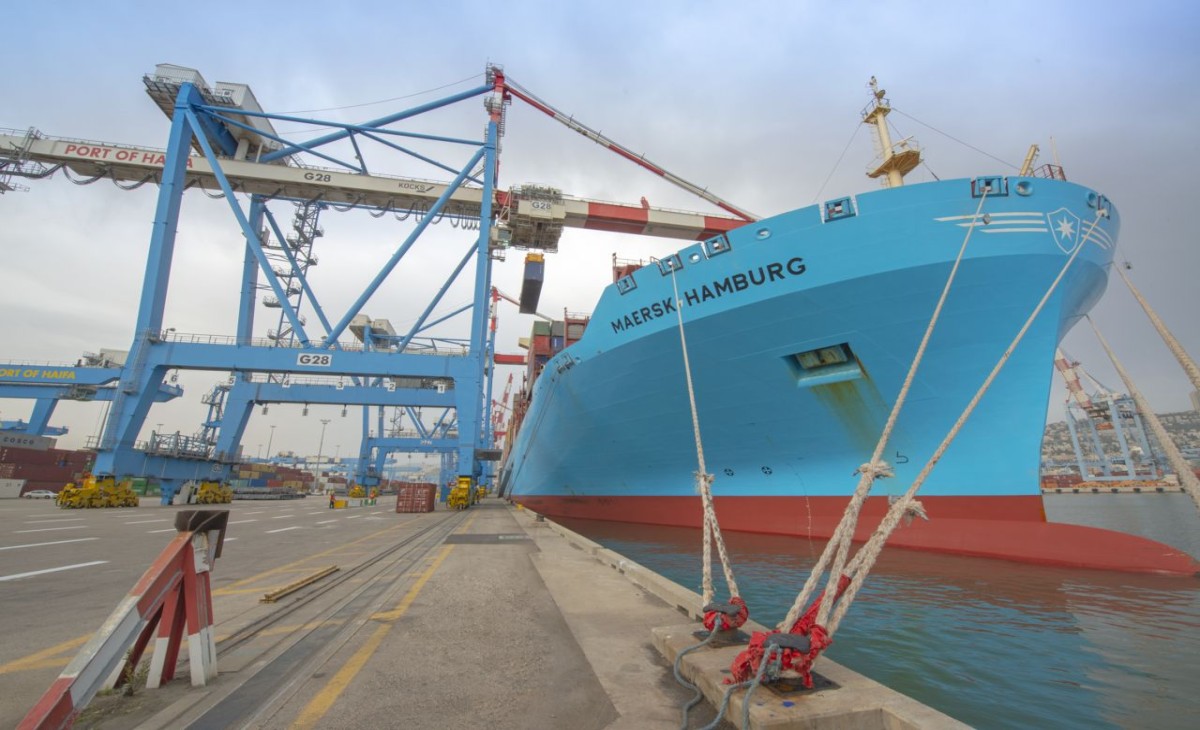
SINGAPORE: A.P. Moller – Maersk has announced that its vessel Maersk Hamburg has received the “Award for Outstanding Contributions to Search and Rescue Efforts in 2025” from the Maritime and Port Authority of Singapore (MPA), recognising the vessel’s exemplary efforts in rescuing 50 people from a distressed boat in the Mediterranean Sea.

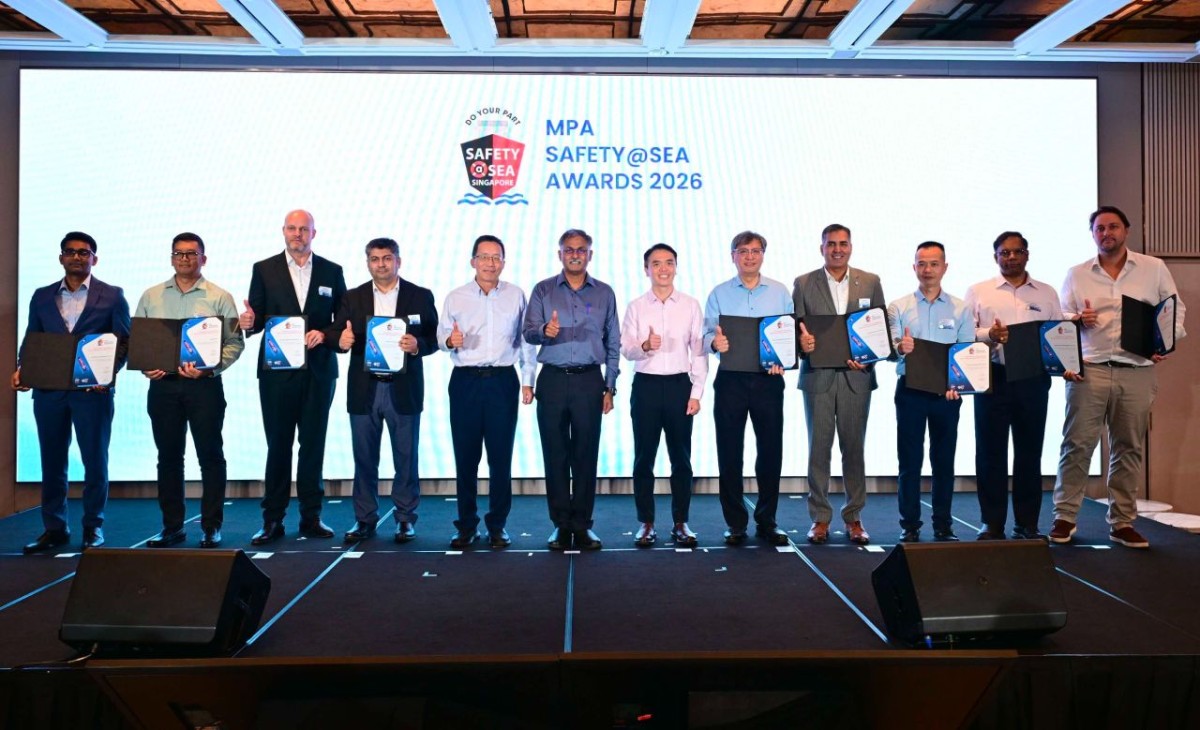
The award was presented in Singapore on 17 August 2026, honouring the courage, professionalism and commitment demonstrated by Captain Dmytro Frolkov and the crew of Maersk Hamburg during the rescue operation on 7 June 2025.

maersk hamburg Maersk Hamburg receives MPA Award for outstanding search and rescue contributions

While sailing from Valencia, Spain, to Port Said, Egypt, Maersk Hamburg responded to a distress call relayed through MRCC Piraeus concerning a boat in distress in the Mediterranean Sea. The vessel promptly proceeded to assist and safely brought all 50 individuals aboard.

Following the rescue, the Maersk Hamburg crew coordinated with the relevant authorities to ensure a safe and secure handover of the rescued persons to the Greek Coast Guard near Crete.

The Maritime and Port Authority of Singapore commended the crew for acting professionally and providing all necessary assistance during the rescue operation.

The recognition also reflects Maersk’s core value of “Constant Care” — looking beyond today, anticipating what is needed and never compromising on the safety of life.

Maersk congratulated Captain Frolkov and the entire crew of Maersk Hamburg for their courage, professionalism and dedication, describing their actions as a strong example of the maritime industry’s responsibility to safeguard human life at sea.

The award underscores the vital role of merchant vessels and their crews in supporting search and rescue efforts and responding swiftly when lives are at risk at sea.

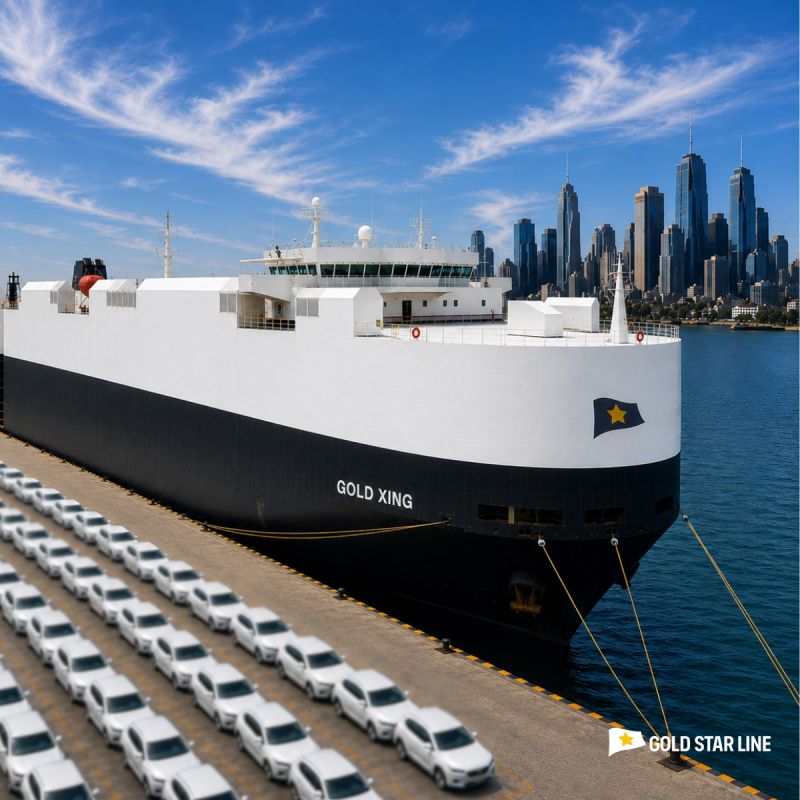
Gold Star Line anounces MV Gold Xing completes maiden calls and expands PCC Network

MELBOURNE: Gold Star Line Ltd. are proud to announce that MV Gold Xing has successfully completed her maiden calls in Australia, marking a significant milestone in the expansion of our Pure Car Carrier (PCC) network.

The addition of the ports of Melbourne, Port Kembla and Brisbane strengthens our regional service coverage, offering customers enhanced connectivity, greater flexibility, and more routing options to support their automotive logistics needs.

As we continue to grow our PCC capabilities, GSL remains committed to delivering reliable, efficient, and customer-centric vehicle transportation solutions that meet the evolving demands of the global automotive supply chain.

Panama Canal adopts additional measures to address Reduced Precipitation in the Canal Watershed

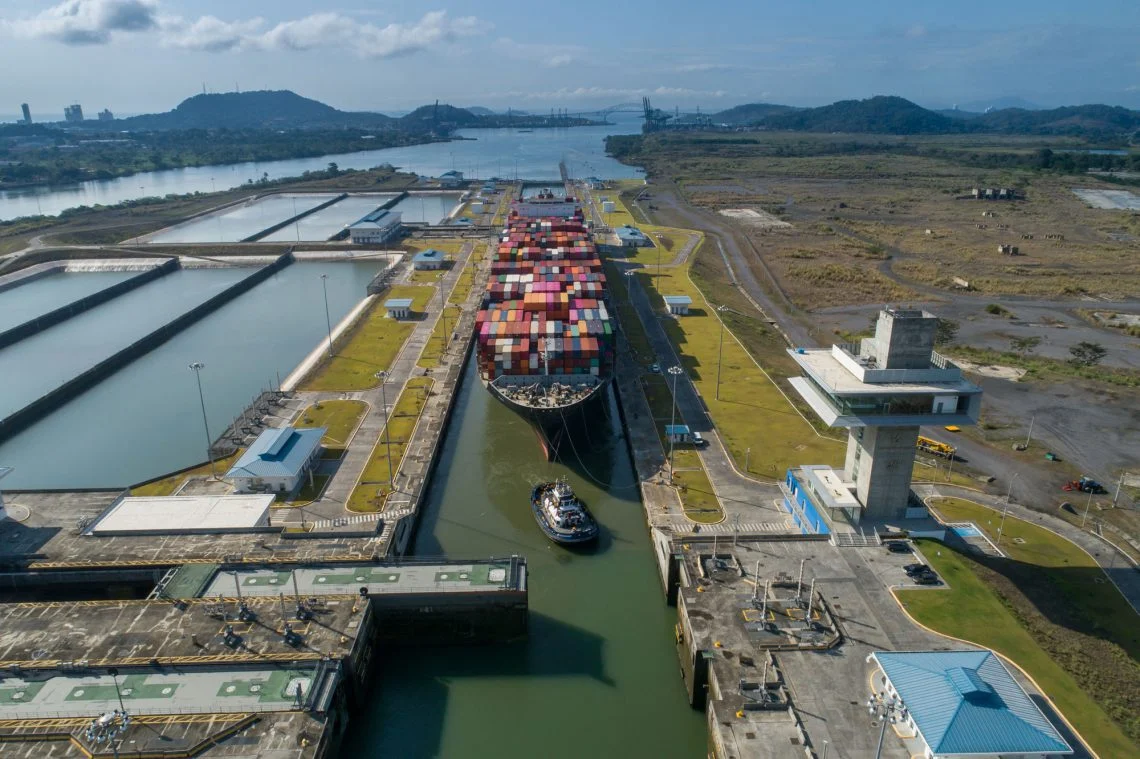
PANAMA CITY: The Panama Canal, Friday, announced via an Advisory to Shipping, temporary modifications to the locks’ transit capacity including adjustments to its daily auctions, amid reduced precipitation in the canal watershed. 

Effective September 3, 2026, the number of daily slots available at the Neopanamax Locks will be adjusted to nine (9), and the daily slots available at the Panamax Locks will be twenty-five (25).  Meanwhile, the number of daily slots accessible at the Panamax Locks will be twenty-three (23), as of September 15, 2026.

Despite the arrival of the rainy season in Panama, and the water-saving measures implemented by the Panama Canal to mitigate the adverse effects of the El Niño event, current watershed conditions, including below-expected precipitation in the Canal watershed, require additional action to support the long-term sustainability of transit operations.

Additionally, to promote a more equitable allocation process that better reflects market composition, including various cargo types and market segment characteristics, the Panama Canal will temporarily adjust the offer of its daily auction slots.

Beginning on September 3, 2026, the daily auction slot designated for Neopanamax, Supers and Regular vessels will be organized into four (4) groups:

Group 1: LNG, LPG

Group 2: Dry Bulk Carriers, General Cargo, Others 

Group 3: Container vessels, Vehicle Carriers / RoRo, Refrigerated

Group 4: Chemical Tankers, Crude / Product Tankers

To promote a balanced allocation of booking slots across all users while maximizing water-use efficiency, customers that have already secured a booking slot for the same transit date through LoTSA, NetZero, or prior allocations will not be eligible to obtain an additional slot unless no other competitors exist. 

Customer limits do not apply to slots awarded through the auction process. Furthermore, in the Neopanamax Locks, full container vessels with the highest TEU capacity will be given priority during the allocation process, with Customer Ranking used as the tiebreaker criterion. Additional details regarding these modifications are available at the following link.

Notably, customers should be aware that a reduction in the number of daily transits may increase waiting times for vessels arriving at the waterway without a secured reservation. 

To reduce the possibility of extended delays, the Panama Canal strongly urges customers to use the booking and reservation options available through the Transit Reservation (Booking) System.

A confirmed reservation through this system is the only mechanism that guarantees a transit date. 

To maintain safe and efficient canal operations, the Panama Canal Authority may, under Notice to Shipping N-07, temporarily suspend all, or part of the Transit Reservation System, when necessary. In such cases, if a reserved transit slot is canceled, the vessel will not be charged any penalty, surcharge, or cancellation fee. 

Moreover, based on the current level of water in Gatun Lake and the latest weather projections, the Panama Canal will postpone until September 2, 2026, the maximum authorized draft of 14.63 meters (48.0 feet) TFW in the Neopanamax Locks, scheduled to become effective on August 26, 2026.  And the maximum authorized draft adjustment of 14.48 meters (47.5 feet) TFW, scheduled to become effective on September 3, 2026, will be postponed until October 1, 2026. 

The Panama Canal will continue to closely monitor weather conditions, watershed inflows, and lake levels. Should additional operational adjustments become necessary, the canal will provide customers with timely updates.   Because weather conditions are changing more rapidly than originally anticipated, the Panama Canal will make every reasonable effort to announce any future adjustments as far in advance as possible. However, the timing of such announcements will depend on evolving conditions and the availability of updated information.

US forces redirect 68 commercial vessels, disable 3, board 2 amid Iran blockade: CENTCOM

WASHINGTON: The US Central Command (CENTCOM) on Friday said that American forces have redirected 68 commercial vessels, disabled three and boarded two others as part of efforts to enforce a blockade against Iran amid rising tensions in the Strait of Hormuz.

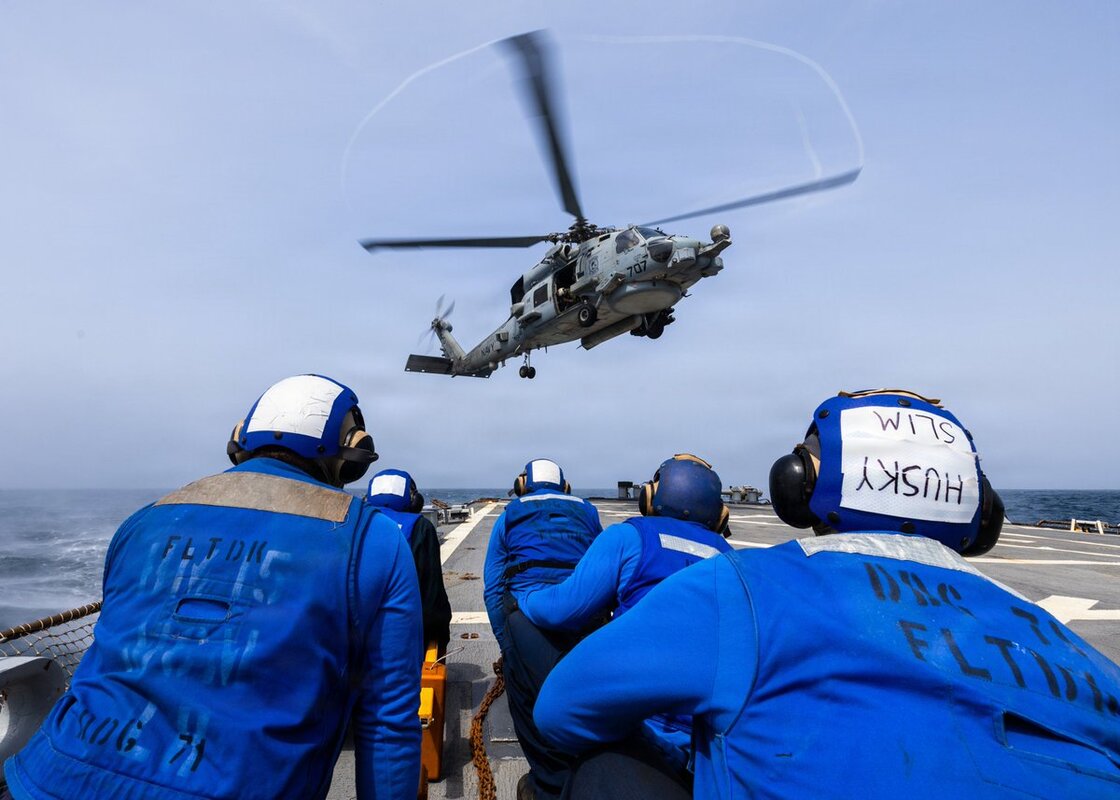
In a post shared on X, CENTCOM said US sailors observed an MH-60R Sea Hawk helicopter landing on the flight deck of the USS Ross (DDG 71), one of more than 20 warships supporting the US blockade against Iran.

“U.S. Sailors observe an MH-60R Sea Hawk landing on the flight deck aboard USS Ross (DDG 71). Ross is one of more than 20 warships supporting the U.S. blockade against Iran. As of Aug. 21, U.S. forces have redirected 68 commercial vessels, disabled 3 and boarded 2 to ensure compliance,” the post read.The development comes amid heightened tensions between Washington and Tehran over the Strait of Hormuz, a key global energy transit route, where maritime operations have intensified in recent months.

Earlier on Thursday, CENTCOM had said that US Marine Corps MV-22B Osprey aircraft were operating from the USS Boxer (LHD 4) as the ship transited the Arabian Sea while supporting blockade operations against Iran.

“U.S. Marine Corps MV-22B Osprey utility aircraft take off from the flight deck of USS Boxer (LHD 4) while the ship transits the Arabian Sea and continues to enforce the U.S. blockade against Iran. As of Aug. 20, U.S. forces have redirected 67 commercial vessels, disabled 3 and boarded 2 to ensure compliance,” the post read.

The US has increased naval presence in the region amid disputes with Iran over maritime security, sanctions and nuclear issues.

Washington has also accused Tehran of attempting to restrict shipping linked to US-allied countries, while the US has responded with naval escorts and maritime operations to keep international energy routes open.

US President Donald Trump, earlier in the day, said Iran wanted to reach an agreement but was not ready for what he called the “right deal”, while asserting that Washington had control over key areas in the region, including the Strait of Hormuz.

“No, not at all. It just means that we’re seeing what happens. They have no money, they have no navy, they have no air force,” Trump told reporters, referring to US economic measures against Iran.

“We’re just going to sort of see what happens, and we have total control, as you know, of the border; we have total control — if you look at the blockade, we have total control of that entire region having to do with the Strait of Hormuz,” he added.

Trump recently announced what he called the “most crushing economic operation ever taken” against Iran and warned countries providing financial, business or government support to Tehran of “tremendous economic consequences”.

Trump said the measures would target Iran’s economic lifelines, including oil smuggling networks, financial transfers, exchange houses, ship registries and front companies.

Meanwhile, Iranian Foreign Minister Seyed Abbas Araghchi criticised Trump’s latest economic pressure campaign against Tehran, calling it a failed approach.

Earlier, Araghchi also accused Washington of using the announcement as a diversion from its own economic challenges and said US pressure policies would not succeed.

Earlier, Iranian Parliament Speaker Mohammad Bagher Ghalibaf said Tehran would not reopen the Strait of Hormuz until the United States fulfilled commitments under a 14-point Memorandum of Understanding, including lifting the blockade, releasing frozen Iranian assets and easing oil sanctions.

Source: ANI

Statement by the DCoC Chair on strengthening regional operational cooperation in response to the resurgence of piracy in the Western Indian Ocean and Gulf of Aden

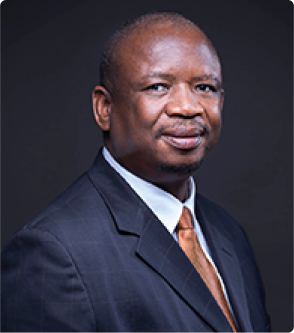
DJIBOUTI: The Chair of the Djibouti Code of Conduct/Jeddah Amendment (DCoC/JA), Mr. Metse Ralephenya – Republic of South Africa, on behalf of the Signatory States, wishes to update the international maritime community on the collective regional response being advanced following the recent resurgence of piracy and armed robbery against ships in the Western Indian Ocean and Gulf of Aden.

The continued captivity of innocent seafarers aboard MT HONOUR 25, SWARD, MV EUREKA, MT ASANA, and other vessels remains a matter of profound humanitarian concern. The Signatory States reiterate their call for the immediate and unconditional release of all seafarers currently being held hostage and reaffirm that the safety, dignity and welfare of seafarers must remain at the centre of all international efforts.

The resurgence of piracy has demonstrated that, while considerable progress has been achieved over the past decade, the underlying conditions that enable piracy have not been fully eliminated. The Signatory States therefore recognize that maintaining maritime security requires sustained vigilance, stronger regional ownership, and practical operational cooperation among coastal States.

In response to the deteriorating security situation,

On 29 July, The DCOC Steering Committee conducted an Extraordinary Meeting with the purpose to consider a range of options to strengthen regional operational cooperation. Following careful consideration and fruitful discussion, the Steering Committee recommended the establishment of a Combined DCoC Task Force under the auspices of Working Group 3 on Operational Coordination and Cooperation at Sea.

In considering this proposal, the Steering Committee took note of the significant progress being made in the Gulf of Guinea under the Yaoundé Code of Conduct, where regional States have recently operationalized a Combined Maritime Task Force to strengthen collective maritime security. The proposed DCoC Task Force mirrors this growing commitment to regional ownership by enabling Signatory States to work together through coordinated maritime operations tailored to the unique operational environment of the Western Indian Ocean and Gulf of Aden. The Committee further agreed that the initiative should complement, rather than duplicate, the valuable efforts of existing international maritime security partners, including the Combined Maritime Forces, Combined Task Force 151, EU NAVFOR and independently deployed naval forces.

Subsequently, these recommendations were considered by the National Focal Points of the Djibouti Code of Conduct during their meeting of 5 August 2026. Following the meeting, the Chair is pleased to announce that the National Focal Points endorsed the Steering Committee’s recommendations and agreed that Working Group 3 should lead the development of the operational framework required to establish the proposed Combined DCoC Task Force. Working Group 3 has accordingly been tasked with developing a comprehensive package of recommendations for consideration by the Steering Committee including the necessary operational arrangements.

In addition, a defining feature of the proposed framework will be the embarkation of officers (sea-riders) from relevant coastal States aboard participating naval vessels. This will enhance interoperability, facilitate coordinated operations across jurisdictions, improve maritime domain awareness, and provide a practical mechanism for participating States to exercise enforcement authority in accordance with international law.

The proposed Task Force represents a significant step in strengthening regional operational cooperation under the Djibouti Code of Conduct. Drawing on lessons from Operation Copper in Southern Africa and the recently established Combined Maritime Task Force under the Yaoundé Code of Conduct in the Gulf of Guinea, it seeks to provide a practical regional mechanism through which willing Signatory States can conduct coordinated maritime operations in support of existing international maritime security efforts. The Chair emphasizes that the proposed Task Force is intended to complement—not replace—existing international naval operations.

Recognizing that successful counter-piracy operations require both operational and legal cooperation, Working Group 3 has also been tasked with developing recommendations for a regional legal framework to facilitate the lawful transfer, investigation and prosecution of suspected pirates. By strengthening regional transfer arrangements and harmonizing operational procedures, the DCoC aims to improve the legal finish of maritime security operations while fully respecting national legislation and due process.

As a next step, the deliverables of Working Group 3 will be presented to the Steering Committee for consideration and tabled at the 9th DCoCJA High Level Meeting for further deliberations and adoption. This important milestone will pave the way for the establishment of the proposed Combined DCoC Task Force and the development of a regional legal framework.

The International Maritime Organization (IMO) continues to fully support regional initiatives undertaken within the DCoC framework, recognizing that operational maritime security measures remain the sovereign responsibility of Member States. The Signatory States welcome this continued support, which provides a clear foundation for advancing practical regional initiatives under the Djibouti Code of Conduct.

The Signatory States remain committed to implementing the Djibouti Code of Conduct and the Jeddah Amendment as the principal framework for regional maritime security cooperation and call upon Signatory States, Friends of the DCoC, international organizations and development partners to support this important initiative. Together, we can build a sustainable regional capability that protects seafarers, safeguards freedom of navigation and reinforces long-term maritime security in the Western Indian Ocean and Gulf of Aden.

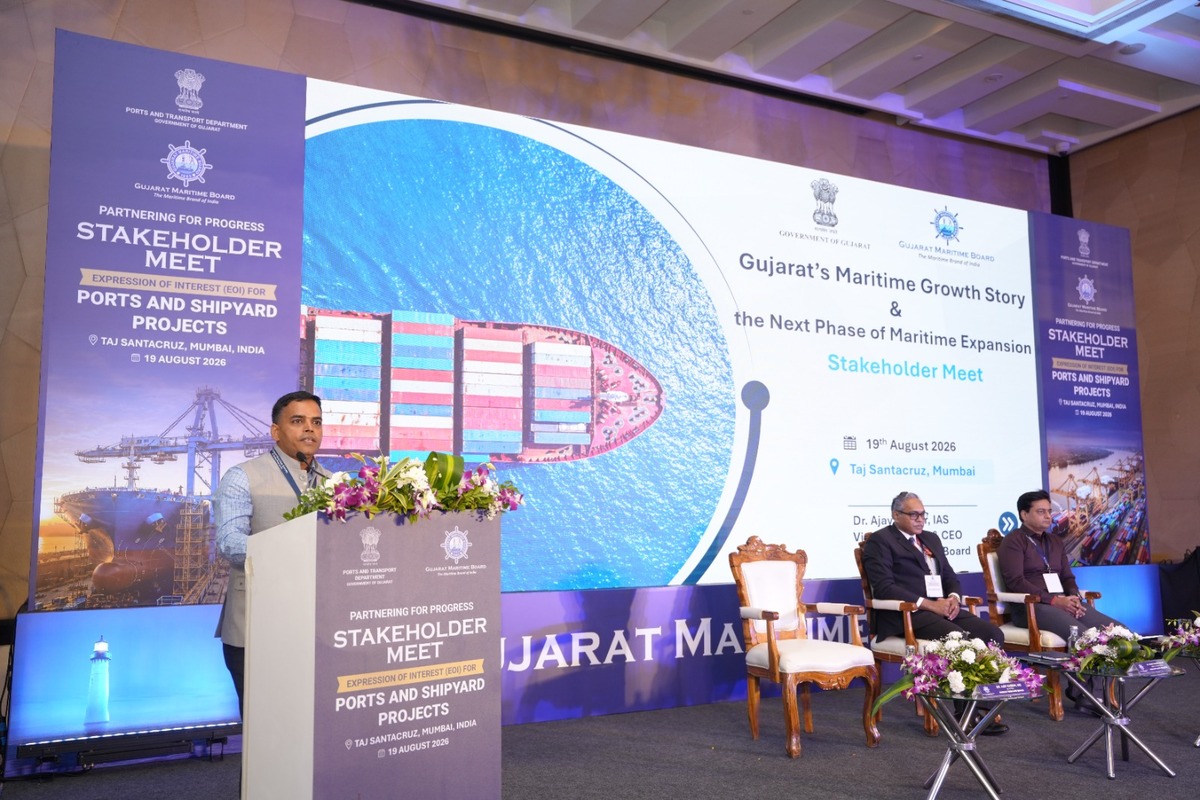
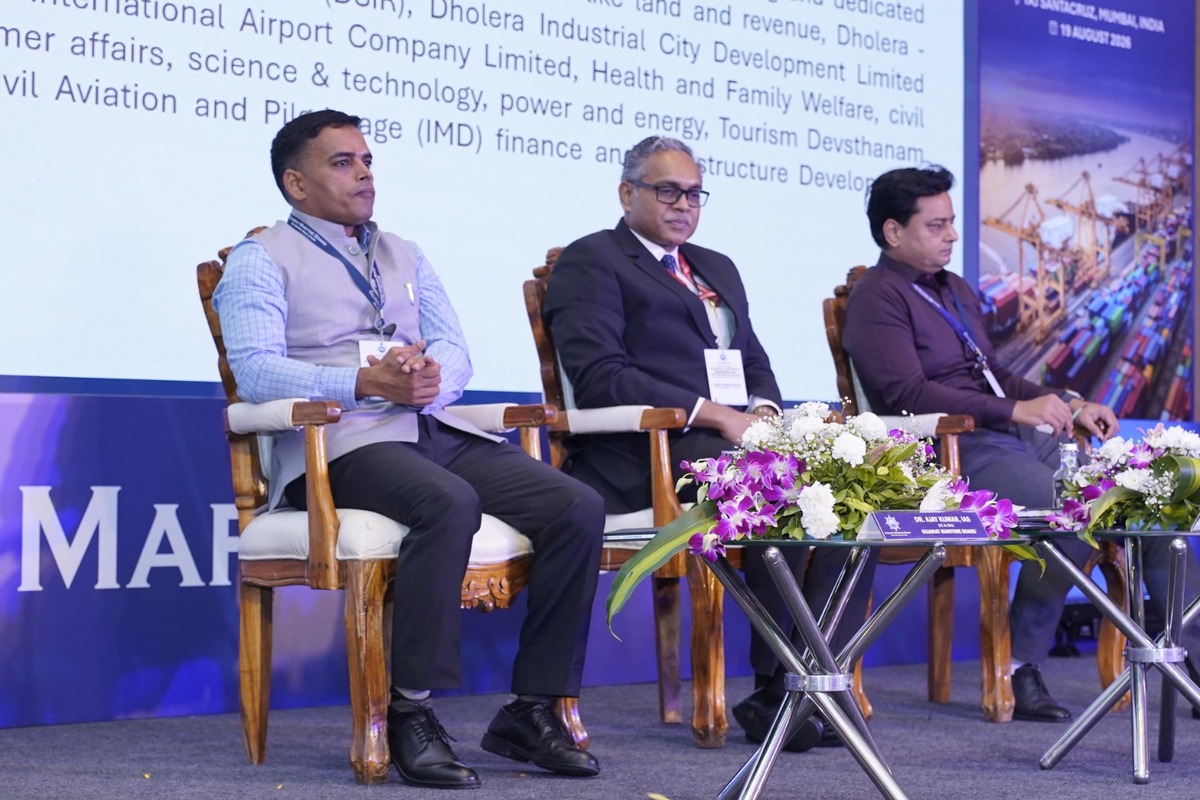
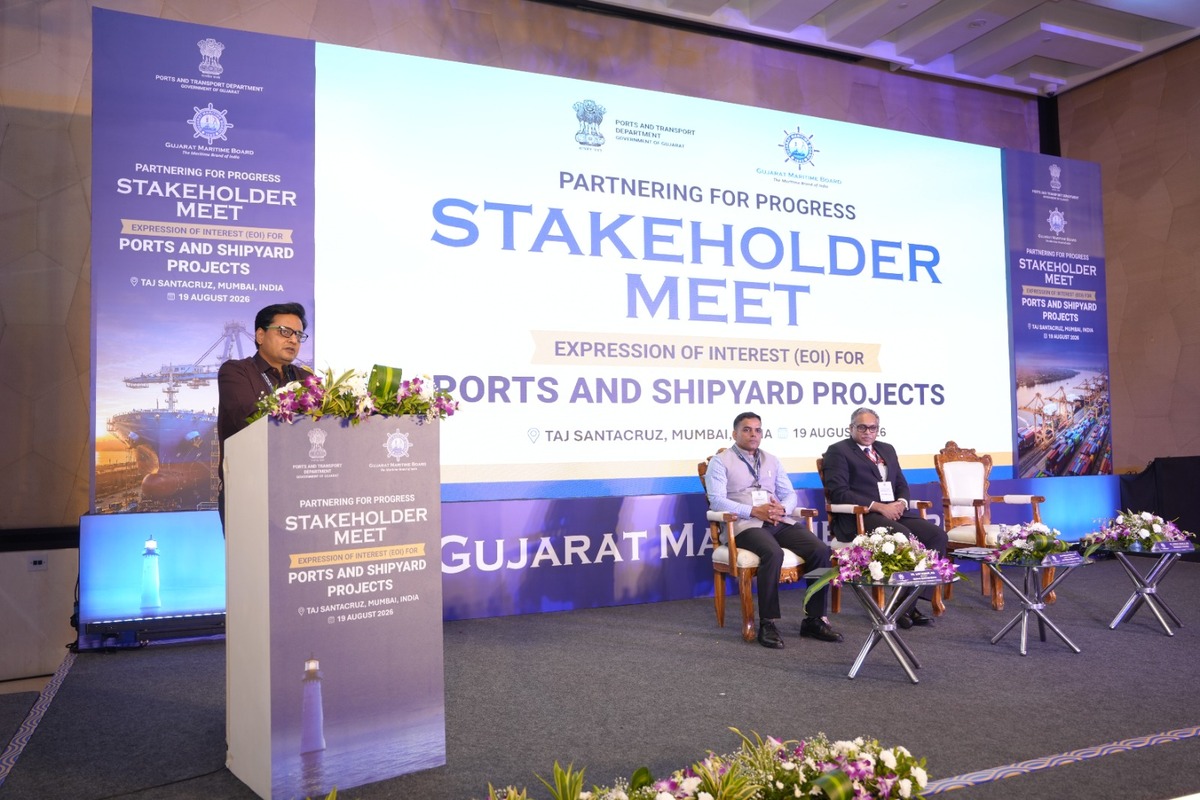
Gujarat Maritime Board Showcases Gujarat’s Next-Generation Port and Shipbuilding Opportunities at Mumbai Stakeholder Meet

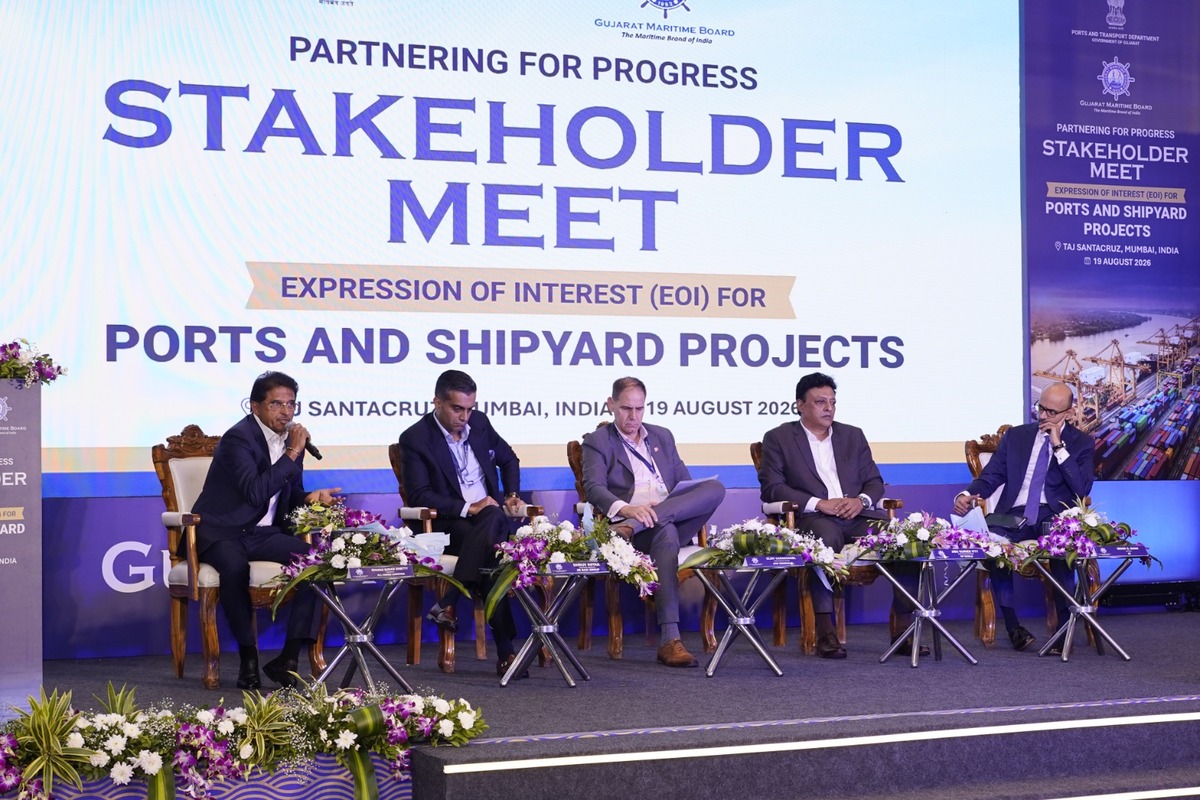
MUMBAI: The Gujarat Maritime Board (GMB) organised a high-level “Stakeholder Meet | Ports and Shipyards Development in Gujarat” on 19 August 2026 at Taj Santacruz, Mumbai, bringing together leading investors, maritime industry leaders, port operators, shipbuilders, financial institutions, developers and other key stakeholders to showcase emerging investment opportunities across Gujarat’s maritime sector.

The stakeholder meet was organised as part of Gujarat’s broader vision of strengthening its position as a global maritime powerhouse and expanding its port capacity to 3,000 MMTPA and beyond by 2047.

The stakeholder meet aimed to reaffirm Gujarat’s commitment to strengthening its maritime ecosystem through strategic investments and industry partnerships across ports and shipbuilding, while creating new opportunities for private sector participation and contributing to the state’s emergence as a leading global maritime and logistics hub.

The event witnessed participation of about 200 stakeholders from across the maritime sector, along with representatives of more than 15 international organisations. International participation included the Consuls General of Indonesia, Italy and Norway, as well as senior representatives from Singapore, the Port of Rotterdam and the Republic of Korea. This strong international presence reflected the growing global interest in Gujarat’s maritime ecosystem and port-led development opportunities, further underscoring the State’s increasing prominence as a preferred destination for maritime investment and collaboration.

During the meet, GMB presented its roadmap for substantial capacity expansion through new greenfield ports and opportunities in the Shipbuilding and Marine Manufacturing across various locations in Gujarat.

A key highlight of the event was the presentation of Expression of Interest (EOI)-based investment opportunities, covering six identified greenfield port opportunities and four shipbuilding yard opportunities, including the proposed Mega Shipbuilding Cluster at Kuchadi. The initiatives were aimed at attracting private sector participation and long-term investments in Gujarat’s port, shipbuilding, ship repair and marine manufacturing ecosystem.

The inaugural session featured an address by Dr. Ajay Kumar, IAS, Vice Chairman & CEO, Gujarat Maritime Board, on Gujarat’s maritime growth story and the next phase of maritime expansion. Shri Hareet Shukla, IAS, Principal Secretary, Ports & Transport Department, Government of Gujarat, spoke on policy continuity, investor confidence and Gujarat’s PPP-led maritime development model, while Shri Shyam Jagannathan, IAS, Director General of Shipping, also addressed the gathering validating the opportunities and potential in the sector.

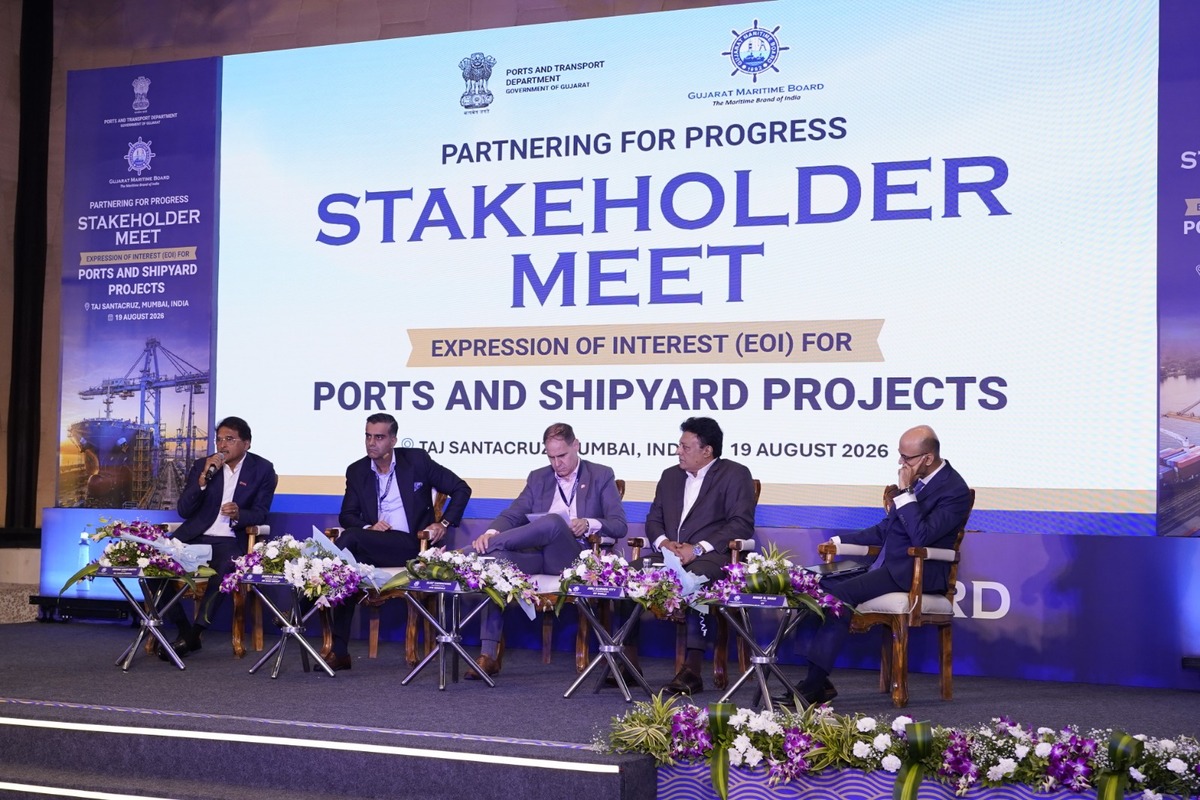
The first thematic session, “Investing in Gujarat’s Next Generation Ports,” focused on greenfield port opportunities, the shipbuilding ecosystem and related infrastructure opportunities. The session was moderated by Shri Mihir G Shah, Partner/Principal and National Leader (Transport), GPS, EY, and featured senior industry leaders including Shri Shashi Kiran Shetty, Chairman, Allcargo Group; Shri Dhruv Kotak, Managing Director, JM Baxi Group; Shri Clint Carmichael, COO, Gujarat Pipavav Port Limited (APM Terminals); and Shri Jibu Kurien Itty, CEO – Ports & Terminals, Nava Sheva, DP World India.

The second thematic session, “Investing in Gujarat’s Emerging Shipbuilding & Marine Manufacturing Ecosystem,” deliberated on opportunities in shipbuilding and marine manufacturing. The panel comprised Shri Rajat Goyal, Principal Investment Officer – Maritime Investment Fund, SBI Ventures; Dr. Harikrishnan S, Director (Shipbuilding), Cochin Shipyard Limited; Rear Admiral Vipin Kumar Saxena (Retd.), CEO, Swan Defense and Heavy Industries Limited; and Cmde PR Hari, IN (Retd.), Garden Reach Shipbuilders & Engineers Limited, with Shri Mihir G Shah as moderator who is the partner at the EY LLP.

The event also provided an opportunity for prospective investors and industry stakeholders to engage in open-house interactions, share their views, suggestions and feedback on the opportunities presented under the EOI. The programme concluded with networking and dedicated B2G and investor interaction meetings, providing prospective investors an opportunity to seek further information and engage directly with GMB and relevant stakeholders regarding the identified investment opportunities.

A New Maritime Chapter: Five Greenfield Shipbuilding Clusters approved Across India

₹9,930 Crore Central Capital Assistance to Support World-Class Shipbuilding Infrastructure Across Five Coastal States

NEW DELHI: India has taken a major step towards transforming itself into a globally competitive shipbuilding hub with the National Shipbuilding Mission (NSbM) granting In-Principle Approval (IPA) to five Greenfield Shipbuilding Clusters across strategically located coastal states.

The approval, granted through the Inter-Ministerial Governing Board (IMGB) under the Shipbuilding Development Scheme (SbDS), marks a significant milestone in the country’s ambitious Maritime Amrit Kaal Vision 2047 and its goal of becoming one of the world’s top five shipbuilding nations by 2047.

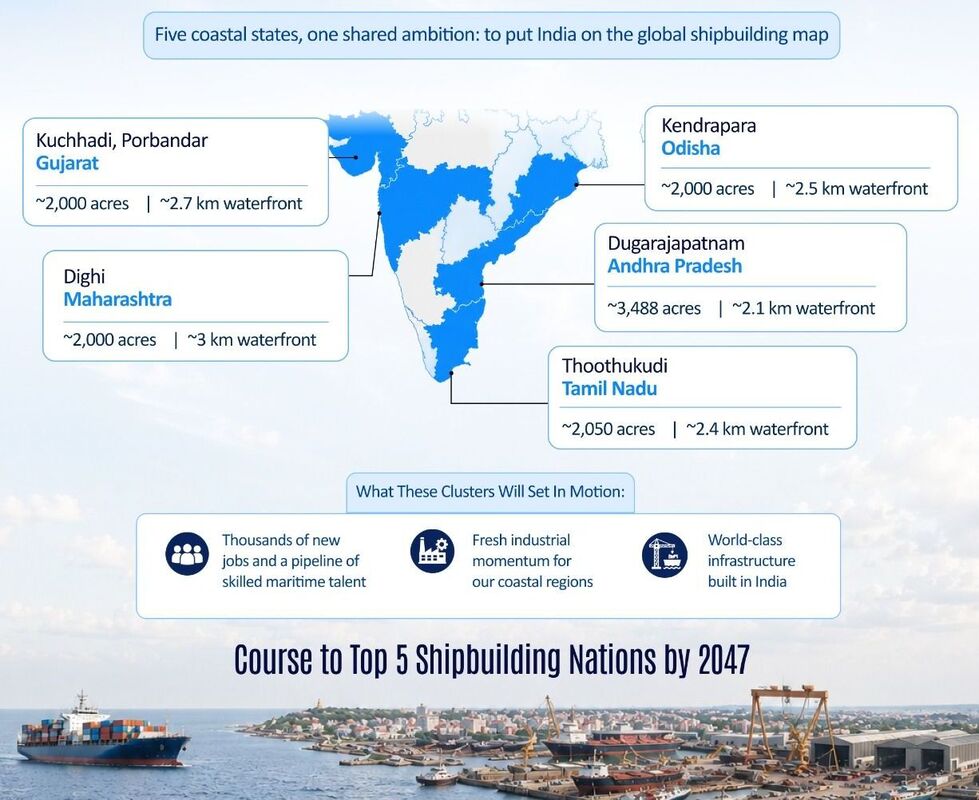
The five proposed clusters are spread across Gujarat, Maharashtra, Andhra Pradesh, Odisha and Tamil Nadu, creating a nationwide platform for expanding India’s shipbuilding capacity, developing maritime infrastructure and generating thousands of skilled employment opportunities.

The Government has earmarked ₹9,930 crore in Central capital assistance, including support for common maritime infrastructure, to help establish these shipbuilding ecosystems.

Five Strategic Locations

The approved Greenfield Shipbuilding Clusters are:

  • Kuchhadi, Porbandar, Gujarat – approximately 2,000 acres with around 2.7 km of waterfront
  • Dighi, Maharashtra – approximately 2,000 acres with around 3 km of waterfront
  • Dugarajapatnam, Andhra Pradesh – approximately 3,488 acres with around 2.1 km of waterfront
  • Kendrapara, Odisha – approximately 2,000 acres with around 2.5 km of waterfront
  • Thoothukudi, Tamil Nadu – approximately 2,050 acres with around 2.4 km of waterfront

The strategic spread of these clusters along India’s coastline is expected to create new centres of maritime industrial activity while strengthening the country’s ability to design, construct and service large-tonnage vessels within India.

From Infrastructure to Global Shipbuilding Capacity

According to the Directorate General of Shipping, the five clusters are designed to provide the foundation for world-class shipbuilding infrastructure, develop a large pool of skilled maritime talent and create a pipeline of globally competitive, Indian-built vessels.

The initiative is also expected to provide a major industrial boost to India’s coastal regions by encouraging ancillary industries, maritime services, engineering capabilities and supply-chain ecosystems around the shipbuilding sector.

Each cluster is being structured as a 50:50 Joint Venture Special Purpose Vehicle (SPV) between State and Central Government entities. With the SPVs formed, land secured and IPA granted, the Government has established the basic framework required to move the projects towards implementation.

However, the approval does not yet represent the final financial commitment for individual clusters. Financial assistance will follow the selection of anchor shipyards and submission of Detailed Project Reports (DPRs).

Global Shipyards Invited to Anchor India’s Next Maritime Chapter

The Government is now seeking participation from world-class anchor shipyards from India and across the globe to establish large-scale shipbuilding operations within these clusters.

The proposition is significant: strategic coastal locations, dedicated land parcels, waterfront access and Central Government support for common infrastructure are being brought together to create a platform where major shipyards can establish globally competitive manufacturing facilities.

The emphasis now shifts from creating the framework to attracting the anchor shipyards capable of bringing technology, investment, expertise and global order books to India.

The initiative therefore represents more than the creation of five new shipyards. It aims to build complete maritime industrial ecosystems, supporting vessel construction, repair and maintenance, equipment manufacturing, engineering services, logistics and a new generation of skilled maritime professionals.

A Major Step Towards Maritime Amrit Kaal Vision 2047

For decades, India has possessed a strong maritime tradition but has remained a relatively small player in global shipbuilding. The Greenfield Shipbuilding Clusters initiative seeks to change that equation by creating the scale, infrastructure and industrial ecosystem required to compete with established shipbuilding nations.

With five coastal states now positioned to participate in this transformation, the Government’s latest move provides a clear roadmap for expanding domestic shipbuilding capacity while reducing dependence on overseas construction for large and strategically important vessels.

As India progresses towards Maritime Amrit Kaal Vision 2047, the message is increasingly clear: the country does not merely intend to sail more ships—it intends to build more of them in India.

The five Greenfield Shipbuilding Clusters, backed by Central Government assistance and now open for anchor-shipyard partnerships, could become a defining component of India’s maritime industrial transformation.

The groundwork has been laid. The next chapter will depend on global shipbuilding leaders stepping forward to build at scale—and build India’s shipbuilding future.

India’s Shipbuilding and Ship-repair sector is set for a major capacity expansion as four brownfield projects receive In-Principle Approval under SbDS

NEW DELHI : India’s shipbuilding and ship-repair sector is set for a major capacity and capability expansion, with four brownfield projects receiving In-Principle Approval (IPA) under the Government’s Shipbuilding Development Scheme (SbDS).

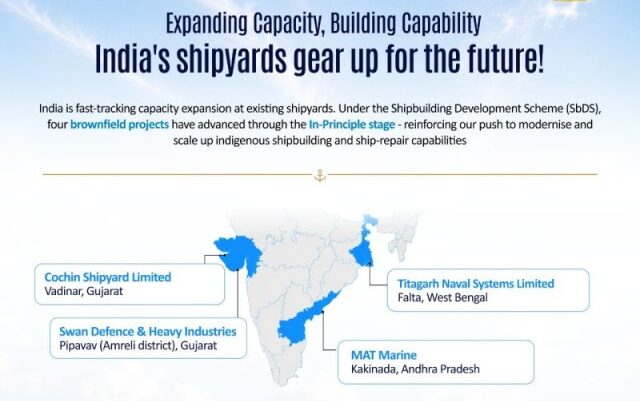
The approvals mark another important step in India’s efforts to modernise existing shipyards, expand indigenous shipbuilding and ship-repair capacity, and create globally competitive maritime manufacturing hubs. The projects span Gujarat, West Bengal and Andhra Pradesh, strengthening shipbuilding capabilities across key maritime regions.

The four projects that have received IPA are:

Cochin Shipyard Limited (CSL) – Vadinar, Gujarat: A new ship-repair facility at Vadinar, being developed in partnership with Deendayal Port Authority (DPA), with an estimated project cost of ₹920 crore. The facility is expected to strengthen India’s ship-repair ecosystem and enhance repair capacity on the western coast.
Swan Defence & Heavy Industries (SDHI) – Pipavav, Gujarat: A ₹504-crore Phase-I infrastructure upgrade, including the installation of major equipment such as Goliath and ELL cranes, aimed at enhancing the yard’s handling, construction and project execution capabilities.
Titagarh Naval Systems Limited (TNSL) – Falta, West Bengal: A ₹516-crore new shipyard project at Falta, designed to deliver approximately 10–12 vessels of up to 160 metres in length per year, adding significant shipbuilding capacity in eastern India.
MAT Marine – Kakinada, Andhra Pradesh: A ₹105-crore shipbuilding and ship-repair infrastructure project, including slipways capable of supporting vessels of 1,000+ GT, further strengthening maritime industrial infrastructure along India’s eastern coast.

Together, these four projects represent ₹2,045 crore of investment approved in-principle, contributing to the broader ₹8,261-crore brownfield expansion drive currently underway to transform and upgrade India’s existing shipyards.

The In-Principle Approval is an important project-stage milestone, indicating the Government’s commitment to the project framework and eligibility. However, it does not constitute a financial commitment. Capital assistance of up to 25% of the approved project cost, subject to a ceiling of ₹1,500 crore per yard, will be sanctioned only at the Final Approval stage following independent appraisal of the Detailed Project Report (DPR).

Once projects receive Final Approval, the eligible capital assistance will be released in four milestone-linked tranches of 15%, 30%, 35% and 20%, ensuring that support remains linked to project implementation and progress.

The four projects form part of a much larger pipeline of ₹10,000 crore-plus in prospective investments, signalling growing industry confidence in India’s shipbuilding and ship-repair sector.

The brownfield expansion programme is expected to deliver multiple strategic benefits, including:

Modernising existing shipyards with advanced infrastructure, equipment and technology.
Increasing domestic shipbuilding and ship-repair capacity to meet growing demand.
Enhancing productivity and competitiveness of Indian shipyards in the global market.
Generating skilled employment and supporting ancillary maritime industries.
Reducing dependence on overseas shipbuilding and repair facilities.
Strengthening India’s maritime manufacturing and supply-chain ecosystem.
Supporting the development of a self-reliant and future-ready shipbuilding industry.

The initiatives are closely aligned with the objectives of Maritime Amrit Kaal Vision 2047, which envisages a stronger, more self-reliant and globally competitive Indian maritime sector.

With brownfield projects advancing across major maritime states, the Shipbuilding Development Scheme is emerging as an important catalyst for unlocking capacity at existing yards, attracting investment, encouraging technology and infrastructure upgrades, and positioning India as a competitive global destination for shipbuilding and ship repair.

Expanding capacity. Building capability. Strengthening India’s maritime manufacturing base for the future.

Chennai Port achieves landmark milestone in automotive exports

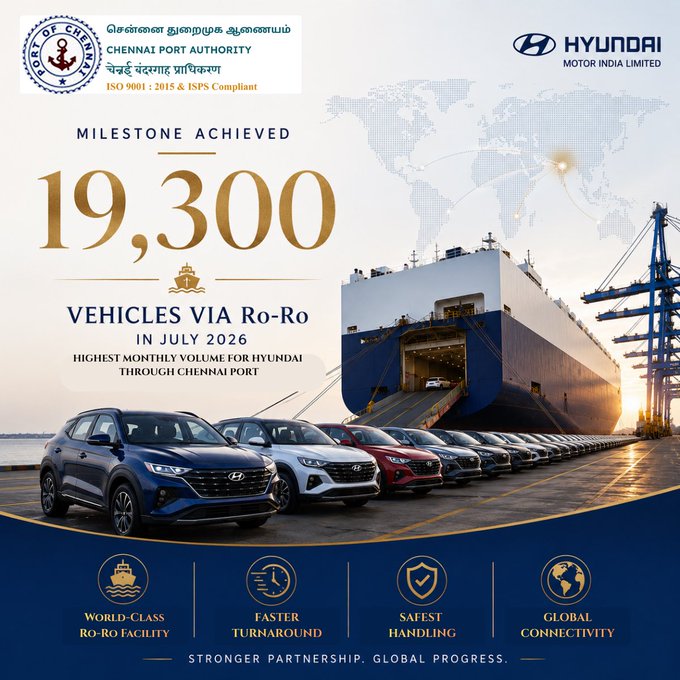
CHENNAI : Chennai Port Authority has achieved a significant milestone in India’s automotive export journey, with 19,300 vehicles handled in a single month, reaffirming the Port’s role as a key maritime gateway connecting India’s world-class automobile manufacturing sector with global markets.

The landmark achievement, accomplished through a seamless Roll-on/Roll-off (Ro-Ro) gateway, highlights the efficiency, reliability and operational capabilities of Chennai Port in supporting high-volume automotive exports.

The milestone is also a testament to the strength of the ecosystem comprising manufacturers, logistics partners, shipping lines, terminal operators and port authorities, working together to facilitate the smooth movement of vehicles from Indian manufacturing facilities to international destinations.

Chennai Port Authority expressed its pride in partnering with Hyundai Motor India Limited (HMIL) in this journey. The achievement reflects the growing synergy between India’s automotive manufacturing capabilities and future-ready maritime infrastructure, enabling Indian-made vehicles to reach markets across the world efficiently and reliably.

Handling 19,300 vehicles in a month represents not only a strong operational performance but also the growing importance of Chennai Port in supporting India’s automotive export ambitions. The Port’s Ro-Ro capabilities provide an efficient gateway for finished vehicles, helping streamline cargo movement and strengthen supply-chain connectivity.

The milestone further reinforces Chennai’s position as an important automotive and logistics hub, supporting the Government of India’s vision of strengthening manufacturing, exports and multimodal logistics infrastructure.

Chennai Port Authority congratulates Hyundai Motor India Limited on this landmark achievement and looks forward to further strengthening the partnership to advance India’s automotive ambitions — further, faster and farther.