Home Blog Page 16

India to have one of the ‘best’ trade deals with the US: Piyush Goyal

NEW DELHI : Commerce and Industry Minister Shri Piyush Goyal on Thursday said India will have one of the “best” trade deals with the US in every respect. He said that India has negotiated a very good set of outcomes with the US in the pact.

“And in every respect, India will have one of the best deals with the US,” he told reporters here. India and the US in February finalised a framework for the first phase of the bilateral trade agreement. However, changes in the tariff landscape in the US have led to further negotiations.

“Nations that make the same products and are at a similar level of development, like India. We will have the most preferred market access in the US post the deal in products of our interest,” Goyal said.

When asked about a timeline for the pact, he said the agreement is under discussion and there are many factors which determine these outcomes.

About the visit of the US officials, he said that it was mainly a discussion with the customs authorities. “The Deputy Chief Negotiator had come for discussions with the customs department on one track,” he said.

On the impact of India’s trade pact on exports, he said: “It’s too early to tell because, as you are aware, the ‘mother of all deals’, the EU agreement is not yet operational. The US will take some time before it comes into effect”.

He also said that Guatemala and Ecuador too have shown keen interest in discussing separate trade pacts with India.

“India today is looked upon as the trusted partner of the world. Otherwise they would not be wanting to do trade agreements with India. They would not be looking to India as a part of their global value chains,” he said.

A two-member team of US officials visited earlier this month for talks on trade and customs facilitation issues. Both sides are in regular touch on the finalisation of the first phase of the bilateral trade agreement (BTA).

India and the US have finalised the framework for the first phase of the agreement in February. However, changes in the tariff landscape have led to further negotiations on the agreement.

India is seeking lower tariffs for its goods in the US market than its competitor nations such as Bangladesh, Vietnam and Cambodia.

These remarks assume significance as US President Donald Trump suffered a crushing defeat in the mid-term elections.

When asked about the impact of the results on the trade pace talks, Goyal said: “We do not link our trade relations with internal elections or results of any kind”.

The US has imposed an additional 10 per cent import duty on various countries, including India, from July 24. These tariffs follow a US investigation into forced labour issues under Section 301 of the US Trade Act of 1974. This duty is over and above the existing MFN (most favoured nation) rates.

When asked about the UK issue on whiskey, he said: “Whenever there is any new agreement, there are some operational issues. Probably this is one of those which is being sorted out”

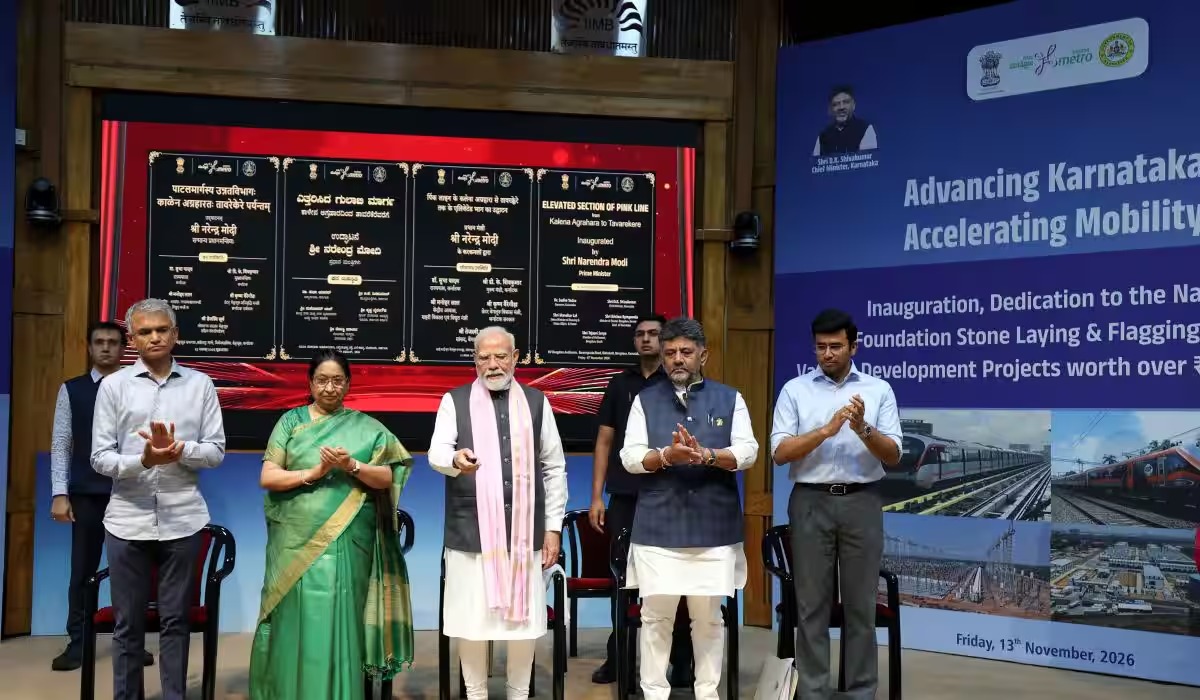
PM Modi inaugurates and lays the foundation stone and flags off various development projects worth over ₹15,600 crore in Bengaluru

BENGALURU : Prime Minister Shri Narendra Modi inaugurated, dedicated to the nation, laid the foundation stone, and flagged off various development projects worth over ₹15,600 crore in Bengaluru, Karnataka. Addressing the gathering on the occasion, the Prime Minister extended his greetings in Kannada and bowed in reverence to the city’s presiding deity Goddess Annamma Tai and Nadaprabhu Kempegowda, noting that today marks a day to give new momentum to the development journey of Bengaluru and Karnataka through projects spanning connectivity and energy security. “From projects connected with metro and rail to works of energy security, all these projects are going to give new strength to the infrastructure of Karnataka,” asserted Shri Modi.

Emphasizing that infrastructure and improved connectivity generate new avenues for progress, employment, and industry that reach every section of society and strengthen the fight against poverty, as reflected in nearly 50 crore citizens escaping extreme poverty in recent years, the Prime Minister extended his best wishes to the people of Karnataka for the newly launched projects. “They will give new momentum to the building of a Viksit Bharat through a Viksit Karnataka, and at the same time further strengthen the identity of Bengaluru as a Tech City,” affirmed PM Modi.

Highlighting the dedication of the Bengaluru Metro’s new Pink Line a short while earlier, the Prime Minister noted that the corridor will significantly improve connectivity to IIM Bengaluru, numerous educational institutions, and major business, technology, and commercial hubs across the city. “Lakhs of people of Bengaluru will not only have convenience in commuting, rather they will also be able to save their money and time,” observed Shri Modi.

Recalling that yesterday marked the Punya Tithi of the late Ananth Kumar, who shared a deep bond with the region, the Prime Minister paid heartfelt tributes to the departed leader. “Seeing this metro line today, his soul too must have been delighted,” remarked PM Modi.

Describing Bengaluru as the Silicon Valley of India that contributes over one-third of the nation’s IT exports and serves as a major engine of innovation and economic growth, the Prime Minister stated that the Central Government has prioritized the rapid development of the Bengaluru region and expanded Namma Metro from just 17 kilometers in 2014 to over 100 kilometers today, making Bengaluru the third Indian city after Delhi-NCR and the Mumbai Metropolitan Region to cross the 100-kilometer metro milestone. “This success of Namma Metro is the result of the country’s new thinking regarding Ease of Living and Ease of Travel, and the outcome of the country’s commitment to make the lives of middle-class families better,” asserted Shri Modi.

Stating that Indian Railways is shedding its colonial-era mindset to build a new legacy where stations, engines, and coaches bear India’s distinct identity through Vande Bharat trains and Amrit Bharat stations, including over 60 stations in Karnataka alongside Chamarajanagar, Chikkamagaluru, Sakleshpur, and Subrahmanya Road, the Prime Minister highlighted how these stations blend modernity with sensitivity by offering special amenities for senior citizens and Divyangjans. “The facilities that were earlier found in airports, efforts are now being made to provide those very facilities at railway stations to poor and middle-class families,” noted PM Modi.

Pointing out that India’s railway budget has grown manifold over the past 10 to 12 years with a ninefold increase in Karnataka’s allocation, the Prime Minister noted that the state received four Amrit stations and two doubling and electrification projects today, alongside a new Vande Bharat train connecting Karnataka with Goa just days after receiving its first Vande Bharat Sleeper train. “Through this train, companions along the entire coastal route of Karnataka, including Mangaluru, will get a new experience of a semi-high-speed train,” observed Shri Modi.

Underscoring that the ongoing war around Iran and the Gulf region has demonstrated the vital importance of energy security, the Prime Minister explained that India weathered this challenging period firmly due to steps taken over the past decade, expanding petrol, diesel, and LPG production, crude oil storage, solar, hydro, and wind energy, near-total rail electrification, and metro networks, and detailed three new Karnataka projects: the Mangaluru LPG Project adding 80,000 metric tonnes of storage capacity, the Devangonthi Marketing Terminal streamlining petrol, diesel, and aviation fuel supply, and the Bengaluru CBG plant producing 13 tonnes of biogas daily. “This will improve waste management and money spent on the import of natural gas will also be saved,” noted PM Modi.

Highlighting that reliable electricity generation is essential as India strives for global leadership across new technologies from chips to ships and from AI and data centers to quantum computing, the Prime Minister noted that the nation is expanding its nuclear power plants to achieve clean energy goals. “Today India’s renewable energy capacity has exceeded 300 gigawatts,” observed Shri Modi.

Pointing out that Central schemes are transforming Indian citizens from electricity consumers into electricity producers, the Prime Minister noted that over 60 lakh households nationwide, including more than 40,000 families in Karnataka, have installed rooftop solar plants with Central assistance of around 80,000 rupees per family under the PM Surya Ghar Muft Bijli Yojana, while irrigation through over 8 lakh solar pumps is being arranged for Karnataka’s farmers under the PM KUSUM Yojana to cut power costs and generate new income and jobs. “Meaning, the Annadatas of Karnataka are now also becoming Urjadatas,” remarked PM Modi.

Observing that purposeful national execution, public participation, and proper utilization of taxpayer money under the post-2014 resolve of Sabka Saath, Sabka Vikas have expanded the middle class and created a new Aspirational Class seeking home appliances, two-wheelers, quality education, nutrition, healthcare, and tourism experiences, the Prime Minister pointed out that these rising aspirations are driving new industrial and job growth across automobiles, electronics, tourism, and services, making the Neo Middle Class a major engine of India’s economic growth. “The interest of this Neo Middle Class, which is present in large numbers in Karnataka and in Bengaluru as well, is among the priorities of the Central Government,” affirmed Shri Modi.

Stating that the Central Government is working continuously to boost middle-class savings and put more disposable income in their hands, the Prime Minister highlighted measures such as exempting annual income up to 12 lakh rupees from income tax, revising TDS rules to benefit senior citizens and rental earners, and lowering the cost of everyday goods through next-generation GST reforms. “By abolishing GST on personal health and life insurance, we made insurance more affordable,” noted PM Modi.

Concluding his address by stating that today’s projects in Karnataka will further accelerate the nation’s developmental trajectory and extending his best wishes to the people, the Prime Minister emphasized the government’s commitment to empowering middle-class families. “Our effort is that the savings of the middle class increase, their purchasing power becomes strong, and along with fulfilling the dreams of their family, they also become partners in the economic progress of the country,” affirmed Shri Modi.

A major boost to Karnataka’s growth! Projects worth over ₹15,000 crore are being launched today to strengthen connectivity and energy security. https://t.co/jfMwD06wCK

Konkan Railway Merger to proceed only with consent of four states: Ashwini Vaishnaw

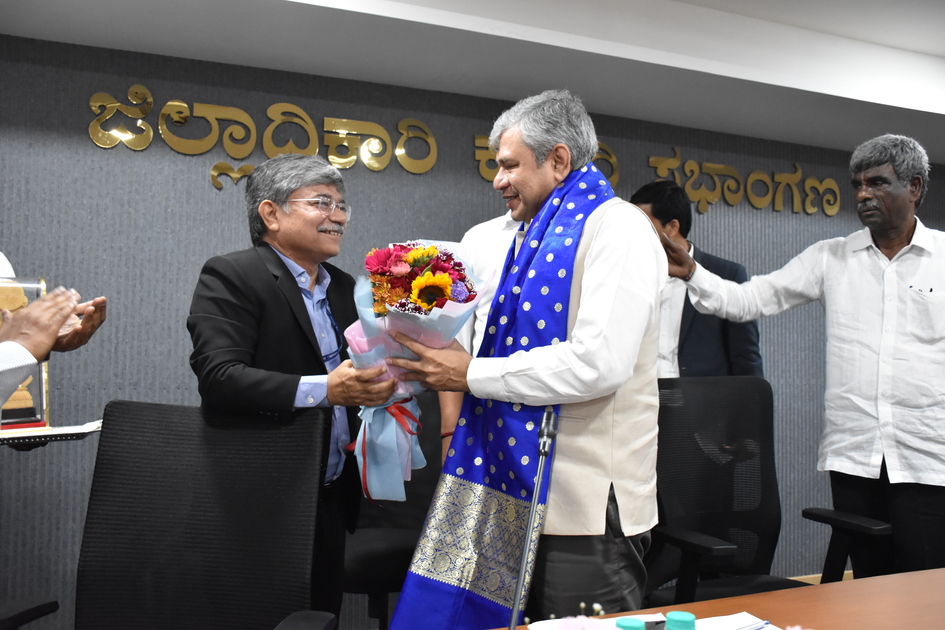
MANGALURU: Union Railway Minister Shri Ashwini Vaishnaw has said that efforts are underway to merge the Konkan Railway with Indian Railways, but the timeline for the proposed merger remains uncertain as it requires the approval of the chief ministers of Maharashtra, Goa, Karnataka and Kerala.

Speaking to reporters at Mangaluru International Airport on Thursday night, Vaishnaw said the Union government and the four state governments are stakeholders in the Konkan Railway. He added that he had requested the chief ministers of all four states to approve the merger proposal.

On the proposed doubling of the railway line between Mangaluru and Bengaluru, the minister said administrative approval had been granted for a survey and preparation of a Detailed Project Report (DPR). The process is currently underway.

Acknowledging the engineering challenges involved in doubling the track through the Western Ghats, Vaishnaw said the project had been redesigned after taking into account the difficulties encountered during the construction of the existing line.

In particular, lessons from the steep gradients along the present route are being incorporated into the new plan to ensure a reduced slope on the second track and avoid operational difficulties.

Referring to the new Vande Bharat service connecting the coastal region with the state capital, Vaishnaw said the project involved overcoming several geographical and technical challenges, including structural modifications along the steep Ghat sections, adjustments to track electrification and customised train configurations.

Responding to Karnataka Large and Medium Industries Minister M B Patil’s allegations that the state had been treated unfairly in the allocation of railway projects, Vaishnaw dismissed the claims as baseless.

He said Karnataka had received unprecedented investment and support under Prime Minister Shri Narendra Modi’s leadership. He cited railway projects worth around Rs 27,000 crore currently underway in the state, along with sanctioned bullet train projects, multiple Vande Bharat and Vande Bharat Sleeper services, and extensive railway station redevelopment works.

Chairman, NMPA & DPA inaugurates two key infrastructure projects at New Mangalore Port

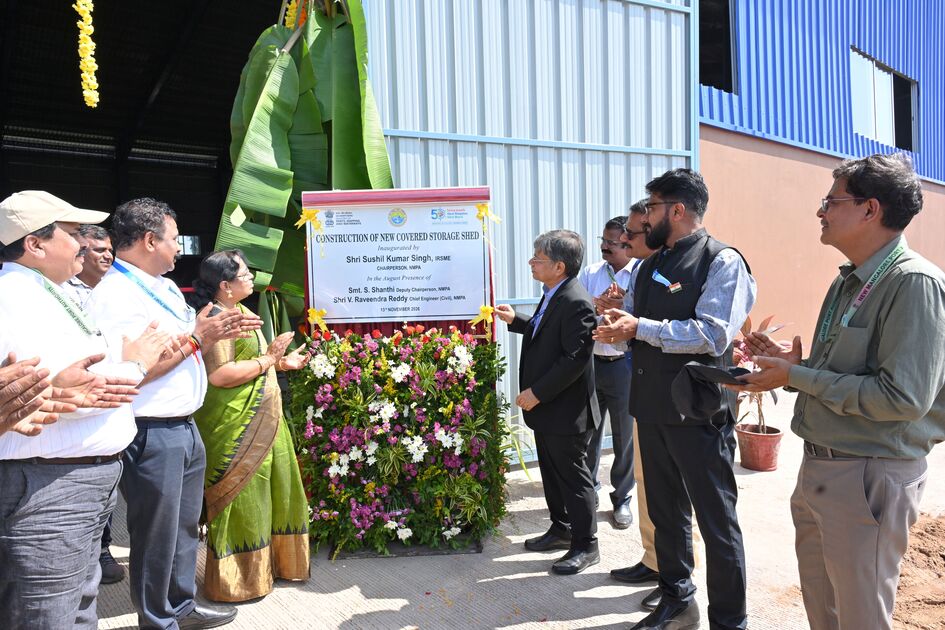
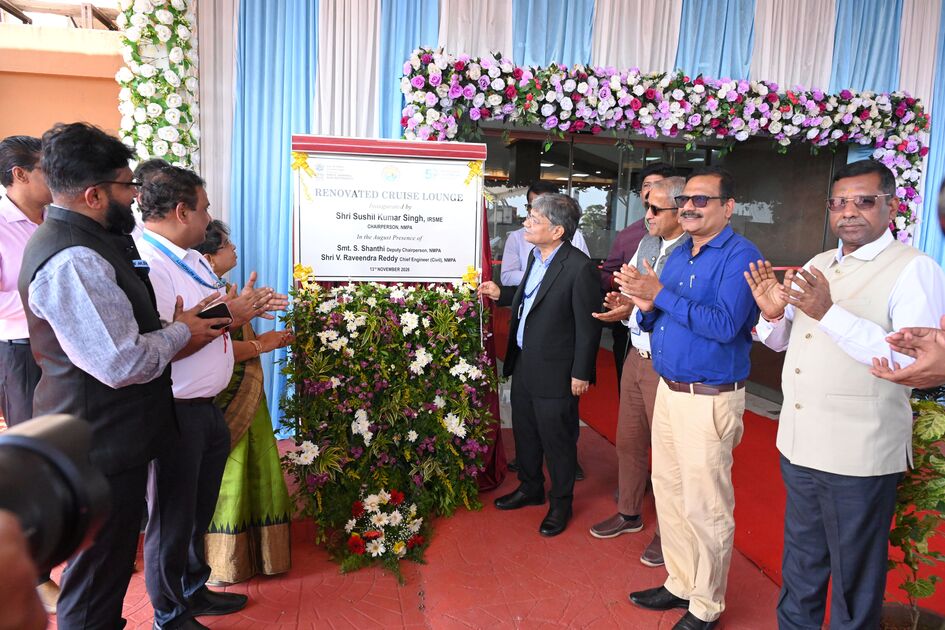
MANGALURU: Shri Sushil Kumar Singh, IRSME, Chairman, New Mangalore Port Authority (NMPA) and Deendayal Port Authority (DPA), inaugurated two important infrastructure projects at New Mangalore Port, aimed at strengthening cargo-handling infrastructure and enhancing facilities for cruise passengers.

The first project, a New Covered Storage Shed inside the Wharf, was built at a cost of ₹8.65 crore. The work commenced on 2 June 2026 and was completed on 28 October 2026. The covered shed, measuring 120 metres x 40 metres, has been developed to provide additional covered storage capacity for export-import (EXIM) cargo such as fertilisers, sugar, maize, food grains and cattle feed.

The new facility will provide much-needed protection and storage space for cargo, improve cargo-handling efficiency and support the growing requirements of trade. The creation of such infrastructure is also expected to facilitate growth in existing cargo volumes and encourage the handling of new cargo at the Port. The project represents a long-term investment in strengthening the Port’s cargo infrastructure in response to market requirements.

The second project inaugurated was the newly renovated NMPA International Cruise Lounge, with a cost of ₹83.26 lakh. The work commenced on 20 July 2026 and was completed on 29 October 2026.

The Cruise Lounge, originally developed around 18 years ago, has been comprehensively renovated to provide a modern and comfortable environment for international cruise passengers and foreign tourists visiting the Port. The renovation covers an area of 2,582 sqm, along with an extension of 432 sqm. The works include new vitrified tile flooring, Aluminium Composite Panel (ACP) cladding and a new false ceiling, significantly improving the aesthetics, functionality and passenger amenities of the facility.

These two projects reflect NMPA’s continued commitment to modernising port infrastructure, facilitating EXIM trade and providing improved facilities for maritime stakeholders and cruise passengers.

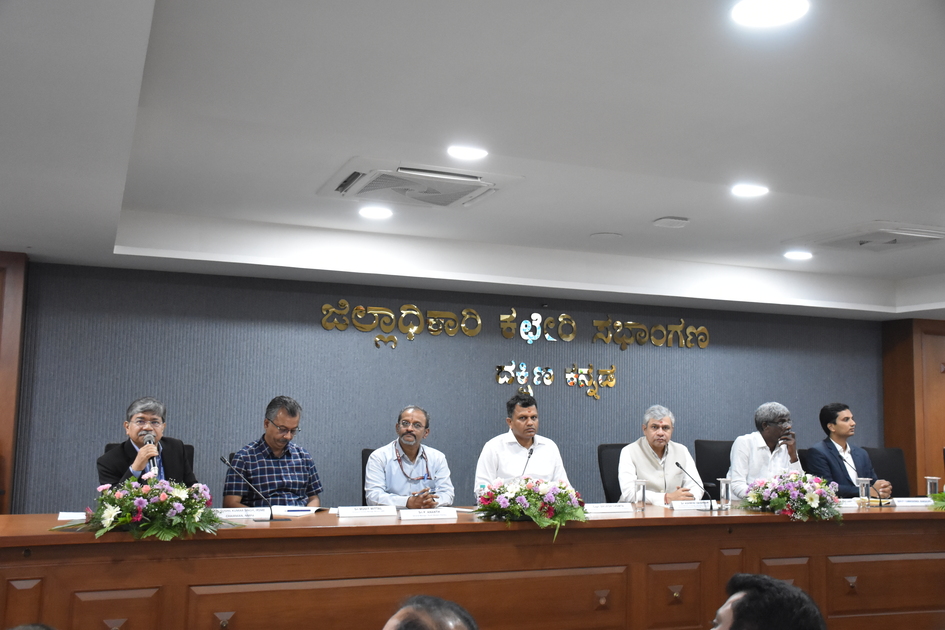
Shri Sushil Kumar Singh, Chairperson, New Mangalore Port Authority (NMPA) and Deendayal Port Authority (DPA), also attended a review meeting on railway connectivity chaired by Shri Ashwini Vaishnaw, Hon’ble Union Minister of Railways, at the Deputy Commissioner’s Office, Mangaluru, during his visit to the city. During the deliberations, the Chairman highlighted the need to strengthen railway connectivity in the Mangaluru region, including the doubling of the Mangaluru–Bengaluru railway line and enhancement of rail links to the hinterland, to facilitate seamless cargo movement and strengthen the region’s logistics network. Capt. Brijesh Chowta, Hon’ble Member of Parliament, Dakshina Kannada; Shri Kota Srinivas Poojary, Hon’ble Member of Parliament, Udupi and Chikkamagaluru; Shri Darshan H. V., IAS, Deputy Commissioner, Dakshina Kannada District; and Shri P. Ananth, General Manager, South Western Railway, were also present at the meeting.

VOC Port Authority concludes Vigilance Awareness Week 2026 with valedictory event

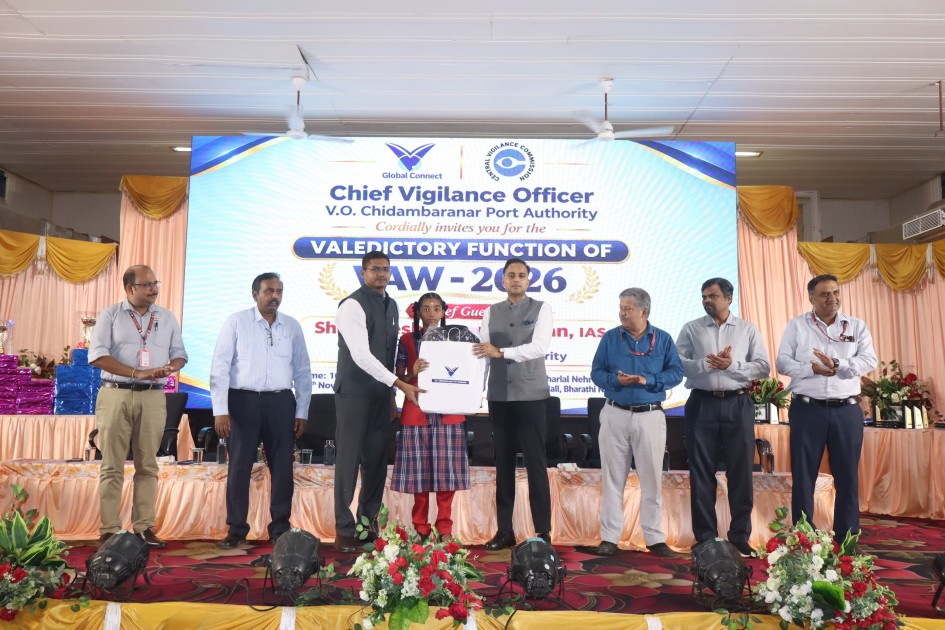
TUTICORIN : The Valedictory Event of Vigilance Awareness Week 2026 on 13.11.2026, was held at the Port on the theme ‘Probity for Prosperity’, highlighting the importance of integrity, transparency and accountability in public service. Shri Rajesh Soundararajan, IAS, Deputy Chairperson, V.O. Chidambaranar Port Authority, graced the occasion as the Chief Guest. The event brought together officers, employees, stakeholders and students to reaffirm their collective commitment to ethical practices and the prevention of corruption.

In his address, the Chief Guest, Shri Rajesh Soundararajan, IAS, Deputy Chairperson, V.O. Chidambaranar Port Authority, highlighted the importance of transparency, fairness and accountability in the functioning of the Port. He emphasised that vigilance is a collective responsibility and underscored the need to strengthen institutional systems, ensure adherence to rules, avoid conflicts of interest and ensure fair treatment of stakeholders. He also stressed the importance of maintaining the quality and timely execution of work while upholding ethical standards.

Shri P. Kavin Maharaj, IOFS, Chief Vigilance Officer, delivered the welcome address and briefed the gathering on the various activities organised by the Port during Vigilance Awareness Week 2026 under the theme “Probity for Prosperity”. He emphasised that the values of honesty and integrity should be upheld not just during the observance but as a continuous commitment in the everyday conduct of every individual.

During the vigilance campaign, which commenced on 17.08.2026, various activities, including rally, street play, essay and slogan writing, debate, singing, digital presentation, skit, dance and rangoli competitions, were organised for Port employees, school children and college students. Training sessions on vigilance functions, GeM, public procurement, and Conduct Rules and Conflict of Interest were also conducted for the officers and staff of the Port. A walkathon, signature campaign and Integrity Pledge were also organised as part of the awareness initiatives, with the participation of officers, employees, contract staff, port users and school students.

The valedictory function included the distribution of prizes to the winners of various competitions conducted during the campaign, recognising their participation and efforts. The cultural programme showcased vibrant performances by students from various schools and colleges, as well as VOC Port employees. Through music, dance and other cultural presentations, the participants conveyed messages of integrity, honesty and ethical conduct, bringing the theme of “Probity for Prosperity” to life. The performances added colour to the occasion and reinforced the importance of upholding ethical values in everyday life.

Shri R. Padmanabhan, Deputy Chief Vigilance Officer, delivered the Vote of Thanks. The valedictory event was attended by Heads of Departments, senior officials, officers and employees of the Port, along with students and teachers from various schools and colleges.

Parekh Marine Services sets New Benchmark with 6,650 Cars Loaded on Single Vessel at Mundra Port

MV Morning Pilot carries 6,650 vehicles, surpassing the previous benchmark of 6,548 cars

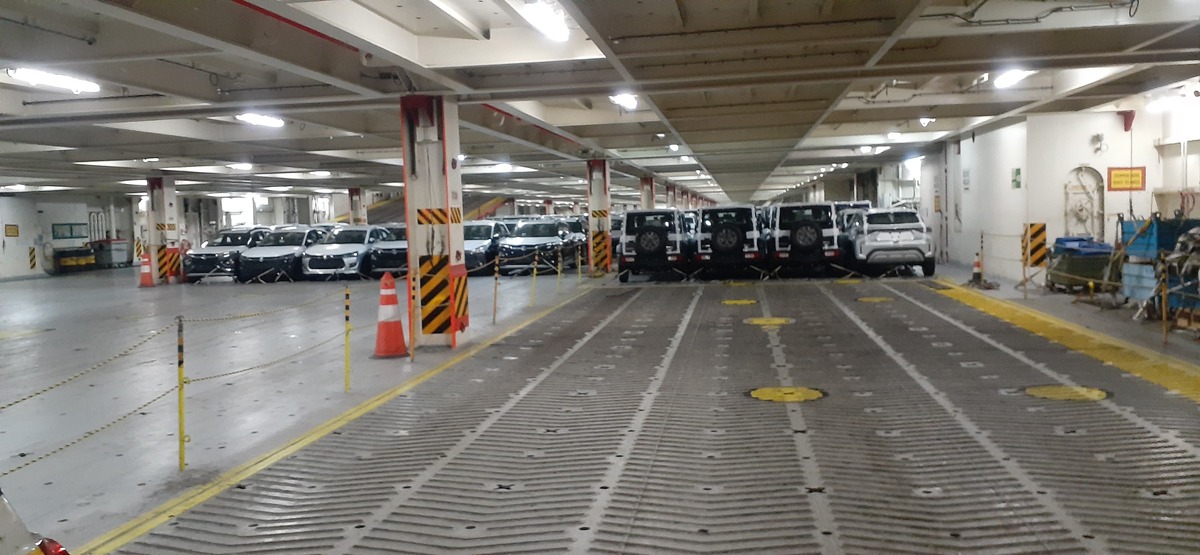
MUMBAI/MUNDRA:  Parekh Marine Services Pvt. Ltd., the shipping agency arm of Parekh Global, has supported a new national benchmark for automobile loading at an Indian port, with 6,650 cars loaded onto a single vessel at Mundra Port.

The vehicles were loaded onto MV Morning Pilot, operated by EUKOR Car Carriers Inc., with Parekh Marine Services acting as the vessel’s shipping agent in India.

The latest loading surpasses the previous benchmark of 6,548 cars, set at Mundra in May 2026. It also extended a series of record-scale automobile loadings at the port this year, following 5,701 cars in January, 6,008 in April and 6,548 in May.

The scale of the latest operation highlights the coordination required between the shipping line, vessel agency, terminal and vehicle manufacturer to execute a high-volume RoRo loading operation within a single sailing. Mundra has emerged as one of India’s key gateways for automobile exports, with its dedicated Roll-on/Roll-off (RoRo) facilities supporting vehicle shipments to international markets.

“This benchmark is a reflection of the scale that India’s automobile export ecosystem is now capable of supporting. Loading 6,650 vehicles on a single sailing requires close coordination across the shipping line, port, terminal, manufacturer and agency teams. The successive high-volume loadings at Mundra also point to the growing importance of efficient RoRo infrastructure and dependable maritime connectivity as Indian vehicle exports expand across global markets,” said Yogesh Parekh, Director, Parekh Global.

For the shipping agency, the operation involved coordination across multiple stakeholders, with vessel planning, documentation, terminal coordination and operational communication forming key components of the loading process.

“An operation of this scale leaves very little room for operational delays or coordination gaps. From vessel planning and documentation to coordination with the terminal and other stakeholders, every part of the operation has to move in sync. Successfully handling 6,650 vehicles on a single vessel is a strong validation of the operational capabilities of the teams involved and the efficiency of Mundra as an automobile export gateway,” said Yash Parekh, Director, Parekh Global.

The latest milestone comes against the backdrop of India’s expanding automobile export activity, with domestic manufacturers increasingly serving overseas markets through dedicated maritime vehicle carriers. The ability to consolidate thousands of vehicles on a single sailing also underlines the importance of port infrastructure, RoRo capacity and coordinated shipping operations in supporting India’s growing automotive trade.

Merchandise trade deficit hits highest-$39.88 billion in October, as imports surge

NEW DELHI: India’s merchandise trade deficit widened to a one-year high of $39.88 billion in October, significantly exceeding economists’ expectations, as a sharp increase in imports outpaced export growth, according to government data released on Friday.

The trade deficit, which measures the gap between merchandise exports and imports, stood at $30.21 billion in September. Economists polled by Reuters had expected the October deficit to come in at $32.25 billion.

India’s merchandise exports rose to $49.47 billion in October, compared with $44.40 billion in September. Trade Secretary Shri Rajesh Agrawal said the country had recorded its highest-ever monthly goods exports in October 2026.

However, the increase in exports was overshadowed by a sharper rise in imports. Merchandise imports climbed to $89.35 billion during the month, up from $74.61 billion in September.

Kirloskar Ferrous plant gets GreenLine electric trucks

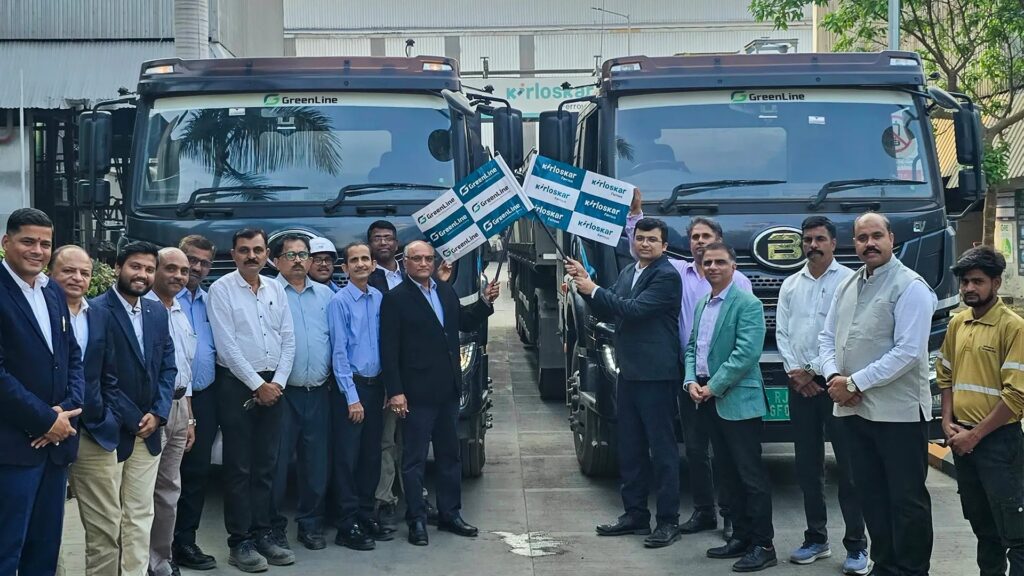
MUMBAI: GreenLine Mobility Solutions, the Essar Group logistics venture, has put electric trucks into service for Kirloskar Ferrous Industries, with trucks flagged off at its plant in Taloja, Navi Mumbai. The deployment shifts goods movements at the Maharashtra site onto battery power and widens the operator’s e-truck business into another industrial setting.

Neither side disclosed truck numbers, routes or contract terms. GreenLine runs more than 1,200 heavy trucks powered by liquefied natural gas (LNG) or batteries along major Indian freight corridors, serving steel, cement, mining, consumer goods and chemicals customers.

That fleet has logged over 100 million km, and the operator credits it with saving customers more than 30,000 tonnes of CO₂. Kirloskar Ferrous adds another named industrial client as GreenLine builds its electric fleet alongside gas.

In a statement, Madhur Taneja, Chief Executive of GreenLine Mobility Solutions, said: “At GreenLine, we are focused on advancing lower-emission freight transportation through solutions suited to different logistics requirements. LNG continues to play an important role in our approach to decarbonising long-haul transportation, while electric trucks offer opportunities in applications suited to electric mobility. Our partnership with Kirloskar Ferrous marks a further step in expanding our electric truck deployments and working with businesses to integrate cleaner transportation solutions into their supply chains.”

Singapore Retains Position as World’s Leading Maritime City in 2026

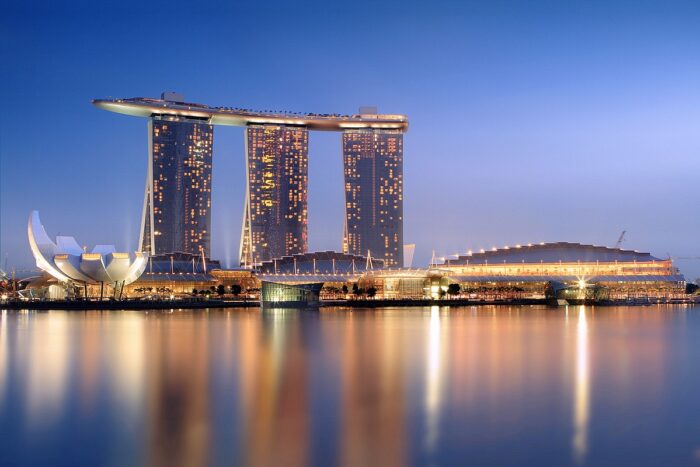
SINGAPORE: Singapore has retained its position as the world’s leading maritime city in the 2026 according to Leading Maritime Cities (LMC) report by DNV and Menon Economics for the seventh consecutive edition. Singapore also maintained its leading position in three of the five pillars[1] assessed in the report — Shipping, Ports and Logistics, and Attractiveness and Competitiveness.

The LMC report benchmarks leading maritime cities based on objective indicators, including shipping activity, port performance and maritime business services, as well as assessments by maritime industry experts worldwide.

Home to over 200 international shipping groups and a wide range of maritime service providers, Singapore’s continued recognition as a leading maritime city reflects the strength of its maritime ecosystem, which brings together global connectivity, port and logistics capabilities, maritime services, talent and innovation. These complementary strengths provide maritime companies with access to markets, business opportunities and specialised expertise, making Singapore an attractive location for companies to establish their presence and grow their businesses.

This ecosystem is supported by Singapore’s position as one of the world’s busiest ports, connected to more than 600 ports worldwide. In 2025, the Port of Singapore handled a record 44.66 million twenty-foot equivalent units (TEUs) in container throughput and 3.22 billion gross tonnage in vessel arrival. Singapore also remained the world’s largest bunkering port, with marine fuel sales reaching a record 56.77 million tonnes. Continued investments in port automation, maritime digitalisation, innovation and the adoption of alternative marine fuels further strengthen the ecosystem and create new opportunities for maritime businesses.

Mr Ang Wee Keong, Chief Executive of the Maritime and Port Authority of Singapore (MPA), said, “Singapore’s strength as a maritime city lies in how our port, connectivity, maritime services, and talent come together to support businesses. Companies choose Singapore not only for these capabilities, but also for the opportunities to connect with partners, develop new solutions, and grow their businesses. This recognition reflects the collective efforts of our government agencies, unions, and industry partners, who have worked closely with MPA over the years to build and strengthen this vibrant ecosystem.”

For more information on the 2026 Leading Maritime Cities report, please visit
https://menon.no/en/projects/the-leading-maritime-cities-of-the-world-2026.

[1] The five pillars are Shipping, Maritime Finance and Law, Maritime Technology, Ports and Logistics, and Attractiveness and Competitiveness.

IMO Chief calls for enforcement of maritime rules in Strait of Hormuz after 25 seafarers die in 133 incidents

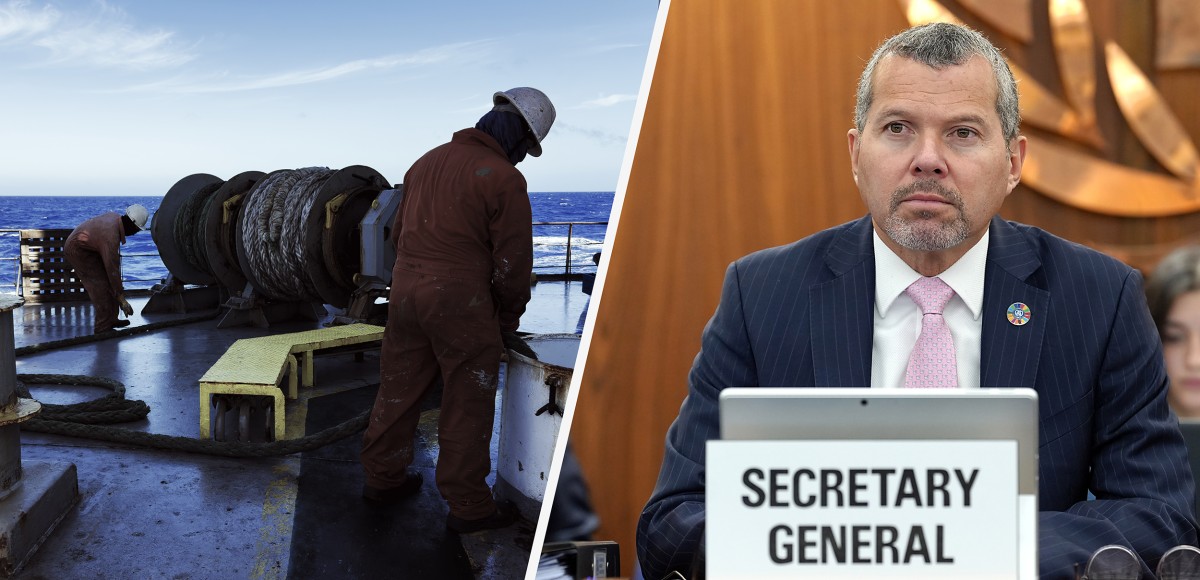
LONDON: The Secretary-General of the International Maritime Organization (IMO) Mr. Arsenio Dominguez has called for stronger action from IMO Member States to enforce maritime safety and security regulations in and around the Strait of Hormuz.

Amid continued attacks against commercial ships in the area, Secretary-General Dominguez stated:

“IMO’s technical and operational regulations are there to protect seafarers, ships and the marine environment. They must be respected and enforced effectively.

There are too many cases of ships transiting the Strait without complying with fundamental provisions of treaties such as the International Convention on the Safety of Life at Sea (SOLAS).”

He expressed concerns about reports of substandard vessels, vessels covering their IMO number, ongoing transits of ships that are fraudulently registered or under false flags, and other unsafe practices.

“I call on all flag States, port States and relevant coastal States to exercise their responsibilities under IMO conventions and take measures to address violations, within their respective jurisdictions, and in accordance with international law.

I strongly urge shipowners and operators to refrain from commercial activities in the Strait that expose seafarers to unacceptable risks.

It is imperative for Governments to tackle the root causes of this conflict, which has also increased the cost of living for millions of people worldwide,” he stated.

Following the recent decisions of the IMO Council, Secretary-General Dominguez urged Member States to pursue political solutions to restore a single, safe and internationally recognized framework for navigation through the Strait of Hormuz that preserves the rights and freedoms of navigation.