MUMBAI : The Centre has approved key appointments under the Central Staffing Scheme, with Telangana-cadre IAS officer Prashant Jeevan Patil and IRAS officer Ishaan Sharma posted to central ministries, according to two separate orders issued by the Department of Personnel & Training on Friday.
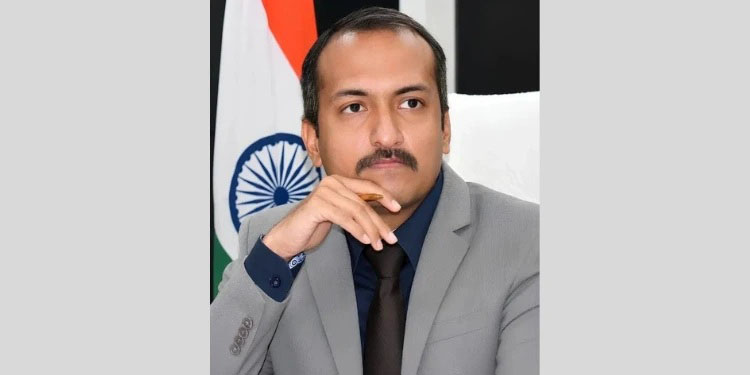
In an order, the DoPT said the Competent Authority has approved the appointment of Patil as Deputy Director General at Director level in the Directorate General of Shipping, Mumbai, under the Ministry of Ports, Shipping and Waterways.
Patil has been appointed for a period of five years “from the date of taking over charge of the post or until further orders, whichever is earlier.”
The Telangana government has been asked to relieve him of his duties immediately, with instructions to take up his new assignment in Mumbai.
In a separate office memorandum, the DoPT said Ishaan Sharma, who was recommended for central deputation by the Ministry of Railways, has been selected for appointment as Deputy Secretary in the Ministry of Home Affairs, Delhi.
Sharma’s tenure will be for four years “from the date of taking over charge of the post or until further orders, whichever event takes place earlier.” The Railway Board has been directed to relieve him immediately for his new posting in Delhi.
The DoPT has requested the Ministry of Ports, Shipping and Waterways and the Ministry of Home Affairs to forward a copy of the notification of appointment for Patil and Sharma, respectively, as and when issued.
Patil is currently serving in the Telangana government, while Sharma is with the Ministry of Railways.
MUMBAI : Mumbai Port Authority (MbPA) has decided to take stringent action against chronic lease rental defaulters and unauthorised occupants on public land under its jurisdiction along Mumbai’s Eastern Waterfront. The Authority will strengthen its legal strategy to recover outstanding dues and initiate criminal proceedings against unauthorised occupants where necessary.
The move comes as MbPA works to develop major port-centric infrastructure in line with the Government of India’s Maritime Amrit Kaal Vision 2047 and Maritime India Vision. Planned projects include the Viksit Bharat Mumbai Marina, maritime tourism facilities, cruise infrastructure, water transport networks and other key developments aimed at strengthening Mumbai’s position in the global maritime ecosystem.
MbPA has stated that several lessees and tenants have accumulated substantial lease rental arrears, affecting the Authority’s ability to invest its resources in important public infrastructure projects. The Authority has therefore engaged senior legal experts and leading law firms to pursue recovery of outstanding dues.
According to MbPA, some tenants have also been involved in violations such as unauthorised construction, illegal subletting, unapproved transfers and unauthorised changes in land use. Such violations pose concerns for port security, public safety and lawful commercial activity.
To ensure public accountability, MbPA has identified major lease rental defaulters whose estimated combined liabilities are around ₹3,500 crore. These include Indian Hotels Company Ltd., Crescent Dyes & Chemicals Ltd., Timber Market Occupants Society, Provident Investment Co. Ltd., Indian Vegetable Product Ltd., Scindia Steam Navigation Co. Ltd. and Subh Hospitality Ltd., among others.
While respecting legitimate legal rights, MbPA has urged all defaulting tenants to clear their outstanding dues and comply with applicable regulations. The Authority reiterated its commitment to safeguarding public resources and advancing the redevelopment of Mumbai’s Eastern Waterfront for the benefit of the city and the country.
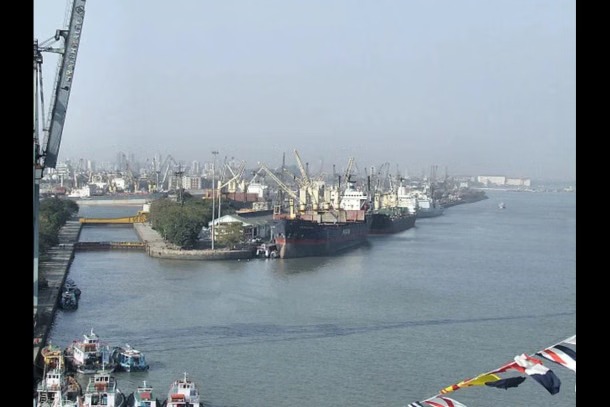
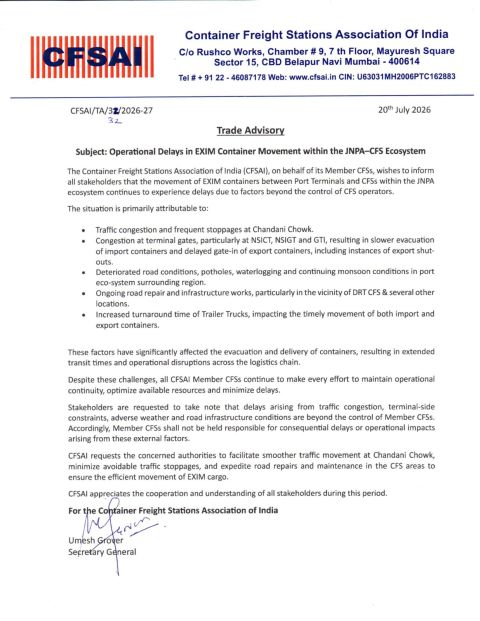
NAVI MUMBAI: The Container Freight Stations Association of India (CFSAI) has issued a Trade Advisory highlighting significant operational delays affecting the movement of EXIM containers between port terminals and Container Freight Stations (CFSs) within the Jawaharlal Nehru Port Authority (JNPA) ecosystem. The Association has clarified that the disruptions are primarily the result of external infrastructure and traffic-related issues that are beyond the control of CFS operators.
In its advisory issued on 20 July 2026, CFSAI informed stakeholders that container evacuation and delivery operations across the JNPA-CFS network continue to face severe challenges due to multiple factors impacting road connectivity and cargo movement.
According to the Association, the key reasons behind the operational delays include:
Heavy traffic congestion and frequent stoppages at Chandani Chowk, disrupting the smooth movement of container trailers.
Congestion at major port terminal gates, particularly NSICT, NSIGT and GTI, resulting in slower evacuation of import containers and delayed gate-in of export containers, including instances of export shut-outs.
Poor road conditions, potholes, waterlogging and the continuing monsoon affecting road transport across the port region.
Ongoing road repair and infrastructure development works, especially around DRT CFS and surrounding areas.
A higher volume of trailer movements, impacting the timely transportation of both import and export containers.
CFSAI stated that these challenges have significantly impacted the evacuation and delivery of containers, leading to extended transit times and operational disruptions throughout the logistics chain.
Despite these constraints, the Association emphasized that member CFSs are making every effort to maintain operational continuity by optimising available resources and minimising delays wherever possible.
The advisory also stressed that the prevailing disruptions arise from traffic congestion, terminal-side constraints and adverse road infrastructure conditions, all of which are outside the operational control of member CFSs. Accordingly, CFSAI maintained that member CFSs should not be held responsible for delays or operational impacts resulting from these external circumstances.
To improve cargo movement, CFSAI has requested the concerned authorities to facilitate smoother traffic flow at Chandani Chowk, minimise avoidable traffic stoppages and expedite road repairs and maintenance around CFS locations to ensure the efficient movement of EXIM cargo.
The Association concluded by expressing appreciation for the cooperation and understanding of all stakeholders during this challenging period and reiterated its commitment to working closely with the trade and authorities to restore normal operational efficiency as early as possible.
ODESSA: Four Indian seafarers were among 10 people killed in an attack on a Guinea-Bissau-flagged merchant vessel off the coast of Ukraine, prompting strong condemnation from India and fresh demands to protect commercial shipping during conflicts.
Ukrainian Foreign Minister Andrii Sybiha said Russia attacked a civilian vessel navigating Ukraine’s maritime corridor on Sunday and its crew included citizens of Syria and India.
It is first instance of the death of Indian seafarers in the Russia-Ukraine conflict.
The Guinea-Bissau-flagged ship was hit by Russian cruise missiles, the Ukrainian Air Force said.
The vessel — MV Golden Leo — had 17 crew members including five Indian nationals, according to the Ministry of External Affairs (MEA).
Names of the 4 Indian sailors who have died after attackonvesselMV Golden Leo leaving Odessaport
Mr. Akhil Joyan
Mr. Gurpreet Singh Bhatt
Mr. Jagan Singh
Mr. Abhishek Nishad
India condemned the attack and reiterated that targeting commercial shipping and endangering innocent civilian crew members is “deplorable and should be avoided”.
“On the evening of July 19, the vessel MV Golden Leo was attacked while departing the port of Odesa. At the time of the incident, there were 17 crew members on board, including five Indian nationals,” theMinistry of External Affairs (MEA)said on Monday.
“As per information available, four Indian nationals have tragically lost their lives, while one is hospitalised in a critical condition,” it said.
The MEA said the Indian mission in Ukraine is closely monitoring the situation and is making every effort to extend all possible assistance to those affected.
“We extend our deepest condolences to the families of the deceased Indian nationals and wish the injured Indian national a speedy and full recovery,” it said in a statement.
Without directly naming Russia, the MEA said: “India condemns such attacks and reiterates that targeting commercial shipping and endangering innocent civilian crew members, or otherwise impeding freedom of navigation and commerce, is deplorable and should be avoided.”
Western media reports said the death toll in the attack has risen to 10.
The incident came amid escalating hostilities between Ukraine and Russia.
Ukrainian Foreign Minister Sybiha came down hard on Russia for the attack.
“A civilian ship. An international crew. A route serving global food security. (Russian President Vladimir) Putin saw another target,” Sybiha said on social media.
“This attack leaves no room for illusions. Putin’s Russia does not care whom it kills. Ukrainians or citizens of any other nation,” he said.
Sybiha said the attack was not an “isolated incident”.
“Just yesterday, Russia attacked another foreign merchant vessel in the Black Sea flying the flag of Antigua and Barbuda, killing one person and injuring three others. Russia is deliberately turning freedom of navigation into a target of war,” he alleged.
The Ukrainian foreign minister said he discussed this issue with the leadership of theInternational Maritime Organization and called for the deployment of an international monitoring mission to Ukraine’s ports.
“We expect this mission to begin its work as planned in the fall and help document every act of Russia’s maritime terror, paving the way for accountability,” he said.
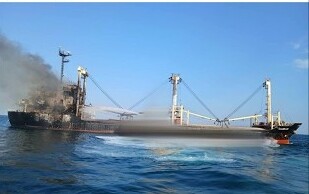
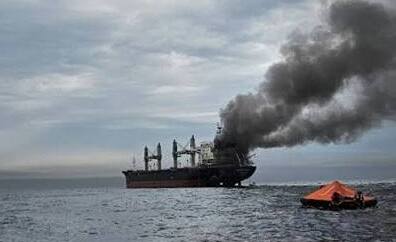
LONDON: A vessel caught fire in the strategic Strait of Hormuzon Monday following a missile strike, prompting an immediate evacuation of the mariners on board.
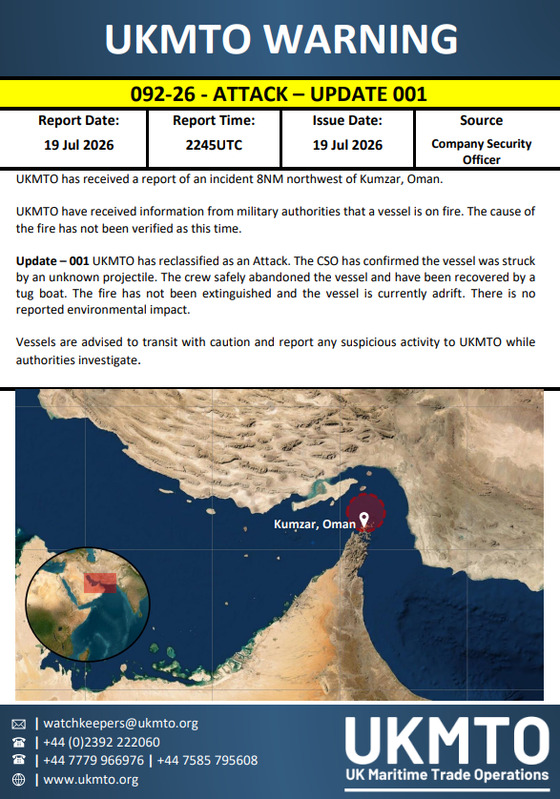
The United Kingdom Maritime Trade Operations (UKMTO) confirmed the incident, stating that “the crew safely abandoned the vessel and have been recovered by a tug boat”.
According to the maritime security watchdog, the assault took place approximately 15 km (8 nautical miles) northwest of Kumzar, Oman.
Assessing the status of the stricken ship, the agency noted that the crisis remains active as the vessel continues to float unmanned.
“The fire has not been extinguished and the vessel is currently adrift,” it said in a statement. “Vessels are advised to transit with caution and report any suspicious activity to UKMTO while authorities investigate.”
The maritime strike directly underscores the severe geopolitical volatility in the region, where the US military has advised vessels to navigate a route close to Oman whilst traversing the Strait of Hormuz.
In retaliation, Iran has launched assaults against these ships, maintaining that it must retain authority over the critical sea lane through which twenty per cent of all globally traded oil and natural gas previously moved during peacetime.
This escalating tanker war is tied to a broader, explosive flashpoint between Washington and Tehran.
Following the announcement of another American trooper’s death, the United States launched a fresh wave of bombardments early on Monday, marking the ninth consecutive night of operations. Meanwhile, Tehran launched missiles towards Jordan, threatening to expand the hostilities into adjacent Israel.
The multi-front escalation indicates that both nations have progressively moved towards full-scale warfare following the collapse of last month’s temporary agreement that was intended to bring a lasting halt to the hostilities.
Consequently, maritime transport through the Strait of Hormuz has virtually ground to a halt, with both factions striking civilian infrastructure used by millions.
The immediate trigger for the sustained American retaliation is the mounting US casualty count. According to the US military, the latest American service member lost their life in Iraq on Saturday amidst the “controlled detonation” of a downed Iranian drone.
This casualty follows an intense weekend of US military operations. Previously, the armed forces stated that their bombardments focused on Iran’s paramilitary Revolutionary Guard in retribution for the killing of personnel in Jordan on Friday.
A service member went missing after that particular assault, and the latest military briefing confirmed that “unidentified remains” were recovered on Sunday and are currently undergoing identification.
The total number of US service members killed since the outbreak of hostilities has now reached 17.
The escalated crossfire, which has entered its second week, has primarily involved US operations hitting electrical installations and bridges across Iran.
Detailing the strategic objective of the continuous aerial campaign, Central Command emphasised its focus on restoring maritime security.
“The strikes will continue degrading Iranian military capabilities used to attack commercial vessels and civilian mariners transiting the Strait of Hormuz,” Central Command announced in an official release.
However, Washington’s offensive has provoked a wide-ranging regional response from Tehran, which has struck American-allied nations across the Middle East.
Consequently, air defence systems were once again engaged by Kuwait, Bahrain, and Jordan to counter arriving Iranian missiles and drones.
Concurrently, Israel cautioned that the projectiles aimed at neighbouring Jordan risked causing the conflict to spill over into Israeli territory for the first time in several weeks.
CAIRO : Yemen’s Iranian-backed Houthi rebels on Monday announced they are imposing a maritime embargo against Saudi Arabia in retaliation for a blockade on Yemen and a recent attack on Sanaa International Airport, threatening another vital waterway for global shipping and raising fears of renewed conflict.
A Houthi military spokesperson, Yahya Saree, said in a video statement that the maritime ban against Saudi Arabia will be effective immediately, describing it as an “equation of ‘an eye for an eye.’”
There were few details on how the embargo might work, but the deputy head of the Houthi media office, Nasruddin Amer, said on X that the Bab al-Mandeb strait will be closed to the Saudis in response to what he called the kingdom’s “unjust blockade on Yemenis for over 10 years.”
Bab el-Mandeb, at the southern tip of the Arabian Peninsula, is the gateway to the Red Sea through which around 12% of the world’s trade usually passes. A fourth of global container trade transits through the 32-kilometer (20-mile)-wide strait to and from the Suez Canal.
The Houthis earlier demonstrated their ability to disrupt shipping there when they targeted ships for months over the Israel-Hamas war in Gaza, with over 100 vessels attacked. It is unclear whether the Houthis will resume that level of attack against neighboring Saudi Arabia.
There was no immediate response from Saudi Arabia. The kingdom already faced pressure as it uses its East-West Pipeline to the Red Sea as an alternative to the Strait of Hormuz, which remains in the grip that Iran imposed shortly after the U.S. and Israel attacked it on Feb. 28
The Saudis have been sending millions of barrels of crude oil a day through the pipeline. Now, about 2.5 million barrels of oil per day could be at risk, Texas-based Rystad Energy wrote Monday.
Saudi Arabia leads a coalition against the Houthis and imposed an air and sea blockade on Yemen in 2015. Yemen’s civil war began in 2014 when the rebels seized the capital, Sanaa, and much of northern Yemen and forced the government into exile. A truce was reached in 2022.
That truce has been threatened in recent days after the Houthis said the Saudis struck the Sanaa airport in an attempt to affect a flight carrying Houthi leaders back from Iran, where they attended the funeral of Supreme Leader Ayatollah Ali Khamenei. The plane landed safely at another airport.
The Houthis then launched missiles and drones at Saudi Arabia’s Abha International Airport in the most significant confrontation in years.
By allowing a direct international flight to land without the approval of the Saudi-led coalition, the Houthis sought to establish a new reality in which they could independently make decisions over Yemen’s airspace, experts told the AP.
“We affirm the right of our great people to respond to the blockade with a blockade,” Saree emphasized on Monday, adding that Houthis are prepared to confront “any foolish act committed by the reckless Saudi enemy … with a comprehensive and decisive escalation.”
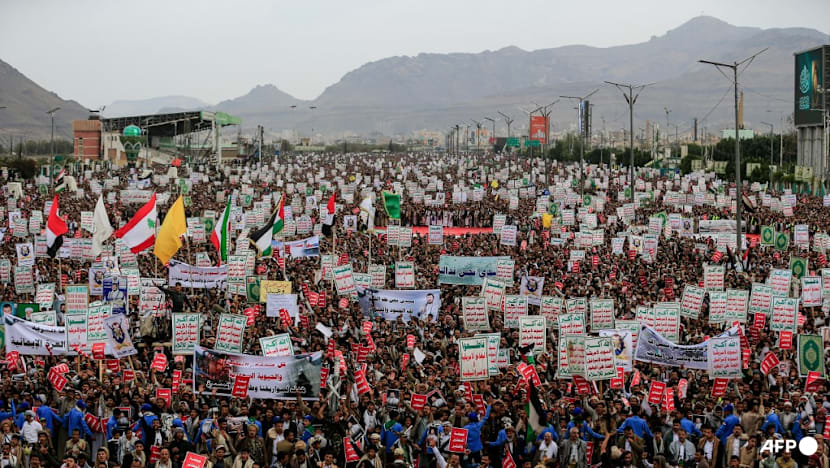
Houthi-run Al Masirah TV broadcast footage of hundreds of supporters gathering in the city of Ibb, south of Sanaa, to back the embargo against Saudi Arabia. Similar rallies were held in the governorates of Saada, Marib, Hajjah and Taiz
The Houthis are a crucial part of Iran’s so-called “Axis of Resistance,” which also includes militant groups in Lebanon, Iraq and the Palestinian territories.
The rebels have had a large stockpile of drones, but several Houthi members previously told the AP that the stockpile is running low after its attacks during the Israel-Hamas war. The Iran war has further impeded the flow of weapons, said the members, who at the time spoke on condition of anonymity because they weren’t authorized to talk to the media.
The U.S. and Israel responded to the Houthis’ earlier attacks on shipping with a punishing air campaign across Houthi-held areas in Yemen until a deal that saw the rebels stop their assaults.
Disrupting transit through the Bab al-Mandeb forces shipping firms to route vessels around the Cape of Good Hope off South Africa, significantly increasing costs. The U.S. government in the past has said going around the cape would add about 2,700 miles (4,345 kilometers) to the journey from Saudi Arabia to the U.S.
WASHINGTON DC: US President Donald Trump on Tuesday (local time) held a conversation with UK’s new Prime Minister Andy Burnham. The discussions ranged from bilateral ties to key global developments such as the demining of the Strait of Hormuz.
The details of the conversation were shared by President Trump in a post on Truth Social.
Terming it a “good conversation”, he said that the two leaders will also meet soon to discuss topics of mutual interest.
Trump wrote, “I had a very good conversation with the new Prime Minister of the United Kingdom, Andy Burnham. We discussed many subjects, including the outstanding relationship we have had with the UK. We will be meeting in the not too distant future for topics of mutual interest. The Prime Minister has got a big job ahead of him, but he will be able to do it and, of course, the U.S.A. will be there to help!”
Describing the areas of discussion, Trump said that the two leaders, “discussed North Sea Oil, Trade, the Military Alliance, Demining of the Hormuz Strait, and many other topics. The call was interesting, and went very well.”
He wished Prime Minister Burnham, “good luck and godspeed.”
Andy Burnham has become the 59th Prime Minister of Britain on Monday after Keir Starmer tendered his resignation at Buckingham Palace. In his first address, he stressed “Britain needs to show the world that we can regain our stability once again” as the Labour leader is the UK’s seventh PM in a decade.
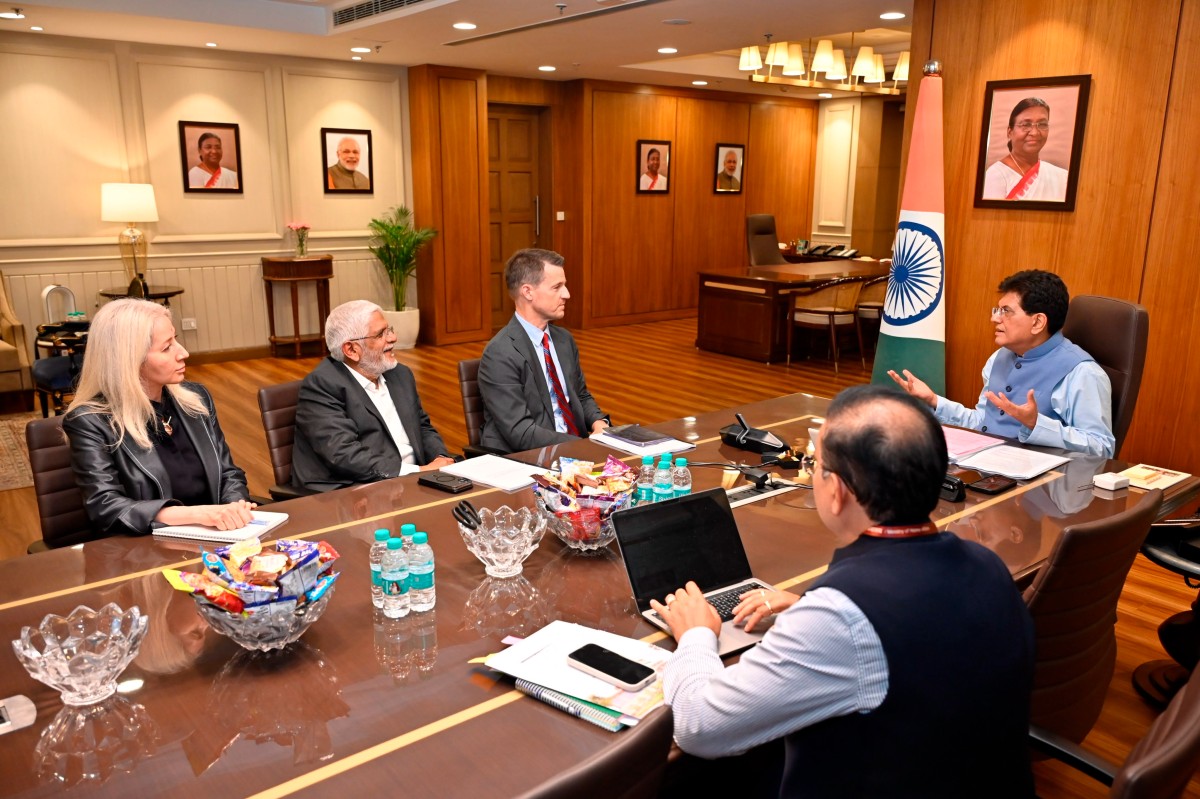
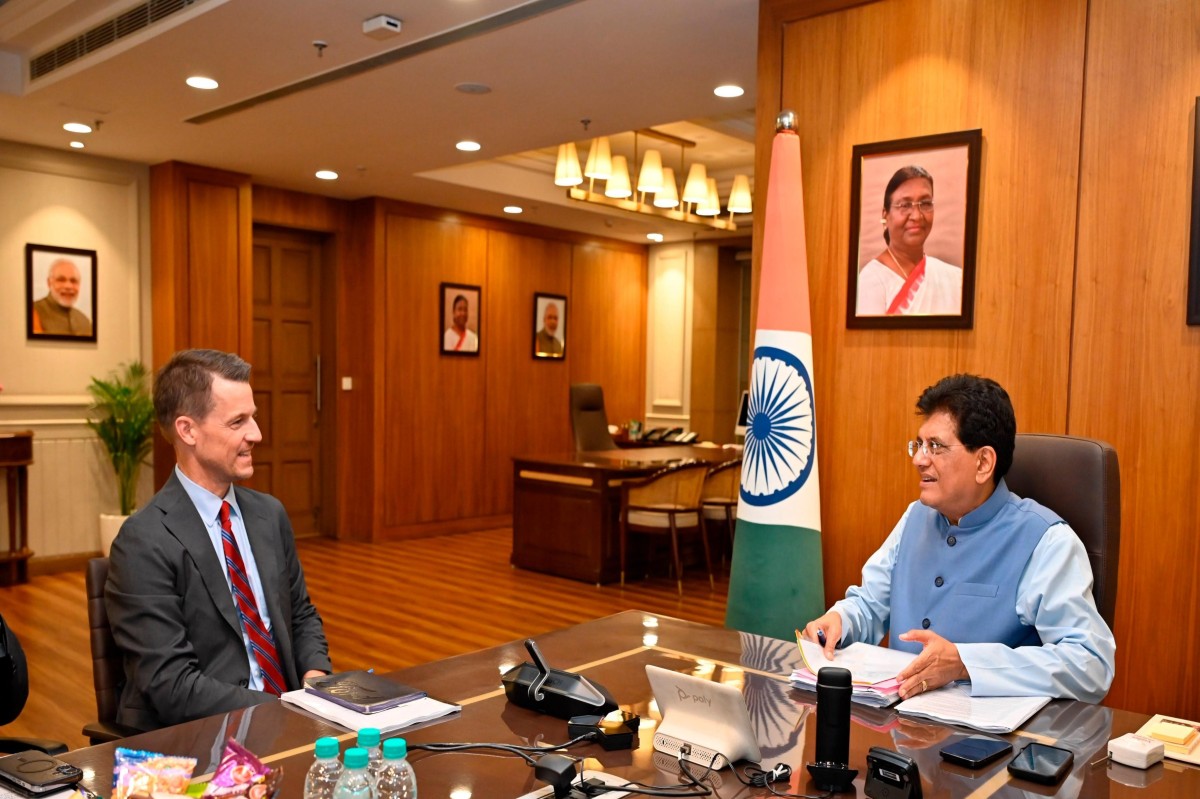
NEW DELHI : Union Minister of Commerce and Industry Shri Piyush Goyal held a high-level meeting with a delegation led by Mr. Matthew Godlewski, Vice President, International Government Affairs, Ford Motor Company, to discuss the company’s ongoing operations in India and its future growth strategy.
The discussions focused on Ford’s expanding export footprint from India and explored opportunities to further strengthen the country’s position as a global manufacturing and export hub for the automotive sector. The meeting also covered potential investments in advanced automotive manufacturing, innovation-driven production, and the development of a resilient and globally competitive supply chain.
During the interaction, Shri Goyal highlighted India’s rapidly evolving manufacturing ecosystem, robust industrial infrastructure, skilled workforce, and investor-friendly policy environment. He emphasized that initiatives such as ‘Make in India‘, ‘Aatmanirbhar Bharat’, the Production Linked Incentive (PLI) Scheme for the automobile and auto components sector, and sustained improvements in ease of doing business have made India an attractive destination for global manufacturers seeking to diversify production and exports.
The Minister reiterated the Government’s commitment to supporting investments in next-generation automotive technologies, including advanced manufacturing, electric mobility, sustainable production practices, and high-value exports. He also stressed the importance of deeper collaboration between global automakers and India’s rapidly expanding supplier ecosystem to enhance competitiveness in international markets.
The meeting reflects the Government’s continued engagement with leading global companies to promote investment, boost manufacturing capabilities, create employment opportunities, and position India as a preferred destination for high-value automotive production and exports. It also underscores the shared commitment to strengthening India’s role in global value chains while accelerating the country’s transformation into a leading manufacturing powerhouse.
NEW DELHI : India’s 8th Trade Policy Review (TPR) meeting at the World Trade Organisation (WTO) is scheduled to be held on 21st and 23rd July 2026. India’s official delegation for the TPR is headed by Commerce Secretary, Shri Rajesh Agarwal.
The review is carried out on the basis of two principal documents; a policy statement submitted by the Member under review (Government Report) and a report prepared by the WTO Secretariat, which is circulated to all Members. All WTO Members are subject to review at regular intervals, with the frequency determined by their share of world trade. India’s TPRs are conducted once every five years. The 8th TPR covers the period from 1 January 2021 to 31 December 2025.
The TPR process for India began in June 2025. Over the fourteen-month period, the Department of Commerce, in consultation with more than 100 Ministries, Departments and Organisations, participated in the process.
India’s performance during the review period has demonstrated remarkable resilience. Following the pandemic-induced contraction and increased global uncertainties, the economy staged a strong rebound and has since sustained high growth rates, establishing itself as the fastest-growing among major economies.
India’s external trade has also remained resilient despite challenging global conditions. In 2025–26, total exports of merchandise and services reached an all-time high of US$ 863.1 billion, registering a growth of 6.3 per cent over US$ 676.5 billion in 2021–22.
The Government Report and the WTO Secretariat Report highlight several achievements of India during the review period. These include India’s strong engagement with its trading partners through various Free Trade Agreements, tax reforms such as the rationalisation and simplification of the Goods and Services Tax (GST) structure, and several digital initiatives, including the Unified Payments Interface (UPI) and the incorporation of digital tools for trade facilitation.
As on 20 July 2026, WTO Members have submitted more than 900 questions for India’s written responses, reflecting significant interest in India’s growing economy and trade profile. The questions cover areas including digitisation and related reforms, MSMEs, women’s participation in the economy, Viksit Bharat and the Atmanirbhar Bharat Abhiyan.
More than 40 WTO Members are expected to deliver statements during the review. The Indian delegation will present India’s position and perspective on various issues of interest to Members and will also share India’s vision for the future.
The TPR is an important transparency mechanism under the WTO. It entails a comprehensive peer review of a Member’s trade policies, consisting of a multitude of border and behind-the-border measures, to enhance transparency, predictability and understanding in the WTO. Trade policy reviews are conducted by the Trade Policy Review Body (TPRB), which comprises the entire membership of the WTO.
NEW DELHI : India has invited the first round of applications for the allocation of import quotas for fully-built passenger cars and goods vehicles from the UK under the duty concession provisions of the India-UK Comprehensive Economic and Trade Agreement (CETA).
The Directorate General of Foreign Trade (DGFT) said eligible importers can submit applications from July 21 to August 4 for quota allocations applicable for calendar year 2026.
“New applications for TRQ under India – United Kingdom CETA for CY 2026 are invited from July 21, 2026 up to August 04, 2026,” the DGFT said in a notification.
The India-UK trade agreement, which came into effect on July 15, allows the import of 3.78 lakh conventional-engine passenger cars from the UK at concessional customs duties over the first 15 years of the pact. Under the agreement, tariffs on automotive imports will be reduced from around 110% to 10%, subject to quota limits on both sides.
In the first phase, applications have been invited for the allocation of quotas covering 9,316 passenger vehicles.
Only Original Equipment Manufacturers (OEMs), dealers and channel partners authorised by UK vehicle manufacturers will be eligible to apply for the tariff rate quota (TRQ). Applicants will also have to submit a pre-purchase agreement issued by a UK-based OEM specifying the number of vehicles to be supplied during the quota year.
For passenger cars with engine capacity of up to 1,500 cc, the quota has been fixed at 2,329 units, with the basic customs duty reduced to 50% from 66%.
A similar quota of 2,329 units has been earmarked for petrol vehicles with engine capacity above 1,500 cc but below 3,000 cc, and diesel vehicles with engine capacity above 1,500 cc but not exceeding 2,500 cc. These vehicles will also attract a reduced customs duty of 50% instead of 66%.
For larger vehicles with petrol engines above 3,000 cc and diesel engines above 2,500 cc, the quota has been set at 4,658 units. The import duty for this category has been lowered to 30% from 110%.
The DGFT has also invited applications for 1,164 goods vehicles in the first round. Overall, the quota for fully-built goods vehicles in the first year of the agreement is 2,500 units, with imports under the quota attracting a customs duty of 37% instead of 44%.