Home Blog Page 23

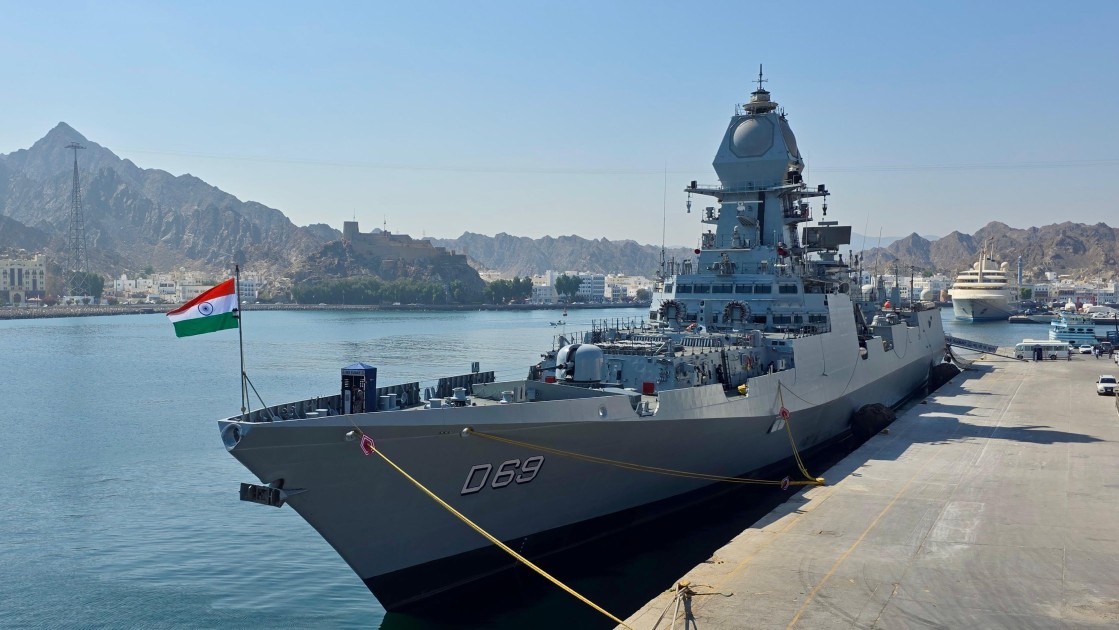
INS Surat at Muscat, Oman

MUSCAT : Indian Naval Ship Surat arrived at Muscat, Oman, on 08 Nov 2026 to participate in the 15th edition of the bilateral maritime exercise ‘Naseem Al Bahr’ (Sea Breeze), followed by a Coordinated Patrol (CORPAT) between the Indian Navy and the Royal Navy of Oman.

The exercise will comprise professional activities during the harbour and sea phases, including cross-deck visits, operational interactions and sporting events. These activities will provide opportunities for personnel of both Navies to exchange experiences and Best Practices, enhance interoperability and foster greater mutual understanding.

The port call underscores the strong and enduring maritime partnership between India and Oman, founded on longstanding ties between the two nations. It is in consonance with the Government of India’s vision of MAHASAGAR (Mutual and Holistic Advancement for Security and Growth Across Regions) and provides an opportunity to build upon the momentum generated during the 13th edition of the Joint Military Cooperation Committee meeting held on 24 Nov 2025

LR and MAWANI sign agreement to support the development of Saudi Arabia’s maritime and ports sector

Collaboration will explore opportunities spanning safety, sustainability, digitalisation, institutional capability and professional development

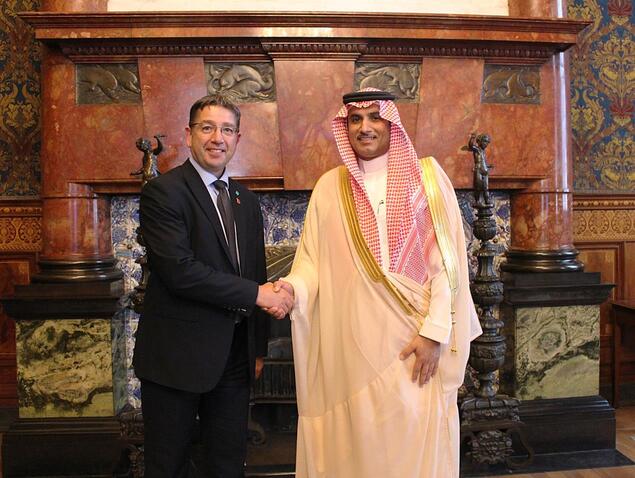
LONDON: Lloyd’s Register (LR) and the Saudi Ports Authority (MAWANI) have signed a Memorandum of Understanding (MoU) to explore collaboration for the continued development of Saudi Arabia’s maritime and ports sectors. The MoU was signed by His Excellency Eng. Suliman Al-Mazroua, President of MAWANI, and LR’s CEO’s Nick Brown.

Over a three-year period, LR and MAWANI will explore opportunities spanning maritime governance and capacity building, sustainability, digitalisation, regulatory compliance and risk management. Both organisations will consider collaboration in innovation, maritime insurance, training and professional qualifications.

The partnership is in line with Saudi Arabia’s National Transport and Logistics Strategy, launched in 2021, which aims to position the Kingdom as a global logistics hub.

The two organisations will explore how LR’s knowledge and Advisory expertise could strengthen the development of effective maritime and port administration and operations. Potential activities include governance and organisational assessments, competency frameworks, leadership development, stakeholder engagement and the creation of policies and procedures aligned with relevant international standards.  

With sustainability a key area of focus, both organisations will explore the development of environmental management systems, decarbonisation initiatives, and green port programmes. They will also consider opportunities to strengthen environmental, social and governance strategies, performance indicators and reporting frameworks.

A further priority will be the development of maritime skills and Saudi talent, potentially exploring measures to strengthen connections between education and industry, support workforce localisation and advance women’s participation and career development within the maritime sector.

James Frew, Maritime Advisory & Energy Sales Director, LR, said: “This agreement reflects our shared ambition to support a safe, sustainable and future-ready maritime sector in line with Saudi Arabia’s ambitions to position itself as a global logistics hub. By combining MAWANI’s national leadership with LR’s international maritime and technical experience, we can identify practical opportunities to strengthen capability and accelerate innovation to support a sustainable maritime and ports sector for the Kingdom.”

Abdullah AlMunif, Vice President of Commercial Business, MAWANI, said: “Our collaboration with Lloyd’s Register will support MAWANI’s efforts to advance operational excellence, develop national capabilities and strengthen the international competitiveness of Saudi ports. It also creates a platform for knowledge exchange and cooperation on digitalisation, helping us explore how better use of data and technology can support more efficient, resilient port operations and prepare for the future needs of maritime trade.”

The agreement builds on LR’s existing collaboration with MAWANI to strengthen port management and develop workforce capability. Under a contract announced in January 2025, LR was appointed to support management systems and certification preparation at Jeddah Islamic Port, King Abdulaziz Port in Dammam, Yanbu Commercial Port and Jubail Commercial Port. The scope included quality and environmental procedures aligned with ISO 9001 and ISO 14001, alongside support for Port State Control processes and personnel training.

Ahead of MEPC85, IMarEST members highlight barriers to Net-Zero delivery

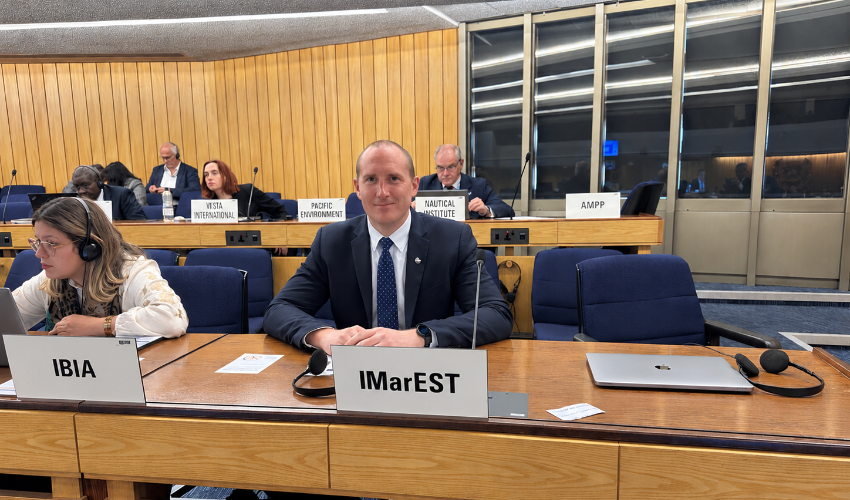
LONDON: Ahead of MEPC85, the Institute of Marine Engineering, Science and Technology (IMarEST) says its members now identify delivery, infrastructure, and value-chain coordination as the sector’s biggest barriers when it comes to IMO 2023 Greenhouse Gas strategy.

The Institute’s Ship Energy and Environment Special Interest Group (SEESIG) gathered views from professionals across ship management, classification societies, engineering, science, academia and maritime services.

They found little opposition to the IMO’s ambition of achieving Net-Zero emissions from international shipping. Instead, respondents overwhelmingly identified issues including infrastructure readiness, commercial incentives, fuel availability and the distribution
of responsibility across the maritime value chain as the most significant barriers to the progress they are seeking.

Alasdair Wishart, Director of technical and policy at the IMarEST commented: “We are not seeing opposition to the Net-Zero Framework, or to decarbonisation as a principle. This is extremely encouraging as the industry seeks clarity at MEPC85. In fact, our industry snapshot suggests that marine professionals are now increasingly focussing on whether the transition can be delivered at the pace required.”

Respondents expressed confidence in a range of potential decarbonisation pathways, including low and zero-carbon fuels, energy efficiency technologies, and operational improvements. However, many highlighted uncertainties around fuel production, bunkering infrastructure, supply chains and long-term regulatory frameworks as factors slowing investment decisions.

They also pointed to growing recognition that maritime decarbonisation cannot be delivered without increased collaboration in the industry. Participants highlighted the need for greater coordination between shipowners, operators, ports, fuel producers, charterers,
cargo owners and policymakers to unlock emissions reductions across the sector.

Significantly, respondents identified operational measures such as voyage optimisation, digitalisation and just-in-time arrivals as among the most effective opportunities for reducing emissions in the near term. These findings suggest progress can be achieved
today while longer-term fuel and propulsion solutions continue to scale.

Alasdair continued: “Shipping has a unique opportunity to take control of its emissions and accelerate the transition to Net-Zero. The cost of inaction is greater than the cost of action, and many of the technologies needed to reduce emissions already exist
or are advancing rapidly.

“But we are seeing that the sector requires answers on how to create the conditions needed for investment confidence for fuels and infrastructure, as well as facilitation to kickstart collaboration on decarbonisation across the sector.”

If this sample of IMarEST members is representative of wider industry sentiment, the commitment to achieving Net-Zero by 2050 is firmly established. The question that IMarEST members are now asking is how quickly practical barriers can be removed in order to deliver it.

VIKING wins €23.8 million contract to build seven high-speed patrol vessels for the Hellenic Coast Guard

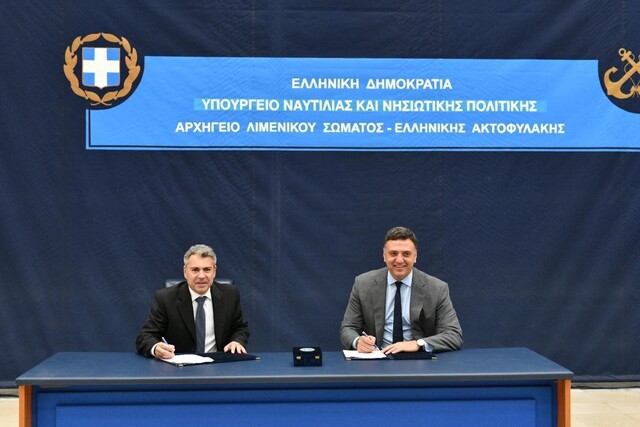
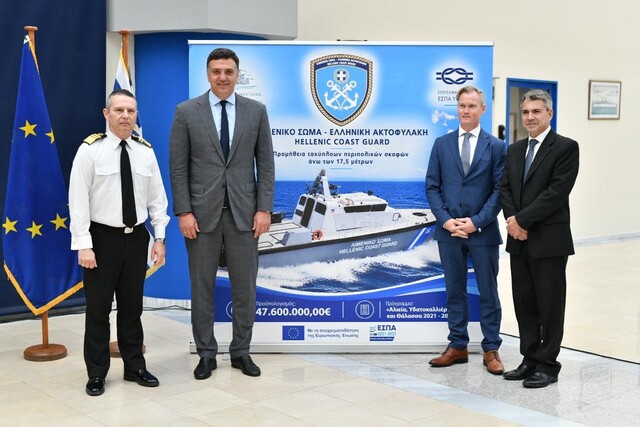
ESBJERG/ATHENS: VIKING Life-Saving Equipment has signed a €23.8 million contract, through its Greek company VIKING Life-Saving Equipment Hellas, to supply seven new high-speed patrol vessels to the Hellenic Coast Guard. The contract was signed by Greece’s Minister of Maritime Affairs and Insular Policy, Vassilis Kikilias, at a ceremony at the Ministry in Athens, attended by Coast Guard officials and VIKING representatives.

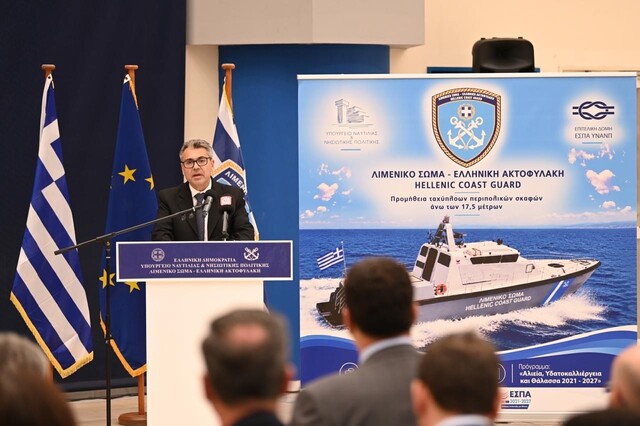
The seven vessels are of the VIKING Norsafe Magnar 1950 type and will be built entirely in Greece, one of five countries with VIKING’s manufacturing facilities. Each vessel measures 21.29 metres in length, reaches a top speed of at least 50 knots and has a range over 320 nautical miles. Each will operate with a six-person crew, carry at least 30 people, and be equipped with modern navigation and communication systems.

Once in service, the vessels will support the Coast Guard’s core missions: surveillance of Greek waters, protection of the country’s maritime borders, fisheries control, and search and rescue. The contract also includes an option for up to seven additional vessels of the same type. Deliveries are scheduled to begin within six to twelve months, with vessels handed over in succession.

At the signing, Minister Kikilias described the procurement as another decisive step in supporting the men and women of the Coast Guard. He said the goal is “to make their job easier, facing the challenges of today and tomorrow.”

“We are honoured by the trust placed in VIKING by the Ministry of Maritime Affairs and Insular Policy and the Hellenic Coast Guard. This contract builds on more than a century of boatbuilding expertise within VIKING, and on the skills of our team in Greece. Building these vessels locally reflects our commitment to Greek shipbuilding and to the people who protect lives at sea every day.” John Georgiadis, Tenders & Projects Director | Defense & Professional, VIKING Life-Saving Equipment.

“This contract is significant both for our Defence & Professional business and for VIKING. It broadens the range of vessels we supply to the Coast Guard, and we are proud to earn that confidence.” Heidi Bjerge Nüsser, VP Defence Wind & Aviation, VIKING Life-Saving Equipment.

The procurement is funded by the Public Investment Programme through the co-financed programme “Fisheries, Aquaculture and Sea 2021–2027.

India’s first dedicated Green Methanol Bunkering Hub nears commercial launch at VOC Port

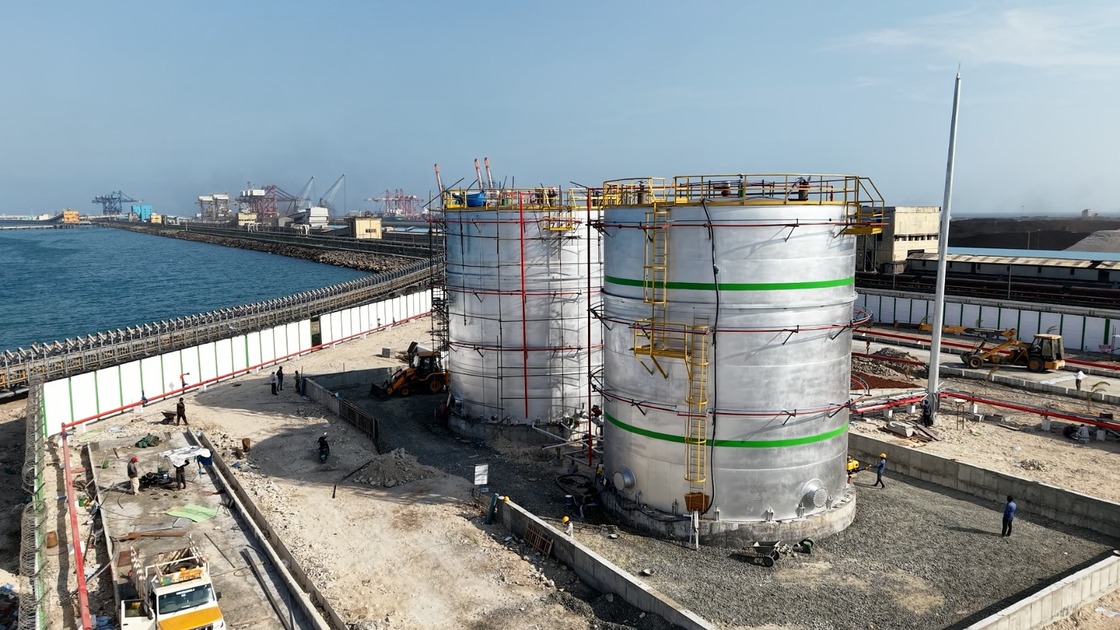
TOOTHUKUDI: India’s first dedicated green methanol bunkering hub is preparing to commence commercial operations at V.O. Chidambaranar Port (VOC Port) by the end of November 2026, marking a significant step in the development of alternative marine-fuel infrastructure on the country’s east coast. The facility was inaugurated by the Hon’ble Prime Minister of India, Shri Narendra Modi, on 11 October 2026.

The development gives VOC Port an opportunity to enter an emerging international market as shipping companies expand their fleets of methanol-capable vessels. Access to dependable fuel supplies will become increasingly important in route planning and bunkering decisions. A dedicated facility at Thoothukudi could help India capture a share of this developing maritime-fuel business while strengthening the Port’s commercial appeal to international shipping lines.

VOC Port’s position near the East–West international shipping route provides a geographic advantage. According to the Port’s estimates, nearly 80% of cargo vessels operating on this route pass within 130 nautical miles of Thoothukudi. Its location on the Rotterdam–Tuticorin–Singapore maritime corridor offers scope to serve vessels seeking green methanol bunkering, including ships beyond those making regular cargo calls at the Port. VOC Port is set to become the only port on India’s east coast to offer this service.

The facility has 1,500 m³ of storage capacity across two tanks of 750 m³ each. A 2.8-km stainless-steel pipeline connects the storage installation to the bunkering point at the jetty, enabling methanol received by road tanker or vessel to be transferred to ships. The bunkering system includes two transfer pumps, each with a capacity of 120 m³ per hour, and is designed for the transfer of approximately 1,20,000 litres per hour. Automated controls, remotely operated valves, emergency shutdown arrangements and dedicated fire-protection systems form part of the installation.

The project is being implemented under the National Green Hydrogen Mission, with the Ministry of New and Renewable Energy allocating ₹35.34 crore for its development under the shipping sector. The Ministry of Ports, Shipping and Waterways has nominated VOC Port as the System Implementing Agency.

Shri Susanta Kumar Purohit, IRSEE, Chairperson, V.O. Chidambaranar Port Authority, said, “The ability to offer alternative marine fuels will increasingly influence the competitiveness of ports serving international shipping. This facility is an important step towards positioning Thoothukudi as a dependable bunkering destination. Our immediate priority is to complete the necessary safety, statutory and operational preparations. We see longer-term potential for these services to support green-fuel production, maritime activity and industrial investment in the region.”

VOC Port is completing port-readiness processes, statutory requirements and trial bunkering ahead of its targeted commercial launch by the end of November 2026. An Expression of Interest has been floated to identify a suitable bunkering operator. Commercial supply will commence following completion of the necessary operational arrangements and clearances.

The project also advances India’s efforts to develop green shipping infrastructure and supports the national objective of achieving Net Zero emissions by 2070.

Paradip Port registers impressive 26.93% growth in Iron Ore and Pellet handling during April–October FY 2026–27

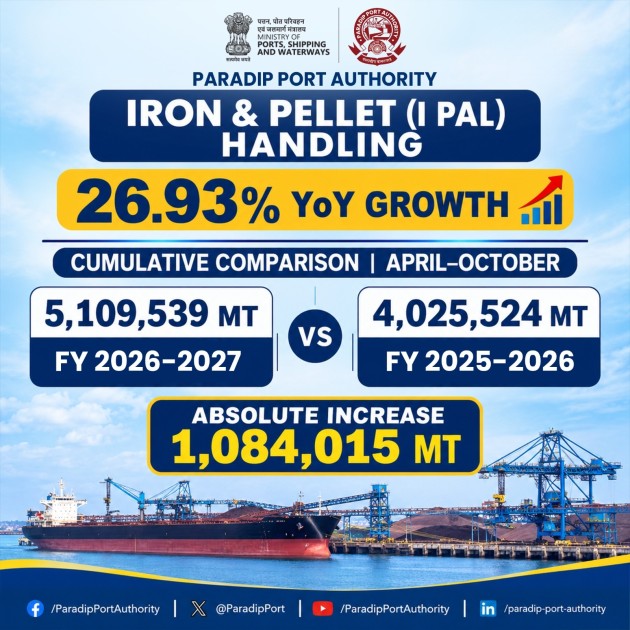
PARADIP : Paradip Port Authority (PPA) has registered a strong performance in iron ore and pellet handling during the April–October period of FY 2026–27, achieving an impressive year-on-year growth of 26.93%. The achievement reflects the Port’s continued momentum in cargo handling and its growing contribution to India’s maritime trade and bulk cargo logistics.

According to the latest performance figures released by Paradip Port Authority, the Port handled 5,109,539 metric tonnes (approximately 5.11 million tonnes) of iron ore and pellets during April–October FY 2026–27, compared with 4,025,524 metric tonnes (approximately 4.03 million tonnes) during the corresponding period of FY 2025–26.

This represents an absolute increase of 1,084,015 metric tonnes (approximately 1.08 million tonnes), translating into a robust year-on-year growth of 26.93%.

The significant increase in cargo volumes highlights Paradip Port’s strengthening position in handling key dry bulk commodities and its important role in supporting India’s iron ore and steel supply chains. The growth also underscores the importance of efficient port operations, cargo-handling infrastructure and seamless maritime logistics in facilitating the movement of essential industrial raw materials.

With its strategic location on the eastern coast of India and its established cargo-handling capabilities, Paradip Port continues to play a vital role in facilitating domestic and international trade, strengthening industrial connectivity and supporting the country’s economic growth.

The latest performance further reinforces Paradip Port Authority’s commitment to operational efficiency, enhanced cargo-handling capacity and sustained growth, in alignment with the national vision of Viksit Bharat @2047.

Paradip Port continues to move ahead with strong performance, reinforcing its position as one of India’s leading maritime gateways.

Visakhapatnam Port achieves historic milestone with first-ever Panamax Vessel berthing at inner harbour for Alumina Exports

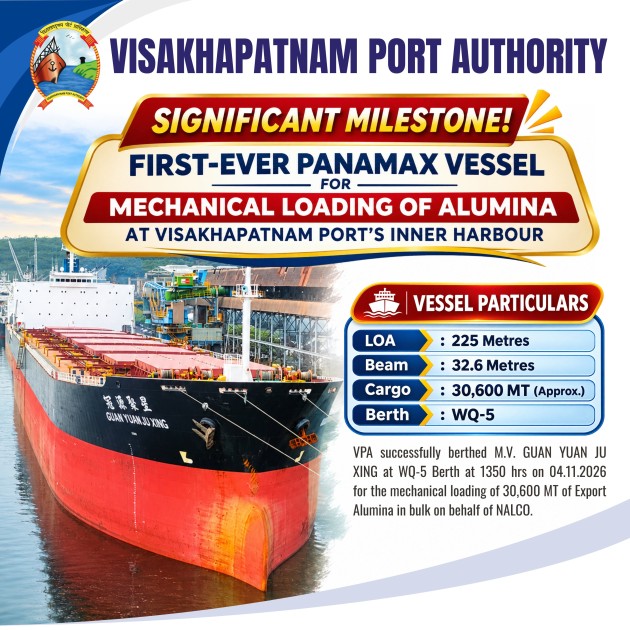
VISAKHAPATNAM : Visakhapatnam Port Authority (VPA) has achieved a significant operational milestone by successfully berthing a Panamax vessel at its Inner Harbour for the first time for the mechanical loading of export alumina. The development marks an important advancement in the Port’s vessel-handling capabilities and infrastructure utilisation.

On November 4, 2026, VPA successfully berthed M.V. GUAN YUAN JU XING at WQ-5 Berth for loading approximately 30,600 metric tonnes of export alumina on behalf of National Aluminium Company Limited (NALCO).

The successful berthing of a Panamax vessel at the Inner Harbour for this specialised cargo operation represents a notable achievement for the Port, demonstrating its growing capability to accommodate larger vessels and facilitate efficient bulk cargo handling.

The operation also highlights the importance of coordinated port operations, berth infrastructure and mechanical cargo-handling arrangements in supporting the export requirements of major industrial organisations such as NALCO.

This milestone is expected to further strengthen the Port’s role in facilitating India’s mineral and industrial exports while enhancing its competitiveness as a major maritime gateway on the eastern coast.

The achievement reflects Visakhapatnam Port Authority‘s continued focus on improving operational efficiency, optimising existing infrastructure and expanding its vessel-handling capabilities to meet the evolving requirements of maritime trade.

The successful berthing and loading operation marks another proud chapter in the Port’s journey towards operational excellence and reinforces its commitment to supporting India’s growing export sector.

India needs 10-year demand pipeline, better financing to boost shipbuilding sector: EY-FICCI report

NEW DELHI: India needs a predictable, long-term demand pipeline for domestic vessels and better access to financing to accelerate the growth of its shipbuilding and ship-repair industry, according to a report by EY and the Federation of Indian Chambers of Commerce and Industry (FICCI).

The report highlighted that India repaired 418 vessels in FY23-24, of which 227 were handled by private-sector shipyards, with the country having around 42 dry docks.

However, India’s share in the global shipbuilding and ship-repair markets remains limited despite its strategic location.

Commander Gautam Nanda, Partner, Business Consulting, EY India, said: “India has an opportunity to build an integrated and globally competitive maritime manufacturing ecosystem. The immediate priority is to convert fragmented domestic vessel requirements into predictable, long-term demand that gives shipyards, suppliers and financiers the confidence to invest. Combining this demand visibility with appropriate financing, stronger domestic supply chains and parallel development of shipbuilding and repair capabilities can help create the scale the industry needs.””

“India accounted for approximately 0.075% of global delivered shipbuilding GT in 2025, while its share of the global ship-repair market remained below 1% in 2024,” the report said.

India’s commercial shipbuilding output has also remained modest and fluctuated over the years. The country’s output reached a peak of 72,137 Gross Tonnage (GT) in 2021 before standing at 57,637 GT in 2025.

However, the report noted that the increase in output “has not yet developed into a sustained growth trend.”

To address these challenges, the report recommended setting up a national maritime demand and market assurance mechanism to bring together vessel requirements from public sector undertakings (PSUs), ports, coastal shipping operators, inland-waterway agencies and other major users.

It suggested creating a structured, rolling 10-year procurement pipeline to provide greater visibility of future orders to domestic shipyards.
The report also said standardising vessel designs and introducing regular procurement programmes could improve shipyard productivity, encourage investment in the supply chain and make financing more accessible.

India’s growing requirements for fleet renewal, coastal shipping, inland waterways and port services could provide a strong demand base for domestic shipbuilders, helping them secure regular orders and plan long-term investments.

Highlighting the role of international cooperation, the report said, “International partnerships can accelerate capability development in vessel design, production engineering, propulsion, automation, marine systems, supplier qualification and lifecycle support.”

It further stressed that the sector’s growth would depend on commercially viable vessel procurement programmes, faster approvals, competitive financing, reliable suppliers and timely project delivery.

Partnerships that combine international technology and market access with domestic manufacturing capabilities would also be important in strengthening India’s position in the global maritime industry, it added.

On the ship-repair segment, the report noted that India’s location close to major international shipping routes offers significant opportunities to attract business.

“India’s proximity to key international shipping routes provides a sizeable market opportunity for ship-repair services; however, limitations relating to repair infrastructure, turnaround time, availability of spares and service reliability continue to constrain the country’s ability to capture a larger share of this market,” it said. (ANI)

Blue Dart reports Strong Financial Performance in Q2FY27

MUMBAI: Blue Dart Express Limited, South Asia’s premier express air and integrated transportation and distribution logistics company, today announced its financial results for the second quarter of FY2026-27, following a meeting of its Board of Directors in Mumbai.

The Company reported a Profit After Tax (PAT) of ₹101.99 Crore, compared to ₹79.50 crore in the corresponding quarter of the previous financial year. Revenue from Operations stood at ₹1,774 Crore, compared to ₹1,549 crore in Q2FY26, registering a year-on-year growth of 14.5%.

During the quarter, the company’s performance was driven by an improved product mix, better yield realisation and continued service optimisation, supported by a focus on unit cost efficiency and disciplined execution across the business. Blue Dart also strengthened customer engagement through targeted outreach to MSMEs and businesses in emerging markets, deepening relationships and supporting their growth ambitions.

Commenting on the results, Balfour Manuel, Managing Director, Blue Dart Express, said: “Our Q2 performance marks a significant milestone, reflecting the strength of our business fundamentals and the discipline with which we continue to manage and grow the business. This quarter’s financial performance was supported by our focus on operational productivity and the effective utilisation of our integrated network. As India’s commerce and supply chains continue to evolve, our priorities remain firmly centred on strengthening our infrastructure, expanding connectivity and building capabilities that allow us to serve customers with greater efficiency and reliability. We will continue to invest in these areas while maintaining the operational rigour and service standards that have defined Blue Dart over the years.”

Following the close of the quarter, Blue Dart entered into strategic partnerships to explore new avenues for parcel movement and deepen the company’s reach into rural India. These initiatives reflect the company’s continued focus on building a more connected, efficient and scalable logistics network to serve businesses across India. Looking ahead, Blue Dart will remain focused on service excellence, operational efficiency and disciplined investment in its network and capabilities. With its extensive reach and integrated infrastructure, the company will continue to support customers’ supply chain requirements and enable access to markets across India and overseas.

Jitin Prasada holds High-Level Meetings and Business Interactions to Strengthen India–Hungary Economic and Technological Cooperation

HUNGARY: Minister of State for Commerce and Industry, and Electronics and Information Technology, Shri Jitin Prasada, visited Hungary from November 4–6, 2026. The visit reflected the growing momentum in bilateral engagement between India and Hungary and provided an opportunity to further strengthen cooperation in trade, investment, technology, innovation and industrial development.

During the visit, Shri Jitin Prasada called on the Deputy Speaker of the Hungarian National Assembly. The interaction focused on strengthening bilateral relations and exploring opportunities for enhanced cooperation between India and Hungary, including in the broader context of India–European Union relations.

Shri Prasada also met the Minister of Science and Technology of Hungary. The discussions focused on expanding bilateral cooperation in emerging technologies, research and innovation, and exploring opportunities for greater collaboration between industries and research institutions of the two countries.

As part of his institutional engagements, Shri Prasada visited the Hungarian University of Agriculture and Life Sciences (MATE), one of Central Europe’s leading agricultural research and educational institutions. The visit provided an opportunity to explore potential cooperation in agricultural research, agri-technology, innovation and sustainable agricultural practices.

Shri Prasada also visited Gedeon Richter Plc., a leading Hungarian pharmaceutical company with an established manufacturing presence in India through Richter Themis Medicare (India) Pvt. Ltd. The visit highlighted existing industrial linkages between the two countries and opportunities for further collaboration in pharmaceutical manufacturing, research and development and healthcare technologies.

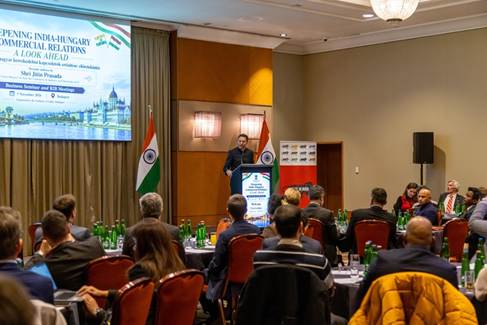
On November 5, Shri Jitin Prasada addressed the India–Hungary Business Seminar in Budapest, attended by more than 100 business representatives. Addressing the gathering, the Minister highlighted the significant potential for expanding bilateral trade and investment and called upon Indian and Hungarian companies to explore new business opportunities, forge stronger partnerships and deepen industrial cooperation. He emphasised opportunities in emerging technologies, electronics manufacturing, pharmaceuticals, agriculture and other sectors of mutual interest. The Minister also highlighted the opportunities arising from closer India–European Union economic engagement and encouraged businesses from both countries to strengthen commercial linkages and explore new avenues for cooperation.

As part of his industry engagements, Shri Prasada visited Foxconn’s manufacturing operations in Hungary, engaged in the production of advanced data centre infrastructure, network communication equipment and AI server technologies. The visit highlighted opportunities for strengthening cooperation in electronics manufacturing, digital infrastructure and emerging technologies, including the development of resilient supply chains.

During the visit, Shri Prasada also interacted with members of the Indian community in Hungary at the Amrita Sher-Gil Cultural Centre in Budapest. Addressing the gathering, the Minister acknowledged the contribution of the Indian diaspora in strengthening people-to-people ties and fostering closer relations between India and Hungary.

The visit reaffirmed India’s commitment to strengthening its economic and technological partnership with Hungary. It provided further impetus to bilateral cooperation in trade, investment, innovation and industrial development, while contributing to the broader objective of deepening the India–European Union partnership.

The Indian business delegation accompanying the Shri Prasada participated in a Business Seminar organized by the Embassy of India, during which it interacted with representatives of the Hungarian Chamber of Commerce and Industry (HCCI), Hungarian Export Promotion Agency (HEPA), and Hungarian Investment Promotion Agency (HIPA). As part of the seminar, B2B meetings were also held between Indian companies and their Hungarian counterparts to explore potential business opportunities, strengthen commercial linkages, and identify avenues for enhanced bilateral trade, investment, and business cooperation between India and Hungary.