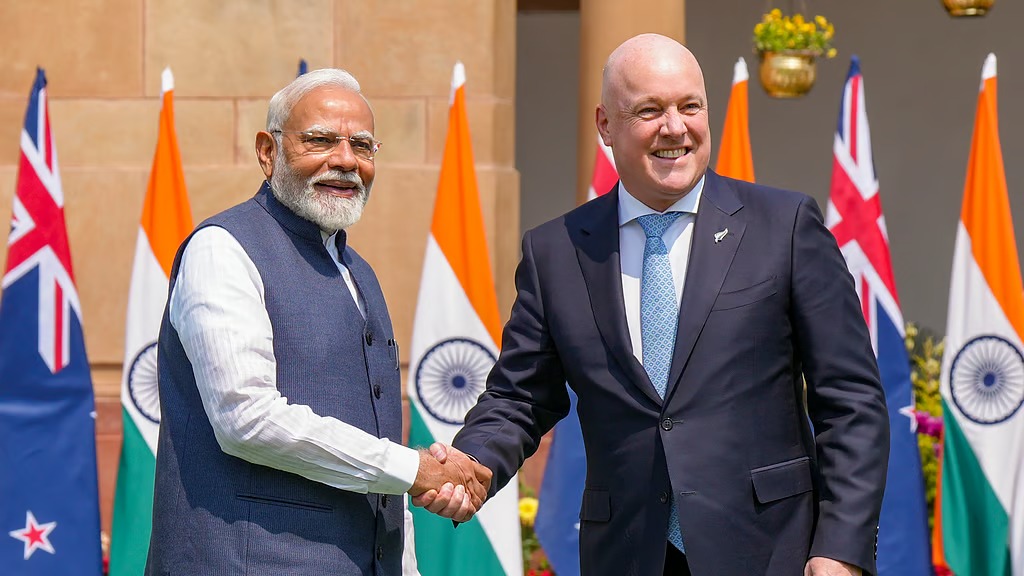
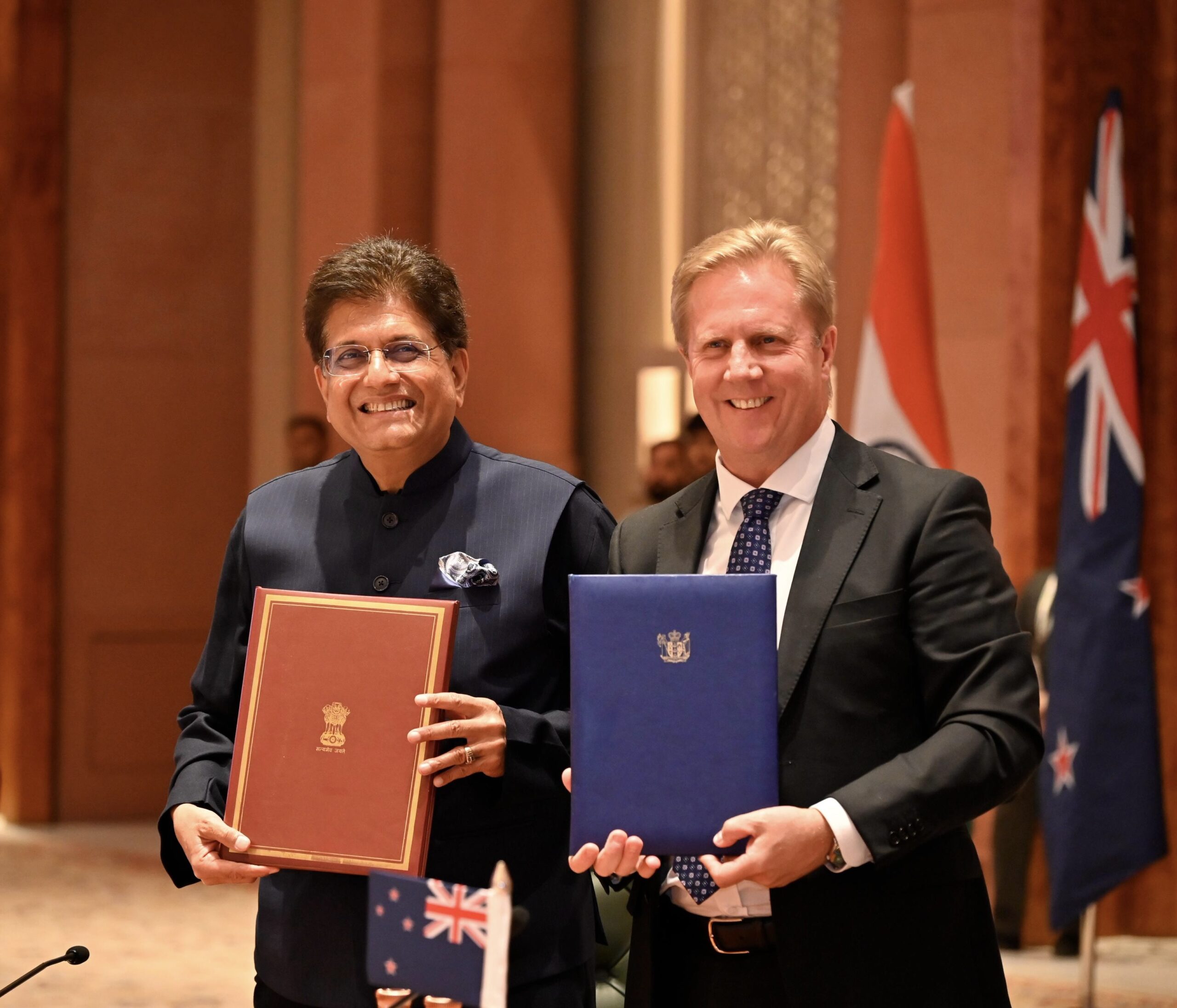
NEW DELHI : India and New Zealand on Monday signed the India- New Zealand Free Trade Agreement (IN- NZ FTA) at Bharat Mandapam, New Delhi, under the vision and leadership of Hon’ble Prime Minister Shri Narendra Modi to strengthen India’s global economic partnerships. The Agreement was signed by Union Minister of Commerce and Industry Shri Piyush Goyal and New Zealand’s Minister for Trade and Investment Hon. Todd McClay.
The signing of the India–New Zealand Free Trade Agreement marks a new and significant chapter in the bilateral relationship, reflecting shared ambition, deepening engagement, and a commitment to mutually beneficial growth said Mr. McClay.
Speaking on the signing, Mr. McClay called the India–New Zealand Free Trade Agreement a “once-in-a-generation” opportunity that will boost exports, create jobs, and strengthen bilateral economic ties. He highlighted strong participation from New Zealand businesses at the signing and said the pact will improve market access, reduce trade barriers, and support MSMEs. He also emphasised deep people-to-people links, including the Indian diaspora’s contribution in New Zealand, and longstanding cultural and sporting ties. Describing India as a key partner in a changing global landscape, he expressed confidence that the agreement will deepen cooperation and deliver shared prosperity.
Union Minister for Commerce and Industry Shri Piyush Goyal said “The India–New Zealand Free Trade Agreement marks a defining milestone in India’s engagement with the developed world. It reflects Prime Minister Narendra Modi’s vision of global economic partnerships for our farmers, women, youth, artisans and entrepreneurs. This is India’s 9th Agreement in the past few years- with 38 developed countries. At the heart of the agreement is the empowerment for exports, agricultural productivity, student mobility, skills, investment and services. The investment commitment of USD 20 billion from New Zealand signals strong confidence in India’s growth story. It places special emphasis on strengthening MSMEs, fostering innovation, and enabling women-led enterprises to thrive in global markets.”
Shri Piyush Goyal said the India–New Zealand Free Trade Agreement was concluded in nine months and marks a key milestone in India’s engagement with developed economies, aligned with the vision of Viksit Bharat 2047. He noted that India is signing its seventh FTA in the last three and a half years, with plans for agreements with the European Union and the United States, taking the total to nine FTAs with 38 advanced economies, covering nearly 65–70% of global GDP. He also highlighted expected US$20 billion investment inflows under the agreement and said New Zealand has opened access in 118 sectors, with MFN commitments in 139 sectors.
The signing ceremony brought together businesses and industry leaders from both countries, with Trade and Investment Minister Todd McClay leading a cross-party delegation of Members of Parliament and over 30 New Zealand businesses.
The negotiations were officially launched on March 16, 2025 on the eve of the Bilateral meeting of Hon’ble Prime Minister of India, Shri Narendra Modi and the Prime Minister of New Zealand, Rt Hon Christopher Luxon. This agreement is anchored on deep people-to-people connections and a partnership between vibrant democracies for advancing trade, economic cooperation, and strategic engagement across the Indo-Pacific. The merchandise bilateral trade between Oceania and India stood at approximately USD 26 billion in 2024-25. New Zealand is India’s second-largest trading partner in the Oceania region, with bilateral trade valued at around USD 1.3 billion. With the coming into force of the India–New Zealand Free Trade Agreement, bilateral trade is expected to witness further growth, supported by enhanced market access, greater trade facilitation, and deeper economic engagement between the two countries.
Through five formal rounds of negotiations and several intersessions, both sides concluded the Agreement on 22 December 2025, just nine months after launch, making it one of the fastest FTAs concluded by India with a developed country.
In a message Commerce Secretary Shri Rajesh Agrawal, said that “The India–New Zealand FTA marks a new era in our economic partnership, one marked by trust and complementary strengths. India now has a level playing field for exports to New Zealand. The FTA broadens its scope to agriculture productivity, organics, services, mobility, Ayush, and pharma access making the opportunities all-inclusive and future-oriented. The agreement gives a strong competitive push to India’s labour-intensive sectors. India’s exporters now have zero-duty access to New Zealand and the broader regional trade ecosystem. Indian exporters can operate with greater scale, and diversification in the Indo-Pacific. The deal offers predictability in today’s uncertain world”
The India-New Zealand Free Trade Agreement was signed under the visionary leadership of Hon’ble Prime Minister Narendra Modi. The India – New Zealand Free Trade Agreement represents a new generation of strategic trade partnership, comprehensive, inclusive, confident, calibrated and rooted in national interest. Under the leadership of Prime Minister Shri Narendra Modi, India is forging partnerships with developed economies that deliver real market access for our labour-intensive sectors and holistic economic partnerships. This FTA stands as a testament to a new approach, where trade will drive jobs, empower youth, women and MSMEs, and align seamlessly with the vision of inclusive growth and economic resilience on the path to Viksit Bharat 2047. The FTA will enter into force after the completion of all domestic procedures and ratification in both countries.
Productivity to Prosperity for People: Tariffs, Talent, Transformation for Viksit Bharat 2047
Trade in Goods: Unprecedented 100% Duty-Free Access to New Zealand Market on entry into force
The FTA provides duty-free access for 100% of India’s exports to New Zealand, covering all tariff lines, and is expected to significantly boost MSMEs and employment by enhancing competitiveness in labour-intensive sectors such as textiles, apparel, leather, footwear, gems and jewellery, engineering goods, and processed foods.
Earlier, New Zealand maintained peak tariffs of up to 10% on key Indian exports including ceramics, carpets, automobiles, and auto components.
With zero-duty market access from entry into force as New Zealand’s other trade partners, Indian products will be fully competitive in New Zealand enjoying a level playing field, directly supporting workers, artisans, women entrepreneurs, youth, and MSMEs across India.
Significantly, India also secures duty-free inputs for its manufacturing sector, including wooden logs, coking coal, and waste and scraps of metals, lowering production costs and enhancing the global competitiveness of Indian industry.
Calibrated Market access and sensitive Sectors Protected
India has offered tariff liberalisation on 70.03% of tariff lines covering 95% of bilateral trade value, while keeping 29.97% of tariff lines in exclusion to protect India’s sensitive sectors.
The products that are kept in exclusion are mainly- Dairy (milk, cream, whey, yoghurt, cheese etc.), animal products (other than sheep meat), Agricultural products (onions, chana, peas, corn, almonds etc.), sugar, artificial honey, Animal, vegetable or microbial fats and oils, Arms and Ammunition, Gems and Jewellery, Copper and Articles thereof (Cathodes, Cartridges, Rods, Bars, Coils etc.), Aluminium and articles thereof (Ingots, billets, wire bars) among others
30.00% of tariff lines will have immediate duty elimination, covering wood, wool, sheep meat, leather-raw hides etc.
35.60% of tariffs are subject to phased elimination over 3, 5, 7, and 10 years, including petroleum oil, malt extract, vegetable oils, and selected electrical and mechanical machinery, peptones etc.
4.37% of products face tariff reductions, such as wine, pharmaceutical drugs, polymers, aluminum, iron and steel articles etc.
0.06% fall under tariff rate quotas, including Mānuka honey, apples, kiwi fruit, and albumins including milk albumin.
Advancing Agricultural productivity Partnership, Farmer incomes and Rural Economies
The Partnership includes the establishment of Centres of Excellence, improved planting material, capacity building for growers, collaborative research, and technical support for orchard management, post-harvest practices, supply chain performance and food safety. Projects for apple cultivators and sustainable beekeeping practices will enhance production and quality standards.
Market access for the selected agricultural products (Apples, Kiwifruit, and Mānuka Honey) and Albumins from New Zealand will be managed through a Tariff Rate Quota system with Minimum Import Price and other safeguards, ensuring quality imports and consumer choice while protecting domestic farmers.
All Tariff Rate Quotas for Apples, Kiwifruit and Manuka are paired with delivery on Agriculture Productivity Action Plans and monitored by a Joint Agriculture Productivity Council (JAPC), balancing market access with protection of sensitive domestic agricultural sectors.
Mānuka Honey: Currently applicable duty: 66%; current imports from New Zealand: 14.2 MT (US$ 0.3 mn) and from world: 356.8 MT (US$ 1.9 mn); in-quota TRQ: 200 MT p.a. with MIP of US$ 20/kg and 75% tariff reduction over 5 years; out-of-quota: MIP of US$ 30/kg with 75% tariff reduction over 5 years. Duty will be 56.1% (year 1); 46.2% (Year 2), 36.3% (year 3), 26.4% (year 4), 16.5% (Year 5 onwards).
Apples: Currently applicable duty: 50%; current imports from New Zealand: 31,392.6 MT (US$ 32.4 mn) and from world: 519,651.8 MT (US$ 424.6 mn); in-quota TRQ: 32,500 MT (Y1) rising to 45,000 MT (Y6) at 25% duty with MIP of US$ 1.25/kg (seasonal window: 1 April–31 August); out-of-quota: Applicable prevailing Duty.
Kiwi Fruit: Currently applicable duty: 33%; current imports from New Zealand: 5,840 MT (US$ 16.9 mn) and from world: 49,167 MT (US$ 61.4 mn); in-quota TRQ: 6,250 MT (Y1) rising to 15,000 MT (Y6) at 0% duty with MIP of US$ 1.80/kg (seasonal window: 1 April–15 October); out-of-quota: 50% MoP with MIP of US$ 2.50/kg.
Albumins including Milk Albumin: Currently applicable duty: 22%; current imports from New Zealand: 3,429.7 MT (US$ 28.9 mn) and from world: 18,801.4 MT (US$ 175.3 mn); in-quota TRQ: 1,000 MT (Y1) rising to 3,000 MT (Y5) at 11% duty; out-of-quota: Applicable prevailing Duty.
Services: Best-Ever Offer by New Zealand empowers our Youth, Women and Professionals
Market access commitments to India in New Zealand in about 118 services sectors that include key sectors of interest to India including Computer Related Services, Professional Services, Audio Visual Services, Other Business Services, Telecommunication Services, Construction Services, Distribution Services, Education Services, Environmental Services, Financial Services, Tourism and Travel related Services, etc.
Most-Favoured Nation Commitment in about 139 sub-sectors which include major interests areas of India
Opening Skilled Employment Pathways and Global Experiences:
The FTA establishes a new Temporary Employment Entry (TEE) Visa pathway for Indian professionals in skilled occupations, with a quota of 5,000 visas at any given time and a stay of up to three years.
This pathway covers Indian professions such as AYUSH practitioners, yoga instructors, Indian chefs, and music teachers, as well as high-demand sectors including IT, engineering, healthcare, education, and construction, strengthening skilled workforce mobility and services trade
Enhanced Mobility Pathways for Indian Professionals, Students and Youth
For the first time with any country, New Zealand has created a dedicated pathway on Student Mobility and Post Study Work Visas with India. The Agreement removes numerical caps on Indian students, guarantees a minimum of 20 hours per week work during study, and provides extended post-study work opportunities-up to three years for STEM Bachelor’s and Master’s graduates, and up to four years for Doctorate holders-creating clear pathways for skills development and global careers.
The Agreement further enhances youth mobility through multiple-entry Working Holiday Visas for 1,000 young Indians annually, valid for 12 months, promoting global exposure, skills acquisition, and people to-people linkages.
Investment: USD 20 Billion Commitment for our innovators, industry and start up ecosystem
The FTA includes a commitment of facilitating USD 20 billion in investment into India, strengthening long-term economic cooperation and supporting India’s growth and development objectives under the Make in India vision.
Joint strategies to promote investment, research and innovation, technology flows, and skill development, particularly in renewable energy, digital services, and modern infrastructure, are fully covered.
A Rebalancing Clause is incorporated into the Agreement to provide a framework for addressing any shortfall in investment delivery, thereby ensuring robust and tangible economic outcomes.
Market Entry fast tracked in a developed market for Pharmaceuticals and Medical Devices: Major Breakthrough
The FTA streamlines access for pharmaceuticals and medical devices by enabling acceptance of GMP and GCP inspection reports from comparable regulators, including approvals by the US FDA, EMA, UK MHRA, Health Canada and other comparable regulators.
These will reduce duplicative inspections, lower compliance costs, and expedite product approvals, thereby facilitating smoother market access and supporting growth of India’s pharmaceutical and medical devices exports to New Zealand.
Intellectual Property Rights
The current GI Law of New Zealand only allows for India’s wines and spirits to be registered.
On intellectual property, New Zealand has committed to amending its domestic Geographical Indications law within 18 months of the Agreement’s entry into force, to enable registration of India’s wines, spirits, and ‘other goods’, extending to India the same treatment previously accorded to the European Union.
This opens the door for formal protection of iconic Indian GIs in the New Zealand market.
Boosting MSMEs, Women Entrepreneurs, Incubators and Global Value Chain Integration
The agreement has been designed to be inclusive and forward-looking, and is expected to significantly boost MSMEs and employment by enhancing competitiveness in labour-intensive sectors.
Reduced trade barriers and regulatory certainty will strengthen Indian manufacturing and global value chain integration for MSMEs in textiles, apparel, engineering goods, chemicals, food processing, and electronics.
Structured cooperation for MSMEs includes enhanced access to trade-related information, export readiness programmes, and linkages with New Zealand’s SME ecosystem, with specific focus on start-ups and enterprises owned by women and youth.
Farmers, MSMEs, startups, students, and professionals are expected to benefit from improved access to global value chains, reduced trade barriers, and enhanced opportunities for growth and innovation.
Rules of Origin: A Balanced and Robust Framework
The Agreement provides for a balanced and robust framework of Product Specific Rules of Origin (PSRs) that ensure substantial transformation within the territories of both parties, while remaining aligned with the existing supply chains of key sectors.
These rules are complemented by provisions on non-qualifying and minimal operations, along with a comprehensive, time-bound robust verification mechanism, including provisions for denial and temporary suspension of preferential tariff treatment.
Together, these measures effectively prevent circumvention, misuse, or falsification of Rules of Origin criteria, ensuring that the benefits of the Agreement flow exclusively to genuine Indian exporters.
Trade Remedies: Safeguarding India’s Domestic Industry
The Agreement affirms both parties’ commitments under WTO agreements on anti-dumping, subsidies and countervailing measures, and global safeguard measures.
The FTA provides for a bilateral safeguard mechanism that can be invoked if a surge in imports, resulting from tariff reductions under this Agreement, causes or threatens to cause serious injury to a domestic industry.
Available measures include suspension of further duty reduction or an increase in duty rates, not exceeding the lesser of the prevailing MFN applied rate or the MFN applied rate at the time of the Agreement’s entry into force.
Fast track mechanism for imports used for export manufacturing, Customs Procedure and Trade Facilitation:
The FTA incorporates a comprehensive set of trade facilitation measures to reduce transaction costs, enhance transparency, and modernise border procedures.
Standard cargo clearance is committed to within 48 hours, with express shipments and perishable goods cleared within 24 hours.
The Agreement provides for Authorised Economic Operators, automation, and paperless single-window clearance systems.
Fast-track mechanisms for imports serving as inputs for export manufacturing ensure that tariff concessions translate into effective market access, particularly for MSMEs and agricultural exporters.
This modernizes customs procedures to ensure predictability, transparency and consistency in trade between trade partners.
Smart Regulation for Safe and Seamless Trade: Sanitary and Phytosanitary Measures
The Agreement includes dedicated Sanitary and Phytosanitary (SPS) and Technical Barriers to Trade (TBT) chapters that advance fast-tracking of market access applications on a reciprocal basis, simplify certification and import permit procedures, and provide for electronic SPS certification.
Enhanced regulatory cooperation and transparency under the TBT chapter reduces procedural barriers that go beyond tariffs, ensuring Indian exporters, particularly in food, agriculture, and manufacturing, gain predictable and cost-effective access to the New Zealand market.
These regulations ensure an optimal balance between the protection of human, animal and plant life or health and the facilitation of trade in goods.
Given New Zealand’s high regulatory standards this recognition would substantially enhance global market access, reducing transaction costs and facilitating smoother market access while ensuring the necessary health and safety protections.
Pioneering Economic Cooperation and Technical Partnership
The FTA offers opportunities for both sides to engage in collaborative activities across various thematic agriculture and non-agriculture areas of interest.
Cooperative activities include capacity building, technical assistance, and other initiatives to enhance productivity, support farmer income enhancement, skill development, and diversification of cooperation beyond trade into research and development, training, and innovation.
Areas of cooperation under agriculture include Horticulture, Honey, Forestry, Livestock, Fisheries, Apiculture, and the Wine sector.
In non-agricultural sectors, cooperation extends to traditional medicine systems (AYUSH), preservation of traditional knowledge, audio-visual and creative industries, sports, and tourism, aiming to strengthen cultural exchange and sectoral innovation.
Cultural Trade, Traditional Knowledge and People-to-People Cooperation: A first in FTAs
A dedicated chapter on Culture, Trade, Traditional Knowledge, and Economic Cooperation advances mutual cooperation to enable and further both parties’ peoples’ economic and cultural aspirations.
For the first time in its trade agreements, New Zealand has a dedicated Health and Traditional Medicine Services access. This landmark provision promotes the global recognition of India’s AYUSH systems, supports medical value travel, encourages collaboration in wellness services, and reinforces India’s position as a global hub for health, wellness, and traditional medicine services.
It gives centre stage to India’s AYUSH disciplines (Ayurveda, Yoga & Naturopathy, Unani, Sowa-Rigpa, Siddha, and Homeopathy) alongside Maori Health practices.
It promotes collaboration in audio-visual and creative industries, preservation of traditional knowledge systems, sports, and tourism, strengthening the cultural and human dimensions of the India-New Zealand relationship.
This creates new pathways for creative industries, cultural exchange, and people-centred growth.
Organics trade through Mutual Recognition Arrangement: A gateway to the Indo Pacific
A stepping stone, an MRA (Mutual Recognition Arrangement) based on the acceptance of a mutually accepted third country’s standard (Australia) will be delivered in this agreement.
India is exporting more than 80 organic products during FY 2024-25. In the same period, total organic exports from India to New Zealand amounted to 2,401.53 MT, valued at USD 3.18 million. Organic products which are expected to gain further traction post Mutual Recognition Agreement (MRA) include Basmati rice, Flax seeds, Arabica Cherry AB, Psyllium husk (Isabgol), Soyabean oil cake, Organic Black Tea etc
Bilateral Trade: Strong Momentum, Vast Potential
Total trade in goods and services reached USD 2.4 billion in 2024. India-New Zealand bilateral trade has shown strong growth in recent years, with bilateral merchandise trade in FY 2024-25 standing at USD 1.3 billion registering a growth of 49% over the trade in previous year.
With the FTA now signed, eliminating tariffs, enhancing services access, securing USD 20 billion in investment, and establishing robust institutional frameworks, the India-New Zealand FTA is expected to boost bilateral trade significantly in the coming years, create employment opportunities, expand exports, and strengthen a deeper and more resilient economic partnership between the two countries.
From Farms, Fisheries to Factories: Deal power Key Sectors and States
Zero-duty market access will significantly boost India’s key export sectors. Textiles and clothing, a cornerstone of exports, will see higher growth and job creation across apparel, home furnishings, fibres, and handloom products. Agriculture and processed foods will become more competitive with tariff elimination on products such as fruits, spices, cereals, coffee, and cocoa. Leather and footwear will gain from the removal of peak duties, strengthening India’s global position. At the same time, engineering, manufacturing, and industrial sectors-including machinery, automotive, electronics, chemicals, plastics, and rubber-will benefit from tariff reductions, reinforcing India’s diversified export base and deeper integration into global value chains.
At the state level, the India-New Zealand FTA is set to deliver broad-based gains, reflecting the diverse and specialised nature of India’s export landscape. Key exporting states-from Gujarat’s chemicals and gems, Maharashtra’s pharmaceuticals and auto components, and Tamil Nadu’s textiles, leather and auto components, Uttar Pradesh’s leather, carpets and handicrafts, Punjab’s agri products, Karnataka’s pharma and electronics, and West Bengal’s tea and engineering goods—are poised to benefit from improved price competitiveness. Coastal states like Andhra Pradesh and Kerala are likely to see higher value from marine exports, while the North-East could gain better market access for tea, spices, bamboo, and organic produce. Overall, the agreement is expected to further diversify and deepen India’s export profile.
The Prime Minister, Shri Narendra Modi today welcomed the signing of the India-New Zealand Free Trade Agreement. Union Minister of Commerce and Industry, Shri Piyush Goyal read the message of the Prime Minister at the start of the ceremony.