Home Blog Page 410

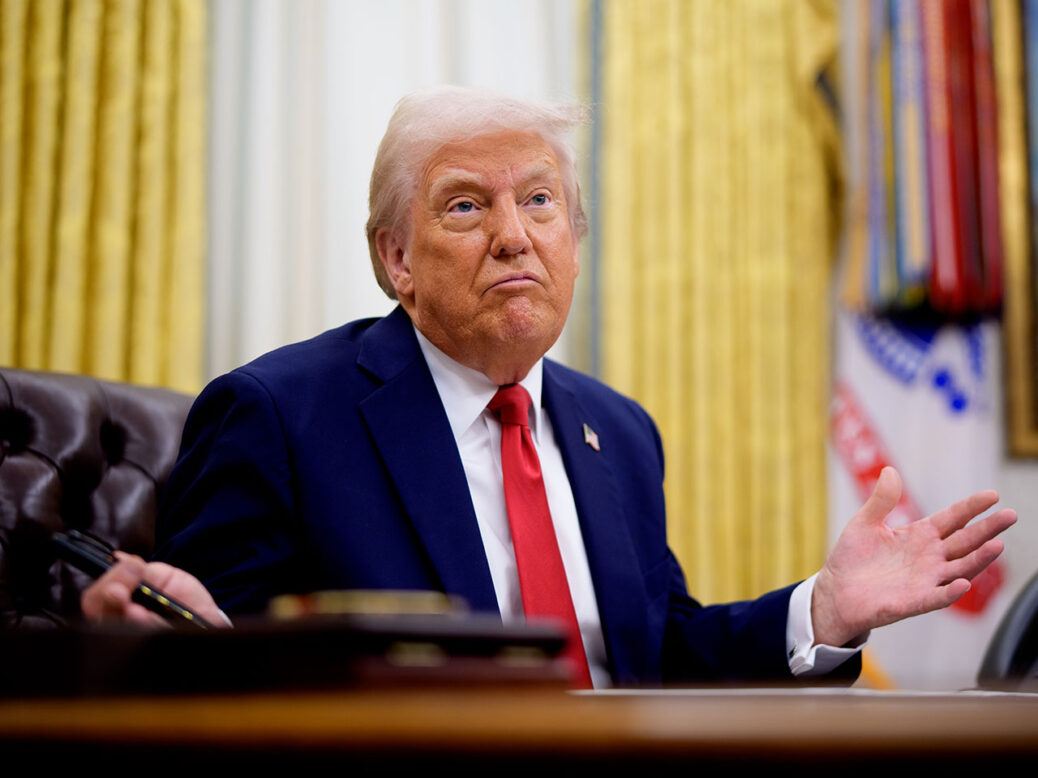
24 US states sue Trump over new 10% tariffs after Supreme Court blocks earlier duties

WASHINGTON D.C.: A group of US states said Thursday that they had filed a lawsuit against President Donald Trump‘s new tariffs on imports, imposed after the Supreme Court struck down his global duties last month.

In their lawsuit, attorneys general from New York, California, Oregon and other states argued that Trump had “once again exercised tariff authority that he does not have” in rolling out a 10-percent levy after his earlier duties were ruled illegal.

“Because these tariffs are unlawful, this court should declare that they are not in force” and order that refunds be made, the group of 24 states said in its filing to the US Court of International Trade.

Trump’s new tariffs last only for 150 days, unless they are extended by Congress, but he has already threatened to raise the rate to 15 percent and his administration is pursuing more lasting action.

For now, the states charged that Section 122 of the Trade Act of 1974 did not authorize Trump’s “immense and ever-changing” duties.

For one, the law was designed to allow limited tariffs to address issues like a significant “balance of payments” deficit, the group said — a situation the group says the United States is not facing.

The law also requires that new tariffs should not be applied discriminatorily, something the filing says Trump is doing.

“The new tariffs exempt many goods from Canada, Mexico, Costa Rica, the Dominican Republic, El Salvador, Guatemala, Honduras, and Nicaragua,” New York Attorney General Letitia James‘s office said in a statement.

“They also include 84 pages of specific product exceptions,” the statement said.

“Once again, President Trump is ignoring the law and the Constitution to effectively raise taxes on consumers and small businesses,” James said.

California Attorney General Rob Bonta said in a separate statement that the state had “challenged the illegal imposition of tariffs time and time again because this question matters enormously for Californians who are already struggling with rising costs.”

The Supreme Court’s ruling does not affect Trump’s sector-specific tariffs, but it has opened the door to a rush for refunds as importers try to get back lost revenues.

The tariffs now ruled illegal had generated more than $130 billion for the US government as of late-2025.

Explosion reported off tanker near Kuwait, crew safe, UKMTO says

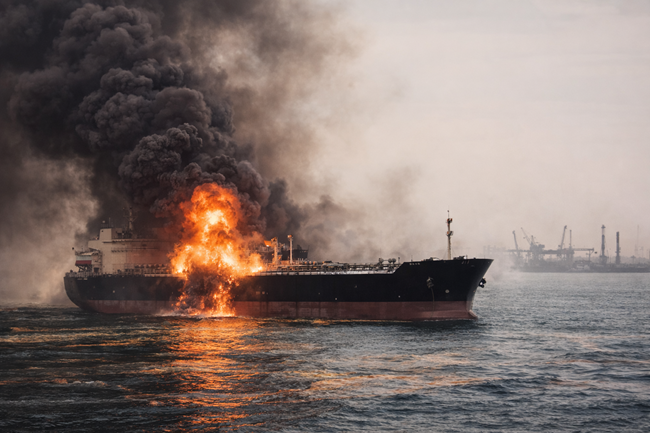
LONDON: A tanker at anchor off Kuwait ​reported seeing a large explosion ‌on its port side and was taking on water, the United Kingdom ​Maritime Trade Operations (UKMTO) said.

The master ​observed a small craft leaving ⁠the area following the explosion, ​which occurred 30 nautical miles (56 km) ​southeast of Kuwait’s Mubarak Al Kabeer port in the Gulf, UKMTO said.

“There is ​oil in the water coming ​from a cargo tank which could have some ‌environmental ⁠impact, the vessel has taken on water, there are no fires reported and the crew are ​safe,” it ​said ⁠in an advisory note.

Kuwait’s interior ministry said in ​a later statement that the ​incident ⁠occurred outside the country’s territorial waters, at least 60 km (37 miles) ⁠from ​Mubarak Al Kabeer ​port.

MSC introduces war-risk surcharge on Africa trade

GENEVA : Mediterranean Shipping Company (MSC) has announced the introduction of war-risk surcharges on cargo shipments bound for African markets and Indian Ocean island destinations. The new charges apply to cargo moving from both the Indian subcontinent and the Gulf region, according to MSC customer advisories.

The measure comes as shipping activity across key Middle Eastern maritime corridors faces disruption and heightened security concerns.

Under the updated surcharge structure, shipments originating in India, Pakistan, Sri Lanka and Bangladesh and destined for East Africa, Somalia, Mozambique and Indian Ocean island ports will incur additional fees.

Cargo transported from Gulf countries to destinations in West, East and Southern Africa, as well as Mozambique and Indian Ocean island markets, is also subject to the surcharge.The cost increase varies depending on the origin of the shipment and container type.

For cargo departing from the Indian subcontinent, MSC has set the surcharge at $500 per 20-foot dry container and $1,000 for refrigerated units.

Shipments originating in the Gulf face higher charges. According to the carrier, the surcharge amounts to $2,000 for 20-foot containers, $3,000 for 40-foot containers, and $4,000 for refrigerated containers travelling to the affected regions.

The surcharges took effect on 5 March 2026 and apply to cargo moving along the affected trade routes until further notice.Shipping companies have increasingly adopted such measures as security risks and operational disruptions affect traffic through critical maritime chokepoints, including routes linking the Middle East with Africa and the Indian Ocean.

Additional surcharges are typically introduced to offset higher operational costs associated with navigating areas exposed to geopolitical tensions or maritime security threats.

Saudi Red Sea Authority Appoints Dr. Maryam Ali Ficociello as Chief Executive Officer

RIYADH: The Saudi Red Sea Authority (SRSA) on Friday announced the appointment of Dr. Maryam Ali Ficociello as Chief Executive Officer, effective March 22nd, 2026. Her appointment marks a new phase in the Authority’s continued mandate to regulate and enable navigational and marine tourism activities across the Kingdom’s Red Sea. In doing so, the Authority remains committed to safeguarding its marine environment and supporting sustainable investment and growth.

Dr. Ficociello brings more than two decades of leadership experience spanning governance, risk management, resilience, and compliance across public and private sectors, including state-owned entities. Most recently, Dr. Ficociello served as the Group Chief Governance Officer at Red Sea Global, where she led the Governance, Risk, and Compliance Division. Her extensive expertise in executive leadership has positioned her as a key advisor on sustainability and ESG matters.

In addition to her professional background, Dr. Ficociello is a dedicated sailor and avid diver, with a profound passion for the oceans. Her love for the marine environment drives her commitment to preserving marine ecosystems and promoting sustainable practices.

She has actively contributed to national initiatives and frameworks, including support on various sustainability targets of the Saudi Green Initiative and was a Founding Member and Secretary of the Executive Committee for the Oversight of the Sustainability of the Red Sea, reflecting her sustained focus on marine ecosystem protection and the advancement of the Blue Economy. Dr. Ficociello has represented the Kingdom at international forums, including the UN Climate Change Conference, UN Ocean Conference and led the Saudi Ocean 20 delegation to the G20.

Commenting on her appointment, Dr. Ficociello said: “It is an honor to join the Saudi Red Sea Authority at this pivotal stage in its journey. SRSA has a critical role in enabling a world-class coastal tourism sector that is safe, well-governed, and investment-ready, while protecting the Red Sea’s unique marine ecosystems. I look forward to working with our stakeholders across government and industry to strengthen regulatory excellence, embed sustainability and resilience across the sector, and advance the Kingdom’s ambitions for responsible coastal tourism and the Blue Economy.”

SRSA also expressed its sincere appreciation to outgoing Chief Executive Officer Mr. Mohammad Ali Al-Nasser for his leadership over the past four years. During his tenure, Mr. Al-Nasser played a central role in laying SRSA’s foundations, supporting the establishment of SRSA’s operating model, advancing its regulatory and institutional capabilities, and strengthening integration with national partners to accelerate the development of coastal tourism.

Global trade reroutes to Africa as Hormuz traffic plunges 90%

LONDON: Commercial shipping traffic through the Strait of Hormuz has dropped as much as 90% amid escalating conflicts in the Middle East, forcing global maritime trade to reroute around the Cape of Good Hope, located at the southern tip of the Cape Peninsula, about 50 kilometers (31 miles) south of Cape Town in South Africa.

After Tehran’s closure of the critical energy and oil waterway in response to joint U.S.-Israeli attacks on Iran, the U.K. Maritime Trade Operations (UKMTO) Center raised the security risk in the transport corridor to critical, prompting insurers to immediately cancel war coverage policies for vessels in the region.

Only four ships transited through the strait on March 3, marking a 90% drop versus the previous seven-day average, according to real-time tracking data from Windward.

The strait has historically handled an average of 138 vessels per day.

Oil tanker traffic also saw a similar 90% plunge compared to pre-attack levels, data from MarineTraffic showed.

Major firms suspend Gulf passages

Meanwhile, Cape of Good Hope transit saw 94 vessels on March 3, up 35% versus the route’s seven-day average.

Major shippers like Hapag-Lloyd, CMA CGM and Maersk suspended all Gulf transits and rerouted around the southern tip of Africa, which adds 10-20 days to delivery times and inflates transport costs.

Hapag- Lloyd told Anadolu Agency (AA) in a statement that the firm’s fleet has not transited through the Red Sea since December 2023, and the firm extended this decision in light of the current situation in the region and the related threats from Iranian-backed Yemeni Houthis.

French shipper CMA CGM announced it instructed all its ships in the Gulf and bound for the region to seek shelter, while passage through the Suez Canal has been suspended until further notice.

Maersk suspended voyages for vessels passing through the Suez Canal via the Bab el-Mandeb Strait, while rerouting all voyages from the Middle East and India ⁠to the Mediterranean and from the Middle East and India to the east coast of the U.S. around the Cape of Good Hope.⁠

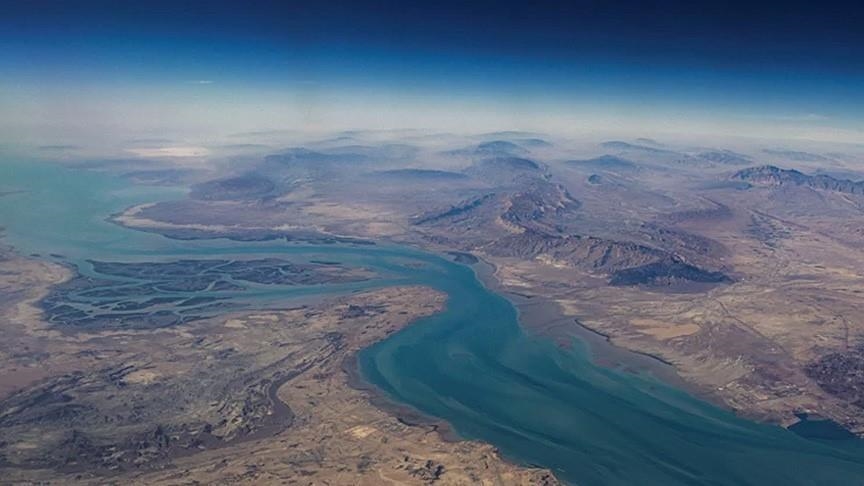
The Strait of Hormuz is a strategically vital waterway positioned at the mouth of the Persian Gulf. The transport corridor connects Middle Eastern oil and liquefied natural gas (LNG) production to global markets via the Arabian Sea and the Indian Ocean.

The waterway handles the transit of around 20 million barrels of oil and petroleum products per day while accounting for roughly one-third of all crude oil transported by sea.

⁠China alone consumes 5.3 million barrels of crude oil transited through there, while India consumes 2 million barrels, Japan and South Korea 1.7 million barrels each, and other countries receive a combined 4.2 million barrels via the Strait of Hormuz, according to S&P Global data.

At the same time, Saudi Arabia is the largest exporter using the strait with 5.1 million barrels of crude oil shipped per day, followed by Iraq with 3.3 million barrels, the United Arab Emirates with 2.6 million, Iran with 1.7 million, Kuwait with 1 million, and other regional producers totaling 1 million barrels.

Meanwhile, the UAE and Saudi Arabia are the top exporters of 5 million barrels of refined petroleum products transiting the waterway daily, making up for 1.26 million and 1.04 million barrels per day, respectively.

Oil tankers began to divert to the Port of Yanbu on Saudi Arabia’s western coast, while loadings at the port surged to 2.44 million barrels per day so far in March, way above its six-month daily average of 650,000-940,000 barrels.

The Iraqi Oil Ministry halted production at the Rumania complex in Basra on Tuesday due to severe tanker constraints preventing vessels from entering the Gulf basin, pushing crude oil levels at domestic storage facilities to critical maximums.

Iraq’s Basra Port, which normally boasts a daily capacity of 3.5 million barrels, handled zero crude oil on Monday.

JPMorgan analysts say that major regional oil producers will be forced to shut down facilities if the disruption in the Strait of Hormuz persists for 21 days.

Tehran actively targeted regional oil and natural gas production plants by drone-striking Saudi Aramco facilities in the eastern Saudi city of Ras Tanura in retaliation for the U.S.-Israeli joint operation.

State-owned QatarEnergy reportedly halted production at its massive LNG facility in Ras Laffan after drone strikes on Monday, deepening global fears of a severe market tightening.

LNG competition between Asia, Europe may ramp up

Ross Wyeno, head of LNG short-term analysis at S&P Global, told AA that supply is insufficient to compensate for the massive imbalance caused by production halts in Qatar and the UAE.

Wyeno stated that the U.S. boasts the largest flexible LNG source in the world, so the freely loaded American LNG will go to Asia, where prices are the highest.

He said shipments from the U.S. will become more and more scarce if the situation does not improve, potentially impeding Europe’s efforts to fill its storage facilities and tighten the gas balance.

A recent development reflects this, as an LNG tanker originally bound for Europe reportedly changed course on Wednesday due to the price hike and was now headed for Asia on Thursday.

Indonesia, Philippines, Vietnam forging maritime security triangle

HAMILTON: Faced with mounting challenges, Indonesia, the Philippines and Vietnam are exploring security cooperation focused on maritime order in the South China Sea. The nations are advancing a framework that reinforces Association of Southeast Asian Nations (ASEAN)-led regionalism while maintaining sovereign flexibility.

A growing network of bilateral arrangements forms the core of a trilateral relationship centered on legal clarity and operational readiness. “What we’re really seeing first is practical cooperation at sea, especially between coast guards,” Ridvan Kiliç, an Australia-based defense analyst, told FORUM. “That’s where Indonesia, Vietnam and the Philippines are finding common ground in very operational, day-to-day ways.”

A significant legal measure underpinning cooperation is an Indonesia-Vietnam agreement demarcating the nations’ overlapping exclusive economic zones (EEZ) in the North Natuna Sea. Settling the EEZ claims under the United Nations Convention on the Law of the Sea was “particularly significant because it removed a long-standing source of friction,” Kiliç said.

The legal alignment enabled Hanoi and Jakarta to expand joint coast guard activities, and in March 2025, the nations elevated ties to a Comprehensive Strategic Partnership, incorporating defense industry cooperation and officer exchanges.

Meanwhile, the Philippines and Vietnam have built mechanisms to manage tensions and reduce risks in contested waters. A 2024 joint statement gave assurances of strengthened maritime law enforcement and search and rescue cooperation, and recent defense policy dialogues have expanded to include cybersecurity, logistics and medical cooperation.

In early 2025, coast guard and fisheries personnel from Indonesia, the Philippines, the United States and Vietnam conducted a two-week maritime law enforcement course in the southern Philippines. The training focused on boarding procedures, arrest techniques, evidence handling and risk mitigation. According to the U.S. Embassy in Manila, the engagement strengthened regional coordination against illegal maritime activity.

Forums such as the ASEAN Defence Ministers’ Meeting provide complementary channels for information sharing, joint training and doctrinal coordination among Indonesia, the Philippines and Vietnam. The nations also regularly co-chair expert working groups, particularly on maritime security.

The ASEAN Coast Guard Forum — initiated by Indonesia in 2022 and hosted by the Philippines in 2024 — is a venue for advancing protocols to prevent maritime incidents.

“At the core, all three countries share an interest in upholding a rules-based maritime order,” Kiliç said. “That common legal and normative position is a quiet but powerful driver of their cooperation.”

Source: FORUM

Pandu, Bogibeel, Silghat & Biswanath Ghat to station country’s first Riverine Lighthouses

DIBRUGARH : India took a pioneering step in inland waterway navigation as Union Minister of Ports, Shipping and Waterways (MoPSW), Shri Sarbananda Sonowal laid the foundation stones for four river lighthouses along the banks of the Brahmaputra River, marking the first time lighthouse infrastructure will be established on an inland waterway in the country. The ceremony, held at Lachit Ghat, Guwahati, was jointly organised by the Directorate General of Lighthouses and Lightships (DGLL) and the Inland Waterways Authority of India (IWAI), under the aegis of the Ministry of Ports, Shipping and Waterways (MoPSW).

HCo8WPqawAADmhk Pandu, Bogibeel, Silghat & Biswanath Ghat to station country’s first Riverine Lighthouses

The four sites — Bogibeel in Dibrugarh district, Pandu in Kamrup (Metro) district, Silghat in Nagaon district, all along the south bank of the river, and Biswanath Ghat in Biswanath district, the only one in the north bank, — are located at strategic points along Brahmaputra (National Waterway-2), one of India’s most important inland cargo and passenger corridors. The combined project outlay for all four lighthouses stands at approximately ₹84 crore. Each lighthouse will rise to 20 metres with a geographical range of 14 nautical miles and a luminous range of 8–10 nautical miles, powered entirely by solar energy. Alongside navigation infrastructure, every site will feature a museum, amphitheatre, cafeteria, children’s play area, souvenir shop and landscaped public spaces, positioning each lighthouse as a tourism landmark as well as a functional maritime asset.

The commissioning of river lighthouses on NW-2 is a direct response to a 53 percent surge in cargo movement on the Brahmaputra waterway in the financial year 2024–25, as recorded by IWAI. Cargo traffic on NW-2 has been growing consistently and the Brahmaputra corridor is now integral to supply chains serving Assam’s tea, coal and fertiliser industries, in addition to carrying passenger and tourism traffic. The new lighthouses will enable 24×7 safe navigation, accommodate weather observation sensors and provide the navigational infrastructure necessary for the sustained growth of both freight and passenger movement on the river.

“Under the dynamic leadership of Prime Minister Shri Narendra Modi ji, inland waterways are not merely an alternative to roadways and railways but they are being energised and enabled as force multiplier for our economy. A tonne of freight moved by water costs a fraction of what road transport demands, generates a fraction of the carbon, and frees our highways for passengers and time-sensitive goods. These lighthouses on the Brahmaputra are a statement of intent: that India’s rivers are open for business, round the clock,” said Sarbananda Sonowal, Union Minister for Ports, Shipping and Waterways (MoPSW).

The foundation stone ceremony was attended by Ranjeet Kumar Dass, Minister of Tourism, Government of Assam; Charan Boro, Minister of Transport, Government of Assam; Jayanta Mallabaruah, Minister of Public Health Engineering, Government of Assam; Bijuli Kalita Medhi, Member of Parliament, Guwahati; and Siddhartha Bhattacharya, MLA, East Guwahati. Senior officials present included Vijay Kumar, IAS, Secretary, Ministry of Ports, Shipping and Waterways, and N. Muruganandam, Director General, DGLL.

“Waterways offer a decisive cost advantage. Moving a tonne of cargo by inland waterway costs roughly one-third of road transport and half of rail. For a region like Northeast India, where road infrastructure is perpetually under pressure from both traffic and terrain, activating the Brahmaputra as a full-scale freight corridor is not a choice but a necessity,” Sonowal added.

The project was conceived following an initiative by the Minister’s Office to explore the feasibility of river lighthouses in the Northeast. A Memorandum of Understanding (MoU) between IWAI and DGLL was signed on April 8, 2025, covering all four sites. Sites were formally transferred to DGLL under Right of Use agreements executed in June 2025, after a technical proposal placed before the Central Advisory Committee for Aids to Navigation. Each lighthouse is scheduled for completion within 24 months of award of contract, following geotechnical investigation, topographic survey and detailed design.

“As traffic on NW-2 grows, the environmental and congestion benefits compound — fewer emissions, less road wear, lower accident risk, and a more resilient supply chain for the Northeast. The Deepstambh lighthouses will make night navigation safe and reliable, removing the single largest barrier to round-the-clock waterway operations,” added Sonowal.

The Directorate General of Lighthouses and Lightships (DGLL), under the Ministry of Ports, Shipping and Waterways, is the statutory authority responsible for providing aids to navigation across India’s 11,098 kilometre coastline and now its inland waterways. The Inland Waterways Authority of India (IWAI) administers and develops India’s network of national waterways, which spans over 20,000 kilometres, managing infrastructure, terminals and navigational facilities to enable cargo and passenger movement across the country’s rivers, backwaters and creeks.

NW-2 connects Assam’s Dhubri to Sadiya across a navigable length of 891 kilometres — the longest navigable stretch of any Indian waterway — passing through the heart of India’s Northeast. The four lighthouses mark the beginning of what MoPSW describe as a wider programme to equip India’s inland waterways with the same navigational safety infrastructure that has long governed its coasts.

JNPA shatters all-time records, surpasses 7.33 Million TEUs in FY 2025-26

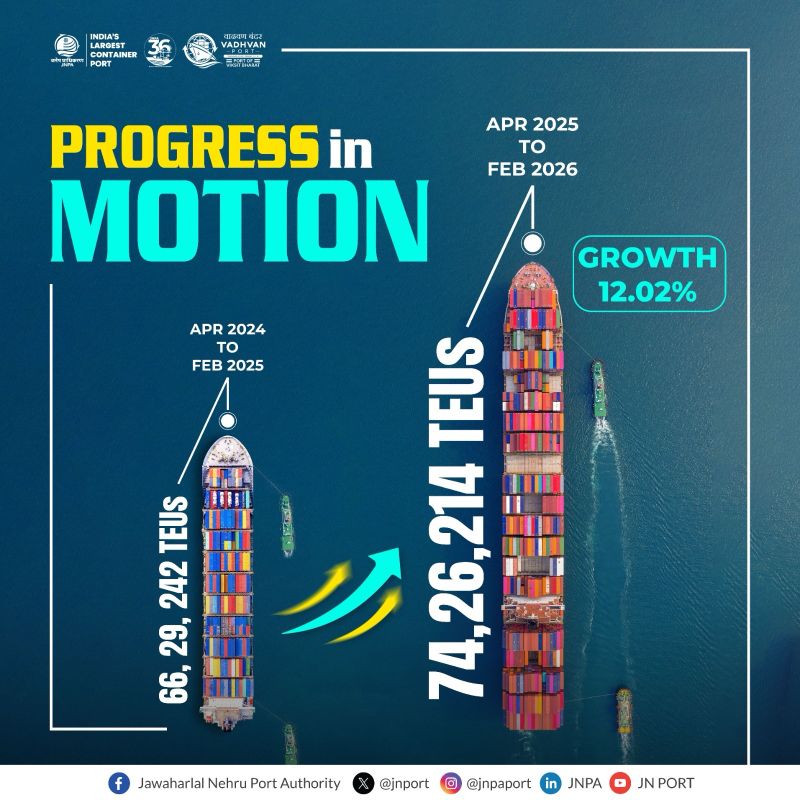
MUMBAI : The Jawaharlal Nehru Port Authority (JNPA) has achieved a significant milestone in the current financial year, recording a container throughput of 74,26,214 TEUs and an overall cargo throughput of 92.85 million metric tonnes (MMT) during April 2025 to February 2026, surpassing the previous record of 73,01,509 TEUs and 92.12 MMT handled during the corresponding period last year.

The performance underscores the port’s sustained growth trajectory and its pivotal role in facilitating India’s maritime trade.

According to the latest traffic data released by JNPA, the port handled 6,68,363 TEUs of containers in February 2026, compared to 6,16,164 TEUs in February 2025, reflecting a year-on-year growth of 8.47 per cent in container traffic. During the same month, the port recorded total cargo throughput of 8.35 million tonnes, registering a 10.51 per cent increase over February 2025.

Officials noted that the strong performance has been driven by improved operational efficiency across JNPA’s container terminals, enhanced port infrastructure, and streamlined logistics processes. The port continues to strengthen multimodal connectivity and operational capabilities to support the growing demands of international trade.

Established in 1989 near Mumbai, JNPA is India’s premier container gateway and among the country’s leading ports, with extensive rail and road connectivity linking it to major industrial and consumption centres across the hinterland.

The latest milestone highlights JNPA’s continued commitment to operational excellence, efficient cargo handling, and strengthening India’s maritime logistics ecosystem, reinforcing its position as a key driver of the nation’s port-led economic growth.

NMPA surpasses last year’s cargo throughput, registers strong growth in FY 2025–26

MANGALURU : New Mangalore Port Authority (NMPA) has continued its strong growth trajectory in the current financial year, recording an impressive cargo handling performance and surpassing last year’s total throughput ahead of the financial year-end.

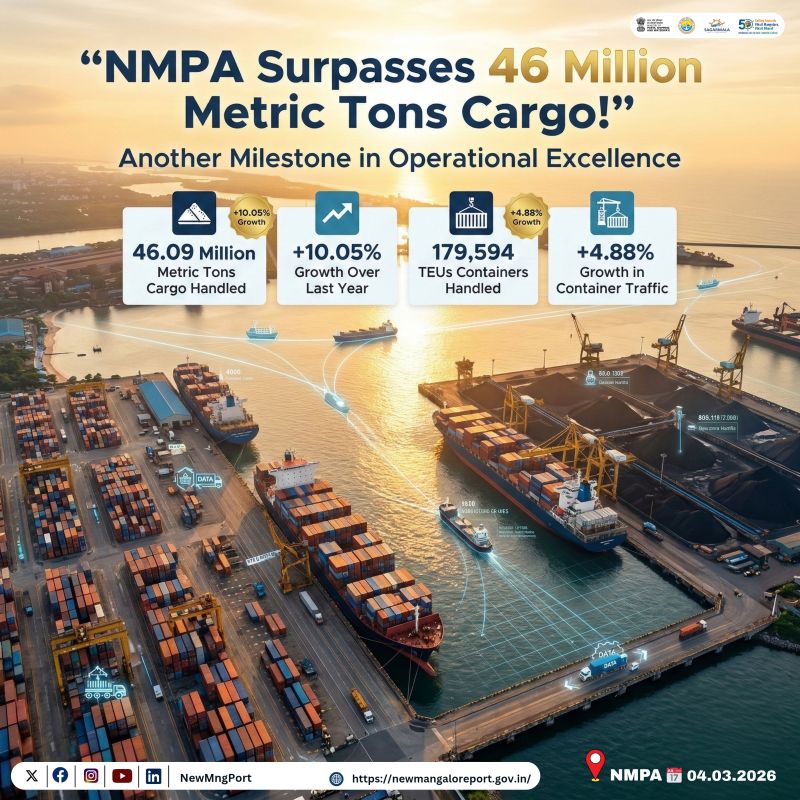
As on 4 March 2026, the Port has handled 46.09 Million Metric Tons (MMT) of cargo, exceeding the 46.01 MMT handled during the entire FY 2024–25. The achievement highlights the Port’s improving operational efficiency, enhanced infrastructure utilisation, and sustained engagement with trade stakeholders.

Port officials attributed the milestone to streamlined cargo operations, improved vessel turnaround time, and coordinated efforts by terminal operators, shipping lines, logistics partners, and the port workforce. The steady performance also reflects the port’s growing role in facilitating trade across India’s western coast.

Container Traffic Records Steady Growth

Container operations at the port have also registered consistent growth during the current financial year. NMPA handled 179,594 TEUs of container cargo during the period, compared to 171,234 TEUs during the corresponding period of the previous year, marking a growth of 4.88 percent.

The rise in container volumes indicates increasing demand from regional industries and exporters, particularly from sectors such as agro-products, chemicals, tiles, marine products, and manufactured goods, which rely on efficient containerised logistics for domestic and international trade.

Strengthening Trade and Logistics Efficiency

Located on the west coast of India in Mangaluru, the port continues to play a vital role in handling diverse cargo streams including petroleum products, coal, fertilisers, edible oils, containerised cargo, and other bulk commodities. The Port Authority has been actively focusing on modernisation, digitalisation of port operations, and enhanced multimodal connectivity to further improve cargo movement efficiency.

Officials noted that the port’s consistent growth reflects strong collaboration with trade partners, efficient cargo evacuation systems, and sustained infrastructure improvements aimed at supporting higher volumes in the coming years.

The latest milestone underscores NMPA’s commitment to strengthening maritime trade, improving logistics efficiency, and contributing to India’s economic growth while positioning the port as a key gateway for cargo movement in the region.

CONCOR introduces bulk cement movement in tank containers, boosting efficient and Green Logistics

BENGALURU : State-run logistics major Container Corporation of India Limited (CONCOR) has introduced specialised logistics services for the bulk transportation of cement in loose form through advanced tank containers, marking a significant step toward modernising India’s cement supply chain.

The new service is currently operational for My Home Industries Limited’s My Home Cement plant at Mellacheruvu in Andhra Pradesh. Under this arrangement, cement is transported directly from plant silos to the CONCOR Inland Container Depot Bengaluru in Bengaluru using specially designed bulk tank containers via rail.

The initiative represents a shift from conventional bagged transportation to modern bulk logistics solutions, significantly improving operational efficiency while reducing handling and environmental impact.

Bulk movement of cement through rail-based tank containers offers several advantages over traditional bagged road transport. These include reduced handling losses and material wastage, lower logistics costs, and faster turnaround times, enabling manufacturers and distributors to optimise their supply chain operations. The system also ensures safer and dust-free transportation, helping maintain product quality while improving workplace safety.

Additionally, the shift to rail-based bulk movement contributes to lower carbon emissions, supporting India’s growing focus on sustainable and environmentally responsible logistics practices. By reducing dependency on road transport, the initiative also helps decongest highways and improve the overall efficiency of freight movement.

Industry observers note that bulk cement logistics using tank containers is widely adopted in several global markets, and its gradual expansion in India could transform the way cement is distributed across major consumption centres.

With this initiative, CONCOR continues to strengthen the country’s multimodal logistics infrastructure while promoting efficient, sustainable, and future-ready freight solutions for the cement industry. The company is expected to expand similar services to other cement manufacturers and industrial clusters across the country, further supporting the government’s push toward green logistics and rail-based freight movement.