Home Blog Page 457

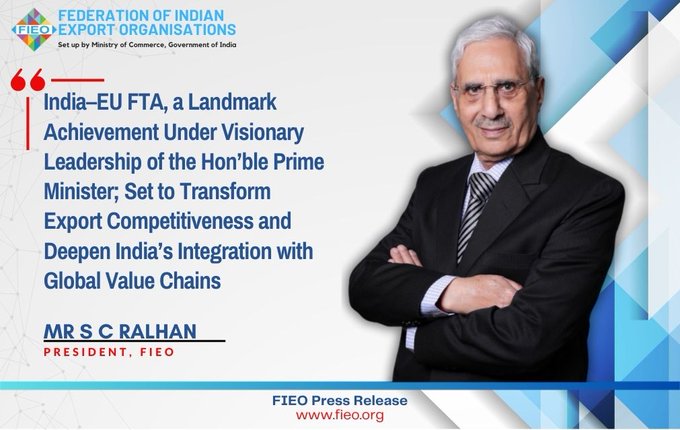
India–EU FTA, a landmark achievement under visionary leadership of the Hon’ble Prime Minister; Set to transform export competitiveness and deepen India’s integration with Global Value Chains: President, FIEO

NEW DELHI : The Federation of Indian Export Organisations (FIEO) has wholeheartedly applauded the visionary leadership, strategic foresight, and decisive diplomacy of the Hon’ble Prime Minister of India, following the historic announcement of the conclusion of the India–European Union Free Trade Agreement (India–EU FTA). The landmark agreement was jointly announced by the Hon’ble Prime Minister Shri Narendra Modi, and European Commission President H E Ms Ursula von der Leyen, at the 16th India–EU Summit held in New Delhi.

The conclusion of the India–EU FTA marks a defining milestone in India’s global economic journey and stands as a testament to the Government of India’s unwavering commitment to trade-led growth, economic reforms, and global integration. The agreement reinforces India and the European Union as trusted and reliable partners committed to open markets, predictability, and inclusive growth. It is the outcome of persistent, result-oriented negotiations steered with strong political resolve by the Government since the re-launch of talks in 2022, reflecting a shared vision to establish a balanced, modern, and rules-based economic partnership, said Mr S C Ralhan, President, FIEO.

The European Union is among India’s largest trading partners. In FY 2024–25, India–EU bilateral trade in goods stood at INR 11.5 lakh crore (USD 136.54 billion), with exports of INR 6.4 lakh crore (USD 75.85 billion) and imports of INR 5.1 lakh crore (USD 60.68 billion). Trade in services reached INR 7.2 lakh crore (USD 83.10 billion). Together, India and the EU represent the 4th and 2nd largest economies globally, accounting for nearly 25% of global GDP and one-third of global trade—an opportunity that the Government of India has strategically unlocked through this transformative agreement.

Commenting further, Mr Ralhan stated that the successful conclusion of the India–EU FTA under the dynamic and reform-oriented leadership of the Hon’ble Prime Minister is a landmark national achievement, which will significantly enhance India’s export competitiveness and provide a powerful thrust to India’s engagement with global value chains. This agreement opens unprecedented market access for Indian exporters across goods and services, particularly empowering labour-intensive sectors, MSMEs, women entrepreneurs, artisans, and youth—core focus areas of the Government’s inclusive growth agenda.

He added that with tariff elimination of up to 10% on nearly USD 33 billion worth of Indian exports, the FTA will provide immediate and tangible gains to key sectors such as textiles, apparel, leather, footwear, gems and jewellery, engineering goods, marine products, handicrafts, and automobiles. These benefits will translate into higher exports, large-scale employment generation, and stronger grassroots participation in global trade, reinforcing the Government’s vision of export-led prosperity.

The agreement comprehensively covers trade in goods and services, rules of origin, customs facilitation, trade remedies, and emerging areas such as digital trade and MSMEs. It includes robust mechanisms to address non-tariff barriers—an outcome of the Government’s proactive engagement with EU regulators—through enhanced regulatory cooperation, transparent SPS measures, and streamlined customs procedures. The calibrated and quota-based liberalisation in the automobile sector will allow EU manufacturers to introduce advanced models in India, while creating future opportunities aligned with the Government’s ‘Make in India’ and ‘Atmanirbhar Bharat’ initiatives.

Indian consumers are expected to benefit from improved access to high-technology products and increased competition. Agriculture and processed food exports will receive a major boost, with enhanced market access for tea, coffee, spices, fruits, vegetables, and processed foods, while the Government has prudently safeguarded sensitive sectors such as dairy and cereals, ensuring farmer interests remain fully protected.

The FTA delivers commercially meaningful commitments in services, including IT/ITeS, professional services, education, financial services, tourism, construction, and other business services. Predictable market access across 144 EU subsectors will significantly enhance opportunities for Indian service providers, while reciprocal access will attract high-technology services and investment into India. Progressive mobility provisions reflect the Government’s sustained efforts to secure global opportunities for Indian professionals, covering short-term business travel, intra-corporate transfers, contractual service suppliers, independent professionals, and work rights for dependents.

Additionally, India has secured recognition for practitioners of Indian Traditional Medicine to work under home title in EU Member States where such practices are not regulated—a significant diplomatic and cultural achievement reflecting the Government’s commitment to global recognition of India’s traditional knowledge systems. The agreement reinforces intellectual property protections under TRIPS, recognises the Traditional Knowledge Digital Library (TKDL), and promotes cooperation in cutting-edge areas such as artificial intelligence, clean technologies, semiconductors, and sustainable development, including support related to CBAM compliance.

Mr Ralhan further reiterated that the India–EU FTA, together with the Government’s recent FTAs with the UK and EFTA, effectively opens the entire European market for Indian exporters, marking a strategic breakthrough in India’s trade diplomacy. This landmark agreement aligns seamlessly with the vision of ‘Viksit Bharat 2047’, and positions India as a resilient, competitive, and forward-looking global trade leader.

The India–EU FTA heralds a new era in bilateral economic engagement, reflecting the Government of India’s strategic clarity, negotiating strength, and long-term vision—strengthening trade, investment, and strategic cooperation with the 27-member European Union while laying robust foundations to address future global challenges.
Cochin Shipyard reports ₹145 crore Q3 profit, announces 70% dividend

KOCHI : Cochin Shipyard Limited (CSL), India’s premier shipbuilding and maintenance company under the Ministry of Ports, Shipping and Waterways, today announced its financial results for the third quarter ended December 31, 2025, along with key board decisions on shareholder returns and strategic initiatives.

Quarterly Financial Highlights

CSL posted a consolidated net profit of ₹144.67 crore for Q3 FY26, demonstrating resilient performance despite challenging conditions.

Profit declined year-on-year compared to ₹176.99 crore in Q3 of the previous fiscal period.

Revenue from operations increased to ₹1,350.41 crore, reflecting an 18% rise over the year-ago quarter.

Dividend Declaration

The Board of Directors approved a second interim dividend of ₹3.50 per equity share, equivalent to 70% on a face value of ₹5 for FY 2025-26.

Record Date: February 3, 2026.

Dividend Payment: Scheduled on or before February 26, 2026.

Strategic Board Decisions

In addition to financial results and shareholder returns, the CSL Board has approved strategic initiatives aimed at enhancing future growth and global competitiveness:

Joint Venture: Formation of a joint venture with HBL Engineering Limited to develop electric mobility technology and energy storage solutions tailored for marine applications.

Global Expansion: Approval of the acquisition of a 23% equity stake in Conoship International Holding B.V., a Netherlands-based ship design and engineering firm, to strengthen CSL’s presence in the European market and access advanced design capabilities.

Outlook

Cochin Shipyard continues to balance near-term performance with long-term strategic positioning in shipbuilding, ship repair, and emerging maritime technologies. The company’s focus on diversification and international collaboration underscores its commitment to growth amidst evolving industry dynamics.

GRSE Q3 FY26 results : Net profit soars 74% YoY; declares ₹81.9 crore dividend

KOLKATA : State-run defence shipyard Garden Reach Shipbuilders & Engineers Ltd (GRSE) reported a stellar 73.9% year-on-year jump in net profit to ₹170.77 crore for the quarter ended December 2025, driven by strong execution of its order book.

The Miniratna defence PSU’s revenue from operations surged 49.1% to ₹1,895.69 crore during the quarter compared to ₹1,271 crore in Q3 FY25. For the nine-month period (April-December 2025), the company posted a net profit of ₹444.74 crore on revenue of ₹4,882.95 crore.

Board Declares Second Interim Dividend
The company’s board declared a second interim dividend of ₹7.15 per equity share (face value ₹10) for the financial year 2025-26, amounting to a total payout of ₹81.90 crore. The record date for determining eligible shareholders has been fixed as February 3, 2026.

What This Means:
GRSE’s strong quarterly performance reflects the accelerated naval modernization program and the government’s focus on indigenous defence manufacturing. The company, which specializes in building warships and survey vessels for the Indian Navy and Coast Guard, continues to benefit from the ‘Make in India’ initiative in defence.

The interim dividend declaration signals confidence in sustained profitability and cash flows, making GRSE an attractive proposition for investors seeking exposure to India’s defence manufacturing growth story.

TVS Supply Chain Solutions acquires Swamy & Sons 3PL for ₹88 crore

TVS Supply Chain Solutions (SCS), one of India’s largest integrated supply chain solution providers, on Wednesday announced the strategic acquisition of a Hyderabad-based third-party logistics (3PL) firm, Swamy & Sons 3PL (S&S3PL).

The company has a well-established operating footprint and marquee customer relationship in the fast-moving consumer goods (FMCG) as well as the fast-moving consumer durables (FMCD) spaces. It has a strong presence in Andhra Pradesh and Telangana.

The acquisition was done through TVS SCS’ wholly-owned subsidiary, FIT 3PL, for an enterprise value of ₹88 crore. The acquisition will be funded through internal accruals.

Over the years, S&S3PL has built deep domain expertise in FMCG logistics and serves a portfolio of leading customers across the country.

Its proven capabilities in managing high-volume, time-sensitive supply chains have established the company as a preferred partner for leading FMCG brands. This acquisition marks a significant strategic milestone for TVS SCS’ India operations, strengthening its position as a key solutions provider in the FMCG and FMCD segments.

ONGC signs resource-sharing pact with Reliance to strengthen India’s offshore energy push

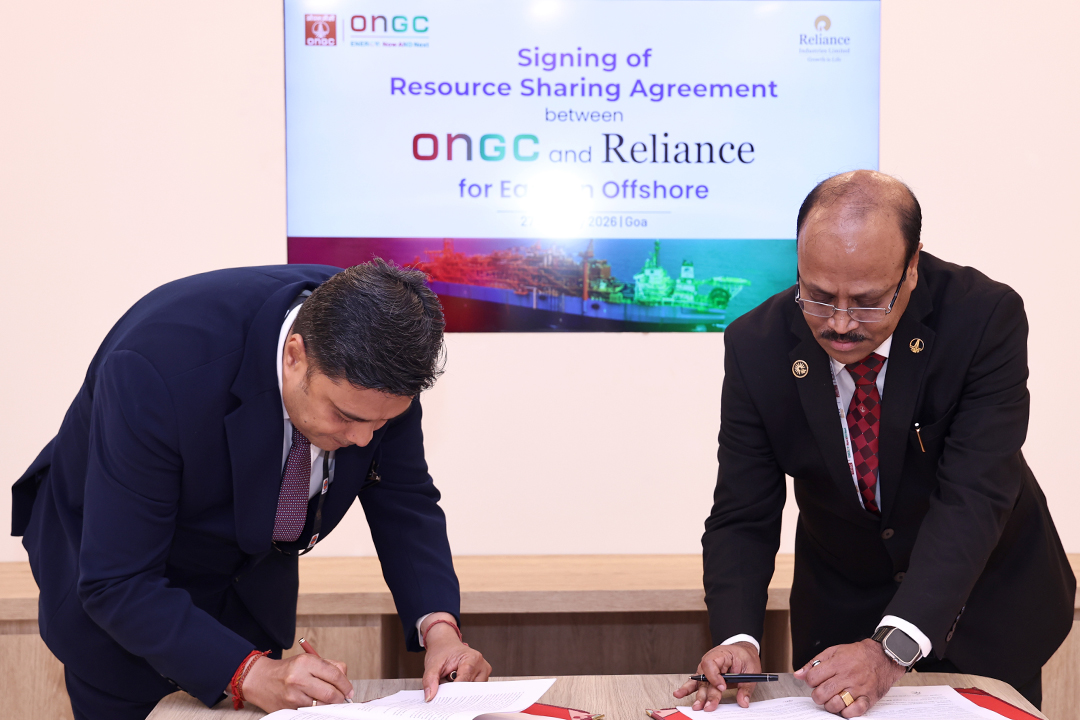
GOA : In a significant step toward strengthening India’s offshore energy capabilities, Oil and Natural Gas Corporation (ONGC) and Reliance Industries Limited (RIL) have formalised a resource-sharing collaboration in line with the Hon’ble Prime Minister’s vision of shared infrastructure and national energy security.

ONGC RELIANCE ONGC signs resource-sharing pact with Reliance to strengthen India’s offshore energy push

The partnership, announced on January 27, 2026, is designed to enhance operational efficiency, enable faster execution of offshore projects, and create stronger synergies between India’s largest public-sector energy producer and one of its leading private energy companies.

Under the collaboration, ONGC and Reliance will explore opportunities to jointly utilise resources, infrastructure, and technical capabilities across offshore energy activities. The initiative is expected to reduce duplication of efforts, optimise capital deployment, and support timely development of offshore assets, which are critical to meeting India’s growing energy demand.

The collaboration marks an important milestone in India’s offshore energy journey, reflecting a shift toward cooperative models that balance efficiency with long-term strategic interests. Industry observers see this partnership as a practical approach to strengthening domestic energy production while improving resilience against global supply disruptions.

Aligned with the government’s broader energy and maritime vision, the ONGC-Reliance collaboration reinforces India’s focus on self-reliance, faster project execution, and sustainable development of offshore resources. Further details on specific projects and operational frameworks are expected to be shared in due course.

RBI signs a MoU with ESMA aims to enable formal recognition of CCIL

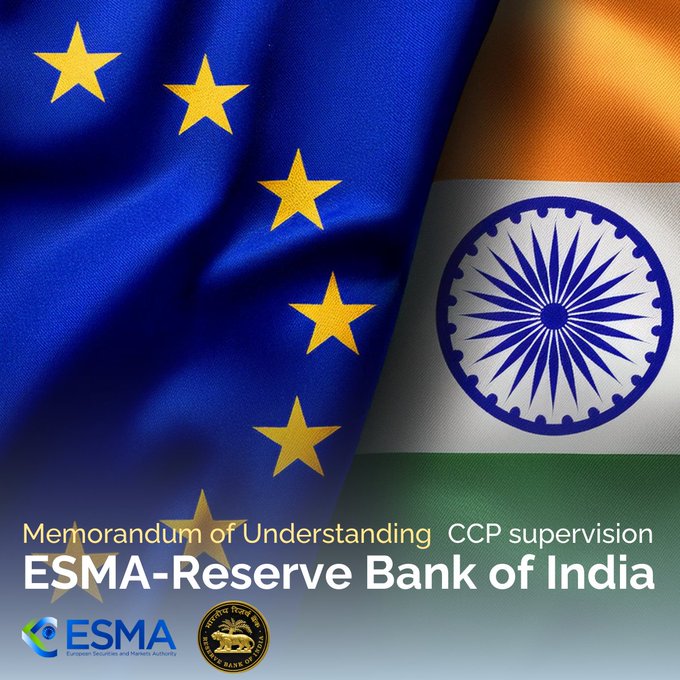
NEW DELHI : With the approval of the Union Cabinet, Reserve Bank of India (RBI) signed a Memorandum of Understanding with the European Securities and Markets Authority (ESMA) during the Visit of President of the European Council and President of the European Commission to India on 27.01.2026.

The primary objective of the MoU is to enable formal recognition of the Clearing Corporation of India Ltd. (CCIL) and other RBI-regulated Central Counterparties by ESMA.

The MoU is a statement of intent of RBI and ESMA, with respect to the covered Central Counterparties (CCPs), and cooperation in regulatory and supervisory practices to the extent permitted by applicable laws and regulations. RBI and ESMA will consult, cooperate and exchange information with each other with regard to the covered Central Counterparties (CCPs) and monitoring of the compliance by the covered CCPs with the recognition conditions. In fulfilment of its responsibilities and objectives, ESMA will rely as appropriate upon the regulatory framework and supervision of the RBI, recognising that the RBI remains accountable in India for the resilience of the Covered CCPs under its supervision.

The MoU does not create any legally binding obligations, confer any rights or supersede any domestic laws. The MoU is effective from the date of signing by the Authorities and will remain operative for an unlimited period of time.

Hapag-Lloyd updates about suspension of commercial cargo transit at Pakistan–Afghanistan Border

HAMBURG : Hapag-Lloyd has informed customers and stakeholders that commercial cargo transit operations at the Pakistan–Afghanistan border have been temporarily suspended due to the prevailing geopolitical situation between the two countries.

As a consequence of this suspension, all containers intended for transit between Pakistan and Afghanistan are currently being held at port and border locations, pending further instructions and clearance from the relevant government authorities.

Hapag-Lloyd has clarified that this disruption is beyond the company’s control and that normal operations will resume only after official approval is granted by the concerned authorities.

The company is closely monitoring the evolving situation in coordination with local authorities and partners and will provide further updates as soon as additional information becomes available.

Hapag-Lloyd appreciates the understanding and patience of its customers during this period and remains committed to keeping all stakeholders informed of any developments.

Oshima Shipbuilding’s multi-fuel-ready Ultramax bulk carrier concept receives Lloyd’s Register approval

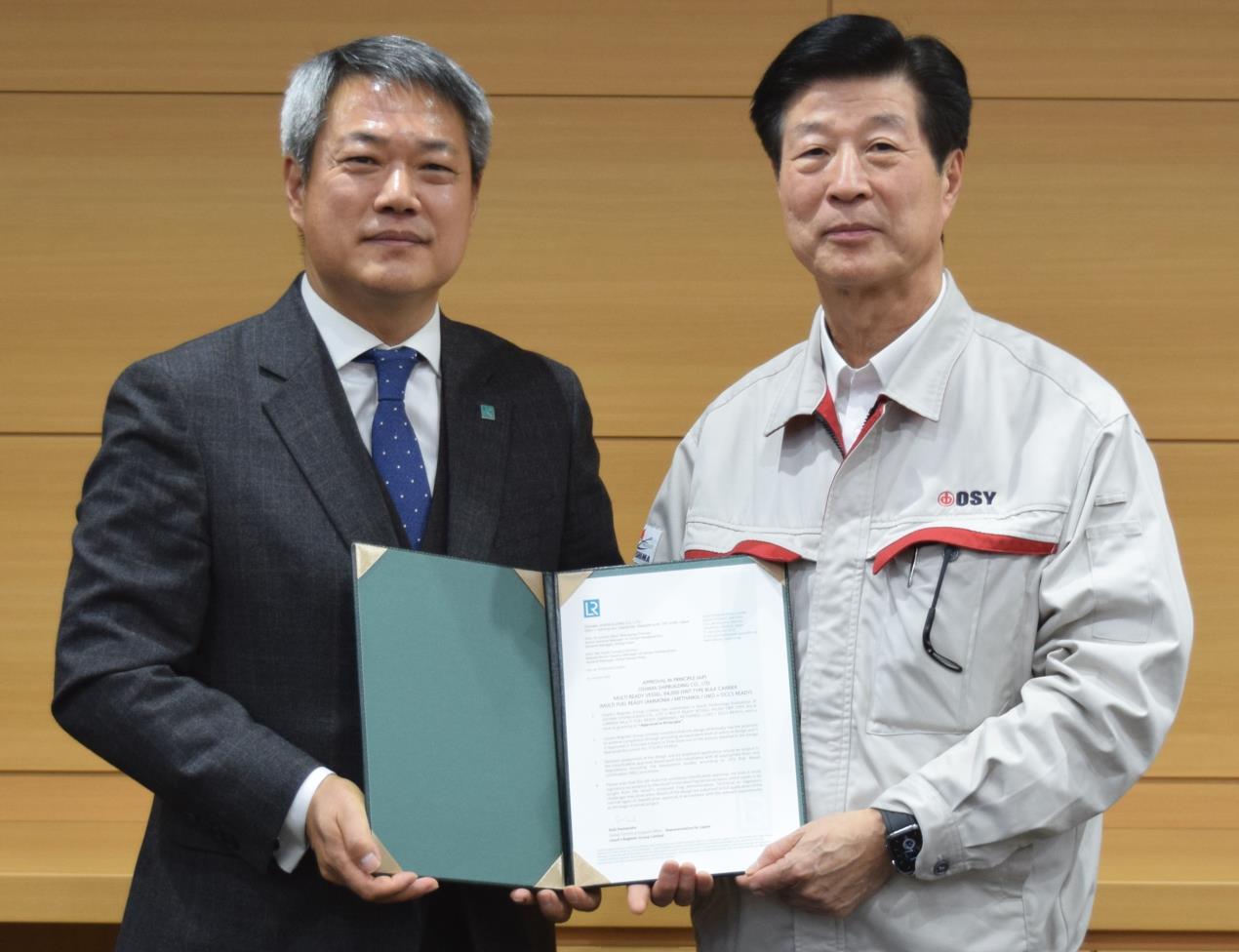
LONDON: Lloyd’s Register (LR) has awarded Approval in Principle (AiP) to Oshima Shipbuilding Co., Ltd. for its multi-fuel-ready Ultramax bulk carrier design.

The AiP covers a 64,000 dwt bulk carrier concept developed to accommodate multiple future fuel pathways, including ammonia, methanol and methane (LNG), alongside provision for onboard carbon capture and storage (OCCS). The approval was formally presented at Oshima Shipbuilding’s headquarters in Japan on 23 January 2026.

Oshima Green Bulker Oshima Shipbuilding’s multi-fuel-ready Ultramax bulk carrier concept receives Lloyd’s Register approval

Oshima’s multi-ready approach enables shipowners to defer final fuel decisions while safeguarding asset value and operational relevance over the vessel’s lifetime.

LR conducted a comprehensive technical review of the design in accordance with its ShipRight Risk Based Certification framework. This process assessed the safety, feasibility and integration of the proposed fuel and carbon capture arrangements, providing independent assurance that the concept can progress towards detailed design and potential construction.

Sung-Gu Park, North East Asia President at Lloyd’s Register, said: “The maritime industry is navigating a period of profound uncertainty as operators evaluate future fuel pathways, infrastructure development, and evolving global regulatory expectations.

“Oshima’s approach, embedding flexibility for ammonia, methanol, LNG, and onboard carbon capture from the outset, provides shipowners with a practical and future resilient solution as they plan their decarbonisation strategies.

“We look forward to continuing our partnership with Oshima Shipbuilding and working together to help accelerate the safe and scalable adoption of next generation technologies across the global fleet.”

Dr Junichi Man, Managing Director of Oshima Shipbuilding, said: “We are honored to receive this approval from Lloyd’s Register for our multi-ready vessel concept. As future fuel options diversify and global regulations continue to evolve, flexibility is becoming increasingly important for shipowners. By enabling compatibility with ammonia, methanol, LNG, and onboard CO₂ capture systems (OCCS), our concept offers a practical and future-ready solution.

“This AiP was made possible through close collaboration between our engineering team and LR’s experts, whose technical insights and rigorous risk-based assessment greatly enhanced the concept. We sincerely appreciate their support.”

The AiP strengthens the long-standing relationship between LR and Oshima Shipbuilding and underscores the importance of early-stage assurance in accelerating the adoption of next-generation technologies.

Tougher standards and enhanced oversight mark launch of New Palau Ship Registry

KOROR (PALAU): The Government of the Republic of Palau has contracted Palau Ship Registry to operate the nation’s official shipping registry under a new governance framework.

The appointment follows a period during which the Government considered how the registry should operate going forward, with a focus on accountability, transparency, and alignment with international maritime standards.

In December, the Ministry of Public Infrastructure and Industries assumed responsibility for operating the Ship Registry to ensure uninterrupted service to vessels flying the Palau Flag. Throughout this period, registry services continued without disruption while the Government evaluated the future operating framework.

Under the new arrangement, Palau Ship Registry has commenced operations and has assumed responsibility for day-to-day registry operations in accordance with its contract with the Government of the Republic of Palau.

The Government of the Republic of Palau confirms that all marine regulations, circulars, notices, and statutory documents, including vessel and seafarer certificates and Seafarer Identify and Record Books, issued on behalf of the Republic of Palau prior to the commencement of the new operating arrangement, remain valid and in full force and effect, subject to verification through online or QR code.

Commenting on the appointment, the Honorable Charles Obichang, Minister of Public Infrastructure and Industries, said: “The Palau Ship Registry now operates under a structure approved by the Government of Palau. Our focus is on providing a clear and robust framework that supports safe, responsible and compliant shipping while ensuring continuity and confidence for vessels flying the Palau Flag. The Government has confidence in entrusting Mr. Panos Kirnidis, who will lead this new chapter of Palau Ship Registry.”

Mr. Kirnidis said:“I am honoured to continue working with the Government of Palau in support of the Palau Ship Registry. Our clear objective is to provide reliable and professional service to shipowners, managers, and seafarers, combining effective digital tools with experienced and responsive support.”

The Government of the Republic of Palau confirmed that the operating framework provides clarity and stability for shipowners, operators, and international partners. It also ensures that the Palau Flag continues to meet the expectations of regulators, classification societies and the wider maritime community.

Baltic Exchange congratulates SGX and EEX on a successful transfer of Panamax FFAs 

LONDON: SGX and EEX successfully completed the transfer of all open interest in the Baltic Panamax 4TC (P4TC) index to the Panamax 5TC (P5TC) index on 16 January 2026, with the migration executed smoothly and without market disruption. This milestone concludes the transition from the long-established 74,000 dwt Panamax vessel specification to the updated 82,500 dwt standard.

Throughout 2025, Baltic Exchange worked closely with the Clearing Houses (CCPs) to prepare the industry for this change. This included market forums, direct stakeholder engagement, and the publication of official circulars outlining the transition process and timeline.

Following the successful migration of open interest to the P5TC, the Baltic will cease publishing the P4TC index, with 30 January 2026 set as the final publication day. For many years, the P4TC has been derived from the P5TC through a fixed differential ($1,336), and although it will no longer be published, the Baltic will continue to provide a calculated P4TC value under licence upon application.

The P5TC superseded the P4TC after the Baltic completed its Panamax vessel‑review process, raising the standard vessel from 74,000 dwt to 82,500 dwt, following consultation with the market and in accordance with the criteria set out in the Guide to Market Benchmarks. As an FCA-regulated benchmark administrator, Baltic Exchange follows defined regulatory protocols in transitioning from one index to another to ensure transparency, governance, and market continuity.

“This transition brings the derivatives market fully in line with the physical benchmark that has been in place since 2020. We updated the Panamax standard vessel and timecharter average in 2020 to reflect changes in the global fleet makeup and better represent the underlying trade. By discontinuing the outdated P4TC index and working closely with our CCPs to ensure the P5TC is the industry standard, we are ensuring that the physical and paper markets are now trading on the same contract,” said Stephen Aitchison, Senior Freight Market Assessor at Baltic Exchange.

Peter Blogg, Head of Global Commodities, Business Development at EEX, added, “We see the consolidation of Panamax timecharter average FFA and options open interest under P5TC as a positive step forward for the market. It removes any ambiguity and enables customers to focus on the continued growth of this key sector under the terms of a single index. The successful completion of this transition also sets in place the process for future open interest transfers at EEX.”

Tan Tee Yong, Head of Commodity Derivatives at SGX Commodities, said, “The liquidity switch from P4TC to P5TC marked our first FFA transfer – an industry wide transition delivered through close collaboration across the dry freight ecosystem. SGX worked closely with the market to shape the operational approach, structuring an orderly continuous transition of liquidity, aligning the derivatives markets with the evolving physical benchmarks. We appreciate the strong cooperation from Baltic Exchange, clearing members, interdealer brokers and market participants for their support and active engagement throughout this milestone process.”

With the Panamax migration now complete, the Baltic is managing the planned update to the Capesize sector.

On 2 January 2026, the Baltic formally adopted the 182,000 dwt Capesize (BCI182) as the standard Baltic Capesize vessel, replacing the legacy 180,000 dwt specification. As part of this transition:

  • C5TC(182) has now become the official Baltic benchmark for the Capesize market.
  • The derived C5TC(180) will cease publication on 24 December 2026 and will remain available to market participants under a Licence, ensuring continuity for those requiring legacy data or valuation support.

Baltic Exchange will work closely with SGX and EEX to coordinate the eventual transfer of open interest from C5TC(180) derivatives to C5TC(182) using a migration mechanism equivalent to the Panamax transition.

These coordinated changes across the Panamax and Capesize sectors ensure that Baltic benchmarks continue to reflect the modern fleet,  and support the long-term health and transparency of the freight derivatives market. Baltic Exchange remains committed to engaging with all stakeholders as the Capesize transition progresses.